
The Flying Careers series got spread around a little bit so here's an index for easy access to the whole thing.
Part 1: My story
Part 2a: The Airlines & Beyond (airline-type jobs)
Part 2b: The Path Less Taken (odd jobs)
Part 2c: Doin' Time (starter jobs)
Part 3: Climbing the Ladder (career progression)
Part 4: Details (various job requirements)
Part 5: Making Bank (pay)
Part 6: Benefits and Retirement
Part 7: Lifestyle
Part 8: Job Stability
Part 9: Getting the Ratings
Part 10: Final Thoughts
Tuesday, January 17, 2006


Monday, January 16, 2006
Flying Careers Part 10: Final Thoughts
Well, the Flying Careers series has stretched considerably longer than I originally meant it to, and I've covered more than I meant to. There's only a few more things I want to say.
I've been thinking more about what I wrote the other day regarding the fact that the flying is the only thing this career has going for it. I argued that these days, a love of flying is almost a prerequisite for an aviation career. That said: a passion for aviation alone isn't enough. Look at the sometimes poor pay and schedules, the impact on family life and health, and the lack of job stability; if your need to fly doesn't overpower those considerations, rethink your career. You can make more money in another profession and fly your Bonanza to the beach on weekends.
In a few weeks, I'm going to write about how the regionals made the jump from flying 19-seat turboprops to 70 seat jets, and how ALPA failed to recognize what a threat it posed to the profession until it was too late. The last few years, the growth of cut-rate regionals has accounted for much of the destruction of good jobs at mainline carriers. If there's one message I would want the reader to take away from this series, here it is: the piloting profession is in trouble. If you choose to jump in anyways, make a positive contribution by considering the effect that your choices have on the profession. Think beyond the quick upgrade. Think long-term.
You'll enjoy airline flying more if you're a bit of a geek. The new technology in our aircraft is stuff they didn't dream of 20 years ago, and it's continually evolving. Old-timers complain that airlins have turned aviators into button-pushers, and to an extent they're right. You'll do well if you enjoy learning all about those buttons.
Networking starts long before you're ready to apply for the airlines. Consider that a friendly attitude will do more for your career than the ability to nail an ILS to minimums in blowing snow and a 30 knot crosswind. Go out of your way to meet other pilots. Help them in any way you can. When it comes time to ask a favor, don't be shy. Everyone else is eager to do one so you can help them out someday. It's kinda like "The Godfather."
Along the same lines, treat your first flying job like the most important one you'll ever have. People will notice and it will help you later in your career. Conversely, burned bridges have a way of coming back to haunt you. Karma is strong in aviation.
When starting out, the temptation is to make aviation your whole life. Those who do so are known as pilot dorks, and you don't want to be that person. Maintain other hobbies and interests. Of course, this is coming from somebody who flies for a living and maintains an aviation blog. Heh. But seriously, the best aviation interview you'll ever have is the one where you and the chief pilot talk flyfishing.
Speaking of chief pilots, they're usually the ones with the most pull for hiring. If you have a buddy at an airline you'd like to fly for, get the chief pilot's contact info and give him or her a call. Even if you're far below the company's hiring minimums, demonstrating interest early on is the best way to get a call for an interview when your resume is on their desk in a year or two.
The more you talk to pilots at major airlines, the more you'll hear the following: "You know, I miss flight instructing/freight flying/regional flying. I sure had a lot of fun back then!" So don't be in such a hurry to get to the majors that you forget to enjoy the journey.
Whether you have a union background or not, they are a fact of aviation. Get used to it. Don't be the idiot who refuses to pay dues and talks nonstop smack against the union. Warts and all, unions can be a force for positive change. Pitch in to help your union become better.
Consider bringing chocolates for the crew when jumpseating on another airline. They'll love you for it!
When shopping around for flight training, be a critical listener. They'll try to sell you on a lifestyle that doesn't exist to separate you from your money. If anybody mentioned Kit Darby or the Tarver Report, quit listening immediately, they're full of crap.
At some point in your life, fly a glider or a seaplane. They're a ton of fun!
Consider that the majority of commercial pilots who die on the job are at between 500 and 2000 hours. This is when you'll start really feeling comfortable with the airplane, and there's a temptation to cut corners and let your discipline slide. Steel yourself against that. Fly by the book whether somebody is looking or not, even when it causes extra inconvenience. Don't let anyone pressure you into something stupid to "get the job done." Many pilots look back on their formative years and are aghast at the risks they took. It's not worth it; don't give yourself anything to regret.
That's all I have to say. Hope you enjoyed the series!
I've been thinking more about what I wrote the other day regarding the fact that the flying is the only thing this career has going for it. I argued that these days, a love of flying is almost a prerequisite for an aviation career. That said: a passion for aviation alone isn't enough. Look at the sometimes poor pay and schedules, the impact on family life and health, and the lack of job stability; if your need to fly doesn't overpower those considerations, rethink your career. You can make more money in another profession and fly your Bonanza to the beach on weekends.
In a few weeks, I'm going to write about how the regionals made the jump from flying 19-seat turboprops to 70 seat jets, and how ALPA failed to recognize what a threat it posed to the profession until it was too late. The last few years, the growth of cut-rate regionals has accounted for much of the destruction of good jobs at mainline carriers. If there's one message I would want the reader to take away from this series, here it is: the piloting profession is in trouble. If you choose to jump in anyways, make a positive contribution by considering the effect that your choices have on the profession. Think beyond the quick upgrade. Think long-term.
You'll enjoy airline flying more if you're a bit of a geek. The new technology in our aircraft is stuff they didn't dream of 20 years ago, and it's continually evolving. Old-timers complain that airlins have turned aviators into button-pushers, and to an extent they're right. You'll do well if you enjoy learning all about those buttons.
Networking starts long before you're ready to apply for the airlines. Consider that a friendly attitude will do more for your career than the ability to nail an ILS to minimums in blowing snow and a 30 knot crosswind. Go out of your way to meet other pilots. Help them in any way you can. When it comes time to ask a favor, don't be shy. Everyone else is eager to do one so you can help them out someday. It's kinda like "The Godfather."
Along the same lines, treat your first flying job like the most important one you'll ever have. People will notice and it will help you later in your career. Conversely, burned bridges have a way of coming back to haunt you. Karma is strong in aviation.
When starting out, the temptation is to make aviation your whole life. Those who do so are known as pilot dorks, and you don't want to be that person. Maintain other hobbies and interests. Of course, this is coming from somebody who flies for a living and maintains an aviation blog. Heh. But seriously, the best aviation interview you'll ever have is the one where you and the chief pilot talk flyfishing.
Speaking of chief pilots, they're usually the ones with the most pull for hiring. If you have a buddy at an airline you'd like to fly for, get the chief pilot's contact info and give him or her a call. Even if you're far below the company's hiring minimums, demonstrating interest early on is the best way to get a call for an interview when your resume is on their desk in a year or two.
The more you talk to pilots at major airlines, the more you'll hear the following: "You know, I miss flight instructing/freight flying/regional flying. I sure had a lot of fun back then!" So don't be in such a hurry to get to the majors that you forget to enjoy the journey.
Whether you have a union background or not, they are a fact of aviation. Get used to it. Don't be the idiot who refuses to pay dues and talks nonstop smack against the union. Warts and all, unions can be a force for positive change. Pitch in to help your union become better.
Consider bringing chocolates for the crew when jumpseating on another airline. They'll love you for it!
When shopping around for flight training, be a critical listener. They'll try to sell you on a lifestyle that doesn't exist to separate you from your money. If anybody mentioned Kit Darby or the Tarver Report, quit listening immediately, they're full of crap.
At some point in your life, fly a glider or a seaplane. They're a ton of fun!
Consider that the majority of commercial pilots who die on the job are at between 500 and 2000 hours. This is when you'll start really feeling comfortable with the airplane, and there's a temptation to cut corners and let your discipline slide. Steel yourself against that. Fly by the book whether somebody is looking or not, even when it causes extra inconvenience. Don't let anyone pressure you into something stupid to "get the job done." Many pilots look back on their formative years and are aghast at the risks they took. It's not worth it; don't give yourself anything to regret.
That's all I have to say. Hope you enjoyed the series!
Saturday, January 14, 2006
Craziest Pirep Ever
MGM UUA /OV SCD 270004/TM 2200/FL090/TP SR22/IC SVR ICG 077-0900/RM ACFT WAS DESCENDING BY PARACHUTE DUE TO SEVRE ICG BUILDUP CORRECTION
For the uninitiated, the above means: Urgent Pilot Report at 2200 Zulu, a Cirrus SR22 encountered severe icing between 7700' and 9000'. In the remarks: the aircraft was descending by parachute due to severe ice buildup. That's one you don't see every day.
The FAA defines severe icing as "an atmospheric condition in which the rate of ice accumulation is such that de-icing or anti-icing equipment cannot reduce or control the hazard." Therefore, a pilot's concept of severe icing will vary pretty widely according to equipment flown and the effectiveness of its anti-icing/de-icing equipment. Pulling the 'chute to save the plane, though - I think that fits within anybody's idea of severe icing.
According to early reports, this airplane lacked the optional TKS anti-ice system, much less an FAA approved system, and was therefore not legal to take into known icing. The fact that this pilot did so, and continued to the point that he lost control of the airplane, is an issue that I suspect the FAA will be chatting with him about. Chalk another save up to Cirrus and BRS - saving pilots from their foibles one 'chute deployment at a time.
For the uninitiated, the above means: Urgent Pilot Report at 2200 Zulu, a Cirrus SR22 encountered severe icing between 7700' and 9000'. In the remarks: the aircraft was descending by parachute due to severe ice buildup. That's one you don't see every day.
The FAA defines severe icing as "an atmospheric condition in which the rate of ice accumulation is such that de-icing or anti-icing equipment cannot reduce or control the hazard." Therefore, a pilot's concept of severe icing will vary pretty widely according to equipment flown and the effectiveness of its anti-icing/de-icing equipment. Pulling the 'chute to save the plane, though - I think that fits within anybody's idea of severe icing.
According to early reports, this airplane lacked the optional TKS anti-ice system, much less an FAA approved system, and was therefore not legal to take into known icing. The fact that this pilot did so, and continued to the point that he lost control of the airplane, is an issue that I suspect the FAA will be chatting with him about. Chalk another save up to Cirrus and BRS - saving pilots from their foibles one 'chute deployment at a time.
Friday, January 13, 2006
Let it be resolved...
In going through my old posts, I'm struck my one thing: I used to update this blog a lot. And I really haven't updated it much at all the last few months. That's unfortunate, because the best blogs are the ones that are updated often, like Cockpit Conversation and Freight Dog Tales. Part of it is that I've been pretty busy between flying, the holidays, and such important activities as skiing. The other thing is that I've been concentrating on the Flying Careers series, which turned out to be longer and more in-depth than I was originally thinking. Many of the posts were huge, and it often took a week or two of procrastination for me to finish each one.
Now that the series is just about done, I'll hopefully be posting here more often. I have a few ideas on subjects I want to write about, but I'd like to get some suggestions. If there's anything aviation related (professional or recreational) you'd like to hear my thoughts on, drop me a line or leave a comment and I'll put it in the suggestion bank. Thanks!
Now that the series is just about done, I'll hopefully be posting here more often. I have a few ideas on subjects I want to write about, but I'd like to get some suggestions. If there's anything aviation related (professional or recreational) you'd like to hear my thoughts on, drop me a line or leave a comment and I'll put it in the suggestion bank. Thanks!
Whitetail Megawhacker
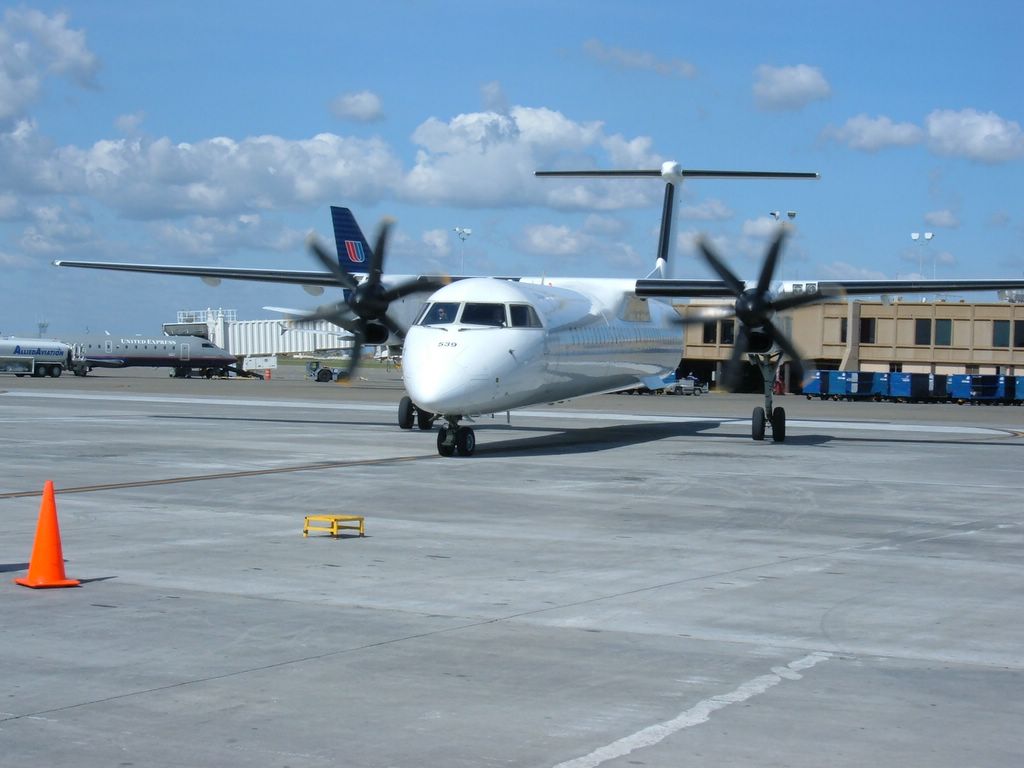
In the process of redacting my employer's name from this blog, I've deleted quite a few pictures of my airplane due to my airline's name being on it. However, until recently we operated a "white tail" without company livery, so here's a suitably anonymous picture of the MegaWhacker.
Flying Careers Part 9: Getting the Ratings
So...
We've established that a flying career is neither fast, flexible, or for sure (to borrow from a particularly fisk-worthy Flying ad). The pay is decreasing, pensions are disappearing, the job market is increasingly unstable, and there's no end in sight to the worst industry slump in history. Anybody starting a flying career right now has to turn a bit of a blind eye to the carnage in the field and simply hope that things get better.
I've seen a lot of pilots simply quit flying and move on to more lucrative fields over the past few years. It seems to me that there's been a "winnowing" taking place: those who fly for material reasons are getting out, and those who love to fly are staying despite all the setbacks. Mind you, that's not to say that pay and retirement don't matter - they do, and a love of flight doesn't stop professional pilots from fighting for the betterment of their profession. But at this point, the only thing that an aviation career really has going for it is the flying. If you have the talent and interest to do something other than flying, I'd suggest you do it, and once you're raking in the dough as a tax attorney or chemical engineer or whatever, you'll have fun flying your Mooney around. If the flying bug has bit you hard, however, and you can't imagine doing anything else for a living, resign yourself to a life of hardship and read on.
I've already written about the various jobs that pilots take to build time after they have their commercial certificate; this post is about getting to that point. Basically, before you get that first job, you need to have your commercial pilot certificate with multi-engine and instrument ratings. This will usually include around 250 hours of flight time, with 10-20 hours in multiengine aircraft. There are several ways you can get to this point from zero experience.
Professional Training Programs
There are a number of flight training outfits across the US that do little but train professional pilots. Examples include ATP, Delta Academy, PanAm, or RAA. They typically have integrated programs designed to take the applicant from zero time to commercial pilot in a fairly short time. Most of this training is done under Part 141, meaning that their courses have been approved by the FAA and often involve less flight time than would otherwise be required. The quality of training is usually pretty good, if somewhat rushed. Many of these schools have connections with regional airlines that may get you hired at one sooner, for whatever that's worth.
There are a few downsides to doing your training this way. Many of these schools are hellaciously expensive; expect to pay $40-60k for a program that takes you from zero time to multi-engine instructor. These schools brag that they can churn out "professional" pilots in 9 months, but that pace carries disadvantages with it. The training can be little more than an assembly line designed to simply pump in the skills and knowledge required to pass a quick succession of checkrides, with little in-depth knowledge or aviation background. Many trainees graduate having never taken a flight that wasn't on the syllabus. Finally - and this is only my opinion - studying nothing but flying for months on end, surrounded by other flight students, could get pretty dang mind-numbing.
Small FBO/Flight School
Another option is to do your training at a smaller FBO or flight school, local or otherwise. FBO stands for "Fixed Base Operator" - the guys at the local airport that sell gas, do aircraft maintenance, rent out airplanes, and offer flight instruction. Some FBO's offer Part 141 instruction, although the majority still train under FAR 61, which is less structured and more flexible. Training at an FBO is usually more relaxed and informal than a large flight school, which can be good and bad. Quality of training can vary pretty widely; you may have to search a bit to find a good CFI that you work well with. The payoff is much lower cost than a large professional program, and the freedom to discover flying at your own pace.
Although a few FBOs have put together integrated programs for aspiring professional pilots, you'll generally do your training piecemeal. The order will usually be Private Pilot, timebuild a little, Instrument Rating, timebuild some more, Commercial Pilot, Multi-Engine Rating, CFI (and II/MEI if desired). If you're a quick study and fly cheaper aircraft, you could do it for under $30k at many FBOs.
The Collegiate Option
If you're planning on flying for a major airline, there's no getting around it: you really need a college degree, preferably a bachelor's or better. If you already have the degree, going to college to learn to fly doesn't make much sense. It will take longer than using an FBO, and cost as much or more than a professional training program. An aviation degree won't give you much advantage, if any, over the degree you have right now. However, if you need both flight training and a degree, an aviation college is a good way to kill two birds with one stone, and get an excellent aviation background besides.
There are a few schools that are entirely aviation centered, Embry-Riddle being the best known of these. More common are aviation programs that reside within larger universities. There are some good programs at both public schools (University of North Dakota, Southern Illinois University) and private (SLU, Purdue).
The cost of flying at aviation colleges is usually comparable to or less than a non-collegiate program, but there's the additional cost of tuition and fees. Some of the state schools are pretty reasonable, but at a place like Purdue or ERAU it can really add up. You could spend anywhere from $30k to over $100k getting an aviation degree.
Mixing It Up
Mind you, nobody said you have to do all your training in one of these three ways. I've done all three, although the bulk of my training was in a collegiate program (UND's). Although large flight schools try to sell the zero-time through commercial packages, they'll generally give credit for prior flying, so it's feasible to start at a small FBO and transfer to a professional program later on. The same goes for aviation colleges, although college credit becomes an issue - you may have to do the classwork over or even some of the flying, depending on the school. I personally earned my private pilot at a small FBO while still in high school, but got credit for it through the local community college so that UND accepted it when I transfered there.
Getting Your Toes Wet
There are a few good reasons I'd encourage you to start at the local FBO. It's worthwhile to get your Private Pilot's license before committing to an aviation career, to make sure that flying's something you really want to do. Flying at a local FBO lets you discover aviation at your own pace, and gaining the new perspective on an area you know well makes it doubly interesting. You'll get to know the world of general aviation better and appreciate it more. Finally, flying in the "real world" will add some perspective when you enter "the bubble" of a professional or collegiate flying program. It's all a good reason to visit your local airport and take an introductory flight lesson sometime soon. If it leads to a Private Pilot certificate, awesome. At that point you'll be well equipped to make a decision about a flying career.
Getting Started
So, Private Pilot or not, you're sure that you want a flying career and you don't want to wait another minute, eh? Well, I've presented a pretty balanced look at the career, I think, and if you're still up for it I won't do anything further to disuade you. Hopefully this series has given you some good information; you should be able to find lots of additional resources on the internet. AvWeb has some good articles on flying careers. There's some good info at JetCareers. Aviation mega-portal Landings has directories of FBOs and Flight Schools, and other training resources. Your best bet, however, may be talking to a professional pilot. We're generally more than happy to help newcomer pilots. Strike up a conversation at the local airport and visit the flight deck after your next commercial flight. Register for the forums at FlightInfo or CAAM, many of the members are professional pilots. In all these cases, you'll not only get good info, you'll also be making contacts that may prove useful later in your career.
My next post will be the conclusion of this series & will include some final words of advice. Is there anything else I should be including as a topic for this series? If so, leave a comment and I'll do my best to address it in the final post.
We've established that a flying career is neither fast, flexible, or for sure (to borrow from a particularly fisk-worthy Flying ad). The pay is decreasing, pensions are disappearing, the job market is increasingly unstable, and there's no end in sight to the worst industry slump in history. Anybody starting a flying career right now has to turn a bit of a blind eye to the carnage in the field and simply hope that things get better.
I've seen a lot of pilots simply quit flying and move on to more lucrative fields over the past few years. It seems to me that there's been a "winnowing" taking place: those who fly for material reasons are getting out, and those who love to fly are staying despite all the setbacks. Mind you, that's not to say that pay and retirement don't matter - they do, and a love of flight doesn't stop professional pilots from fighting for the betterment of their profession. But at this point, the only thing that an aviation career really has going for it is the flying. If you have the talent and interest to do something other than flying, I'd suggest you do it, and once you're raking in the dough as a tax attorney or chemical engineer or whatever, you'll have fun flying your Mooney around. If the flying bug has bit you hard, however, and you can't imagine doing anything else for a living, resign yourself to a life of hardship and read on.
I've already written about the various jobs that pilots take to build time after they have their commercial certificate; this post is about getting to that point. Basically, before you get that first job, you need to have your commercial pilot certificate with multi-engine and instrument ratings. This will usually include around 250 hours of flight time, with 10-20 hours in multiengine aircraft. There are several ways you can get to this point from zero experience.
Professional Training Programs
There are a number of flight training outfits across the US that do little but train professional pilots. Examples include ATP, Delta Academy, PanAm, or RAA. They typically have integrated programs designed to take the applicant from zero time to commercial pilot in a fairly short time. Most of this training is done under Part 141, meaning that their courses have been approved by the FAA and often involve less flight time than would otherwise be required. The quality of training is usually pretty good, if somewhat rushed. Many of these schools have connections with regional airlines that may get you hired at one sooner, for whatever that's worth.
There are a few downsides to doing your training this way. Many of these schools are hellaciously expensive; expect to pay $40-60k for a program that takes you from zero time to multi-engine instructor. These schools brag that they can churn out "professional" pilots in 9 months, but that pace carries disadvantages with it. The training can be little more than an assembly line designed to simply pump in the skills and knowledge required to pass a quick succession of checkrides, with little in-depth knowledge or aviation background. Many trainees graduate having never taken a flight that wasn't on the syllabus. Finally - and this is only my opinion - studying nothing but flying for months on end, surrounded by other flight students, could get pretty dang mind-numbing.
Small FBO/Flight School
Another option is to do your training at a smaller FBO or flight school, local or otherwise. FBO stands for "Fixed Base Operator" - the guys at the local airport that sell gas, do aircraft maintenance, rent out airplanes, and offer flight instruction. Some FBO's offer Part 141 instruction, although the majority still train under FAR 61, which is less structured and more flexible. Training at an FBO is usually more relaxed and informal than a large flight school, which can be good and bad. Quality of training can vary pretty widely; you may have to search a bit to find a good CFI that you work well with. The payoff is much lower cost than a large professional program, and the freedom to discover flying at your own pace.
Although a few FBOs have put together integrated programs for aspiring professional pilots, you'll generally do your training piecemeal. The order will usually be Private Pilot, timebuild a little, Instrument Rating, timebuild some more, Commercial Pilot, Multi-Engine Rating, CFI (and II/MEI if desired). If you're a quick study and fly cheaper aircraft, you could do it for under $30k at many FBOs.
The Collegiate Option
If you're planning on flying for a major airline, there's no getting around it: you really need a college degree, preferably a bachelor's or better. If you already have the degree, going to college to learn to fly doesn't make much sense. It will take longer than using an FBO, and cost as much or more than a professional training program. An aviation degree won't give you much advantage, if any, over the degree you have right now. However, if you need both flight training and a degree, an aviation college is a good way to kill two birds with one stone, and get an excellent aviation background besides.
There are a few schools that are entirely aviation centered, Embry-Riddle being the best known of these. More common are aviation programs that reside within larger universities. There are some good programs at both public schools (University of North Dakota, Southern Illinois University) and private (SLU, Purdue).
The cost of flying at aviation colleges is usually comparable to or less than a non-collegiate program, but there's the additional cost of tuition and fees. Some of the state schools are pretty reasonable, but at a place like Purdue or ERAU it can really add up. You could spend anywhere from $30k to over $100k getting an aviation degree.
Mixing It Up
Mind you, nobody said you have to do all your training in one of these three ways. I've done all three, although the bulk of my training was in a collegiate program (UND's). Although large flight schools try to sell the zero-time through commercial packages, they'll generally give credit for prior flying, so it's feasible to start at a small FBO and transfer to a professional program later on. The same goes for aviation colleges, although college credit becomes an issue - you may have to do the classwork over or even some of the flying, depending on the school. I personally earned my private pilot at a small FBO while still in high school, but got credit for it through the local community college so that UND accepted it when I transfered there.
Getting Your Toes Wet
There are a few good reasons I'd encourage you to start at the local FBO. It's worthwhile to get your Private Pilot's license before committing to an aviation career, to make sure that flying's something you really want to do. Flying at a local FBO lets you discover aviation at your own pace, and gaining the new perspective on an area you know well makes it doubly interesting. You'll get to know the world of general aviation better and appreciate it more. Finally, flying in the "real world" will add some perspective when you enter "the bubble" of a professional or collegiate flying program. It's all a good reason to visit your local airport and take an introductory flight lesson sometime soon. If it leads to a Private Pilot certificate, awesome. At that point you'll be well equipped to make a decision about a flying career.
Getting Started
So, Private Pilot or not, you're sure that you want a flying career and you don't want to wait another minute, eh? Well, I've presented a pretty balanced look at the career, I think, and if you're still up for it I won't do anything further to disuade you. Hopefully this series has given you some good information; you should be able to find lots of additional resources on the internet. AvWeb has some good articles on flying careers. There's some good info at JetCareers. Aviation mega-portal Landings has directories of FBOs and Flight Schools, and other training resources. Your best bet, however, may be talking to a professional pilot. We're generally more than happy to help newcomer pilots. Strike up a conversation at the local airport and visit the flight deck after your next commercial flight. Register for the forums at FlightInfo or CAAM, many of the members are professional pilots. In all these cases, you'll not only get good info, you'll also be making contacts that may prove useful later in your career.
My next post will be the conclusion of this series & will include some final words of advice. Is there anything else I should be including as a topic for this series? If so, leave a comment and I'll do my best to address it in the final post.
Thursday, January 05, 2006
The Last Straw
Tonight I came across a posting on my union's bulletin board referencing this blog. Predictably, I got lambasted for it pretty quick. Basically, the poster felt that I shouldn't be discussing my employer's problems in a public forum. I disagree from the standpoint that problems within the regional airline industry and piloting profession should be discussed, and not just in the echo chamber of the union bulletin board. But, at this point, there's no good reason that I should identify who my employer is, as the challenges I discuss are by no means unique to them.
I've been having more and more coworkers find this site, and it's only a matter of time before I get "outed." There's no guidance for employees on this subject from my company - at least that I'm aware of - but that probably wouldn't stop them from disciplinary action or perhaps even termination. Given the reaction from fellow pilots, I don't know that I'd get much support from the union. Basically, this is the last straw. I'm anonymizing this blog.
**************
Scratch that. After sleeping on it overnight, and reading a few emails, I've realized that the genie is out of the bottle & there's no way to be truly anonymous at this point, if someone really wanted to know who I am. Rather, the best thing is just to omit the name of my employer. I'll be going through the old posts in the next few days and editing them, and also deleting any comments that name my employer. Sorry if your comment falls victim. In the future, I'd appreciate it if those who know my employer or guess it (it's really not that hard) would refrain from using their name in comments. I'll also be deleting pictures that have my employer's name in them. Let me know what ya'll think of this.
I've been having more and more coworkers find this site, and it's only a matter of time before I get "outed." There's no guidance for employees on this subject from my company - at least that I'm aware of - but that probably wouldn't stop them from disciplinary action or perhaps even termination. Given the reaction from fellow pilots, I don't know that I'd get much support from the union. Basically, this is the last straw. I'm anonymizing this blog.
**************
Scratch that. After sleeping on it overnight, and reading a few emails, I've realized that the genie is out of the bottle & there's no way to be truly anonymous at this point, if someone really wanted to know who I am. Rather, the best thing is just to omit the name of my employer. I'll be going through the old posts in the next few days and editing them, and also deleting any comments that name my employer. Sorry if your comment falls victim. In the future, I'd appreciate it if those who know my employer or guess it (it's really not that hard) would refrain from using their name in comments. I'll also be deleting pictures that have my employer's name in them. Let me know what ya'll think of this.
Subscribe to:
Posts (Atom)


