Showing posts with label Training. Show all posts

Friday, May 06, 2016

Six Months In (Sorta)

Considering my lack of posting you might think that my airline is working me to death, but no, that's not the case. Recently I passed 120 hours on the B757/767...just over six months since I went to class! Keep in mind that I was originally awarded the slot way back in Feb 2015, meaning I'm only nine months away from my seat lock expiring. I'm not planning on going anywhere but it keeps options open.

Basically what happened is that my airline was originally planning on retiring a significant portion of the 7ER fleet, didn't train many new pilots on it for a while, then decided to keep many of the airplanes after all at the same time that a bunch of senior 7ER FOs took captain slots on other fleets. Whoops, big training logjam! It's just now finally clearing.

So here's basically how my training went:

Oct-6Nov15: Home study for 7ER course (we basically teach ourselves the systems on our own time via computer based training, honestly not my favorite way to train).

6Nov15-6Dec15: 7ER Initial training. You may recall from Mad Dog school that we break our initial training into four blocks, numbered 100 to 400, that roughly correspond with systems training, procedures training, maneuvers training, and line-oriented training. These all end in checkrides but the two most important are 34X (Maneuvers Validation) and 44X (Line-Oriented Evaluation). Unlike Mad Dog school, I was paired with an FO rather than a CA, which complicated things a bit in that we each had to learn left-seat duties and got only half the time we otherwise would in the right seat. However, my sim partner (who is only a few numbers senior to me) is an extremely sharp guy, we worked very well together, and we made it through the course without problems. One happy footnote: we weren't stuck in "the schoolhouse" the entire time, our 300-series sims were all down at the Boeing training facility in Miami. We passed our 44X checkrides easily on December 6th and were sent home indefinitely waiting on IOE.

31Jan15-05Feb15: Initial Operating Experience (IOE). I flew with a super-nice Detroit-based Line Check Airman, he was completely understanding that I hadn't been in training for eight weeks and might take a little more time to get spooled up. My very first leg was in a B757-200 and operated from Detroit to Cancun for a 24 hour overnight, a very nice way to kick things off! Our subsequent layovers were in Orlando, Fort Myers, and Atlanta. I ended up flying the B752 for 5 legs, the B753 for 2 legs, and even our GE-powered domestic B767-300 for 2 legs. I liked the legendary power and performance of the B752, but I loved the fingertip-light control feel of the B763 (due to the additional inboard ailerons). You simply think about turning, and she's turning.


29Feb-04Mar: Transoceanic Operating Experience (TOE), 2 crossings of 4 required. There was less time off before this so I didn't have much catchup on the airplane itself, but there's a lot to cover over the course of the first 8-hour crossing (during which I was in the rest seat for 2 hours) and it's all stuff that I'd last covered in mid-December. I crammed to catch up in the days before the TOE, and the LCA was happy with my preparation. We flew one leg from Atlanta to London-Heathrow in the B767-300ER, and after a 18 hour layover flew an ETOPS B757-200 back across to PHL. We even got tagged for a couple domestic legs the next day, the better to increase my landing count. I gotta say, though, I've found all the variants pretty easy to land. It just takes the first few to adjust to the higher sight picture.

06Mar-10Mar: TOE crossings 3 & 4. Only one day off before straight into my 2nd TOE, which was based out of Seattle and consisted of only two legs, SEA-PVG-SEA. This was my first time to China, and I had a really nice 48 hour layover to explore Shanghai. The takeoff out of Seattle, at 407,000 lbs, is my heaviest to date. Like I said the B767 is really light on the controls, so you don't feel that heavy, but acceleration obviously takes longer and you have to be really sharp with your pitch control to avoid overspeeding the flaps while retracting them at the proper speed and keeping the airplane accelerating. On the way over we were in VHF coverage the whole way, flying north via Alaska, the Bering Sea, Russia, and arriving from over Beijing. The Russian and Chinese controllers weren't too hard to understand, but once in China you switch to flying metric altitudes, which is a little different. The weather really stunk in Shanghai when we landed, with a big gusty crosswind, but the rainy runway made for a nice landing. On the way back we flew via Japan and then over the water. Because this is such a long flight, it was a 4-man crew, meaning I spent nearly half of each crossing in the bunk (and these particular B767s actually have bunks - so nice!). Pretty easy work if you can get it.



And that's it, I was released to the line on 10Mar, didn't work again thanks to creative bidding until early April, and have done a few trips since, all domestic. I'm getting pretty comfortable with the airplane - as expected, it's superior to the MadDog in every way possible, but there are also a surprising number of similarities that make for an easy transition. I've been quite busy taking advantage of all the free time for the last six months, and have done the following trips:

mid-October: Interline Regatta, British Virgin Islands.
Christmas/New Years: Dawn and I flew the Pacer from Minnesota to Connecticut and then down to Key West.
early Jan: flew around Florida visiting friends.
mid-Jan: Dawn and I flew the Pacer from Florida to Phoenix.
mid-Feb: Dawn and I flew the Pacer down Baja with our friends Brad and Amber (they rented a 182 out of San Diego). Awesome, epic trip - story is coming out in July issue of Flying.
late-Mar: Went to Thailand to visit my sister and her kids in Chiang Rai, flew down to Phuket, met my parents, chartered a 39' Leopard catamaran for 5 days of sailing the Andaman Sea.
mid-Apr: Dawn and I flew the Pacer up the west coast to Portland, OR.

Besides all that, there are some pretty major developments in my and Dawn's plans, dating back to last August. As a result, we sold our rented-out townhome in Vancouver WA back in February, and just sold our house in Minnesota a few weeks ago. We close on June 7th, and are renting a small apartment in downtown St. Paul for the summer before taking off for "new horizons." Yes, I have some pretty serious catch-up blogging to do.


Tuesday, February 03, 2015

Great Leap Forward

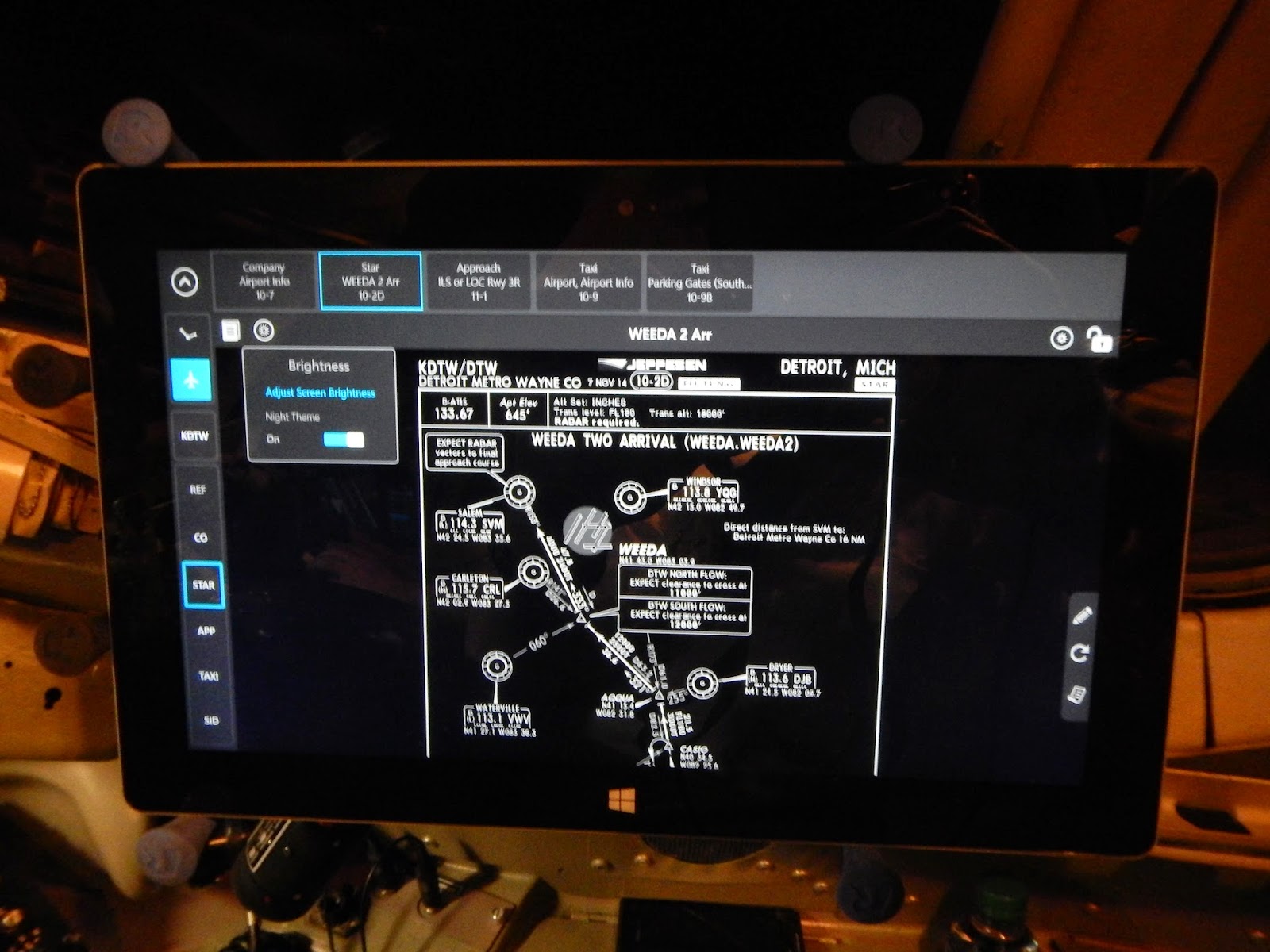
My airline recently rolled out our Electronic Flight Bag (EFB), a Microsoft Surface 2 tablet, and I've been using it for about a month now. The idea of a paperless cockpit has been around for a long time, and we're a bit late to the party; EFBs have been de rigueur at most major airlines for a couple of years. The most common platform, by far, is Apple's iPad; it's used by Alaska, American, United, FedEx, and UPS, plus many regional airlines, corporate flight departments, and thousands of private pilots. There's a wide variety of well-proven off-the-shelf EFB software available for the iPad, and reams of data on the system's reliability. The FAA is getting very experienced at approving iPad-based EFB installations.

For a variety of reasons, my airline chose not to go that route. First, we are a very Windows-based company - we Mac users are barely tolerated and most training & crew applications are not supported on our machines. Secondly, Microsoft is one of our largest corporate customers, and we're currently expanding in the Pacific Northwest. Frankly, we're not a company that's entirely known for its tech savvy. It probably shouldn't come as a surprise that our choice of a fairly uncommon tablet paired with an orphaned standalone operating system (Windows RT), combined with Jeppesen having to do a custom port of their FlightDeck Pro software, resulted in rather lengthy delays. Even now, we're merely in the test phase; until the EFB is fully proven, we're still carrying around ship sets of Jepp charts and operational manuals (individual subscriptions are thankfully a thing of the past - updating Jepps was always among the most hated of pilot chores).

That said, now that the EFB is finally here, I think Microsoft, Jeppesen, and my company absolutely knocked it out of the park. For what it was designed to do, both the hardware and software are beautiful, functional, and intuitive. Here's a good measure of just how easy it is to use: I received my tablet a few days before recurrent simulator training, did the hour-long training DVD, and was able to effectively use it for the first time during two intense days in the sim (one of which, the maneuvers validation, is a graded checkride). All the present features are contained in two programs: Jeppesen FlightDeck Pro is used to view IFR enroute charts and terminal/approach/airport plates, and Secure Content Locker provides access to all company and aircraft manuals and bulletins. The operating system incorporates a number of intuitive touchscreen gestures to make it easy to smoothly switch between programs or even split the screen between them. For example, the other day my Captain and I briefed a Category III ILS approach with the approach plate on one half of the screen and the company Cat III briefing card on the other half.


My favorite feature of the Surface 2 EFB, versus equivalent iPad-based systems, is the inclusion of a very nifty hinged cover that incorporates a backup battery and keyboard. It attaches to the Surface with a magnetic hinge / power connector. While connected, the backup battery recharges the main battery. I typically carry the Surface between flights with the cover connected and closed, take it out during the preflight and input the flight plan and other information with the keyboard, and then disconnect the cover/keyboard and stow the Surface in its RAM mount (which is suction-cupped to the side window). You can leave the backup battery / keyboard attached if needed, but I've found that the mount holds the Surface alone much more securely.


Besides the company's stated reasons for going to an EFB system (to save fuel and waste by eliminating the paper charts, the weight of which is considerable), I believe its use also increases safety. There's a lot less heads-down time spent digging through Jepp binders for charts, especially in response to last-minute runway, procedure, and route changes. Finding and highlighting critical information is far easier than with paper charts & manuals, particularly in low-light conditions. The mounts allow for easy EFB removal for briefings; I've found that physically taking the EFB in my hands and turning towards the other pilot is far better for facilitating crew communication than facing the window as we talk. I'm also finding that having the EFB makes me far readier to dig into the manuals when I'm not quite sure about something or haven't done a particular procedure in a while; it's a lot more tempting to wing it when the definitive answers are hidden deep within one of about seven heavy paper manuals (good luck guessing which one!). Finally, casual studying for upcoming training is a lot more palatable on the Surface; I made heavy use of it for this purpose in the days before my recurrent events.


That said, there are some improvements I hope to see over time. Even though all the manuals are searchable, you still have to know which manual to search. The content locker includes a master index that tells you where various references are located but it's not clickable; it would be nice if each subject included hyperlinks to the relevant sections of each manual. We also have a paper "Fast Access Tab" that contains selections of most commonly-used reference pages from various manuals, but it's not on the EFB yet. The internal GPS is not enabled, so some nice Flight Deck Pro capabilities like geosynchronous charts & airport diagrams are not available. We are also prohibited from connecting to airborne WiFi, though it could provide invaluable updated weather, radar overlays, and turbulence plots. Both of these issues are primarily due to FAA restrictions. Hopefully once we have full approval for the EFB, we'll be able to make some headway in getting the feds to let us use its full potential.


Really, my only serious complaint is the Windows RT operating system. It's not really a bad OS, it's just completely orphaned. There are hardly any third-party apps available, and no aviation apps at all other than our custom, IFR-only copy of Flight Deck Pro. I had been hoping to use the Surface in the Pacer, but it turned out to be useless for VFR flight. I ended up buying an iPad 2 off of eBay and running WingX Pro7, which I'll write about in another post soon. Thus, we tripled the number of tablet computers in our household nearly overnight. That said, while my airline allows us to use our Surfaces for personal use (on the ground only), it was never a focus of the program. For strictly company use in the flight deck, I have very few complaints, and became an EFB addict within days of its introduction.

Friday, November 14, 2014

Kick It Out?

The following video has been making the rounds on the interwebs, showing a landing on runway 27L at Chicago O'Hare on a windy day last week:


I initially thought the plane was an AA 737, but closer inspection shows it to be a JungleBus operated for AA by Republic Airways. I have about 5000 hours in the airplane and have made my share of crosswind landings up to and including the published demonstrated crosswind limit of 38 knots (one of which was on 27L at ORD, actually). At NewCo this was considered a hard limit inclusive of gusts, and our FAA principal inspector later lowered our limit to 28 knots steady with gusts to 38. The airplane handled crosswinds very well, with more than enough rudder authority even at 38 knots crosswind component, and enough nacelle and wingtip clearance to use proper wing-low crosswind technique. In big wind, you'd start to kick out the crab and establish the aileron input just before beginning the flare, at about 50 feet.

The technique shown in the video has been criticized by some pilots, and it's definitely not ideal (especially considering the crosswind component was only 15-20 knots), but I don't think the landing was nearly as hairy as the video shows. This was shot from a long ways off using a very high-zoom lens, which greatly exaggerates angular differences (note that 27L looks about 4000' long and 400' wide!). I would guess they landed with somewhere around 5-10 degrees of crab - again, not ideal, but likely within design limits for JungleBus' robust landing gear. Looking at the video, it appears that the pilot attempted to kick out the crab late in the landing flare and didn't put in a corresponding aileron input, which rolled the plane a bit left, where the wind caught the upwind wing, so they touched down on the downwind gear while still crabbed.

I think most airlines would prefer the occasional sideloaded landing to a wingtip or nacelle strike, and for this reason many actually teach a wings-level crosswind technique. The idea is to wait until late in the flare and then kick out as much crab as possible just before touchdown; if you time it right, the plane will be aligned with centerline but on the ground before any side drift develops. You still use some upwind aileron, but only enough to hold wings level. This is a commonly taught technique on the 747 and 737 due to low nacelle clearance, on Airbus products due to the flight control software making cross-controlling difficult, and on the CRJ-200 and JungleBus' little brother JungleJet due to low wingtip clearance. I do not know whether Republic teaches the "kick it out" method on the JungleBus or the JungleJets operated by sister company Chautauqua.

In the JungleBus you have 16 degrees of bank before striking a wingtip or a nacelle. The former requires an unusually high pitch and the latter a nose-low attitude. When landing in 38 knots of crosswind, the most bank I ever saw was about 6-7 degrees. You're typically using Flaps 5 with a lot of wind additive, so you're looking at approach speeds of 140-160 knots depending on weight. There's no reason to use the "kick it out" method; the plane sideslips and lands beautifully on the upwind main wheel with perhaps 3/4 rudder deflection and 1/3 aileron deflection on touchdown, and increasing the aileron deflection throughout the landing roll greatly aids in keeping the plane tracking down centerline. It's not very different to how I land the Cub.

The Mad Dog absolutely hates being landed with any crab at all; doing so nearly always results in a nasty bounce and dramatic gyrations as the tires skip across the runway. For this reason my airline teaches a very similar wing-low technique to the one I used in JungleBus, with cross-control inputs made somewhat lower but still fairly early in the landing flare. There is less wingtip clearance on the Mad Dog than JungleBus, and the ailerons are far less effective (they're manually controlled via cables to servo tabs); the control wheel is close to full deflection on touchdown at the crosswind limit of 30 knots. I know this because a few days before the above video, I landed in Atlanta with winds 310 at 38 knots (twice in one day, actually).

It's easy to pile on the pilots in the video above, but I can say that over the course of thousands of landings I've made some real doozies and was just fortunate that no cameras were rolling. The same goes for any professional pilot flying. The pilot may have well been planning on using a wing-low technique but got a last minute sinker and he was just trying to save it from a hard touchdown. The last few seconds before landing get really busy when the winds are howling, and not just because of the crosswind - it's because your airspeed is often bouncing around +/- 10 knots, and you're making fairly dramatic pitch & power changes in response to floaters and sinkers. At the end of the day, this guy landed on centerline, in the touchdown zone, at what looked like a fairly low sink rate, and the plane appeared to handle the sideload fairly well. This was one of the first windy days since last spring, everyone's knocking the rust off, and no doubt we'll all refine our technique considerably as winter approaches.

Sunday, June 01, 2014

The Way We Train Today

The last fifteen years or so have seen a significant change in the way that airlines train their pilots, even though in many cases the airplanes themselves have not changed (the Mad Dog being a perfect example - it's a mid-80s update to a 1960s design). The methods of instruction, means of evaluation, areas of emphasis, training footprint, and regulatory framework are all completely different than they were through most of aviation history, up until the late 1990s. There were many factors behind the seismic shift: advances in technology, greater data collection and analysis, human factors and CRM research, cultural shifts, and aggressive airline cost-cutting. Whether the new system is better is still occasionally debated by line pilots, but it's almost certainly here to stay.

I arrived at the airlines midway through the changeover, and so I got to see a glimpse of the old ways during new-hire training at Horizon, when they were just beginning to change their program. Other than that experience, most of what I know of how it used to be has been related to me by older pilots, instructors, and check airmen.

Under the old regime, there were three distinct, separate phases of training: ground training, flight training, and checking. "Ground School" typically lasted several weeks and covered all aircraft systems, limitations, and emergency procedures in great detail. Everyone - Captains,  Copilots, and Flight Engineers - was expected to learn aircraft systems at an aeronautical engineer level of understanding. Because the QRH (Quick Reference Handbook) concept was still in it's infancy and cockpit warning systems were still fairly rudimentary, it was expected that flight crews be able to diagnose malfunctions instinctively through advanced knowledge of the systems involved. This knowledge was tested through lengthy oral exams in which the questions occasionally reached a ridiculous level of detail ("How many rivets are there on the left wing?") that had little to do with the actual operation of the aircraft.

Flight training was originally conducted in the actual airplane - mostly at night when it wasn't needed for revenue operations - but moved into full-motion flight simulators as they become more advanced in the late 1970s and early 80s (later for smaller regional aircraft). The emphasis was mostly on specific maneuvers required to be tested by the FAA, and especially V1 cuts, single-engine approaches, and various other emergencies. There was little emphasis on line flying during initial training; this was reserved for line check airmen conducting Initial Operating Experience (IOE) during revenue operations. In the late 80s and 90s, as CRM became a greater emphasis item, the FAA required that airlines tack on a few LOFT (Line Oriented Flight Training) events to train & evaluate crews in their use of CRM during line operations. This was practically an afterthought at many airlines, and usually a non-jeopardy event.

The culmination of training was the "checkride," the Proficiency Check required by FAR 121.141. There was really no checking before the PC; though the instructors ultimately had to sign you off, you weren't under the microscope during training events. Woe to the pilot who failed a PC, though! At many airlines, failing a PC could be a career-ending event, especially if you were a new hire. And you could - and would - be failed for very minor deviations from ATP Practical Test Standards. Everything was geared towards passing the PC. Even at Horizon in 2004, for new hires it was a high-pressure event in which you were expected to perform flawlessly if you wished to stay employed.

Nearly all of that is gone now. First off, ground school is almost an anachronism. The vast majority of systems training is done via Computer-Based Training (CBT) - usually at home, on your own time, though most airline contracts still pay you for it. You may or may not get paper reference materials - at NewCo if you wanted them you had to print them off the PDFs at your own expense. Far better to learn to love Acrobat, and Ctrl/Cmd-F is your friend. The level of systems knowledge taught is far, far less detailed than in years past. If you're the sort of person who actually likes to know the path that an air molecule takes on its journey through an Air Cycle Machine, good luck finding that information in anything the airline provides you. They don't expect you to know it, and you will not be tested on it. The reality is that they'd just as soon have you not know it. Over the years they've come to the conclusion that crews attempting to diagnose systems malfunctions make things worse as often as they make things better. Now crews are expected to religiously use QRHs any time a system abnormality is encountered, which combined with greatly advanced indication & warning systems has greatly simplified the task of dealing with malfunctions. Meanwhile the number of aircraft limitations and emergency recall items expected to be memorized has been greatly reduced, essentially to only those time-critical safety items that aren't easily referenced in real time.

Nearly all airlines have moved to the Advanced Qualification Program (AQP) regulatory framework which replaced the old system of separate flight training and checking events. Training and checking are practically the same thing now. AQP programs typically consist of several blocks of training each consisting of a number of training modules followed by a validation. Each module has completion standards associated with it, essentially turning every event into a checking event that can be failed & required to be repeated. Meanwhile the validations are not 100% checking events; many allow for some degree of retraining and repetition of unsatisfactory maneuvers. Rather than being purely "pass-fail," most events are graded on a scale both by maneuver and by competency. For example, you may have flown a "5" V1 cut (good!) but only get a "2" in use of CRM (bad!). A mid-level passing score may involve some deviation from ATP standards, but with early recognition and correction.

Typically the earlier blocks of training now take place in "paper tigers," "systems/procedures trainers" (SPTs),  & "flight procedures trainers" (FPTs). These are all non-moving simulators of varying sophistication in which the pilot cements systems knowledge, learns flow patterns, and practices "buttonology" and basic flight procedures before moving on to the more elaborate & expensive full flight simulators. In the flight simulator, the initial emphasis is on maneuvers such as steep turns, stalls, V1 cuts, approaches, go-arounds, and landings. These lessons are followed by a Maneuvers Validation (MV) which is very similar in format to the old Proficiency Check.

LOFTs now typically make up the entire last block of training and are followed by the penultimate checkride, the Line Oriented Validation (LOE). These events help ease the transition to Initial Operating Experience, and allow the trainee to see a variety of emergencies under realistic line conditions. Where the emphasis used to be on individual performance, now crews are now expected to use all available resources in dealing with abnormal situations, exactly like they would on the line. It's entirely possible to fail a LOE by responding to a malfunction with the correct technical actions but in a "lone ranger" fashion. It's equally possible to fail the LOE for failing to speak up when your partner is doing something boneheaded.

The end result is a training footprint that is considerably shorter than in years past, and less use of the full flight simulator, which the airlines love for cost and scheduling reasons. Much of the burden of training has been shifted onto the pilot; rather than just showing up and expecting to be spoonfed, you have to do a lot of homework before training begins or you'll never keep up. That said, you're expected to remember a lot less total information than in years past. The pressure of training events has gone up, but the pressure of checking events has gone down. It's harder to flunk out, but it's also harder to sail though.

This is what the training footprint looked like on the Mad Dog (it's actually changed somewhat since, I was the last person to go through this curriculum):
  • 4 modules Systems Training. 2 SPTs, 2 FPTs. Electronic Systems Validation (eSV), an extensive computerized written test that replaces the oral exam. 
  • 4 modules Procedures Training. 4 FPTs. Procedures Validation.
  • 4 modules Maneuvers Training, all in full-flight simulator. Maneuvers Validation.
  • 4 modules Line Oriented Training, all in FFS. Line Oriented Validation. 
This is very similar to most airlines' training footprints today, including NewCo, United, USAirways, and Spirit (have had friends go through all those programs lately).

I'm happy to say that I passed each event on first try and did particularly well on the 4 validations. I studied my tail off and was assisted by a very sharp sim partner, one who had actually been a Mad Dog captain before he was displaced back to the right seat. He also happened to be an avid motorcycle rider and I had a bike in town, so we snuck in some fun rides to decompress from the grind of training. The one big hiccup was when I came down with shingles - on my face! - the day before my MV. The APD (check airman) rightly insisted that I call in sick for the MV for various reasons, not the least of which was he'd never had chicken pox and could therefore get them from me. I got on meds right away and only lost a few days, and the training department was great about rescheduling me. Unfortunately they sent my sim partner ahead without me, so I was by myself or with seat support for the remainder of training. It still went quite well. I had a very good LOE on Tuesday, sat on Mad Dog jumpseats for an observation rotation on Friday and Saturday, and start IOE tomorrow. I'm really looking forward to it. The Mad Dog is a very interesting, busy airplane, a unique combination of old and new. I'll write about that in my next post.


Tuesday, February 18, 2014

FNG

Last week I had the unusual (for me, anyways) privilege of flying with a brand new First Officer. I don't mean new to me - I mean brand spanking new to the company and the JungleBus, on his very first trip after Initial Operating Experience (IOE). I shouldn't be so surprised, because there are a ton of new faces on the line given all the hiring NewCo has been doing to replace those of us flowing up or moving on to other majors. But I've been bidding around 14% (from the top) in the MSP Captain category for over three years, and have become accustomed to flying with the same 20 or so senior First Officers. Many of them could hold a junior Captain position on reserve or in our new LAX crew base, but choose to stay in the right seat for the weekends & holidays off, efficient trips, and 18-day-off monthly lines that their seniority provides. All are extremely comfortable with the JungleBus and our system, and their knowledge often surpasses my own. Flying with excellent First Officers who you know makes the left seat a pretty easy gig on most days.

Joe joined the trip in Salt Lake City, replacing the reserve First Officer from Detroit who had flown the first two legs. I'm not sure what happened to the FO who originally bid the trip; I'm guessing he was sick or was able to drop the trip into open time. My first thought when I met Joe was how shockingly young he looked, much like myself when I was hired at Horizon ten years ago. Indeed, he turned out to be nine years my junior, at age 23. Born in 1990, Joe was 10 years old when I started instructing. It makes me feel suddenly old! Incredibly, this isn't Joe's first airline; he spent over a year at Great Lakes, and his experience is fairly instructive of how the pilot shortage has been shaping up so far. He struggled through a year of poverty-level First Officer pay (less than $15,000/yr) and upgraded in the Beech 1900D as soon as he turned 23. By then, Lakes was losing so many First Officers that he ended up flying in the right seat even after upgrading, which at least gave him captain pay but no turbine PIC flight time. When NewCo started hiring, it wasn't a hard decision to jump ship; even our paltry first year FO pay is as much as Great Lakes' captain pay! Six of the ten pilots in Joe's NewCo class were ex-Lakers, and they also made up the majority of the classes before and behind his.

All of Joe's IOE took place in our east coast system, flying in and out of LaGuardia. He had never been to our trip's airports of Salt Lake City, San Francisco, or San Antonio; he had flown in and out of LAX as a Laker, but not from WidgetCo's terminal. I passed along some of the finer points of flying in and out of these cities, though few of these tips actually involve flying. The Jeppesen plates do a pretty good job of presenting all the data needed to navigate one's way to a busy airport; it is mostly on the ground that some tribal knowledge comes in handy. This includes typical taxi routes, which ground and ramp controllers to contact and where, whether operations will respond to your on-the-ground call, which services are available - even something as simple as "The ground power at gate 48 isn't reliable, so leave the APU running." In Salt Lake City, I noted the semi-permanent winter inversion layer and cautioned Joe about the sudden thick fogs that often defy forecasters, suggesting the occasional need for a precautionary alternate. Approaching San Francisco, I explained the Tipp Toe, Quiet Bridge, and new FMS Bridge visual procedures, reviewing the techniques needed to comply with altitude and speed restrictions and still get stabilized by 1000' and sharing tips on avoiding TCAS Resolution Advisories (RAs) when paired up with another aircraft on the parallel approach.

Mostly, though, the trip was notable for just how little instruction was needed. If Joe hadn't told me he was fresh off IOE, I never would have guessed it. His aircraft control was smooth and precise, his procedural knowledge flawless, his automation management confident and fluid. It's worth noting that this is Joe's first time flying a glass, FMS-equipped airplane. I suspect such a transition is much easier for his tech-raised generation than going from a technically advanced aircraft to an old-school steam-gauge bird like the B1900. Our procedures required that I make the landings and takeoffs in San Francisco since it is a special qualifications airport and Joe is "green," but I would have been perfectly comfortable letting him fly at SFO or anywhere else. About the only clue that Joe was new to the airplane was the fact that he started slowing down for approaches a few miles earlier than I would have. This is a smart technique when new to any aircraft, but especially when coming out of the B1900. Its lighter weight and massive drag with props at fine pitch make carrying 250 knots to the outer marker standard procedure. The JungleBus is actually draggier than many jets and its large flight spoilers and high gear and flap speeds making getting down and slowing down relatively easy, but it's certainly no B1900, and it behooves one to play it conservative until intimately familiar with its drag characteristics. Even then, you have to be careful not to leave yourself hot and high, as I discovered with a Fed on my jumpseat four years ago.

Flying with Joe was a heartening reminder of how well most airline training programs prepare their pilots for flying the line from Day One, even when it's a big change from their previous aircraft. I myself have a similarly stark transition in my near future, going from the well-designed, modern, highly-automated JungleBus to the decidedly quirky, semi-automated hodgepodge of workaround design from several eras that is the "Mad Dog." It's a little intimidating to think about, but then I remember flying freight in decrepit Navajos single pilot in hard IFR sans autopilot. If I could do that then, I can certainly make it through MadDog school with one of the world's largest airlines' notably thorough training program. Sometime later this year, I'll have the privilege of introducing myself to my first post-IOE captain as the "FNG." Let's hope that I fly as well on my first trip as Joe did!

http://aviationtroubleshooting.blogspot.com