Showing posts with label Safety. Show all posts

Friday, March 13, 2015

Greater Leap Forward

After my last post about the Surface 2 EFB I use for work, I intended to write soon after about the iPad-based system I'm using in the Pacer, using a real-life cross-country flight as an example. However, the weather has been so crummy that what little Pacer flying I've been able to do on my days off has been entirely local - until this week, when I went cross country in a big way. On Sunday and Monday I flew from Flying Cloud to Peachtree City, GA, and then on to Sebastian, FL - a trip of 1230nm, 12 flying hours, and 7 landings. I'll write about that in the next post. It was an eventful trip weather-wise, and did a good job of showcasing where the modern GA EFB systems really shine, but the photos turned out useless due to glare off of the iPad's screen (I'm new to the iPad and didn't know how to take screenshots at the time). So, the below screenshots are from the last leg of the trip running in simulation mode, with weather from several days after I actually flew it.

There are a number of excellent EFB platforms available for the iPad, and a lesser number available for Android systems. The Surface 2's orphaned operating system, Windows RT, predictably has absolutely zero aviation apps available (indeed, few apps of any sort), other than the ported version of Jeppesen Flight Deck Pro that my company uses. Because GPS synchronicity, VFR charts, and weather overlays are all disabled on my airline's installation, it makes it fairly useless for general aviation purposes. I have Avare, a freeware charting and GPS program with limited flight planning capabilities, on my Android-based phone, and it's fine as a backup but I wanted more capability, so I bought a used iPad 2 off of eBay. Though a few years old, a fairly basic 16GB iPad 2 makes a fine EFB platform so long as you have the 3G model for internal GPS, or an external GPS receiver. The addition of a rugged Otterbox case and/or a RAM mount, space permitting, completes the hardware package.

The most popular EFB applications for the iPad are (in rough order of popularity among GA pilots): Foreflight, WingX Pro7, Garmin Pilot, and Jeppesen FlightDeck. I have experience with the first two, and use a version of FlightDeck for work, but am most familiar with and comfortable with WingX. It helps that they're giving away free subscriptions to CFIs (normally a subscription is $75/yr for VFR and $150/yr for full capability). A good friend and former student of mine whose Warrior I fly occasionally has been using WingX for years, and has always been very impressed with Hilton Software's frequent improvements and responsiveness to customer suggestions. I will say that I do think Foreflight seems a little more intuitive and better integrated, but WingX has a few neat features that Foreflight does not, and supports a greater range of external hardware options.


Here's what WingX, and all the other EFB programs, are at their very basic core: a way to display VFR sectional charts while superimposing your flight planned route and current position. For this, they're honestly not really any better than paper charts. I love paper charts, I still use them for local flights and Cub flying. They're easier to read than electronic charts, which need to be zoomed up to be readable, at which point it's easy to miss important information downrange. It's much easier to rotate a paper chart so that it is aligned with your course, while still being able to read labels upside down or sideways; with electronic charts you pretty much always have to switch back to "North Up" mode to read them (I just leave it there, myself). That said, sectionals are a pain to fold in a manner that's usable in the confines of a small cockpit, and planning a flight that goes between panels or between sectionals is a pain in the ass. Most of all, long flights end up requiring a lot of charts, which are expensive and take up space, and then they expire within six months (or if you're IFR, every 28 days). If you're going to do much cross country flying, a program like WingX will save you money over old-school charts.


Modern EFBs are, of course, much more than simple chart readers. They're fairly sophisticated flight planners and GPS navigators. On the above screenshot, notice that the top of the moving map prominently displays groundspeed, track, and GPS altitude (generally accurate within 100 feet, even using the iPad's internal GPS). Below that is cross-track error, next waypoint, distance, bearing, ETA, and ETE. In the map you can see several gray dots that show where I'll be in 5 and 15 minutes if I maintain my present track. Several overlays are available; I currently have 100LL prices displayed (you can see where my cheapskate priorities lie!) but at various points in the trip I chose to display flight rules (as in the last screenshot), ceilings, vis, or wind speed. More about weather overlays in a second. On the left-hand side I have both route and the Airport/Facility Directory (A/FD) displayed, but I usually only toggle that on when I need it.


You can plan flights from WingX's moving map route editor, or go over to the dedicated route planner. Here's one of the things I found really useful during my trip: if you've updated the weather database recently, you can use the altitude optimizer to find the best altitude considering winds aloft. It's still a little primitive (you can't store aircraft performance profiles, and it assumes a constant entered true airspeed regardless of pressure altitude and temperature) but it's a heck of a lot simpler than eyeballing winds aloft forecasts and interpolating between altitudes and forecast stations. I saved a significant amount of time and money on this trip by frequently going higher or lower than normal due to winds aloft, a major consideration in a 105-knot airplane.


Here's another great feature that is worth its weight in gold. As long as you've downloaded the NOTAMs recently, WingX displays temporary flight restrictions (TFRs) for the next few days and makes them painfully obvious by outlining them in red. Simply tapping on the TFR brings up all the pertinent info. Instead of UTC dates and times, it simply tells you whether the TFR is currently active, and if not, how long from now it will go active. In this case, there's a rocket launch from Cape Canaveral in 8 hours, 27 minutes. Incidentally, there's also a lot of restricted airspace around that area. WingX makes it super easy to look up special use airspace (just tap it!) but unfortunately doesn't tell you whether it is currently active. I was on VFR flight following and just asked ATC; otherwise I could have called a FSS (I assume I could have found it somewhere on my DUATS briefing but didn't look hard enough, I guess).


WingX's best feature, in my opinion, is how easy it makes it for the pilot to obtain weather information. Tap on any airport, tap display wx, and this panel pops up, showing the METARs, TAFs, etc for the airport and surrounding area. Here's the fairly obvious problem: you need a way to update the weather for it to be useful on a longer flight. ADS-B is fantastic for this and is free once you buy the receiver, but reception is spotty below 3000 feet. On the ground and at low altitudes, a 3G-enabled iPad will often have connectivity, allowing you to regularly download weather. I don't yet have an ADS-B box and 3G isn't enabled on my iPad, so I was reduced to running into the FBO at each fuel stop and trying to download updated weather; they didn't always have WiFi. The weather was significantly worse than forecast for a portion of my trip, and better than forecast for another portion, and I ended up getting updates the good old fashion way: listening to AWOSes and ATISes downrange and calling Flight Watch.


If you do have an ADS-B-In source, WingX does a really nice job of integrating datalink weather with the moving map display. Here's a NEXRAD radar overlay. Pilots have gotten themselves into trouble trying to use datalink radar in a tactical fashion, but it's great for making long-range strategic decisions as long as you recognize that you're looking at what the weather was doing somewhere between 5 and 30 minutes ago.

I haven't really even begun to scratch the surface of WingX's features, like the GPWS display (top left), or how it displays which runway you're taking off on and counts down feet remaining, or the terrain profile view (bottom center button), or ability to split screens with multiple displays, or how it automatically brings up the airport diagram (and shows your position on it) when you're below 45 knots on landing. There's just a lot of really neat capability built into the program and I'm still constantly discovering new things. I've heard the same said of Foreflight and the other EFB programs. My point is, there's a heck of a lot of capability available to the VFR pilot for $75 a year - that's essentially all one need spend on flight information, once you have the hardware. It's a rare good deal in GA. Also worth mentioning is that, as usual, the general aviation community is enjoying the benefits of modern technology well, well before it trickles down to the airline guys. We're finally getting EFBs several years after they came into widespread usage within GA, and the capability in our expensive, custom, FAA blessed EFB software is a small portion of that contained in off-the-shelf consumer software one can download and be using in 5 minutes.

One final note...the iPad is a very reliable piece of hardware, but it's not infallible. You need to have a backup. For flights within 200 miles of my home base, I have paper charts available. I also, as mentioned, have the free Avare program on my Android phone. I'll be switching over to an iPhone 6 soon (I have a MacBook and iPad already, so why not complete the transition to total Apple fanboy!), and I'll be able to use my existing WingX subscription on that for no additional cost.

Tuesday, February 03, 2015

Great Leap Forward

My airline recently rolled out our Electronic Flight Bag (EFB), a Microsoft Surface 2 tablet, and I've been using it for about a month now. The idea of a paperless cockpit has been around for a long time, and we're a bit late to the party; EFBs have been de rigueur at most major airlines for a couple of years. The most common platform, by far, is Apple's iPad; it's used by Alaska, American, United, FedEx, and UPS, plus many regional airlines, corporate flight departments, and thousands of private pilots. There's a wide variety of well-proven off-the-shelf EFB software available for the iPad, and reams of data on the system's reliability. The FAA is getting very experienced at approving iPad-based EFB installations.

For a variety of reasons, my airline chose not to go that route. First, we are a very Windows-based company - we Mac users are barely tolerated and most training & crew applications are not supported on our machines. Secondly, Microsoft is one of our largest corporate customers, and we're currently expanding in the Pacific Northwest. Frankly, we're not a company that's entirely known for its tech savvy. It probably shouldn't come as a surprise that our choice of a fairly uncommon tablet paired with an orphaned standalone operating system (Windows RT), combined with Jeppesen having to do a custom port of their FlightDeck Pro software, resulted in rather lengthy delays. Even now, we're merely in the test phase; until the EFB is fully proven, we're still carrying around ship sets of Jepp charts and operational manuals (individual subscriptions are thankfully a thing of the past - updating Jepps was always among the most hated of pilot chores).

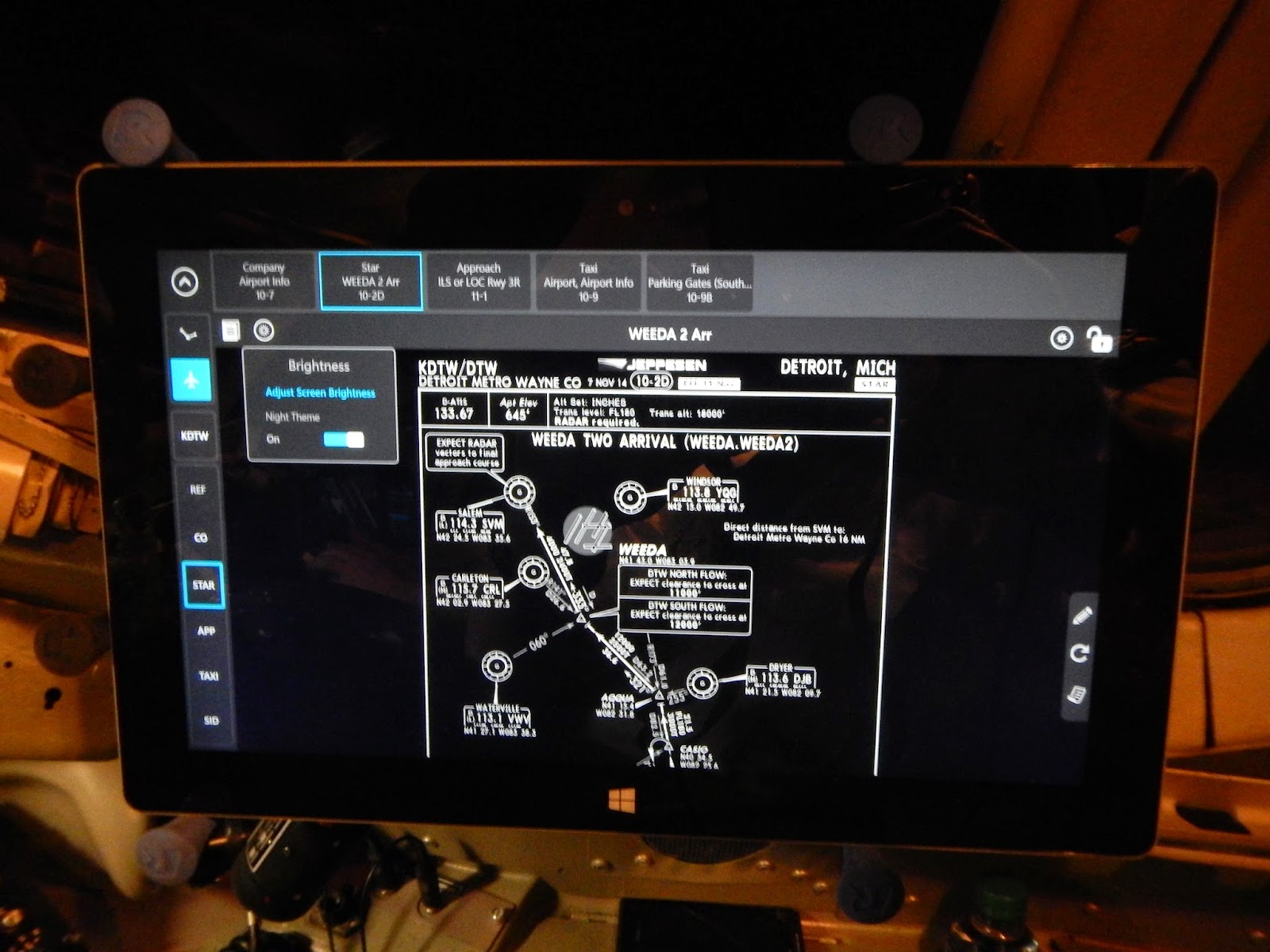
That said, now that the EFB is finally here, I think Microsoft, Jeppesen, and my company absolutely knocked it out of the park. For what it was designed to do, both the hardware and software are beautiful, functional, and intuitive. Here's a good measure of just how easy it is to use: I received my tablet a few days before recurrent simulator training, did the hour-long training DVD, and was able to effectively use it for the first time during two intense days in the sim (one of which, the maneuvers validation, is a graded checkride). All the present features are contained in two programs: Jeppesen FlightDeck Pro is used to view IFR enroute charts and terminal/approach/airport plates, and Secure Content Locker provides access to all company and aircraft manuals and bulletins. The operating system incorporates a number of intuitive touchscreen gestures to make it easy to smoothly switch between programs or even split the screen between them. For example, the other day my Captain and I briefed a Category III ILS approach with the approach plate on one half of the screen and the company Cat III briefing card on the other half.


My favorite feature of the Surface 2 EFB, versus equivalent iPad-based systems, is the inclusion of a very nifty hinged cover that incorporates a backup battery and keyboard. It attaches to the Surface with a magnetic hinge / power connector. While connected, the backup battery recharges the main battery. I typically carry the Surface between flights with the cover connected and closed, take it out during the preflight and input the flight plan and other information with the keyboard, and then disconnect the cover/keyboard and stow the Surface in its RAM mount (which is suction-cupped to the side window). You can leave the backup battery / keyboard attached if needed, but I've found that the mount holds the Surface alone much more securely.


Besides the company's stated reasons for going to an EFB system (to save fuel and waste by eliminating the paper charts, the weight of which is considerable), I believe its use also increases safety. There's a lot less heads-down time spent digging through Jepp binders for charts, especially in response to last-minute runway, procedure, and route changes. Finding and highlighting critical information is far easier than with paper charts & manuals, particularly in low-light conditions. The mounts allow for easy EFB removal for briefings; I've found that physically taking the EFB in my hands and turning towards the other pilot is far better for facilitating crew communication than facing the window as we talk. I'm also finding that having the EFB makes me far readier to dig into the manuals when I'm not quite sure about something or haven't done a particular procedure in a while; it's a lot more tempting to wing it when the definitive answers are hidden deep within one of about seven heavy paper manuals (good luck guessing which one!). Finally, casual studying for upcoming training is a lot more palatable on the Surface; I made heavy use of it for this purpose in the days before my recurrent events.


That said, there are some improvements I hope to see over time. Even though all the manuals are searchable, you still have to know which manual to search. The content locker includes a master index that tells you where various references are located but it's not clickable; it would be nice if each subject included hyperlinks to the relevant sections of each manual. We also have a paper "Fast Access Tab" that contains selections of most commonly-used reference pages from various manuals, but it's not on the EFB yet. The internal GPS is not enabled, so some nice Flight Deck Pro capabilities like geosynchronous charts & airport diagrams are not available. We are also prohibited from connecting to airborne WiFi, though it could provide invaluable updated weather, radar overlays, and turbulence plots. Both of these issues are primarily due to FAA restrictions. Hopefully once we have full approval for the EFB, we'll be able to make some headway in getting the feds to let us use its full potential.


Really, my only serious complaint is the Windows RT operating system. It's not really a bad OS, it's just completely orphaned. There are hardly any third-party apps available, and no aviation apps at all other than our custom, IFR-only copy of Flight Deck Pro. I had been hoping to use the Surface in the Pacer, but it turned out to be useless for VFR flight. I ended up buying an iPad 2 off of eBay and running WingX Pro7, which I'll write about in another post soon. Thus, we tripled the number of tablet computers in our household nearly overnight. That said, while my airline allows us to use our Surfaces for personal use (on the ground only), it was never a focus of the program. For strictly company use in the flight deck, I have very few complaints, and became an EFB addict within days of its introduction.

Monday, December 15, 2014

The Busted Pilots of Instagram

By now I'm sure many of you have seen "The Pilots of Instagram" piece that's been going around the interwebs. I'm choosing not to post a link because the author printed the names and airlines of the pilots involved, even in cases where it's pretty clear that safety was not compromised and not even certain that regulations were violated. Even if the pilots did mess up, viral press like this has the potential to ruin careers where more measured discipline might be more appropriate. You can find the article easily enough if you want to.

That said, the piece was surprisingly accurate and nuanced for a general news source (if that's what you call it; I'd never heard of Quartz before this). The author had a solid grasp on the particulars of the new FAR 121.542 regulation and how it interfaces with the more established sterile cockpit rule. I dare say the author has much better knowledge of the legalities of in-flight photo-taking than most airline pilots do. I wrote about the new regulations back in June, when I learned about them several months after they took effect. Since then most airline pilots to whom I've mentioned the new 121.542 were either unaware it existed or had an inaccurate idea of its provisions (erroneously thinking that only laptops were banned, that phones are ok in airplane mode, etc). Most airlines, it seems, did little to educate their pilots about the new law.

In some cases, such as my airline, many personal electronic devices were already prohibited by the Flight Operations Manual (FOM). Though it contains airline policy, the FOM is approved by the FAA and technically has the full force of the FARs (and even supersedes them, where there is conflicting guidance). Despite this, it is my experience that pilots tend to be less heedful of FOM rules than the FARs, and in many cases the FOM has considerable grey areas open to interpretation, whereas the FAA's stance on most major regs is well known. Here's a good example. In my June post, I wrote that my airline's FOM already prohibited any camera with electronic functions, which would rule out nearly every modern example. Later, a check airman pointed out that my interpretation hinged on the meaning of a single word, and that based on the use of that word elsewhere in the FOM and the FARs, this provision would not appear to prohibit cameras that were otherwise permitted by FAR 121.542 (that is, cameras with no wireless capability). So my new understanding is that in a non-sterile phase of flight, I can take a photo with my Nikon D5000 SLR, as it has no capability that would render it a "personal wireless communications device." I could then, after the flight is over, insert the SD card into my laptop and upload the photo to Instagram, or Facebook, or use it for one of my Flying articles, all without being in technical violation of the regulation.

There's another loophole mentioned in my previous piece that very well may have been at play with some of the photos and videos referenced in this article. The FAA specifically said in the final ruling that 121.542 does not apply to jumpseaters. When I see a photo or a video that appears to be taken from near aircraft centerline rather than the left or right side of the cockpit, I tend to suspect it was taken by a jumpseater. For that matter, what of a first-generation GoPro with no wireless capability that is set up on a suction mount in non-sterile flight and then allowed to run through landing and all the way to the gate? Depending on the provisions of that airline's FOM, I can see one arguing that this meets the letter of the regs. In most cases, it's very difficult to tell just from the photo or video whether it was taken legally. Even in seemingly egregious case, such as a photo on short final, it can be difficult to tell whether safety was compromised. What if it was a still from a video shot by the aforementioned mounted camera? If mounted out of the way, I find it hard to accept that any lives put in danger.


Here's the thing though. It's one thing to take a photo or video in the privacy of your own cockpit under circumstances that are arguably safe and legal. It is another thing to put that photo or footage, with identifying information, on a website that allows anyone to view it (or in the case of Instagram, encourages maximizing public views). I myself have had to become a lot more careful about this over the years. I once took a picture at PHL while parked on a taxiway with engines shut down on an extended ground hold, and later posted it to this blog. The FOM of the airline I was with at the time made clear this was a non-sterile period, and allowed us to open the cockpit door under these circumstances. I was immediately lambasted by a commenter for violating sterile cockpit, and why not? I certainly couldn't prove that we weren't in a sterile phase of ground operations. Likewise, the outed pilots of Instagram that posted landing footage taken from aircraft centerline can't prove that a jumpseater was holding that camera. When it comes to the court of public opinion, the concept of innocent until proven guilty definitely does not apply; nor does it hold much weight when facing company discipline.

Honestly, I really dislike that my job has come to this, that recording the neat things that I do and see on a daily basis and sharing them with my friends would put my livelihood at risk. It is what it is; going against the grain and posting this stuff online is almost inevitably going to end up with someone trying to destroy you. I'll certainly continue to share inflight pics and vids with you, my friends...but they're generally going to be taken from a single-engine airplane flying under FAR 91. For the past few years that's been my flying club Cub. As of today, however, you're going to start seeing another pretty yellow airplane cropping up in my multimedia offerings. More on that in my next post!

Friday, November 14, 2014

Kick It Out?

The following video has been making the rounds on the interwebs, showing a landing on runway 27L at Chicago O'Hare on a windy day last week:


I initially thought the plane was an AA 737, but closer inspection shows it to be a JungleBus operated for AA by Republic Airways. I have about 5000 hours in the airplane and have made my share of crosswind landings up to and including the published demonstrated crosswind limit of 38 knots (one of which was on 27L at ORD, actually). At NewCo this was considered a hard limit inclusive of gusts, and our FAA principal inspector later lowered our limit to 28 knots steady with gusts to 38. The airplane handled crosswinds very well, with more than enough rudder authority even at 38 knots crosswind component, and enough nacelle and wingtip clearance to use proper wing-low crosswind technique. In big wind, you'd start to kick out the crab and establish the aileron input just before beginning the flare, at about 50 feet.

The technique shown in the video has been criticized by some pilots, and it's definitely not ideal (especially considering the crosswind component was only 15-20 knots), but I don't think the landing was nearly as hairy as the video shows. This was shot from a long ways off using a very high-zoom lens, which greatly exaggerates angular differences (note that 27L looks about 4000' long and 400' wide!). I would guess they landed with somewhere around 5-10 degrees of crab - again, not ideal, but likely within design limits for JungleBus' robust landing gear. Looking at the video, it appears that the pilot attempted to kick out the crab late in the landing flare and didn't put in a corresponding aileron input, which rolled the plane a bit left, where the wind caught the upwind wing, so they touched down on the downwind gear while still crabbed.

I think most airlines would prefer the occasional sideloaded landing to a wingtip or nacelle strike, and for this reason many actually teach a wings-level crosswind technique. The idea is to wait until late in the flare and then kick out as much crab as possible just before touchdown; if you time it right, the plane will be aligned with centerline but on the ground before any side drift develops. You still use some upwind aileron, but only enough to hold wings level. This is a commonly taught technique on the 747 and 737 due to low nacelle clearance, on Airbus products due to the flight control software making cross-controlling difficult, and on the CRJ-200 and JungleBus' little brother JungleJet due to low wingtip clearance. I do not know whether Republic teaches the "kick it out" method on the JungleBus or the JungleJets operated by sister company Chautauqua.

In the JungleBus you have 16 degrees of bank before striking a wingtip or a nacelle. The former requires an unusually high pitch and the latter a nose-low attitude. When landing in 38 knots of crosswind, the most bank I ever saw was about 6-7 degrees. You're typically using Flaps 5 with a lot of wind additive, so you're looking at approach speeds of 140-160 knots depending on weight. There's no reason to use the "kick it out" method; the plane sideslips and lands beautifully on the upwind main wheel with perhaps 3/4 rudder deflection and 1/3 aileron deflection on touchdown, and increasing the aileron deflection throughout the landing roll greatly aids in keeping the plane tracking down centerline. It's not very different to how I land the Cub.

The Mad Dog absolutely hates being landed with any crab at all; doing so nearly always results in a nasty bounce and dramatic gyrations as the tires skip across the runway. For this reason my airline teaches a very similar wing-low technique to the one I used in JungleBus, with cross-control inputs made somewhat lower but still fairly early in the landing flare. There is less wingtip clearance on the Mad Dog than JungleBus, and the ailerons are far less effective (they're manually controlled via cables to servo tabs); the control wheel is close to full deflection on touchdown at the crosswind limit of 30 knots. I know this because a few days before the above video, I landed in Atlanta with winds 310 at 38 knots (twice in one day, actually).

It's easy to pile on the pilots in the video above, but I can say that over the course of thousands of landings I've made some real doozies and was just fortunate that no cameras were rolling. The same goes for any professional pilot flying. The pilot may have well been planning on using a wing-low technique but got a last minute sinker and he was just trying to save it from a hard touchdown. The last few seconds before landing get really busy when the winds are howling, and not just because of the crosswind - it's because your airspeed is often bouncing around +/- 10 knots, and you're making fairly dramatic pitch & power changes in response to floaters and sinkers. At the end of the day, this guy landed on centerline, in the touchdown zone, at what looked like a fairly low sink rate, and the plane appeared to handle the sideload fairly well. This was one of the first windy days since last spring, everyone's knocking the rust off, and no doubt we'll all refine our technique considerably as winter approaches.

Saturday, September 06, 2014

The Hazards of Going On Autopilot

An interesting New Yorker article that mirrors a lot of what I've found to be true of cockpit automation over the years:


The Hazards Of Going On Autopilot - Maria Konnikova

Tuesday, September 04, 2012

QRH

Being a morning person is a tremendously helpful attribute in an airline pilot, and I'm just not. Ever since adolescence, I've been a pretty serious night owl, with my peak hours typically occurring between 8pm and midnight. This worked well when I was freight-dogging, and may yet prove fortuitous to flying red-eye transcons and ocean crossings. In my present incarnation as a regional airline pilot, though, it's a bit of a handicap. We have a lot of early morning report times, especially in the ultra-efficient trips I like to bid, and I have to work to adjust my body clock accordingly. I can usually function well on six hours of sleep, assuming I started the trip without a sleep deficit, sprinkling in short naps as needed.

Even this means that those really painful 3am wake-up calls for a 4am showtime require getting to sleep by 9pm, which is quite early for me.  Last week I had one of those in Bismark, North Dakota, for a 5am flight to Minneapolis followed by an east coast turn. I was in bed by 9pm, and tossed and turned for hours on end before finally falling asleep, only to be jolted awake by my alarm clock seemingly only minutes later. A hot shower did little to clear the fog. I fought the nods during the 15-minute van ride to the airport. I chugged two cups of coffee before departure time. By the time we pushed back, I was wide awake and ready to assume my Captainly duties of groping around a dark, uncontrolled field under construction and then taking off into inky skies and darting around a large line of storms - but the fatigue was still palpable, a slow steady hiss in the back of my head that grew louder as the flight went on. By the time we were descending into Minneapolis, I was contemplating the possibility of a fatigue call to crew scheduling. They wouldn't like that this early.

 Minneapolis was appropriately quiet at 6am and approach control almost immediately cleared us to 4000 feet; I hustled down, anticipating a short approach. As we leveled, I spun the speed selector back to 200 knots, and at an appropriate speed commanded "Flaps 1." The FO reached for the flap handle and slid it back into the first detente. Normally this results in a 10-second sequence of the slats moving 15 degrees down, followed by 5 degrees of flaps, during which the airplane pitches down appreciably as the lift devices enable a lower angle of attack. Instead we were immediately rewarded with a loud "ding!," flashing yellow master caution lights, and four messages displayed on the EICAS:

SLAT FAIL
SPOILER FAULT
AOA LIMIT FAIL
SHAKER ANTICIPATED

As I reached to press the caution switchlight to cancel the alarm, the first thought that sprung into my head was "why now!?" Readers who have flown the CRJ series will laugh at this, but I've never had to do a real-life zero-flap landing in the JungleBus. I've had a few friends who've done it, and they said it wasn't too bad, but things happen pretty quickly and you touch down uncomfortably close to the JungleBus' 195 knot maximum tire speed. It didn't sound like something I really cared to do with my brain fogged in from lack of sleep and the still-early hour. This indulgence lasted for maybe two seconds before a deeply-seated imperative forced its way up through my sleep-clouded consciousness and crowded everything else out: "QRH!"

"I have the airplane and the radios. Slat Fail QRH, please." The FO already had the spiral-bound, plastic-tabbed rectangular booklet that is the JungleBus' Quick Reference Handbook out and was thumbing to the appropriate page. The Slat Fail checklist seemed like the natural place to start, as the failure happened while we were deploying slats and the other messages were all related to them. I spun the airspeed back up a few knots to give us more margin from the now-undepicted stall speed. While the FO began reading the checklist, I told Minneapolis approach that we had a malfunction we needed to diagnose and requested an extended downwind. No problem, the controller said, and asked if we were declaring an emergency. "Not at this time, but we'll keep you posted." A zero-flap landing would likely merit the precaution of rolling the trucks. 

It turned out to be unnecessary. The very first step in the QRH was to return the slat/flap handle to its last position - UP - and see if the messages cleared. They did. The second step was to extend the slats again and see if the messages returned. The slats and flaps deployed normally this time. "Proceed with normal operations." QRH complete. We thanked Minneapolis Approach for their assistance, and they turned us onto a 25 mile final for an easy visual to 30R. 

So it turned out to be a complete nonevent, one of those things that happens pretty routinely when flying an electronic airplane like the JungleBus, a quick control-alt-delete fix-it. It's doubtful any of our passengers even noticed the extended downwind. It was part of the "almost nothing worth blogging about" I mentioned in my last post. It didn't even interrupt our trip, for although I wrote up the malfunction and it almost certainly required computer replacement as it was the second occurrence in four days, we were scheduled to swap to another airplane anyways. The primary, rather agreeable result of the incident was to provide just enough of a diversion to jolt me into full useful consciousness. I didn't feel the least bit tired afterwards, and flew a pleasant turn to Hartford and back to finish the trip. 

But that's really the point of the procedural, aircraft, and training safety systems we have in place. They turn most potential events into non-events, because there's seldom any doubt about what to do. Even a fatigue-addled brain automatically knows through repetition to fly the airplane, call for the QRH, and coordinate with ATC while the non-flying pilot runs the checklist. Had the slats not healed themselves and we actually had to perform a zero-flap landing, even this would have been relatively easy because the guidance on how to do it is quite explicit, and I've done it a number of times in the simulator. Over the years, I've occasionally decried the lack of emphasis on stick and rudder skills and common sense in pilot training, but the flip coin to that is that turning airline pilots into checklist-reading automatons has itself undoubtedly done a great deal for safety.

Wednesday, May 30, 2012

Delayed

When I think about all the complexities of an airline, all the moving parts that need to work together for a flight to get out, and how "lean" most operations are these days, I'm frankly amazed that we ever run on time. Yet, this is the case far more often than not. The U.S. Department of Transportation has collected data on airline performance since 1995, and most years at least 75% of airline flights operated on-time (defined as arrival within 14 minutes of scheduled time). So far this year we're at nearly 84%. Typically between 1% and 3% of flights are cancelled, and around 1 in 500 are diverted enroute.

NewCo turns in frequent on-time performance of 90% or more, but it's not necessarily due to superior management or pilots (as much as I'd like to claim the latter). It's mostly a function of where we fly. I've landed the JungleBus at 83 airports in 40 states and five Canadian provinces, which is amazing for a small airline of 42 airplanes (and there are a dozen additional destinations I've never landed at). This is because WidgetCo is a bit schizophrenic about how to use us, as they are with all ten of their regional partners. Right now we're doing a lot of west coast flying out of Salt Lake City, which is very good for on-time performance. Last year, though, we did a lot of flying up and down the east coast out of Washington-National Airport. The year before that, we did a ton of flying out of New York's LaGuardia Airport, to the extent that we nearly opened a crew base there. Our on-time rating took a huge hit then.

The northeast airports - particularly PHL, EWR, LGA, JFK, and BOS - have the most air traffic congestion, along with mega-hubs ORD and ATL. This has such a big impact on airline operations that when WidgetCo wanted to rid themselves of a troublesome long-term contract with Mesa Airlines, they simply moved their airplanes to JFK, waited for the inevitable, and then terminated the contract for poor performance. During JFKs evening peak, a two-hour taxi is fairly common - and that's without weather. In the summer, a single air-mass thunderstorm 100 miles west can shut down most departures. In the winter, it doesn't take much snow to bring ground traffic to a grinding halt. The DOT's three-hour rule further complicates things. Even on decent weather days, it's pretty common to have a EDCT (Expect Departure Clearance Time) to the northeast airports.

Most places outside the northeast, though, delays are usually weather-related, and tend to vary seasonally. Minneapolis, Chicago, and Detroit suffer in the winter. Thunderstorms regularly shut down Dallas and Atlanta in the spring and summer. Los Angeles hums right along in all seasons.

Behind weather and air traffic control, unplanned maintenance is a common cause of delays. Most of the time, airplanes are scheduled for maximum utilization with few breaks, so any unplanned maintenance results in a rolling delay for the rest of the day unless the airline has a spare airframe handy somewhere along the way. For this reason, many minor items can be deferred for later repair through the use of a Minimum Equipment List (MEL). When I find that something has broken, the first thing I reach for is the MEL book, followed shortly thereafter by the aircraft logbook and my phone to call Maintenance Control. We discuss whether the discrepancy can be deferred, whether it should be deferred, and if not, what our plan of action is. I try to get an estimate of how long it'll take mechanics to arrive at the airplane and how long it will then take them to either fix the discrepancy or at least arrive at a diagnosis. If passengers on board, I try to give them an update on our status every fifteen minutes or so. If we haven't started boarding, I pass along information to the gate agent.

With experience, one develops a sense of which maintenance problems will be resolved quickly and which ones will have you sitting a while, and you can act accordingly. With a long anticipated delay, both passengers and cabin crew will be happier with the passengers off the airplane. If at a hub, I'll start bugging dispatch about getting a different airplane in these cases. If I think it'll be resolved quickly, I'll start or continue boarding and have everything ready to go on my end as soon as we get the logbook back. It's important to communicate with the ground crew, as they otherwise often get left out of the loop and will wander off to other airplanes; you can find yourself finally ready to go but with no personnel to load the last bags or push back the aircraft. Over time, I've learned to overestimate maintenance delays when talking to passengers, as they have a way of dragging out long than expected; best to under-promise and over-deliver.

In my experience, the most common source of delays is simply receiving the airplane late from another crew at the start of your day. I've had days where this has occurred three times, every time I had a plane swap. It's frustrating, especially during an already-long day when delays cut into already-short rest time.

Once delayed, your goal is to get back on-time or as close to it as possible, although always within the bounds of safety. It is possible to get so fixated with going fast that you make mistakes. There are usually some easy, common-sense steps, though. You can request a more convenient runway from ATC. You can request more direct routing from center. You can change your altitude based on aircraft performance and winds aloft, and you can fly at a faster cruise mach number. This may result in worse efficiency, but sometimes it's worth it to get the airplane back on time - particularly early in the day, when making up fifteen minutes makes all subsequent flights that day fifteen minutes closer to on-time. On long flights that tend to be over-blocked, it's possible to make up 30 to 45 minutes in one flight. That said, it's important is to make sure you don't short yourself on fuel you might need later. I'm far more likely to cruise at Mach .81 and FL300 going to Billings on a clear day than I am going to Newark with forecast thunderstorms. You need to coordinate with your dispatcher, and take on extra fuel if necessary.

The other time to make up delays is on subsequent ground turns. The key here is communicating with ground personnel. They'll know you're coming in late, but expressing the need for a quick turn and the crew's willingness to pitch in helps put them in high gear. Small things like starting the APU early to shut the engines down quickly, helping clean the cabin, and running gate-check bags out to the rampers can help shave off minutes.

One thing I do find a bit ludicrous is the obsession many airlines, most gate agents, and some pilots have with "On-Time Zero" or "D-0," basically making sure the airplane isn't even one minute late in departing. Some people go to extraordinary lengths to get the door closed and the parking brake dropped by departure time, even if there's still a lot that needs to be done and the airplane can't actually move for another five or ten minutes. Mind you, all that's at stake is the airline's own internal records. So far as the DOT is concerned, the airplane is on-time until it's fifteen minutes late. The gate agent, however, is often called to account by their supervisors if the plane is even one minute late. This was particularly bad at Northwest; Widget is a bit less extreme about it, although some gate agents still get really wrapped around the axle about it. My own philosophy is that I'll do my job efficiently and will do what I can to help get the flight out on time, but won't cut corners just for the sake of some meaningless internal record that has absolutely no effect on whether we actually get to our destination on-time or not. I've been called by the chief pilots office over very minor delays in the past, and that's always the answer I've given them. I've never been in trouble over it.

As you can see, most delays are out of the crew's control, and we typically do a lot to help mitigate them. There is one exception to this rule: a withdrawal of enthusiasm, or WOE. It usually occurs during contentious contract negotiations. The idea is that if the company is stonewalling or applying undue pressure to the pilot group, the pilots do their job as defined in the contract, and nothing more. You don't have to try to deliberately delay the airline, that takes care of itself. You simply fly the same way whether the plane is delayed or not. Because airlines have become so used to pilots going above and beyond and have built their schedules accordingly, the operation falls apart when the pilots don't make the extra effort. It can be very effective; as recently as 2007 a WOE campaign resulted in Northwest deleting some of the most onerous provisions of their pilots' bankruptcy contract. Whether it's legal is another matter entirely, as a number of judges have ruled that even a withdrawal of enthusiasm constitutes an illegal work action under the Railway Labor Act. This interpretation, however, hinges on the WOE being coordinated. It's apparently hard for management and their accomplices in the legal profession to imagine that pilots who are being told how little they are worth to their companies might be a bit less than willing to go the extra mile, on their own and without the urging of their union.

Wednesday, September 07, 2011

I, Robot

-->
The aviation world has been a bit aflutter the past two weeks over an article that recently came out in the mainstream press and was subsequently picked up by various media outlets. The article, available here, was reprinted with several alternate headlines, the most sensational and popular of which asked, “are pilots forgetting how to fly?” Predictably, the article has stirred up a variety of strong opinion among pilots, with attitudes ranging from outrage to derision to hearty approval.


I actually thought the article was fairly well done for something written by and for laymen. There were some factual errors and I don’t agree with all the author’s conclusions, but there’s a pretty big kernel of truth in there. I wouldn’t say pilots have “forgotten how to fly,” but there has been a pretty fundamental shift in our role and duties over the past 20 years, and we are only now seeing some of the unintended consequences of that shift.


Any discussion of airliner automation needs to begin with an affirmation of its value. I do not like that automation makes my job less interesting or that it has decreased the value of my skills as a pilot, but it has undoubtedly made aviation a great deal safer. There was a time when good pilots, real stick-and-rudder types, were crashing airliners with frightening regularity. No matter how “good” one is, humans are fallible creatures, and in the course of operating a complex machine will inevitably make mistakes. When these mistakes take place in times of stress, in environments that inundate one with information to be sorted and interpreted, they can compound unnoticed until no amount of airmanship can save the ship. Automation decreased the pilot’s workload, sorted the information, arranged it in more easily understood formats, and trained an unblinking eye on the pilot, alerting him to all his most common foibles. The results speak for themselves.


So while we’ve seen an uptick in accidents that can be attributed to automation – or rather, the way we’ve interfaced with automated systems – one would do well to remember how many lives have likely been saved by increased automation. That said, our strength as an industry has always been our willingness to ferret out our weaknesses and confront them head-on. A spate of loss-of-control accidents is disconcerting no matter how low the overall accident rate remains, and I for one am very happy to see “the experts” recognizing the problem and doing some hard thinking about how to solve it.


The degradation of stick and rudder skills is one negative side-effect of automation, but not the most serious one in my mind, despite the article’s emphasis of it. It varies according to the aircraft, airline, and personal preferences. The JungleBus has one of the more automated, integrated cockpits out there, but my airline takes a pretty reasonable line on the use of automation. They encourage its use but caution that it should only be used at the level most appropriate to attain the goals of safety, passenger comfort, and economy – in that order. To that end, it is left to the PIC to determine what level of automation to use at any given time, so long as the pilots remain proficient in the use of all levels of automation, including its complete absence. My last airline took a similarly common-sense approach. There are, however, airlines that require automation to be used to the maximum extent possible, particularly overseas. As an example, there is a well-known British airline that prohibits its pilots from using manual thrust on the A320 except in abnormal situations.


I’ve flown with pilots who prefer to turn on the autopilot at 1000’ on departure and leave it on until 200’ on approach. I’ve also known a few guys who, left to their own devices, would hand-fly everything raw-data from takeoff to touchdown. Most of those I’ve flown with, however, are like me: hand-fly down low when the weather is good, use the automation when the weather is crappy or when in busy, complex airspace. This typically results in anywhere between three and twenty minutes of hand-flying per leg. Beech 1900 types excepted, most regional and domestic pilots probably hand-fly anywhere from 2 to 10 hours per month, long-haul pilots considerably less. Most of this time is spent in takeoff, acceleration, climb, visual or easy instrument approach, and landing. Flight directors and autothrottles (where installed) are most commonly left on.


This alone does not lead to anyone “forgetting how to fly,” least of all anyone who had a decent bit of flight time before the airlines. The most autopilot-loving JungleBus pilot has to turn it off to land, and most do a beautiful job of doing so. It does mean, however, that if automation is unexpectedly lost – especially in an unfamiliar flight regime – handling the aircraft without benefit of autopilot, autothrottles, or flight director will probably not be second nature. It will require some concentration, potentially at a time when multiple anomalies of an ambiguous nature are clamoring for attention of their own. The master warning and caution lights have loud alarms that sound with each new occurrence, but only the quiet voice of your first flight instructor reminds you to “fly the airplane!” It’s understandable that sometimes the former get more attention than the latter.


In my opinion, however, the real problem with over-reliance on automation has less to do with stick-and-rudder skills and more to do with how it has affected our habits as professional pilots. Automation was supposed to free us to think more, but instead has freed us to think less. Consider the enroute phase of flight: it’s been so thoroughly automated, there’s precious little left for the pilot to do. Your course is drawn out for you, there is no doubt as to your position, updated weather is at your fingertips, your fuel state at next fix, destination, and alternate is right in front of you, and ATC has become much better about routing aircraft around heavy weather. All of these are good things – nobody is looking to give up positional certainty, accessible weather data, or fuel planning aids - but they are not conducive to keeping one alert and engaged in the flight. It’s too easy to get lulled into passivity, to turn your brain off and let things happen.


This technology-induced torpor can linger beyond cruise into the descent phase. In Dave’s thoughtful post on this same subject, he mentioned that a strong pilot should, when told to cross 40 west of a certain fix at FL250, be able to mentally calculate his descent point in three seconds flat – “tired or not.” Not so long ago, such mathematical process was a baseline requirement of the job; you wouldn’t survive on the line without it. Technological progress has made it possible for weak pilots to fit in. Worse, it has atrophied the brains of some formerly strong pilots.


The JungleBus, like “Fifi”, has a Vertical Navigation (VNAV) system that is very capable – when it works. It can be led astray by operator error, it has some insidious failure modes, and occasionally it does things that are just plain goofy. More than once, manually calculating my descent point as I received a crossing clearance saved my bacon – not from crashing, mind you, but certainly from violating my clearance. Yet, I often witness otherwise good pilots whose very first instinct upon receiving a crossing clearance is to enter it into the FMS. Worse, when asked where they plan to start down, many do not have an answer ready. The steady stream of ASAP reports for busted clearances my company receives (and this is true of other companies operating VNAV-equipped aircraft) suggests that my experience is typical. Yet, you are far more likely to be busted on a line check for failing to enter a crossing restriction in the FMS than you are for failing to mentally back up the FMS.


I do not wish to imply that the majority of airline pilots out there are weak or lazy. The opposite is true: most wish to do their job to the best of their abilities, and expend considerable effort in doing so. I am saying that we have been unintentionally training our pilots to value the technology in their aircraft over their own common sense. We have made it passé for a pilot to fly by his wits and then wonder why those wits have become dulled with disuse. This is becoming evermore true as we start pilots on technologically advanced aircraft ever earlier in their careers, to the point that we have pilots being hired at the regionals today whose very first flight lessons were in Garmin-1000 equipped Cessna 172s.


So long as the technology works perfectly, it’s a mere academic issue. Like the JungleBus’ VNAV, technology seldom works perfectly, and is always subject to outright failure. The real question, then, becomes “what happens when the automation quits?” How our pilots handle that is the real test of our reordered priorities. The recent cases of Colgan 3407, Turkish 1951, and Air France 447 are not encouraging. In each case the crew had an abrupt and unexpected transition from full automation to partial or full manual control, in the latter two cases coupled with insidious or confusing failure modes, and they did not handle them well. I can honestly say that just about every messed up situation I’ve seen in both the Q400 and the JungleBus happened because the automation abruptly quit or did something we weren’t expecting, and we handled the transition to manual control poorly. In most cases it was because we spent too much time asking “what’s it doing now?” and “how do we fix it?” instead of just pushing the big red button and flying it like the big 172 it is.


The good news is this: pilots like to be pilots. With some changes I think we can restore a proper balance no matter how advanced our aircraft are. Firstly, an adjustment in automation philosophy is in order (at some airlines more than others). I think my airline’s policy is a good starting point: fly at the level of automation most conducive to safety, passenger comfort and economy, and leave it up to the PIC which level best attains those goals. However, I think we should also emphasize the importance of regular exposure to all levels of automation, including manual thrust and raw data, in various phases of flight, in order to maintain proficiency in all levels. Training and checking should be conducted at all levels of automation, whether the FAA requires it or not.


Secondly, we should adjust procedures to keep pilots engaged in the more automated phases of flight. In cruise, I would suggest pilots be required to complete a navigational log, perhaps collocated with the expanded flight plan section of the release. Passing over or abeam each planned waypoint, the pilots would be required to enter time, fuel load, difference from planned time enroute and fuel burn, estimated time and fuel to the next waypoint & destination, and nearest suitable airport. This is already SOP at a few airlines, but not many. It may smack of busy-work to some, but I think it would be useful as a means of keeping pilots’ brains alert and focused on the flight, as well as serving as an invaluable backup in case of unexpected loss of navigational capability. With newspapers, crossword puzzles, laptops, Angry Birds, and napping all banished from airliner cockpits, I will only half-jokingly suggest that each pilot be issued a sextant and mariner’s almanac to take sightings to back up the GPS.


Lastly and most importantly, we need to adjust our training and checking to emphasize the necessity of brainwork. Technology and mental skill ought to be mutually beneficial and neither should be employed to the exclusion of the other. Simulator instructors and check airmen should make a regular practice of failing the automation in unexpected and artful ways as a means of ensuring that pilots are actively backing up their technology and are continuously prepared to revert to lower levels of automation. Ultimately, the most difficult thing about all this is that it will require a certain change in the training mindset at many airlines. With training footprints slashed to a bare minimum, the goal has become preparing the pilot to pass his checkride in a minimum of time. The focus needs to shift back to preparing the pilot for whatever life on the line throws at him, in particular the sneaky problems that have a way of snowballing unnoticed. Vee One cuts are serious and it’s good that we practice them, but they’re not particularly subtle, nor do they require much thought beyond rote repetition. We need to move beyond “checking the boxes” mode and include opportunities for real learning in every training and checking event. This will require more simulator time and therefore increased training budgets, but I believe the result will be more thoughtful pilots more attuned to their aircraft and better equipped to handle unusual problems.


While the industry sorts out the big-picture stuff, we as individual pilots can take a few simple steps to maintain a balanced relationship with the automation in our aircraft. First, use it as a backup to your own airmanship and common sense. Calculate your descent profiles mentally and then use VNAV. When ATC clears you direct to a fix, have a pretty good idea of what your heading should be so you can check the route your FMS or GPS is proposing for reasonableness. Secondly, make a regular practice of flying under various conditions with reduced levels of automation. You can put together a regimen. I try to fly at least one approach each trip without autothrottles, and one every other trip raw-data. I also occasionally practice fully-automatic RNAV approaches, something we do in real life very little. If you are an FO, explain your habit of practicing all levels of automation to your Captain at the start of the trip. If you’re a Captain, encourage your FOs to do the same.


My third suggestion is to ensure you are paying close attention to what is on your FMA (Flight Mode Annunciator) or equivalent display at all times. Return to it often. It should be as central to your scan as the attitude indicator. Many of the “what’s it doing now?” moments I’ve seen occurred because the autopilot and/or autothrottles were in a different mode than the pilot thought he had selected. And finally, when you do find yourself asking “what’s it doing now?”, make it your very first step to fly the airplane, reverting to lower levels of automation as necessary, and not succumbing to the temptation to troubleshoot until the airplane is going where you want it to.

All these guidelines are applicable to advanced airplanes from glass-equipped C172s on up through A380s. Flight instructors, drill them into your students from the very first flight lesson. I generally believe that glass cockpits in training aircraft are overkill or even counterproductive for early flight training. I may very well revise that opinion, however, if their use results in a new generation of professional pilots who start their careers with a healthy and balanced approach to automation.

Monday, May 02, 2011

Stuck in the Mud


Last week, Southwest Airlines topped off a month of unwanted publicity when one of their B737s slid off the end of Runway 13C at Chicago's Midway Airport. Thankfully, nobody was seriously hurt and the aircraft appeared to suffer only minor damage. It's not the first time Southwest has been off the runway in Midway: in 2005, SWA1248 departed the same stretch of pavement (in the opposite direction, on 31C) at high speed, crashing through the airport fence and coming to rest on South Central Avenue, where a six year old boy in a car was killed.

This time around, the happier ending had a few airline pilots making cracks at Southwest's expense. It's true, SWA's accidents have all involved running off the end of runways, and their pilots do have a reputation for taxiing at a, umm, brisk speed. That said, I think there's a bit of schadenfreude over SWA's financial success and the fact that their B737 pilots are now better paid than senior widebody pilots at all the legacy airlines. The old advice about stone-casting in glass houses definitely applies here. The fact remains that Southwest has yet to kill a passenger in 40 years of flying, something none of the legacy airlines can claim. Moreover, to the extent legacy pilots haven't been running airplanes off runways lately (ahem), it's worth pointing out that much of their flying to marginal airports has been outsourced. Delta and American and United jets have all gone on offroad adventures lately, but in each case the airplane was operated by a regional carrier. Every Southwest jet has a Southwest pilot at the controls, something that should shame legacy pilots a whole lot more than Southwest's superior payrates and work rules.

The 2005 accident occurred while landing downwind on a contaminated runway in an intense snowstorm. Touchdown occurred 2000 feet down the runway, and the thrust reversers failed to deploy for 18 seconds. This incident took place in considerably better conditions, although the runway was reported to be wet. The NTSB will do its thing and we'll find out what went wrong, but for now it's worthwhile noting that the airplane went off the end of the runway to the side, and not straight ahead into the EMAS bed that was installed to prevent a recurrence of the 2005 accident. I'm guessing the pilot tried to make a fast left turn onto Taxiway Echo and lost traction.

Regardless of what mistakes were made in this case, Midway is a pretty marginal airport for most jet airliners. Runway 31C is the longest landing runway with 6059' usable, and all the others have under 6000 feet. There are no approaches to 22L/R, and only the ILS 31C is available in under one mile visibility. Circling approaches and landings with strong crosswinds or slight tailwinds are all common. There's really nothing wrong with the airport that an extra 1000' of pavement for each runway wouldn't fix, but that would involve bulldozing a fair amount of South Chicago low-income housing. It isn't going to happen.

In the meantime, Midway is one of those airports that require special attention. I am particularly mindful of what the wind is doing and what runways are available, and will divert rather than land downwind. O'Hare is very close, and there are a number of other usable alternates within a half-hour's flight time. I always land with full flaps regardless of landing weight (we land at normal airports with "Flaps 5;" full flaps make the Junglebus "shake like a dog trying to pass a peach pit!"). At Midway, my idea of the "touchdown zone" shrinks significantly, and I'll usually touch down in the first 1000' or so of runway.* I'll always try to touch down firmly, and few of my MDW landings would be considered "pretty." A firm touchdown ensures that the landing gear proximity sensors close immediately, extending the ground spoilers and enabling immediate braking. All of this is admittedly overkill on a good day, but I use the good days to practice for the really bad ones.

Most pilots that land at Midway or similarly marginal airports with any regularity can understand how it wouldn't take a whole lot going wrong to end up sliding off the end of the runway. Seeing the Southwest 737 stuck in the mud off Runway 13C is a good reminder to stay vigilant and continue doing everything I can to prevent it happening to me. Incidentally, I worry a lot more about the "Engine Failure at V1" scenario in MDW than a long landing, and there's not much I can do to decrease my risk in that department. The good news is that the chances of anyone suffering a complete engine failure in the few seconds between 100 knots and Vr while departing Midway are rather small, which makes my own personal risk quite tiny indeed.

* Touching down at 1000' requires going below the VASI in the final stages of the approach. Some airline pilots balk at this based on a flawed understanding of 91.129(e)(3), which requires pilots to "maintain an altitude at or above the glide path until a lower altitude is necessary for a safe landing." If you follow the VASI all the way down, you will touch down 1500-2500 feet down the runway, which is unacceptable at Midway with anything other than dry, bare pavement. Most airplane's contaminated runway numbers are contingent on touchdown at the 1000' mark. I certainly don't suggest dusting off the chimneys of the houses surrounding Midway, but with the displaced thresholds and lack of high obstacles on approach, going below VASI in the last quarter-mile at MDW is both safe and legal. You will see most aircraft cross the displaced threshold at well under 50'.

Monday, January 24, 2011

How Not to Build a Trip


Last month I was assigned a trip that is an excellent example of how the current rest and duty rules are woefully inadequate and change is long overdue. I have reproduced the trip key below with only format changes to improve clarity. I hasten to add that although this is a NewCo pairing, every airline out there has these trips to some extent, and they are relatively rare here. Since their work rules were stripped away in bankruptcy, even the major airlines build some rotations like this one, and a few regionals build trips far worse than this one as a regular practice.

M7284 BASE REPT: 1050L
DAY FLT DEP-DEST STD STA BLK TURN

MO 5694 MSP-YYC 1135 1343 308 37
MO 5876 YYC-MSP 1420 1803 243 132
MO 5778 MSP-MDW 1935 2103 128
BLOCK 719 DUTY 1028 REST 1658
DUTY END: 2118L REPT: 1416L

TU 5749 MDW-MSP 1501 1635 134 230
TU 5755 MSP-BHM 1905 2134 229
BLOCK 403 DUTY 733 REST 926
DUTY END: 2149L REPT: 0715L

WE 5887 BHM-MSP 0800 1038 238 237
WE 5784 MSP-OMA 1315 1425 110 30
WE 5729 OMA-MSP 1455 1606 111 254
WE 5657 MSP-MSN 1900 2004 104
BLOCK 603 DUTY 1304 REST 926
DUTY END: 2019L REPT: 0545L

TH 5649 MSN-MSP 0630 0740 110 240
TH 5696 MSP-MKE 1020 1132 112 35
TH 5696 MKE-MSP 1207 1332 125 208
TH 5850 MSP-ORD 1540 1657 117 103
TH 5850 ORD-MSP 1800 1925 125 E75
BLOCK 629 DUTY 1355
DUTY END: 1940L
TOTALS BLOCK 2354 LDGS: 14 CREDIT 2354 T.A.F.B. 8050

Since most readers don’t likely see many trip keys, I’ll break this one down. The first two days are pretty easy, with three and two legs, respectively. The first layover, at Chicago-Midway (MDW), is a long one of nearly 17 hours. The following day, two legs to Birmingham (BHM), has less than 8 hours of duty time. That night, though, has only 9 hours and 26 minutes of rest time. In this situation, 9 hours is the legal minimum. It might even be adequate if followed by a moderately easy day and a long overnight. The trip, however, goes rapidly downhill from there.

On day three, there are four legs, three of them short, which combine for 6 hours of block time. Duty time, however, is 13 hours and 3 minutes thanks to two lengthy sits in Minneapolis. The day ends in Madison, WI with another barely-legal overnight. After 9:26 minutes of rest time, day four begins at 5:45am - completing the circadian swap from a trip that began on a P.M. schedule. There is a nearly three-hour sit in Minneapolis after the first leg, followed by a Milwaukee round trip and another two-hour sit. The day concludes with a Chicago O’Hare turn, with a little over an hour spent in Chicago. Block time and pay is 6 hours 29 minutes, but duty time is nearly 14 hours.

In all fairness, I bid for this trip, although not intentionally. I set my computer bidding preferences to look for efficient trips, those that have the most pay per day. This one is fairly efficient from that standpoint, with nearly 24 hours of pay in 4 days. It is inefficient from the standpoint that much of the down time is spent at airports, where there is no possibility of sleep, instead of at layovers. This is not, however, a criteria that our bidding system can sort. I was surprised when this trip appeared on my line, but on closer inspection saw that it did indeed meet all my criteria. There was nothing to do but fly the trip and get as much rest as I could in the little time allotted.

The first two days went fine. Everything was on time, the weather was good, and we even got into Birmingham a half hour early on day two, lengthening the layover to a full ten hours (although a late hotel van meant that less than nine was actually spent at the hotel). Day three was pretty long and tiring. We had plane swaps on each of our long sits, and the Omaha turn was delayed for a late inbound and for deicing. When we got to Madison, I was ready to hit the hay. Instead, we got to wait a half hour for the hotel van, and then spent twenty-five minutes riding to the complete opposite end of Madison. It was 9pm by the time we got to the hotel. I hurriedly ate a late dinner and went to bed. I tossed and turned for a long time before finally falling asleep, and then woke repeatedly throughout the night for a noisy fan that wouldn’t turn off.

The 4:30am wakeup call came bone-achingly early. The long ride to the airport, coupled with a shuttle that leaves on the top and bottom of the hour, meant we had to take a 5am van for a 5:45am show time. A hot shower and early cup of coffee didn’t do much to break my stupor. The short flight to Minneapolis seemed to take forever. A nap on our long break would have done wonders, but there was nowhere to sleep at MSP. The crew room is constantly busy, bright, and loud, and the designated quiet room off the side has been declared off limits to all but airport reserves. Instead I had another large cup of coffee. It worked, for a while: I was practically jumping off the seat on our way to Milwaukee.

Then I came crashing back down on the return leg, and I found myself missing radio calls and messing up simple things. On the descent, I fought an aggressive case of the nods by using the oxygen mask on 100% oxygen. We still had a two hour sit in Minneapolis – often more tiring than actually flying – followed by a four hour Chicago turn. There was no way I was going to make it. I called in fatigued shortly after landing.

The crew scheduler sounded incredulous. “Fatigued? You’ve only done three legs!” I told him to take a look at the trip, but that didn’t move him. “You’re going to have to talk to a chief pilot about this!” he exclaimed, obviously annoyed that he would need to find someone to cover the O’Hare turn. I told him I would go downstairs and talk to the base chief pilot that very minute, and hung up.

I’m happy to report that the base chief pilot was very supportive. I showed him the trip key and explained how the cumulative shortage of sleep was affecting me, and he agreed that the trip wasn’t exactly conducive to obtaining sufficient rest and thanked me for doing the safe thing. I know that fatigue calls are handled in a much less positive manner at certain other airlines, and that previous flight ops managers at NewCo reportedly took a different tack. In this case, the only negative effect I suffered was the loss of around $180 in pay.

It’s worth noting that none of my other crewmembers called in fatigued. They all said they were tired, but felt they could battle through the day safely. Fair enough; fatigue affects different people differently, and they may have been more successful in getting sleep the previous night. It’s impossible to say how the loss in pay may have affected my poorly paid flight attendants’ and First Officer’s decisions.

In any case, it’s hard to see how our crew planner could put together that pairing without it occurring to him that chances were excellent that at least one crewmember might become severely fatigued. At most airlines, not just NewCo, there is a prevalent attitude that “If it’s legal, it must be safe.” From a statistical perspective I suppose they’re right. We just finished the third year out of the last four without a major airline fatality in the United States. If pilots are flying around tired, they’re doing a remarkable job of not killing people in the process. The ATA and RAA’s obstructionism of the new rest and duty regulations shows they’re utterly willing to accept an occasional Colgan 3407 here, an American 1420 there, right up to the point that the body count causes passengers to start booking away.

Fair enough. They have tickets to sell and profits to make, and these days corporate responsibility in this country tends to start and end with the stockholders. It’s not like the majority of passengers disagree; I suspect the vast majority would willingly sacrifice 100 strangers every few years to keep ticket prices low. As a pilot, though, safety is my only concern. Sure, I put in the effort to run my ship in a timely and efficient manner, but I don’t lose any sleep if I block out a few minutes late or burn an extra hundred pounds of gas. My real job, indeed the very core of my professional identity, is to minimize the risk to my passengers in every way practical.

This is also, theoretically, the FAA’s only job. They do not have a responsibility to ensure the airlines turn a profit. Congress removed their responsibility to promote aviation economically a few years back for the very reason that I’m writing this post. Now, the FAA’s only job is to manage risk, and fatigue is clearly the chief risk factor they have allowed to go unaddressed for too long. It’s high time to put the new rest and duty regulations into effect and end the silliness of asking pilots to fly exhausting trips that tempt them to fly fatigued.

Tuesday, November 16, 2010

Security Silliness

The least favorite part of my workday is at the very beginning, when I am required to subject myself to security screening by the Transportation Security Administration. The checkpoints are usually crowded, power-tripping TSA agents are often barking orders, I feel like a jerk cutting in front of long-suffering passengers, and then there's the process of trying to disassemble and reassemble my luggage ensemble in a timely matter without battering surrounding fellow-sufferers. There are usually no less than five items to send through the X-ray machine: flight kit, overnight bag, lunch bag, bin with laptop computer, bin with hat and overcoat. It's small comfort that they don't make flight crew remove their shoes.

All this inconvenience would be an acceptable part of my job if I felt that it serves some purpose. It does not. It's completely absurd to screen the pilots who will, in less than an hour's time, be seated at the controls of a fuel laden aircraft in flight, with crash axe within easy reach! This was recognized before 9/11 and we were allowed to bypass security. That changed in the wake of 9/11, but not due to any credible threat of terrorist acts by pilots or pilot impostors. Rather, it was believed that seeing flight crews forced to go through security would make the public more accepting of new procedures. This is exactly the sort of useless display that has become the TSA's primary stock in trade, what security expert Bruce Schneier refers to as "security theater."

Recent changes in TSA equipment and procedures have elevated flight crew screening from a mere inconvenience and exercise in stupidity to an outright violation of rights and decency. The TSA recently installed hundred of whole body imaging scanners, both of the Millimeter-Wave (Terahertz) and Backscatter X-ray varieties, in order to better detect non-metallic weapons and explosives. These machines penetrate clothing to create a nude image of the subject. Ostensibly this image is to be viewed in private by a screener of the same sex, and TSA claimed that images cannot be saved; both of these assurances have been shown by events to be false. TSA also asserts that the devices are perfectly safe and cannot cause health problems. Expert opinion is not nearly so settled, particularly regarding backscatter technology, and in any case there have been no independent studies to verify that the TSA's health claims are any more authentic than their privacy claims.

Anticipating these objections, the TSA danced around Fourth Amendment issues by allowing pilots and other travelers to "opt out" of whole-body imaging and subject themselves to secondary screening instead. Simultaneously, the TSA changed their secondary screening procedures to make them infinitely more humiliating and invasive, and thus discourage further opt-outs. I have witnessed this process first-hand at several airports. First, the TSA agent loudly exclaims "Opt out! Opt out!"; this is sometimes parroted by other TSA agents, and has the effect of drawing the attention of other passengers. Then, in full view of those passengers (unless the subject specifically requests a private screening), a TSA agent aggressively pats down the subject's body, including breasts and genitals. The TSA manual states that the breasts and genitals are to be searched using the back of the hand, but I have twice observed TSA agents breaking that rule (at LaGuardia, I even observed an agent take both of a woman's breasts in the palm of her hands and squeeze hard twice - "honk, honk!"). This would be sexual assault if anyone other than the government were doing it. Worse yet, they can and do subject children to the search (again at LGA, I observed a TSA agent groping a crying 3 or 4 year old girl).

It is one thing to pass through a magnetometer and have my belongings X-rayed as a requirement of my job. It is another thing entirely to be forced to choose between a virtual strip-search that adds to the radiation I already get on the job (higher than a nuclear plant worker!) and a government-sponsored molestation. Those are absolutely unacceptable conditions of employment, and it's high time that pilots fight back. Toward that end, both the Allied Pilots Association (American Airlines' union) and the US Airline Pilots Association (USAirways) recently issued recommendations for their pilots to opt out of whole-body imaging, request a private room for secondary screening, require the presence of a supervisor or law enforcement officer during the pat-down, report inappropriate TSA behavior, and call in sick if the process leaves them too shaken to fly safely. That is excellent advice which has the potential to quickly overburden TSA checkpoints. It has already had the effect of reviving a long-stalled program to verify flight crew employment and allow them to bypass security. Sometime soon, I may not have to subject myself to the TSA's goons to go to work.

But what about when I travel out of uniform? What of my wife and parents when they nonrev? What of all our passengers, our customers, our bread and butter? Many of them are required to fly as a condition of their livelihood. Why should they be required to give up their Fourth Amendment rights by dint of setting foot on an airplane? Why have airports become rights-free zones? Because aviation has been targeted by terrorists? Trains and subways have been extensively targeted worldwide, should search and seizure without probable cause be allowed on them as well? New York City itself has been repeatedly targeted by terrorists more than any other city in America; should the Bill of Rights no longer apply on the island of Manhattan?

The standard worn-out answer is, "If you don't like it, you don't have to fly." That's a horrible excuse that can be expanded to cover nearly every trammeling of God-given rights. You don't have to travel by train or subway, or visit or live in New York City, do you? You don't have to use the sidewalk by your house, do you? In that case, should using these purely optional pieces of public property be probable cause for a police officer to detain and strip search you? I'm not saying we shouldn't have security at airports, nor that every right should apply (the 2nd ammd clearly does not, for example). The courts have clearly held that security checks at airports, as previously conducted, are constitutional administrative searches. That said, unelected officials have made a very large leap from minimally invasive passive technologies such as magnetometers and explosive trace sniffers to highly invasive technologies and techniques without a sniff of public debate on the constitutional implications and the poor precedents that might be set. That worries me.

Not everyone is so worried about rights. Some are a lot more worried about terrorism. Some are willing to give up almost any right "so long as it makes us safer from terrorists." It's not a mindset I agree with, but even by this standard there is not much reason to support the new body scanners. Many security experts doubt whether they would've detected the components that the "underwear bomber" of NW253 sewed into his undergarments. They cannot see under the skin, nor in body cavities. Remember that both surgically implanted bombs and bombs inserted into body cavities have already been used in Iraq and Saudi Arabia, and presumably any operation sophisticated enough to produce a viable high-explosive device would use one of these methods of gaming the body scanners. In a German test of one of the machines, a subject was able to hide all the components needed to assemble a bomb on his body (not in cavities) and pass through the scanner undetected. The Israelis don't use them for airport security and have no plans to; the head of security at Tel Aviv's Ben Gurion International Airport called them "expensive and useless." For detecting explosives, sniffer machines are also expensive and maintenance intensive but considerably more useful. More low-tech but still one of the best means of detecting explosives: trained dogs. It just happens that the body imaging companies have far better lobbyists. Chief among them: Michael Chertoff, the Secretary of the Department of Homeland Security immediately preceding Janet Napolitano.

I'm on the front lines here. If, God forbid, a terrorist should succeed in detonating an explosive on board an airplane in flight, there's a decent chance that somebody I know will die, and I will find myself out of a job in rather quick order. I'm generally in favor of things that decrease the possibility of that happening. I don't think subjecting ourselves, spouses, and children to a virtual strip search or public molestation does anything to help in that regard, and the one thing it does do is make flying a far less pleasant experience. Meanwhile, rampers and other airport workers with much less extensive background checking than pilots are allowed to bypass security entirely. The TSA refuses to considers the one thing the Isrealis have found to be effective: behavior-based profiling, essentially ensuring that each traveler gets some face time to chat with a trained security officer and tailoring further screening according to their behavior.

I think it's high time we put our foot down to the TSA's incompetence and boorishness. To that end, the recommendations put forth by APA and USAPA show the best way forward: use the opt-out process to bring the whole works to a grinding halt. I suggest that everyone who will be flying on November 24th participate in "National Opt-Out Day."