Showing posts with label Major Airlines. Show all posts

Friday, May 06, 2016

Six Months In (Sorta)

Considering my lack of posting you might think that my airline is working me to death, but no, that's not the case. Recently I passed 120 hours on the B757/767...just over six months since I went to class! Keep in mind that I was originally awarded the slot way back in Feb 2015, meaning I'm only nine months away from my seat lock expiring. I'm not planning on going anywhere but it keeps options open.

Basically what happened is that my airline was originally planning on retiring a significant portion of the 7ER fleet, didn't train many new pilots on it for a while, then decided to keep many of the airplanes after all at the same time that a bunch of senior 7ER FOs took captain slots on other fleets. Whoops, big training logjam! It's just now finally clearing.

So here's basically how my training went:

Oct-6Nov15: Home study for 7ER course (we basically teach ourselves the systems on our own time via computer based training, honestly not my favorite way to train).

6Nov15-6Dec15: 7ER Initial training. You may recall from Mad Dog school that we break our initial training into four blocks, numbered 100 to 400, that roughly correspond with systems training, procedures training, maneuvers training, and line-oriented training. These all end in checkrides but the two most important are 34X (Maneuvers Validation) and 44X (Line-Oriented Evaluation). Unlike Mad Dog school, I was paired with an FO rather than a CA, which complicated things a bit in that we each had to learn left-seat duties and got only half the time we otherwise would in the right seat. However, my sim partner (who is only a few numbers senior to me) is an extremely sharp guy, we worked very well together, and we made it through the course without problems. One happy footnote: we weren't stuck in "the schoolhouse" the entire time, our 300-series sims were all down at the Boeing training facility in Miami. We passed our 44X checkrides easily on December 6th and were sent home indefinitely waiting on IOE.

31Jan15-05Feb15: Initial Operating Experience (IOE). I flew with a super-nice Detroit-based Line Check Airman, he was completely understanding that I hadn't been in training for eight weeks and might take a little more time to get spooled up. My very first leg was in a B757-200 and operated from Detroit to Cancun for a 24 hour overnight, a very nice way to kick things off! Our subsequent layovers were in Orlando, Fort Myers, and Atlanta. I ended up flying the B752 for 5 legs, the B753 for 2 legs, and even our GE-powered domestic B767-300 for 2 legs. I liked the legendary power and performance of the B752, but I loved the fingertip-light control feel of the B763 (due to the additional inboard ailerons). You simply think about turning, and she's turning.


29Feb-04Mar: Transoceanic Operating Experience (TOE), 2 crossings of 4 required. There was less time off before this so I didn't have much catchup on the airplane itself, but there's a lot to cover over the course of the first 8-hour crossing (during which I was in the rest seat for 2 hours) and it's all stuff that I'd last covered in mid-December. I crammed to catch up in the days before the TOE, and the LCA was happy with my preparation. We flew one leg from Atlanta to London-Heathrow in the B767-300ER, and after a 18 hour layover flew an ETOPS B757-200 back across to PHL. We even got tagged for a couple domestic legs the next day, the better to increase my landing count. I gotta say, though, I've found all the variants pretty easy to land. It just takes the first few to adjust to the higher sight picture.

06Mar-10Mar: TOE crossings 3 & 4. Only one day off before straight into my 2nd TOE, which was based out of Seattle and consisted of only two legs, SEA-PVG-SEA. This was my first time to China, and I had a really nice 48 hour layover to explore Shanghai. The takeoff out of Seattle, at 407,000 lbs, is my heaviest to date. Like I said the B767 is really light on the controls, so you don't feel that heavy, but acceleration obviously takes longer and you have to be really sharp with your pitch control to avoid overspeeding the flaps while retracting them at the proper speed and keeping the airplane accelerating. On the way over we were in VHF coverage the whole way, flying north via Alaska, the Bering Sea, Russia, and arriving from over Beijing. The Russian and Chinese controllers weren't too hard to understand, but once in China you switch to flying metric altitudes, which is a little different. The weather really stunk in Shanghai when we landed, with a big gusty crosswind, but the rainy runway made for a nice landing. On the way back we flew via Japan and then over the water. Because this is such a long flight, it was a 4-man crew, meaning I spent nearly half of each crossing in the bunk (and these particular B767s actually have bunks - so nice!). Pretty easy work if you can get it.



And that's it, I was released to the line on 10Mar, didn't work again thanks to creative bidding until early April, and have done a few trips since, all domestic. I'm getting pretty comfortable with the airplane - as expected, it's superior to the MadDog in every way possible, but there are also a surprising number of similarities that make for an easy transition. I've been quite busy taking advantage of all the free time for the last six months, and have done the following trips:

mid-October: Interline Regatta, British Virgin Islands.
Christmas/New Years: Dawn and I flew the Pacer from Minnesota to Connecticut and then down to Key West.
early Jan: flew around Florida visiting friends.
mid-Jan: Dawn and I flew the Pacer from Florida to Phoenix.
mid-Feb: Dawn and I flew the Pacer down Baja with our friends Brad and Amber (they rented a 182 out of San Diego). Awesome, epic trip - story is coming out in July issue of Flying.
late-Mar: Went to Thailand to visit my sister and her kids in Chiang Rai, flew down to Phuket, met my parents, chartered a 39' Leopard catamaran for 5 days of sailing the Andaman Sea.
mid-Apr: Dawn and I flew the Pacer up the west coast to Portland, OR.

Besides all that, there are some pretty major developments in my and Dawn's plans, dating back to last August. As a result, we sold our rented-out townhome in Vancouver WA back in February, and just sold our house in Minnesota a few weeks ago. We close on June 7th, and are renting a small apartment in downtown St. Paul for the summer before taking off for "new horizons." Yes, I have some pretty serious catch-up blogging to do.


Monday, December 14, 2015

The Last Tour

I was originally awarded the 757/767 back in February, but this came on a fairly open-ended bid that allowed the company to converted awarded pilots more or less when they pleased (though always in seniority order). At the time the thinking was that they needed us on the line yesterday, and I assumed I'd be trained and on the line by July. As it turned out, I was dead wrong and got to enjoy another sweaty summer on the Mad Dog. I then would have been placed in training in October, except that was when I had two weeks of vacation, and in the bid preferences I had asked for the vacation to be honored. After all, that was when I was heading down to the BVI for my fourth year of sailing in the Interline Regatta. Because of the vacation, PBS only assigned me six days of flying in October, a four-day trip before the regatta and a two-day to end the month. I was subsequently assigned a 6 Nov class date, and despite my best efforts to get 1-5Nov off, PBS assigned a two-day trip on the 1st and 2nd.

I caught a lucky break and had my early October trip pulled for newhire OE, since I was paired up with a line check airman. This left me with only four days of flying to finish up my stint on the Mad Dog, 30Oct-2Nov. Coming back to any airplane after a full month off is a little uncomfortable, but once you've been on it a while it only takes a leg or two to get back into the swing of things. Of course I'd already been hard at work studying for my new airplane for a few weeks, and I had a couple minor screwups due to the negative transfer (on one takeoff roll I accidentally called "80 knots, throttle hold, thrust normal" instead of "Clamp, 80 knots, thrust normal" - which the captain thought was hilarious). Overall, though, I didn't make too many "short-timer's" mistakes.

Lord knows there was plenty of opportunity to screw the pooch. The first three days were a hilariously bad compendium of the assorted and well-known ravages of Mad Dog flying that keep senior FOs on widebody fleets long after they can hold MD captain. The weather was dogshit all up and down the east coast - low ceilings, wind, and rain - with the attendant flow programs and major delays going in and out of hub airports. We seemed to have maintenance issues on nearly every leg: a bunch of MELs, or unusual ones that required extra study, or open writeups from prior crew, breakages during preflight, and glitches enroute. We had the exact same malfunction I wrote about in my column earlier this year: the FMS spontaneously dumped all route and performance data, apparently due to a momentary power interruption. This time it happened while descending at night on a complex RNAV arrival (and getting the snot kicked out of us in heavy rain); I saw the problem right away and immediately reverted to lower automation levels while the captain coaxed a simpler clearance out of the clearly-displeased controller. That was on leg three of a long four-leg day - with two plane swaps - in and out of our largest hub. The next leg (different airplane) saw me hand-flying a no-kidding ILS approach into mountainous Asheville, NC, after the autopilot did a decidedly unsatisfactory job of tracking the localizer. We broke out about a hundred feet above minimums. Despite our late-night arrival and the driving rain, the captain accompanied me to one of my favorite Asheville watering holes for a nightcap. The brew went down easy on my last Mad Dog layover.

The last day started the same as the first three, with rain and low ceilings prompting flow delays into "Mecca." Our last leg to Minneapolis, thankfully, was blissfully smooth once we got past Nashville. The weather was decent in Minnesota, we broke out of the high overcast to see the lights of the Twin Cities stretched before us, and ATC cleared us for the visual approach quite early. I clicked off the autopilot and autothrottles at 8000 feet and enjoyed my last time handflying the old gal around the pattern to Runway 12R. My last landing wasn't perfect, but it wasn't horrible either; I'll take it. It was a little surreal to think I may have landed that plane for the last time, though I rather suspect I'll have another crack at Mad Dog wrangling at some point in my career. In the meantime, I've been advised that any misplaced nostalgia for the Mad Dog will likely disappear right about when I land the Boeing 757 for the first time!


Wednesday, December 02, 2015

Ode to Mad Dog

Long before I was assigned the Mad Dog, I knew I was destined to fly her. My company assigns seniority within new-hire classes according to the last four digits of your social security number, and with a sub-0300 SSN I was guaranteed to be one of the most junior in my class and assigned by default to the most junior seat at the airline: New York Mad Dog FO. I was at peace with that, and after six plus years of the stultifyingly automated JungleBus I was honestly ready for a challenge and a change of pace. The Mad Dog’s rugged design and old-school cockpit held a certain attraction for me, and my only real regret was that I never got a chance to fly the DC-9 before it was retired.

That said, I wasn’t quite prepared for just how busy the Mad Dog is, particularly in the right seat during ground operations. The preflight, pushback, after engine start, taxi, before takeoff, after takeoff, descent, approach, before landing, after landing, and shutdown flow patterns and checklists are all considerably longer than on the JungleBus (a couple of those nearly three times as long). Engine starts just about require three hands. Quite a few switches on the right side of the cockpit belong to the FO even while Pilot Flying with the autopilot off. The airplane has VNAV and autothrottles, but both are glitchy enough to require close attention and frequent intervention to smooth out their operation and ensure compliance with restrictions. The relatively small wing means that very careful attention must be paid to speed and maneuvering margins both after takeoff and at cruise altitude, which seldom exceeds FL330. The brakes are by turns pitifully weak and unpredictably grabby, and it’s nigh impossible to symmetrically deploy and spool up the thrust reversers. This is an airplane with a fairly steep learning curve; I did well in training only by studying my ass off (it also helped to have a sharp training partner with experience on the airplane).

Coming to the line as a brand new FO was an eye-opening workout. Many of the captains I initially flew with on reserve had been on the airplane for years and were used to an experienced FO’s pace of operations. I sometimes had to remind them that I was new and needed a little more time. Every trip I made mistakes, found more gotchas, learned new tips and tricks, and saw more unfamiliar glitches and failure modes. There’s a lot of tribal knowledge among Mad Dog drivers, much of it not written down anywhere. And then, after a couple months, I was able to hold a junior line and often flew with captains who were themselves brand new to both the airplane and the left seat. With only a couple hundred hours in the airplane, I was occasionally the “experienced guy” passing on my scant slice of the tribal knowledge.

I passed the magic 400-hour mark, releasing me from probation, after only five months of line flying. Remarkably, I found myself getting comfortable with the airplane. Actually, that’s not exactly the right way to put it, because I continued watching the Mad Dog as closely as ever, if not more so. Perhaps it is better to say that I got comfortable with being uncomfortable. Relaxed preflights, clean uncluttered cockpits, flawlessly smooth autopilots and autothrottles, and trying to stay awake as we blithely cruised across the country at FL370 all faded from memory until they seemed like distant, fanciful dreams. I came to simply accept the Mad Dog’s flaws and quirks as just the way life is. I didn’t pine for a more relaxed, more sophisticated airplane. The hardest part of coming to the Mad Dog is coming to the Mad Dog, and that was already done.

And in fact, once I accepted the plane’s busyness and quirkiness, I actually found quite a few things about it that I really liked. For starters, it’s built like a brick shithouse. The systems are simple and robust, and while there’s not a great deal of redundancy the plane doesn’t really need it as it’s not horribly dependent on hydraulics, electric, etc. The primary flight controls are all manual, with control cables driving servo tabs. It hand flies pretty well for being a notorious truck; though control forces are fairly high, it’s easy to put the plane right where you want it and keep it there. Near-centerline thrust makes single-engine work a cakewalk. The extension speeds on the very draggy flaps are ridiculously high (starting at 280 kts) so it’s easy to get down when you find yourself high. The pilots are so far forward of the engines that even on the JT8D model it’s really quiet, and though the cockpit looks like the bridge of a Russian submarine, it's actually laid out pretty logically. The Flight Mode Annunciator may look like a 1980s football scoreboard but it’s large and visible in any lighting conditions. And once you figure out the myriad controls for the cockpit lighting, it’s almost infinitely customizable which makes for a very comfortable nighttime environment.

I found myself growing downright fond of the airplane. More than one friend suggested that my newfound appreciation for the Mad Dog was nothing more than Stockholm Syndrome. Perhaps. The reality is that, much like taildraggers, a certain amount of the Mad Dog’s cachet comes not despite its flaws but because of them. It’s frequently stated to be a “real man’s airplane” (though I hasten to add that several female friends have flown it for years and claim to love it). Airbus pilots, like Cherokee drivers, are considered perhaps a little suspect for no other reason than that their airplanes can camouflage weak flying skills, while Mad Dog wranglers, like tailwheel pilots, get a (sometimes undeserved!) presumption of competence. In 757/767 training, each instructor has asked what fleet I’m coming from and, informed of my Mad Dog status, to a man they’ve given a relieved little wave and assured me I’d do great on the Boeing.

Given all this, I wasn’t planning on leaving the Mad Dog anytime soon. I enjoyed the fruits of its juniority, spending a mere six weeks on reserve in New York, soon thereafter holding weekends-off regular lines, and then getting back to Minneapolis after eight months of commuting. Of the other aircraft in my base, the Airbus has remained improbably senior (nobody wants to leave it!) and the 757/767 category was slowly shrinking. But then pending aircraft retirements were cancelled, the category got additional flying, there was movement from senior FOs upgrading to captain, and suddenly there was a bid out for fifty (!) MSP 757/767 FOs. I ran the numbers and concluded I’d have about the same seniority in either airplane. The Boeing paid more and had better trips, though I might not be able to hold international flying. I was still undecided when I had lunch with (now-former) Flying editor Robert Goyer on an Austin layover. I mentioned the possibility of bidding the Boeing but noted I’d have to spend a month at training. “Don’t you like training for new airplanes?” prodded Goyer. He had a point, I actually do, and I've wanted to fly the 757 since I was ten years old. That decided it; I put the bid in that night.

I was awarded the Boeing in February and didn’t start training until November 5th, so I had plenty of extra time to appreciate the Mad Dog. The last four days on the plane were so hilariously Maddogish that they merit their own separate post. Meanwhile I wrap up training on the Boeing in a couple days and will be enjoying some paid time off over the holidays while I wait to be assigned OE/TOE. 


Saturday, November 28, 2015

Across the Sea

(Originally written back in August)

"So, you're an airline pilot, huh? Do you fly the big planes?"

"Eh, more medium-ish. 149 to 160 passengers."

"I see. What's your route?"

"It changes from week to week. I go all over the U.S., but probably 75% East Coast."

"Oh. Any overseas routes?"

"No, the plane I fly is pretty range limited. I do a little close-in international."

"Like South America?"

"No. Like Nassau."

Such is cocktail party conversation as a Mad Dog pilot. My 757/767 friends talk of Paris and Palau and Rio, and such exotic ports of call may well beckon in my near future, but for now I mostly ply my trade to places like Huntsville, Buffalo, and Columbus. I have not yet landed in the Great White North with my new company. I have flown turns to Nassau several times, but was rerouted out of my one overnight there. I've laid over in Kingston, Jamaica; a tropical paradise it is not. Atlanta-based Mad Dog driver friends report dreamy wanderings to Providenciales (Turks and Caicos), Montego Bay, and Grand Cayman, but I do not believe any MSP Mad Dog wrangler has ever laid eyes on those bejeweled realms. We do, however, fly to Cancun, Mexico, and in fact I have gone there twice, most recently this past week.

Cancun is actually about as International as our humble fleet gets, for it involves legitimate "offshore" flying. Our other Caribbean destinations involve going "feet wet" (our New York-Florida routes also go offshore more often than not), but always within 162nm of land. This is as far as we can go without life rafts, with which only a handful of the Mad Dogs are equipped. The Cancun route nearly always goes further out and thus requires the raft-equipped aircraft. I'm not sure how 162nm came to be the magic number, as it seems somewhat arbitrary, but I surmise it must somehow relate to the offshore capability of rescue helicopters. I'm not certain that I would want to be 161nm from land with nothing but a life vest keeping me afloat and marginally visible to would-be rescuers, but don't ever plan on testing this scenario in depth.

Our jaunt across the Gulf of Mexico also exposes us to the world of Class II navigation, meaning outside of the reception area of most VORs. Not to worry, the Mad Dog's modern navigation equipment frees it from dependence on obsolescent land-based navaids. No, not GPS, silly! A $50 burner flip phone may have GPS accurate to within a couple feet, but not the Mad Dog! We use Inertial Navigation System, or INS, for long-range navigation. We have to do a full realignment before such a long flight, and then check it against a trusty ground-based NavAid before launching out into the trackless ether.

We also fly outside of the reach of radar for a short stretch, right around the changeover from Houston Center to Merida Center. Thus, we get a little practice in making position reports, usually on first contract with Merida southbound or Houston northbound. This still takes place within voice VHF communications range - we don't have HF radios installed, much less the CPDLC datalink systems now commonly used for trans-oceanic communications. The only communications challenges on Mad Dog international flights are of the linguistic variety: Mexican and Cuban controllers converse with local pilots in Spanish, making it a bit harder to keep track of who's doing what (my high-school/traveler smattering of Spanglish helps); their accents when speaking English also vary considerably, from slight to barely comprehensible. You just have to listen carefully and make inquiries if anything isn't perfectly clear. Recording the ATIS usually takes a few loops, and you definitely want the captain listening in before attempting to transcribe your clearance.

On my next fleet, of course, there will be far more opportunities to do overwater flying. This is an airplane that we operate to five continents, and I see all five represented in the MSP bid packet. Of course I'll be fairly junior so it's likely the majority of my flying will be domestic, but I think I'll be able to occasionally sample trips that take me further afield. The variety of flying was one of the reasons I bid the new category. Dawn and I have traveled to many of the places that the Boeing flies, so it's not necessarily the attraction of visiting new places, but moreso the appeal of doing something completely different than I've been doing for the last twelve years. I'm both a night-owl and able to sleep almost on command, so I think I'll be able to adjust well to the schedules (fingers crossed). And, of course, far-flung flying adventures always make good fodder for blogging!

Monday, April 13, 2015

Dear MadDog

This is one of the hardest letters I will ever write. I'm leaving you. I didn't make this decision lightly. You're a great airplane, quirks and all, and we had some great times - even when you occasionally tried to kill me or get me violated. I grew to love you despite your faults, or maybe because of them. But now I've met someone new, somebody wonderful, and it's time for you and I to part company.

When we first met, I was both intrigued and intimidated by your age and experience, your heavy manual controls, your various aerodynamic protuberances, and your reputation as the heartbreaker of the fleet. I stayed up late at night studying your systems and practicing my flow patterns, and later flying the simulator in preparation for our first liason. And then we were together, at long last, and at first I was completely overwhelmed. Heck, it takes three hands just to get you started! But over the next several hundred hours, I became comfortable with your heavy demands, your old-school design, and your occasional nonsensical outbursts. I even started to think of them as normal. Right engine spools up eight seconds slower than the left engine? "It's a Mad Dog." VNAV mysteriously levels off at 6250 feet and refuses to descend further? "It's a Mad Dog." Get sent around because your Vref is 30 knots faster than the preceding 757? "It's a Mad Dog." Bumping through the tops because stall margin won't let you climb above FL310? "It's a Mad Dog." Number 17 in line for takeoff in ATL and it's 87 degrees in the cabin with the packs full cold? "It's a Mad Dog." I came to accept that this was just the way things were.

And yet...I heard tantalizing rumors of a sweeter, kinder plane, a pilot's airplane with boosted controls, great big engines, a long efficient wing, and a lithe, sexy airframe free of unsightly strakes and vortilons. Many of my captains knew her before they upgraded to your left seat, and in your more temperamental moments I'd hear them mutter, "Never should have left the ER!" Some of my fellow new hires were fortunate enough to fly her right out of the gate, and I couldn't help overhearing their gushing accolades of her attributes. I tried to defend you. "Yeah, well...the Mad Dog has control cables! She'll keep flying through a nuclear holocaust! And look how senior I am in the Mad Dog! I held a Saturday off last month!" But every time that other airplane taxied past, I couldn't help but cast an appreciative gaze her way. And when this bid came out, with a whole bunch of new slots in my home base, I couldn't resist her siren call. I had to find out for myself what all the fuss is about.

So I'm off on a whirlwind romance with the plane they call "The Boeing" in October. But you and still have the summer to make some last sweaty memories together. I'll never forget you, Mad Dog. And somehow I get the feeling that fate with bring us together once again, perhaps sooner than I think.


Tuesday, March 17, 2015

Living the Dream!


I can't take credit for this one, but it's pretty freakin' brilliant. The cop/porter thing is hilarious, as I have indeed been mistaken for both, among other things.

Tuesday, February 03, 2015

Great Leap Forward

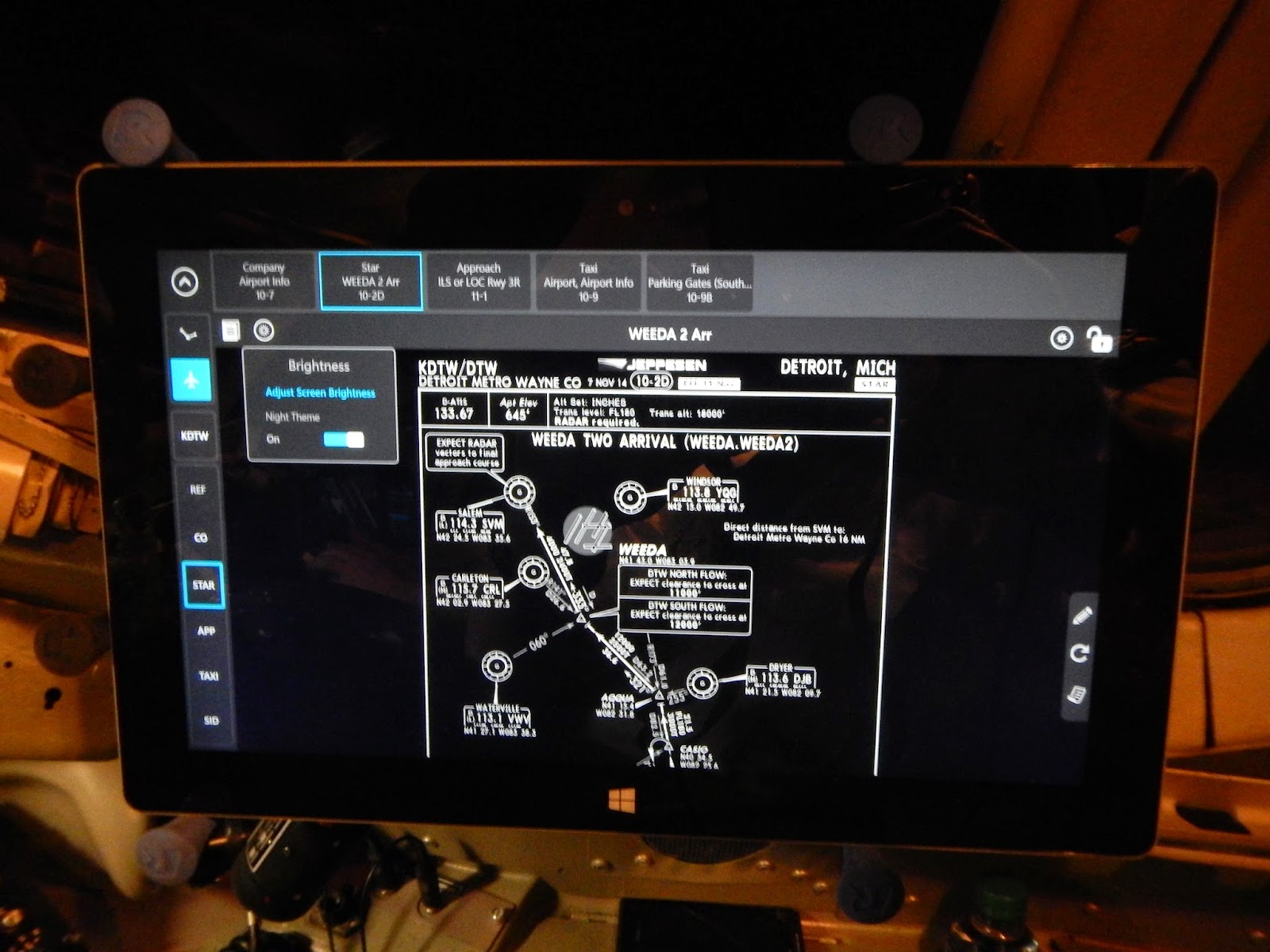
My airline recently rolled out our Electronic Flight Bag (EFB), a Microsoft Surface 2 tablet, and I've been using it for about a month now. The idea of a paperless cockpit has been around for a long time, and we're a bit late to the party; EFBs have been de rigueur at most major airlines for a couple of years. The most common platform, by far, is Apple's iPad; it's used by Alaska, American, United, FedEx, and UPS, plus many regional airlines, corporate flight departments, and thousands of private pilots. There's a wide variety of well-proven off-the-shelf EFB software available for the iPad, and reams of data on the system's reliability. The FAA is getting very experienced at approving iPad-based EFB installations.

For a variety of reasons, my airline chose not to go that route. First, we are a very Windows-based company - we Mac users are barely tolerated and most training & crew applications are not supported on our machines. Secondly, Microsoft is one of our largest corporate customers, and we're currently expanding in the Pacific Northwest. Frankly, we're not a company that's entirely known for its tech savvy. It probably shouldn't come as a surprise that our choice of a fairly uncommon tablet paired with an orphaned standalone operating system (Windows RT), combined with Jeppesen having to do a custom port of their FlightDeck Pro software, resulted in rather lengthy delays. Even now, we're merely in the test phase; until the EFB is fully proven, we're still carrying around ship sets of Jepp charts and operational manuals (individual subscriptions are thankfully a thing of the past - updating Jepps was always among the most hated of pilot chores).

That said, now that the EFB is finally here, I think Microsoft, Jeppesen, and my company absolutely knocked it out of the park. For what it was designed to do, both the hardware and software are beautiful, functional, and intuitive. Here's a good measure of just how easy it is to use: I received my tablet a few days before recurrent simulator training, did the hour-long training DVD, and was able to effectively use it for the first time during two intense days in the sim (one of which, the maneuvers validation, is a graded checkride). All the present features are contained in two programs: Jeppesen FlightDeck Pro is used to view IFR enroute charts and terminal/approach/airport plates, and Secure Content Locker provides access to all company and aircraft manuals and bulletins. The operating system incorporates a number of intuitive touchscreen gestures to make it easy to smoothly switch between programs or even split the screen between them. For example, the other day my Captain and I briefed a Category III ILS approach with the approach plate on one half of the screen and the company Cat III briefing card on the other half.


My favorite feature of the Surface 2 EFB, versus equivalent iPad-based systems, is the inclusion of a very nifty hinged cover that incorporates a backup battery and keyboard. It attaches to the Surface with a magnetic hinge / power connector. While connected, the backup battery recharges the main battery. I typically carry the Surface between flights with the cover connected and closed, take it out during the preflight and input the flight plan and other information with the keyboard, and then disconnect the cover/keyboard and stow the Surface in its RAM mount (which is suction-cupped to the side window). You can leave the backup battery / keyboard attached if needed, but I've found that the mount holds the Surface alone much more securely.


Besides the company's stated reasons for going to an EFB system (to save fuel and waste by eliminating the paper charts, the weight of which is considerable), I believe its use also increases safety. There's a lot less heads-down time spent digging through Jepp binders for charts, especially in response to last-minute runway, procedure, and route changes. Finding and highlighting critical information is far easier than with paper charts & manuals, particularly in low-light conditions. The mounts allow for easy EFB removal for briefings; I've found that physically taking the EFB in my hands and turning towards the other pilot is far better for facilitating crew communication than facing the window as we talk. I'm also finding that having the EFB makes me far readier to dig into the manuals when I'm not quite sure about something or haven't done a particular procedure in a while; it's a lot more tempting to wing it when the definitive answers are hidden deep within one of about seven heavy paper manuals (good luck guessing which one!). Finally, casual studying for upcoming training is a lot more palatable on the Surface; I made heavy use of it for this purpose in the days before my recurrent events.


That said, there are some improvements I hope to see over time. Even though all the manuals are searchable, you still have to know which manual to search. The content locker includes a master index that tells you where various references are located but it's not clickable; it would be nice if each subject included hyperlinks to the relevant sections of each manual. We also have a paper "Fast Access Tab" that contains selections of most commonly-used reference pages from various manuals, but it's not on the EFB yet. The internal GPS is not enabled, so some nice Flight Deck Pro capabilities like geosynchronous charts & airport diagrams are not available. We are also prohibited from connecting to airborne WiFi, though it could provide invaluable updated weather, radar overlays, and turbulence plots. Both of these issues are primarily due to FAA restrictions. Hopefully once we have full approval for the EFB, we'll be able to make some headway in getting the feds to let us use its full potential.


Really, my only serious complaint is the Windows RT operating system. It's not really a bad OS, it's just completely orphaned. There are hardly any third-party apps available, and no aviation apps at all other than our custom, IFR-only copy of Flight Deck Pro. I had been hoping to use the Surface in the Pacer, but it turned out to be useless for VFR flight. I ended up buying an iPad 2 off of eBay and running WingX Pro7, which I'll write about in another post soon. Thus, we tripled the number of tablet computers in our household nearly overnight. That said, while my airline allows us to use our Surfaces for personal use (on the ground only), it was never a focus of the program. For strictly company use in the flight deck, I have very few complaints, and became an EFB addict within days of its introduction.

Wednesday, December 10, 2014

Sixteen Again

At my new airline, as at Horizon, many of the captains I am flying with are my parents' age or a little younger. Most of these have adult children and part of the standard "getting to know you chit-chat" is inquiring how many kids they have, what they do for work, what their marital status is, and whether any grandkids are on the way. Most of these children's lives were spent while their father (or mother) worked at a major airline. Which is to say: most had an upper-middle-class upbringing, often involving private schools and world travel and the chance to attend a good university. They tend to fall in either the brilliant-and-going-places category or else good-for-nothing-and-probably-moving-home, at least in their parent's retelling. What I not yet heard is even a single example of a child who is now an airline pilot. This makes sense, in a way. Most captains in this age bracket have offspring that came of age around or just after 9/11, when the airlines were in full economic free-fall and pilot group after pilot group was facing bankruptcy or liquidation. Nobody in this situation would encourage their kids to follow in their footsteps. Many have said as much.

Lately, though, I've also flown with quite a few newer captains who've been with the airline for "only" 14 or 15 years. These pilots suffered the effects of 9/11 much more acutely than their senior brethren; many spent months or years on furlough, and they've stagnated in the right seat since. However, their kids were young at the time and are just now getting to the age where they have to pick a career field. Surprisingly, I've flown with three or four younger captains whose kids are actively pursing being an airline pilot. They're either taking flight lessons, are planning to, or are a Private Pilot already, and are selecting an aviation college for their advanced training. All have their parents' enthusiastic support despite the formidable costs involved. Some of this is probably attributable to the upbeat attitude around my airline at the moment. There's a lot of hiring and upgrading going on, the company is making a lot of money, the profit-sharing checks are handsome, and the pilot contract has been slowly inching up towards pre-9/11 levels. My friends at other major airlines report that morale there is considerably worse, understandable since they're all still working through the merger glitches that my airline had to deal with five years ago.

It's made me wonder what I would do if I was sixteen again and looking for a career to pursue, knowing what I know now. When I was sixteen in 1997, the major airline bankruptcies and furloughs were starting to fade from memory, profits and hiring were on the upswing, and Kit Darby was declaring that the biggest pilot shortage in history was right around the corner. I loved flying and thought I was good at it. The idea of flying heavy iron across the world fascinated me. Flight training was a lot of money even then, but I figured the eventual payoff justified it. Had I been able to predict 9/11 and its fallout, had I known that payrates would be gutted and retirements stolen and huge swaths of the domestic networks outsourced to lowest-bidding regional airlines and flown for inferior pay with zero job stability, I'm not sure my decision would have been the same. Had I foreseen it would take 15 years of hard work and low pay and cross-country moves and occasionally dangerous flying to get to the majors, I might not have taken the leap. If my gift of prophecy had included insight into the runaway executive pay in this country coupled with the continuous shrinking of the middle class, I might have gone to business school.

It's probably good I didn't know the future, because I've enjoyed life and flying over the last fifteen years despite the career bumps along the way, and I seem to have arrived at the majors at a good time. But what would I tell a sixteen-year-old version of myself starting out right now? That consolidation has ensured continued profitability and stability at the remaining major carriers for years to come? That the mandatory retirement numbers are incontrovertible and the pilot shortage is real this time? That the upheaval in the regional sector will have played itself out by the time he's qualified and he can expect a more defined, secure career path? Or would I say that the inexorable march of automation has ensured the continual decline of the airline pilot's worth, or that the capacity discipline exhibited by the major airlines of late will attract new entrants and fresh upheaval, or that cabotage is inevitable and the US airline industry will go the way of the US maritime industry? Hell, for all I know airliners could be pilotless in 30 years. By the same token medicine could be automated by then, tort reform may put thousands of lawyers out of work, or the revolution could come and MBAs will swing from every lamppost. I don't know what's going to happen.

I do know this: Aviation has been an unstable, irrational industry since the day Wilbur cracked up on Flight Four and will likely continue to be thus for a long time to come, consolidation be damned. Even in the salad days airline pilots were known to bitch about pay and working conditions, and will continue to do so until they're finally replaced by robots. Very few pilots will have smooth careers from beginning to end. Most of those getting into aviation for money, lifestyle, prestige, or excitement will find one or all of those things lacking at some point in their career, and it may be enough to kill whatever love of flying they had in the first place. For those who love to fly, though, and can't imagine doing else, the joy of flight transcends what's going on in the industry at any given moment. If you are that sort of person, and you can be happy despite low income, birthdays and holidays spent away from family, and uncertainty about the future, you are probably well-suited for a career in aviation. The good news is that at some point along the way, there's a good chance that you'll happen into a sweet well-paid gig that affords a decent lifestyle. As long as those things are considered side benefits, and the flying is the main goal, it's still a pretty decent way to make a living. Of course, if you're an airplane-mad sixteen-year-old like I was, you probably don't need some old codger to tell you that.

Friday, October 31, 2014

Almost Home

Besides the better pay, work rules, and benefits, one of the reasons that so many young pilots aspire to fly for one of the remaining legacy network airlines is the variety of flying available to its pilots over the course of their careers. The "Big Three" have large networks covering the US, North America, and the entire world, with a large number of different aircraft types of various sizes, capabilities, makes, and levels of automation. Once the new American Airlines is fully integrated, for example, a newhire may find themselves flying an old-school MD83, a Boeing 737, an Airbus 320/319/321, or an Embraer 190. Moving up, they might fly internationally in a Boeing 757/767, A330, 777, or 787 - or they might stay on domestic narrowbody equipment for better seniority. They might delay upgrade for a better schedule, or they might chase the highest-paying left-seat position available. They might give up a pay raise to hold a base they live in or which features an easier commute. The options are many, and few pilots will make the exact same choices over the course of their career.

Personally I enjoy variety in my flying, which is one of the main things that made me wait out a class date at a legacy carrier rather than trying to get hired at an airline like jetBlue, Southwest, or Alaska. Those are fine companies that treat their pilots well, but they are also (for now) single-fleet operators with narrowbody equipment confined to North America. That's what I'm doing now and that's just fine for a few years, but I can't see doing it my entire career. My current airline has even greater fleet variety than American. Assuming that both my health and the state of the economy and my employer stays strong, I'll hopefully bid to widebody international equipment in a few years, do that until I upgrade on the Mad Dog or similar domestic narrowbody, and eventually go back to international in the left seat. Changing it up will help keep the flying from getting stale over the next 32 years to mandatory retirement (I hope to retire sooner...said every 33-year old pilot ever).

For now I'm just hoping to get home to Minneapolis as soon as possible. There is a Mad Dog base there and it's not really that senior, but there is a huge glut of newhires who happen to be from the Twin Cities who are trying to get home. Among the 2010 hires, I have a several friends who have been trying to get back ever since; they've been commuting to reserve in New York for much of the last four years. Considering this, I was thinking it would be a year or better before I could hold Minneapolis, but nevertheless kept it active in my online vacancy bid. Imagine my surprise when, several months ago, a vacancy award was published that had my name and "MSP Mad Dog FO" on it! Some 19 pilots senior to me and 8 junior to me got back to MSP in the same bid. I talked to a chief pilot shortly afterwards, and he showed me slated for a December 1st "conversion date." I was a bit doubtful; letting 20+ pilots go all at once would decimate the New York base. But as time went on and the December 1st date held firm, I allowed myself a glimmer of hope.

The December category lists were just published - and disappointingly, I'm still in New York, along with most of the senior pilots awarded MSP. The contract gives the company wide discretion on when they chose to convert vacancy awards, and they apparently realized that short-staffing New York immediately before the holidays and the return of winter weather was not in their best interests. That's ok. I know plenty of people forced to commute their entire careers. I'll likely commute again at some point in mine. For now, it's good to know that I'm coming home, and I only have to wait a few more months. For December, I'll be over 50% seniority in the New York Mad Dog base, raising the possibility of holding Christmas off in my very first year. I got Thanksgiving off in November. Minneapolis, like widebody international flying, will be there for me down the road. In the meantime I'm enjoying much better seniority than a probationary pilot would usually dare to hope for.


Friday, July 25, 2014

I Heart NY

Well, it sure didn’t take long to get off low-time restrictions. My seven weeks of line flying on the Mad Dog have netted me 120 hours in the plane despite being on reserve. Reserve pilots usually fly less than lineholders because you're seldom used every day, you do plenty of oddball 1- or 2-leg trips, and you tend to ride around in the back of airplanes a lot (deadheading). This summer, though, my company is doing a lot of flying, especially in the Mad Dog, and it’s all hands on deck. Thus far I’ve been used on nearly every day of reserve, mostly for 3 and 4 day trips.

I’m based in New York City, partially by choice. My airline has a Mad Dog domicile in Minneapolis, but it’s proving to be an extremely popular base among our junior pilots. I estimate that there are 50+ pilots between me and the “plug” in MSP, meaning it could be a year or more before I can hold it. In the meantime I’m forced to either move or commute. Dawn has a good job she enjoys in the Twin Cities, we like our home here, and we’ve become used to having family nearby, so we’ve decided to stay put for the time being. My choice then, is which commute is least painful. I can hold all three other Mad Dog bases, but the first is a small base connected to MSP only by 50-seat RJs, and the second has a ton of employees that commute from MSP, making it difficult to find an open seat or jumpseat. New York, however, has plenty of flights from MSP, they tend to have seats available, and I have higher seniority there than I would in any other base. This is true across all fleets at my airline: NYC goes junior.

This extra seniority comes at a price. NYC-based pilots at my company must cover three separate airports (LGA, JFK, and EWR); moving between them is slow and expensive, and the airspace and airports are both quite congested. Because there’s so much Origination & Destination (O&D) traffic, many of the rotations begin early in the morning and end late at night, forcing pilots to commute on their days off and spend extra nights in the domicile. That said, because so many NYC-based crewmembers are commuters (I’ve seen estimates of 80%), there’s a pretty well developed infrastructure in place. For starters, there are many crashpads scattered throughout Queens between LGA and JFK. One area, Kew Gardens, hosts so many crashpads that it has acquired the nickname of “Crew Gardens” and boasts a cab company that caters almost solely to airline crew. Some crashpads are pretty basic and offer little more than a mattress for the night; others offer all the comforts of home. My crashpad is actually pretty close to LGA, in Jackson Heights, since ¾ of the Mad Dog flying is out of that airport. It’s quite nice, well equipped and clean, with its own free shuttle service to LGA and JFK. It's also not far off the E or 7 trains, making it easy to go into Manhattan on the rare reserve days I'm not being used.

Commuting to reserve is a notoriously tough gig, but the work rules at my airline make it a lot easier than it was at either of my last two companies. Most reserve days are “long call," meaning I get at least 12 hours notice before report time, and I usually know about trips by 3pm the day before I start reserve, making informed commuting decisions much easier. On the first day of reserve we cannot be assigned a trip that begins before 10am. Many of the trips begin or end with deadheads; our contract allows us to “deviate” from a scheduled deadhead positive-space. So if I begin work tomorrow and am awarded a trip for which the first leg is a deadhead LGA-ATL, I call crew scheduling, tell them I will deviate, and book positive-space travel MSP-ATL for around the same time as the original deadhead. I save myself a night away from home and get a confirmed seat to work - score! Reserves can put in “Yellow Slips” that tell crew scheduling their preferences for awarded trips. I have a permanent yellow slip for trips that begin or end with a deadhead, as well as for trips that have a report time after 1pm and/or release time before 6pm (allowing a same-day commute). Obviously if a trip needs to be covered and I’m next in line, I’m going to fly it regardless of preferences, but if there are several trips to be covered and one meets my criteria, that’s the one I get. This has worked very well over the last month, giving me multiple extra nights at home and eliminating several potentially stressful commutes.

The Preferential Bidding Software (PBS) that my airline uses also gives reserve bidders much more flexibility than my last company. If you wish, you can lump all 17 reserve days into a single giant block, giving yourself a stretch of 13 days off (or 26, if you go back-to-back across bid periods). Of course, under Part 117 you are required to have 30 hours free of duty every 168 hours (7 days), so unless you are awarded a trip with a 30-hour overnight, you’ll end up with extra days off in the middle of your reserve block. This has happened several times, and the timing has worked out to give me several extra nights back in Minnesota.

Because of all the flying this summer, crew scheduling is offering a lot of “green slips” – basically, last-minute trips on your days off for premium pay and/or additional “payback days” off later in the month. A lot of senior pilots, anticipating the ability to make extra cash by green-slipping, purposely bid reserve with the first two weeks off, during which they pick up enough green slips to get the next two weeks off, during which they greenslip yet more, essentially flying the whole month at 200% pay. This is known as "Rolling Thunder." Those senior enough to buddy-bid with check airmen often get their trips bought off for IOE and then greenslip the entire month, basically making 300% pay. We have one Mad Dog FO in NYC that reportedly made over $300k last year doing exactly this.

As for me, I value summer days off far more than extra cash, so I don’t bid with green slips in mind, and I don’t hang around NYC any longer than necessary hoping I’ll get one. Thanks to the fact that reserve is going fairly senior, and that I’m already #80 out of 105 FOs in my category, I got a regular line for August, and a pretty nice one at that! All the trips are commutable on at least one end, I got partial weekends off, and I got a mid-month 8-day stretch of days off for a sailing trip I’m doing out of LA. Not bad for my third month! So yes, New York can be a pain to get to, and it can be crowded, dirty, and expensive, and the airports can be pretty hectic places – but these things, much like the Mad Dog's quirks, keep senior FOs away and afford me much better seniority than I'd otherwise have. So I don't care what anyone says - 'till the day that I can hold Minneapolis, I love NY!

Tuesday, July 08, 2014

Old School / New School

I’ve been flying the Mad Dog on the line for about five weeks now, have finished IOE, am on my third week of reserve, and have about 90 hours in the airplane. I wouldn’t say I’m comfortable yet – that’s going to take some time – but it’s getting more natural, I’m not having to make such a conscious effort to think ahead, I’m making fewer mistakes, and I’m up to about 90% of the speed of an experienced FO. It takes time to get used to any new airliner, but probably more than most in the Mad Dog, simply because it’s such a quirky, busy airplane. The good news is that the quickest way to get used to any airplane is to fly a lot of cycles in a short amount of time, and I’m certainly doing that.

The Mad Dog is basically a late 1980s stretch and update to a 1960s design. It is a contemporary of both the Boeing 757 and the Airbus A320, two much better designs in many respects. Perhaps a better comparison is the B737, another continually stretched and updated 1960s airplane that is not as good as it should be because Boeing maintained commonality with the earlier design. The Mad Dog’s builder was notorious for their thriftiness, reuse of existing components, and leaving as much of their designs unchanged as possible. The Mad Dog actually uses the exact same knob for its cockpit window latches as was used on the DC-3 (and -4, -6, and -7) throttle levers! Less humorously, the largest Mad Dog variant weighs in at up to 168,000 lbs MGTOW and uses the same basic wing as much smaller predecessors.

This lack of wing is the airplane’s most notable shortcoming. Its clean stall speed is quite high, which combined with takeoff warning system malfunctions has resulted in several bad accidents when crews forgot to set flaps for takeoff. After takeoff, we are limited to 15 degrees of bank until reaching a clean maneuvering speed of 250 kts or more at high weights; if a tighter turn is called for, we have to leave the slats out until maneuvering is complete. At altitude, one has to pay very close attention to airspeed, as it’s easy to get behind the power curve and be forced to descend to avoid stalling. Consequently the airplane is quite altitude-limited; it’s common to have an initial cruise altitude of FL300 or lower, a real handicap in thunderstorm season. The B737 comparison holds up here, as the newest super-stretch versions of that design are similarly limited.

In the cockpit, the Mad Dog kept many of the quirks of the original. Several systems retain manual controls and switches where competitors automated them – the pneumatic crossfeed valves, for example, or the fuel system, or engine ignition. The engine start valves are manual and must be continuously held throughout the start, making that a three-limb exercise in which the poor FO begs the Captain to taxi slower lest a pothole dislodge his finger and prompt an aborted start. The engines have no FADEC and care must be taken to avoid an overtemp or overspeed. The spoiler and flap handles are Rube Goldberg devices (held over from the original) that take practice to activate without a struggle. The whiskey compass is famously (and hilariously) mounted on the aft cockpit bulkhead, requiring a light switch and a glareshield mirror adjusted to look through another mirror in order to read it! There’s no way the FAA would certify such an arrangement on a new design, but because somebody gave the OK in 1965, the cockamamie arrangement lives on even in the Mad Dog’s younger cousin, the Angry Pup.

For all that, this is an airplane that has glass, dual FMS, autothrottles, autoland, and even VNAV. It’s all these new-school gizmos, combined with the retention of old-school systems, that make the Mad Dog so much busier than its simpler predecessors.  There's also the fact that these features represented early efforts in automation, as conceived by Long Beach - consider them an alternative vision of a future that never was. So we have glass, but the engine display shows the exact same round engine dials as the non-glass airplane, and the PFD just displays an attitude indicator; airspeed and altitude still have their own round-dial analog gauges. There’s a Flight Mode Annunciator, but it’s mounted inboard of the flight instruments, out of the pilot’s direct view despite being absolutely critical to keep in one’s scan. The autothrottles are laggy and flaky and occasionally command huge splits. The autopilot has two speed windows depending on which pitch mode you’re in, and reversion to another mode will also cause reversion to another speed if you’ve failed to keep the inactive window updated. The dual Honeywell FMS is surprisingly modern and capable (it's actually fairly similar to the JungleBus’ FMS) but since the airplane doesn’t have GPS, we can’t do RNAV approaches and frequently monitor raw data (the box determines its position through IRS/DME/DME inputs). The VNAV is unnecessarily complicated while being rather opaque and often unreliable, requiring very close attention to make sure it’s doing what you think it should be doing. That’s a pretty good description of the whole plane, really. It demands a lot of attention.

From this description you might think I dislike the Mad Dog, and nothing could be further from the truth. I’m having a blast! It’s so utterly unlike the JungleBus, and that’s 90% of the fun. The JungleBus would lull you to sleep if you let it; that’s never a threat in the Mad Dog. The plane is built like the proverbial brick shithouse. Flap and gear speeds are ludicrously high (Flaps 11 at 280 kts, Flaps 40 at 200) so there’s seldom any danger of being caught high. The engines are the penultimate -219 variant of the venerable JT8D, and are pretty reliable for an old design. Systems, though they lack automation, are extremely simple and robust. The controls are virtually foolproof (with proper maintenance; see Alaska 261); fly-by-wire in this plane means 3/8” stainless steel cables connecting the control columns to control tabs on each flying surface. The controls aren’t sporty by any means (those are pretty small tabs that you’re moving!), but the plane flies so solidly that it doesn’t really matter. It just sorta stays where you put it – kinda like the Piper Lance of my freight-dogging days, now that I think about it. The cockpit is extremely quiet, thanks to the rear-mounted engines. The seats are pretty comfortable. There are some neat unique features, like the takeoff condition computer to verify your takeoff trim setting and the dial-a-flap detent for optimized-performance takeoff configurations and get-down-quick descent settings. There are something like 30 different rheostats for ultimate night cockpit customization; I’m still figuring out which does what. Yeah, so cockpit trim pieces are always falling in my lap and the windows leaks on me every time it rains. It builds character! My airline is 100% sold on the Mad Dog’s financial performance and it seems they’ll be in the fleet for a long time to come. If the Mad Dog is going to be my upgrade airplane, I’m glad to be getting experience in it as an FO.

It’s worth noting that my airline actually has two Mad Dog variants. I'll call the newer one the Big Dog, as it seats 11 more passengers. It also has high-bypass turbofans with electronic engine control, more automated systems, and a hydraulic elevator that improves control responsiveness. Over the last couple years my airline has greatly expanded the Big Dog fleet, buying every used copy they could get their hands on; there are now roughly half as many Big Dogs as Mad Dogs. One of our largest competitors was until recently the world’s largest operator of Mad Dogs, though they call them by another name. Their variant is the exact same as ours, except they lack our quasi-glass cockpit. Our version has a different designator only because my airline insisted on it when they ordered them. Alas, the competition is rapidly forsaking their Mad Dog roots for the electric charms of the A320, making my airline the world's new Mad Dog king (especially if you count the Angry Pup, of which we're getting 88). Lots of Mad Dog FOs are moving to other airframes or to the left seat, making the Mad Dog a very common first airplane for new hires, and affording me nearly instant seniority in our junior New York base. I'll write about commuting to work there in my next post.

Sunday, June 01, 2014

The Way We Train Today

The last fifteen years or so have seen a significant change in the way that airlines train their pilots, even though in many cases the airplanes themselves have not changed (the Mad Dog being a perfect example - it's a mid-80s update to a 1960s design). The methods of instruction, means of evaluation, areas of emphasis, training footprint, and regulatory framework are all completely different than they were through most of aviation history, up until the late 1990s. There were many factors behind the seismic shift: advances in technology, greater data collection and analysis, human factors and CRM research, cultural shifts, and aggressive airline cost-cutting. Whether the new system is better is still occasionally debated by line pilots, but it's almost certainly here to stay.

I arrived at the airlines midway through the changeover, and so I got to see a glimpse of the old ways during new-hire training at Horizon, when they were just beginning to change their program. Other than that experience, most of what I know of how it used to be has been related to me by older pilots, instructors, and check airmen.

Under the old regime, there were three distinct, separate phases of training: ground training, flight training, and checking. "Ground School" typically lasted several weeks and covered all aircraft systems, limitations, and emergency procedures in great detail. Everyone - Captains,  Copilots, and Flight Engineers - was expected to learn aircraft systems at an aeronautical engineer level of understanding. Because the QRH (Quick Reference Handbook) concept was still in it's infancy and cockpit warning systems were still fairly rudimentary, it was expected that flight crews be able to diagnose malfunctions instinctively through advanced knowledge of the systems involved. This knowledge was tested through lengthy oral exams in which the questions occasionally reached a ridiculous level of detail ("How many rivets are there on the left wing?") that had little to do with the actual operation of the aircraft.

Flight training was originally conducted in the actual airplane - mostly at night when it wasn't needed for revenue operations - but moved into full-motion flight simulators as they become more advanced in the late 1970s and early 80s (later for smaller regional aircraft). The emphasis was mostly on specific maneuvers required to be tested by the FAA, and especially V1 cuts, single-engine approaches, and various other emergencies. There was little emphasis on line flying during initial training; this was reserved for line check airmen conducting Initial Operating Experience (IOE) during revenue operations. In the late 80s and 90s, as CRM became a greater emphasis item, the FAA required that airlines tack on a few LOFT (Line Oriented Flight Training) events to train & evaluate crews in their use of CRM during line operations. This was practically an afterthought at many airlines, and usually a non-jeopardy event.

The culmination of training was the "checkride," the Proficiency Check required by FAR 121.141. There was really no checking before the PC; though the instructors ultimately had to sign you off, you weren't under the microscope during training events. Woe to the pilot who failed a PC, though! At many airlines, failing a PC could be a career-ending event, especially if you were a new hire. And you could - and would - be failed for very minor deviations from ATP Practical Test Standards. Everything was geared towards passing the PC. Even at Horizon in 2004, for new hires it was a high-pressure event in which you were expected to perform flawlessly if you wished to stay employed.

Nearly all of that is gone now. First off, ground school is almost an anachronism. The vast majority of systems training is done via Computer-Based Training (CBT) - usually at home, on your own time, though most airline contracts still pay you for it. You may or may not get paper reference materials - at NewCo if you wanted them you had to print them off the PDFs at your own expense. Far better to learn to love Acrobat, and Ctrl/Cmd-F is your friend. The level of systems knowledge taught is far, far less detailed than in years past. If you're the sort of person who actually likes to know the path that an air molecule takes on its journey through an Air Cycle Machine, good luck finding that information in anything the airline provides you. They don't expect you to know it, and you will not be tested on it. The reality is that they'd just as soon have you not know it. Over the years they've come to the conclusion that crews attempting to diagnose systems malfunctions make things worse as often as they make things better. Now crews are expected to religiously use QRHs any time a system abnormality is encountered, which combined with greatly advanced indication & warning systems has greatly simplified the task of dealing with malfunctions. Meanwhile the number of aircraft limitations and emergency recall items expected to be memorized has been greatly reduced, essentially to only those time-critical safety items that aren't easily referenced in real time.

Nearly all airlines have moved to the Advanced Qualification Program (AQP) regulatory framework which replaced the old system of separate flight training and checking events. Training and checking are practically the same thing now. AQP programs typically consist of several blocks of training each consisting of a number of training modules followed by a validation. Each module has completion standards associated with it, essentially turning every event into a checking event that can be failed & required to be repeated. Meanwhile the validations are not 100% checking events; many allow for some degree of retraining and repetition of unsatisfactory maneuvers. Rather than being purely "pass-fail," most events are graded on a scale both by maneuver and by competency. For example, you may have flown a "5" V1 cut (good!) but only get a "2" in use of CRM (bad!). A mid-level passing score may involve some deviation from ATP standards, but with early recognition and correction.

Typically the earlier blocks of training now take place in "paper tigers," "systems/procedures trainers" (SPTs),  & "flight procedures trainers" (FPTs). These are all non-moving simulators of varying sophistication in which the pilot cements systems knowledge, learns flow patterns, and practices "buttonology" and basic flight procedures before moving on to the more elaborate & expensive full flight simulators. In the flight simulator, the initial emphasis is on maneuvers such as steep turns, stalls, V1 cuts, approaches, go-arounds, and landings. These lessons are followed by a Maneuvers Validation (MV) which is very similar in format to the old Proficiency Check.

LOFTs now typically make up the entire last block of training and are followed by the penultimate checkride, the Line Oriented Validation (LOE). These events help ease the transition to Initial Operating Experience, and allow the trainee to see a variety of emergencies under realistic line conditions. Where the emphasis used to be on individual performance, now crews are now expected to use all available resources in dealing with abnormal situations, exactly like they would on the line. It's entirely possible to fail a LOE by responding to a malfunction with the correct technical actions but in a "lone ranger" fashion. It's equally possible to fail the LOE for failing to speak up when your partner is doing something boneheaded.

The end result is a training footprint that is considerably shorter than in years past, and less use of the full flight simulator, which the airlines love for cost and scheduling reasons. Much of the burden of training has been shifted onto the pilot; rather than just showing up and expecting to be spoonfed, you have to do a lot of homework before training begins or you'll never keep up. That said, you're expected to remember a lot less total information than in years past. The pressure of training events has gone up, but the pressure of checking events has gone down. It's harder to flunk out, but it's also harder to sail though.

This is what the training footprint looked like on the Mad Dog (it's actually changed somewhat since, I was the last person to go through this curriculum):
  • 4 modules Systems Training. 2 SPTs, 2 FPTs. Electronic Systems Validation (eSV), an extensive computerized written test that replaces the oral exam. 
  • 4 modules Procedures Training. 4 FPTs. Procedures Validation.
  • 4 modules Maneuvers Training, all in full-flight simulator. Maneuvers Validation.
  • 4 modules Line Oriented Training, all in FFS. Line Oriented Validation. 
This is very similar to most airlines' training footprints today, including NewCo, United, USAirways, and Spirit (have had friends go through all those programs lately).

I'm happy to say that I passed each event on first try and did particularly well on the 4 validations. I studied my tail off and was assisted by a very sharp sim partner, one who had actually been a Mad Dog captain before he was displaced back to the right seat. He also happened to be an avid motorcycle rider and I had a bike in town, so we snuck in some fun rides to decompress from the grind of training. The one big hiccup was when I came down with shingles - on my face! - the day before my MV. The APD (check airman) rightly insisted that I call in sick for the MV for various reasons, not the least of which was he'd never had chicken pox and could therefore get them from me. I got on meds right away and only lost a few days, and the training department was great about rescheduling me. Unfortunately they sent my sim partner ahead without me, so I was by myself or with seat support for the remainder of training. It still went quite well. I had a very good LOE on Tuesday, sat on Mad Dog jumpseats for an observation rotation on Friday and Saturday, and start IOE tomorrow. I'm really looking forward to it. The Mad Dog is a very interesting, busy airplane, a unique combination of old and new. I'll write about that in my next post.


Wednesday, May 21, 2014

First Day of School

April 7, 2014. I was already awake when my cell phone alarm clock started beeping at 6am, and when the automated wakeup call came a few moments later. I lay in the dim dawn light of my hotel room, thinking. I'd been dreaming of this day for 20 years. There wasn't really anything to be nervous about, but my heart was in my throat. I had slept fitfully through the night. It was the first day of class at a major US airline. My new airline.

I got up, showered, and fretted about what tie to wear for a good 10 minutes before picking the one I'd planned on all along. Outside of my room, I ran into Jack P. He and I had been in the same basic indoc class at NewCo, though that was only a one-day event (most of it was done via computerized distance learning). Jack and I ate breakfast in the hotel restaurant, eying a similarly attired group a few booths down who looked like they could be our classmates (they were). After breakfast we found the rest of our suit-and-tie-clad counterparts milling in the lobby, having shown up early for the early van to the training center. On the first day of class, nobody was going to risk being late.

The van dropped us off at the front door of the training center. This is a large brick four-story building that turned out to be a bit of a misnomer, for it only hosts a portion of the airline's training activity; there is a similarly sized annex next door, and several stories of the two operations buildings across the street house flight simulators, briefing rooms, & instructor lounges. Indeed, the pilot new hire classroom was not in the training center itself, but up three floors, down a long hallway, across a footbridge to the annex, and halfway down another long hallway. A line pilot who was early for his recurrent training graciously showed us the way, marveling all the while at the sheer volume of new hire pilots and flight attendants in training (currently 600 FAs, he said!). It's been a while since this airline has seen such a hiring boom.

We were all 45 minutes early for class, leaving plenty of time for chitchat. I noticed, with some dismay, that the class immediately split into its constituent parts. There were ten flow-throughs from my airline, 9 flow-throughs from another carrier, and 5 off-the-street hires from Skywest, ExpressJet, and Pinnacle. All of the flow-throughs had been hired at their respective former airlines around the same time (several, like Jack and I, on the same day), and therefore most of them knew each other already. That said, you can go months or even years without running into someone who is right next to you on the seniority list, and so the only person I really knew well was Richard, my sim partner during JungleBus initial training in 2007. I chatted with acquaintances for a while, then broke off to meet a few new faces. The first person I chatted with, Roger, recognized me as "the Flying columnist," and to my dismay started introducing me as such to our classmates. I wasn't trying to hide the writing - I was certain my new airline was aware of it - but had hoped to stay "under the radar" during basic indoc. That said, I appreciated hearing fellow pilots saying how much they enjoyed my articles. It's about the closest I've ever come to minor celebrity!

The manager of fleet-common programs arrived right on schedule, we took our seats, and he gave us the first of what would be many warm welcomes to the airline throughout the day and week. "We're so glad you're here!" and "You're getting in at a great time!" was sincerely uttered so many times that it became a bit of a running joke by the end of basic indoc. We went around the room and introduced ourselves, our background, and why we chose to come to this airline. I mentioned I had been hired at Horizon on April 7th, 2004, exactly ten years prior, and that Dawn and I had traveled the world on this airline and had been treated very well over the years. I was struck by the fact that at 32 years old and with 10 years of airline flying, I was one of the youngest and least experienced of the 24 new hires. Most of the others were in their upper 30s to lower 50s, with 15+ years at the regionals. Also notable was that only a few had flown in the armed forces, and none had come straight from the military, which would have been unthinkable in a major airline class this size only a few years ago. This is of course a partial consequence of the flow-through programs and may change as the flowups dwindle later this year, but even in the classes before and after ours that had few flowups, pure military hires made up half or less of the off-the-street hires. This is an enormous shift from previous hiring waves. I think the airlines still prefer military pilots, but there just aren't a ton of them leaving the service compared to previous eras.

The first day of indoc, and indeed much of the first week, was comprised of presentations by various managers and heads of departments. I was surprised at how high-ranking many of the presenters were; there were several VPs who took the time to welcome us aboard. My second impression was of the sheer size and complexity of many of the departments involved, several of which would have been handled by a skeleton crew of a few people at most regional airlines. The presenters seemed very aware of this, and several times we heard the refrain: "We are not the regional airlines. We know how some of your previous airlines were run and how they might've treated you, and you have to leave that in your past. We do things differently here." On the third day, we toured the operations center, an enormous room that houses domestic and international dispatch, load planners, maintenance control, crew routing, meteorologists, radio communications specialists, the duty pilot desk, and more. It was an eye-opening and humbling look at what it takes to make one of the world's largest airlines run - and for every person on duty in the operations center itself, there are another five or ten working elsewhere in the operations complex. As part of the tour, each new-hire got to sit with a dispatcher for an hour while they worked their flights. It was one of the highlights of my week, and it made much of what was subsequently discussed in class make a lot more sense.

Lunch was catered the first day of class, and the new-hires started to mingle outside of their earlier groups. I met Nick, a Skywest Brasilia check airman who I'd share a few beers with while getting Windows running on his Mac later that week, and Lindsay from ExpressJet, a friendly gal who seemed to already know everyone in the training department thanks to a Women In Aviation scholarship that had provided a type rating course in the airline's B737 flight simulators. By the end of the day I had talked to most of my classmates and several of the instructors who would be teaching later in the week. My heart was no longer in my throat; my suit felt lighter. Everyone I met made me feel welcome, like I belonged here, regardless of flow-through status. With the anxiety gone, I actually enjoyed myself, recalling how often I had dreamed of this day over the years, and pinching myself at my good fortune to be here now.

Looking back over this blog's archives from late 2008 into 2009, during the merger and recession I had fully expected to have this airline's pilots flow down to NewCo, displacing me onto the street and likely sending me to China to find work! The fact that this never happened, that I enjoyed some great years of good seniority insulated from much of the regional industry's turbulence and have now seamlessly flowed up to my dream job even after NewCo was sold off, can be regarded as nothing more than the product of extremely good luck and perhaps a few nudges from my guardian angel. Likewise my decision to go to NewCo in the first place, when I had been planning to take a leave of absence from Horizon to fly Metroliners for Ameriflight (and nearly blew off the NewCo interview until Dawn talked some sense into me!). I look at the winding path that took me here, and there are so many twists and turns that could have easily gone another way. I'm thrilled that things turned out the way they did, but am under no illusion that my good fortune is the product of my own intelligence or hard work. Yes, I put in my time and made the decisions that seemed to be best at the time, but there are a lot of smarter and harder-working pilots than me who are still stuck at the regionals. The good news is, I don't think they'll be stuck for long. All of the US airlines are hiring, and several (including mine) have already revised their hiring numbers upwards several times this year. I've had friends with zero turbine PIC get hired at major airlines recently.

I'm trying to avoid triumphalism because I'm keenly aware that many 1999 and 2000 hires thought they were set for life, only to wind up on the street a few years later. The airlines have always been boom-or-bust, and have typically careened from one to the other with little warning. The same will likely hold true this time, and nothing in particular says I and my friends won't be caught in the bust whenever it comes. But for now at least, times are very good at the majors, and I want to encourage those who are still toiling away in the lower levels: keep up the good work. There's light at the end of the tunnel. You'll get there, and when you do, it's an absolutely amazing feeling.

Friday, February 07, 2014

On The List

Ask a regional pilot what his or her career goals are, and about 75% of the time they will answer "to fly for a major airline." This can mean many different things. They may mean simply that they wish to fly a mainline-sized airplane, and a national carrier like Allegiant or Spirit might fit their plans quite nicely. They might mean a large airline with thousands of pilots and multiple crew bases, making domestic majors like jetBlue and Southwest worthy destinations. The designation could include freight companies like FedEx and UPS, or overseas airlines like Emirates. Niche majors like Alaska or Hawaiian may be tempting targets. But for many, the ultimate goal is to be hired by one of the remaining consolidated legacy carriers: Delta, United, or American (still in the process of merging with USAirways). These airlines offer good payrates, a variety of equipment, a mix of domestic and overseas flying, and significant career progression due to older pilot groups that will retire en masse in the next 15 years. Alas, there has been precious little pilot hiring at these companies over the last 13 years. Until now, getting hired at one has been akin to winning the lottery.

When I got hired at NewCo in 2007, I was aware that there was a flow-up/flow-down agreement between NewCo and the company I then called RedCo. This was a product of RedCo's bankruptcy and the compromise they reached with their pilots' union in order to form NewCo. At the time RedCo had thousands of pilots on furlough, and it was believed that many of them would staff the JungleBuses at NewCo. Therefore, NewCo pilot slots were reserved for current and future RedCo furloughees. In return for this measure of career uncertainty, off-the-street NewCo pilots were given flow-up rights whenever RedCo was hiring: 20 pilots a month, up to around 100 pilots a year, only after upgrading and completing 30 months of service at NewCo.

Ultimately, by the time NewCo started flying RedCo had recalled most of its furloughees, with the result that only four RedCo pilots ever flew for NewCo; the rest of us were off-the-street hires, and were given flow rights to RedCo. For some, this was the entire attraction of NewCo. I was more skeptical. The history of flow agreements between regional and major carriers had not been promising; they tended to only work in the downward direction. I correctly suspected that a merger was in the works, and thought there was a much better chance of me being furloughed due to flow-downs than of me flowing up to RedCo or its successor company. It was a risk I was willing to take because I figured I would get a JungleBus type rating and 1000 hours of turbine PIC before that happened, and the alternative was indefinite stagnation at Horizon. When the merger was announced and the bottom fell out of the economy more or less simultaneously, I started looking into well-paid JungleBus jobs in China pretty seriously.

But a strange thing happened: the combined airline never furloughed. They were seriously overstaffed for years, and came perilously close to furloughing several times, but their new joint pilot contract preserved both flow-up and flow-down, and the training costs of flowing their pilots down to NewCo were huge. By 2010, traffic had recovered sufficiently that they decided to hire 300 pilots; 60 of these were NewCo flows. Just before they left, NewCo was sold off to the company I call Osage Holdings, again endangering the flow. The agreement was in fact cancelled for future NewCo hires, but all pilots then on property retained flow rights. The movement afforded by the 2010 flows gave me excellent seniority the last few years while we've all been waiting for [the major airline] to hire again.

Within the last two years, [nameless major airline] has really started to hit its stride and reap the benefits of industry consolidation: restraining capacity, rightsizing equipment in each market, elevating yields, and ultimately raking in record profits. They began shifting capacity from regional carriers to mainline as industry conditions rendered the regionals increasingly irrelevant. Along the way, their pilot overstaffing evaporated even though few pilots left during the 2007-2012 retirement freeze. Many people thought they would hire in 2012. They didn't, and ended up seriously understaffed on several categories over the summer of 2013.

I was in a bar in Cape Town when I got the news on July 15th: [nameless major airline] had announced pilot hiring would commence in the fall. The wait ever since has seemed endless. The hiring moved to January as hundreds of military leave and deferred-return furloughees filled the autumn classes. I got my flow letter in October while at the Interline Regatta in the British Virgin Islands. I received a FedEx envelope with newhire paperwork to be completed just after Christmas. I got a class list with a choice of aircraft and bases to bid at the end of January. And finally, this last Monday, February 3rd, I became pilot number 11,648 on a 11,649-pilot seniority list. It's still hard for me to believe after all that has happened. I do indeed feel as though I've won the lottery. [Nameless major airline] is expected to hire at least 300 pilots this year, and it's likelier the number will be closer to 600. Absent another economic meltdown or 9/11-type event, mass retirements mean they will continue to hire for another 15 or 20 years.

It's not time to break out the champagne just yet, though. Due to one of the provisions of the flow agreement, NewCo is retaining me for "operational necessity" until April or May, at which time I'll be released to Basic Indoc training. After that I have ground school and then simulator training on my awarded aircraft, the "Mad Dog". After six and a half years of Junglebus automation, passing Mad Dog school will take a lot of hard work and knocking the cobwebs off my old freight-dog skills. Then its off to IOE ("Initial Operating Experience), learning to operate the old girl within the new system. After that I'll be commuting to reserve in New York City, and will be on probation until February of next year. During this time I am essentially an at-will employee. My greatest fear is that [nameless major airline] will take exception to my blogging or my writing for Flying Magazine; they're famously protective of their image. I'm not willing to stop either if I can help it, so I'll just keep writing professionally, objectively, and as honestly as I dare, and if it causes problems we'll cross that bridge when we come to it. Other than that, all I can do is work hard to learn my aircraft and the system, and try to make a positive impact on everyone I work and fly with. It's going to be an interesting year!

In honor of my next aircraft, an interesting video of some of its features and quirks:

Saturday, December 14, 2013

While I Was Out....

Anybody looking at this year’s blogging content could be excused for assuming I had retired from aviation blogging. I haven’t – it’s just been a jam-packed year, one of my busiest ever, with lots of travel and adventure and new writing opportunities. My year in review:
  • In January Dawn and I spent a long weekend in Homer, Alaska. 
  • In February my friend Brad and I spent two weeks dirt-biking down Baja California. 
  • In March I spent an additional week dirt-biking from Loreto to Cabo San Lucas. 
  • In April I returned to the line after 3 months of medical leave and flew back to Cabo to prep and sell my DRZ-400 motorbike.
  • In May I purchased two motorcycles on the east coast and Dawn and I spent 4 days riding the mountains of NC & TN; a few weekends later, my dad and I went back out for more riding. 
  • In June my first article in Flying came out, Dawn and I rode the length of the Blue Ridge Parkway with friends Brad & Amber, and we spent 10 days in Ireland with Dawn’s extended family. 
  • In July and August we spent a month traveling through South Africa, Botswana, and Zimbabwe. 
  • In September my second article in Flying came out, and I spent 8 days in Southern California taking advanced sailing courses. 
  • In October we spent 9 days sailing in the British Virgin Islands at the Interline Regatta with a team composed of crewmembers from Horizon, NewCo, and several other airlines. 
  • In November, Flying began running my new monthly column, “Taking Wing.” 
Whew! Maybe I should have stayed home more often to do more blogging, because it has certainly been an eventful year in the airline business. Many of these stories are ongoing and I’ll certainly return to them both here and in the pages of Flying, but they’re worth summarizing for the time being:

Merger Mania Continues Apace 

United & Continental and Southwest & AirTran are putting the final touches on their respective tie-ups. American & USAirways have made significant progress, especially in reaching a fairly favorable settlement with the DOJ and states’ attorneys general who had sued to stop the merger, and in getting the various unions on board with agreements that will significantly improve their current bankruptcy contracts. There is now widespread speculation as to the future of current niche carriers like jetBlue, Hawaiian, and Alaska, with many believing they will be gobbled up by one of the four remaining megacarriers. I suspect the DOJ’s lawsuit against American & USAirways was mostly intended to signal that the current administration thinks merger mania has gone quite far enough.

The Major Airlines are Making Money! 

The global economy continues to teeter along, but don’t tell it to the likes of Delta and United – they’re making money hand over fist, especially Delta, who recently notched up a $1.37 Billion-with-a-B quarterly profit (they're expecting $2.6B for the year). All of the U.S. airlines have done an admirable job of capacity control, which was the whole point of the mergers to begin with, and so airfares have remained at sustainable levels with few fare-wars-for-market-share breaking out. Meanwhile extra baggage and service fees are sticking and are contributing handsomely to the airlines’ bottom line, and the new megacarriers are increasingly comfortable throwing their weight around, Walmart-style, in squeezing their vendors for additional savings.

The Legacy Airines are Hiring!

Mandatory retirements have resumed after the five year hiatus brought about by raising the retirement age from 60 to 65, new rest rules will require slightly increased staffing at most carriers, and the major airlines are very cautiously adding capacity and shifting existing capacity from regional carriers to mainline. As a result, all the legacy airlines have begun hiring in significant numbers for the first time since 2001 (a few of them did a little hiring in 2007 and 2010). Short of economic meltdown or another 9/11-type event, heavy hiring is expected to continue for the next decade. Of course, in this industry nothing ever goes as expected, but for now the outlook looks quite good. On a related note, in October I got a letter from WidgetCo informing me that I can expect to flow up as early as January. I’ve been running the numbers and it looks like I will probably end up with a hire date of February, and a class date in March or April once NewCo exercises their holdback rights. This is obviously hugely exciting news: getting hired by one of the largest, most stable, most successful legacy carriers, and one that has a significant presence in my hometown, is a dream come true. But I’m trying hard not to count any pre-hatched chickens until my butt is actually sitting in class…and then I have to pass training! Possible aircraft include the B717 and MD88; if it’s the latter, I’m going to have to revert to my freight-dogging steam gauge skills after 10 years of getting spoiled by glass cockpit airliners.

Regional Airlines Continue to Struggle 

Thank God that major airline hiring is providing some light at the end of the tunnel, because the regionals are not a good place to be these days. Most of the trends that I’ve written about in the past few years have continued to play out. The consolidation of legacy airlines, permanently elevated fuel prices, maturing regional labor costs, and aging aircraft with high CASM have all made the regional airline model increasingly obsolete, particularly in the 50-seat segment. The major airlines have been aggressively retiring their 50-seat feed earlier than planned, replacing it with a smaller number of 70-76 seaters. Meanwhile, the majors have been increasingly ruthless with their erstwhile partners, forcing lower profit margins and increased risk-sharing on them if they are to get any new flying to replace their dying CRJ-200s and EMB-145s.

The case of Pinnacle is instructive. In an effort to hedge against their high exposure to the 50 seat market, Pinnacle purchased Mesaba and Colgan in 2010 to gain more access to the 76-seat jet and 70-seat turboprop markets, respectively. When they bought Mesaba from Delta, Pinnacle renegotiated their air service agreement with Delta on terms that were reportedly less favorable than their previous contract. Pinnacle bungled the merger, which came as no great surprise to anybody familiar with Pinnacle management, and began hemorrhaging money. When Pinnacle filed for bankruptcy, Delta swooped in and bought them on the cheap, which must have been horribly familiar to their ex-Mesaba employees; NWA did the exact same thing in 2007. Delta then forced already low-paid Pinnacle employees to take huge concessions (this while they made billions and paid their own employees handsome profit-sharing checks) and changed their name to Endeavor.

This, frankly, is about the best outcome that many regional airlines can hope for. Having been built up so quickly by their mainline partners in the late 1990s-2000s, having been awarded flying on the basis of low costs that could only be sustained through continued growth, the regionals have nowhere left to grow and can only get smaller, further raising their costs, making them even less attractive to the majors. It’s a vicious cycle and the case of Pinnacle shows that the ongoing regional consolidation is not really a viable solution.

Big Regulatory Changes are Ongoing

2013 was a year of sea change in the airlines’ regulatory environment. In August, the ATP rule took effect. It requires all pilots – both Captains and First Officers – at Part 121 carriers to have an ATP, while at the same creating a reduced-minimums “restricted ATP” for military- and college-trained first officers. The change was mandated by Congress, largely prompted by the Colgan crash and by many regionals hiring pilots with the bare legal minimums in 2006-08. I think 1500 hours is probably slight overkill and I would have preferred more rigorous testing rather than creating cutouts for the Riddle and UND kiddies, but the law is preferable to the ridiculous hiring practices of the last shortage. The airlines really brought this one on themselves.

Likewise the new Part 117 flight time / duty time regulations revealed this year and set to take effect on January 4. New rest regulations to combat pilot fatigue have been among the NTSB’s “most wanted” items for over 20 years; until now the industry has successfully defeated efforts to update the current outdated rules. Had the industry willingly refrained from scheduling its pilots to FAR minimums, they likely could have continued to escape the hassle and expense of completely new regulations. With freshly gutted bankruptcy contracts at the majors and increasingly desperate economic circumstances at the regionals, too many players in the industry adopted the idiotic notion that “if it’s legal, it’s safe,” and Congress called them on it. Unfortunately I think the new regs are going to cut down on pilot productivity and therefore quality of life, but at least the usual suspects will not be able to fall back on flying their pilots ragged to cut costs.

The Pilot Shortage is Nigh! Sort of…. 

There’s been a huge rash of articles on the impending pilot shortage this year, and I can’t help but speculate on the extent to which the A4A & RAA lobbies are behind them as they push back against the ATP and rest rules. Of course, it is absolutely true that there is a big increase in retirements coming in the latter part of this decade, and that historically low numbers of new commercial pilots are entering the US job market. That said, the shortage will be confined to rather predictable segments of the industry. The major airlines will never have a shortage of qualified applicants; the fact that the regional airlines account for about 30% of all airline pilots makes sure of that. The regional airlines, however, will have trouble replacing all the pilots that move onto the majors (or better-paid regionals), with a few carriers already feeling the effects.

Great Lakes Airlines, in particular, is cancelling a huge portions of their flights due not being able to hire enough pilots, has lost several EAS routes for the same reason, and looks increasingly likely to go out of business. Great Lakes, however, is in that position because it has refused to consider raising starting pay from its current $15,000/year. Over time, the shortage will likely creep up the food chain until it eventually impacts most regionals. I think starting pay will come up a bit at the regionals, but the long term solution will likely involve major airlines working with their regional partners to create more defined career progression. Eventually, I could see major airlines screening and hiring new commercial pilots contingent on them flying for a regional partner for a defined period. Pilots would be much more willing to sink money into training and put up with regional pay if there is a guaranteed light at the end of the tunnel. I'd personally prefer to see the regionals disappear altogether with the major airlines recapturing that flying, but there's too much money at stake for too many players for that to happen; I rather expect them to head off the shortage with solutions similar to the one I outlined above.

Another Year, another Automation Crash

The NTSB just held a public hearing on the Asiana 214 crash, but nothing groundshaking was revealed outside of the Captain’s own doubts about his ability to fly a visual approach on a clear and calm day. The meat of the case is already well known, and quite in line with the string of automation accidents in the last five years: crew finds themselves in a situation that precludes full use of automation, crew gets confused as they’re more used to flying with everything on, flying pilot bungles the transition to manual flight, gets distracted from basic stick-and-rudder skills until it’s too late, and crashes. That’s been the basic narrative for Colgan 3407, Air France 447, Turkish 1951, and now Asiana 214. The only really notable thing about this crash is just how little it took to throw this crew off their game: a glideslope being out of service on an otherwise perfect day. Increasingly, crews around the world are getting used to flying nothing but straight-in ILSes with autopilot & autothrottles coupled. Many airlines are making things worse by prohibiting manual flying under normal conditions. It makes flying easier for the 250-hour wonders, but does crews a terrible disservice when the automation fails or does things they’re not expecting. The FAA has woken up to this problem and is increasingly encourage US airlines to train and test manual flying skills in their pilots. Perhaps with this crash, the rest of the world will start to rediscover the need for stick-and-rudder skills and practice to ward off automation dependency.

The Gulf Carriers Keep on Growing 

Emirates, Ethiad, Qatar, and flydubai made headlines at the recent Dubai Airshow with their blockbuster $192B, 393 airframe order of Airbus and Boeing products. If all these orders hold firm – and that’s usually a fairly big if – it will roughly double the Persian Gulf carriers’ already-large capacity, and they’ll be looking for a lot of new markets to put it in. There’s widespread speculation, verging on barely-restrained panic, that they’ll be invading US airspace in a big way, destroying all the yields of the US carriers’ oh-so-carefully-managed capacity restraint. The rhetoric has become increasingly sharp including charges and counter-charges of unfair government subsidies, and has pitting Boeing against US airlines and their labor groups.

A few points are in order. First, these carriers are doubling their capacity in the length of a few short years, at great expense, without any apparently concrete plans for where they will fly these planes other than vague noises that currently closed markets "will have to open up." Plenty of other airlines in the last 30 years have fallen victim to their own hubris, expanding without regard for economic sanity, trusting that the expansion itself will keep costs low enough to offset plummeting yields and hoping they put enough other airlines out of business to bring yields up as costs mature. Three major Gulf carriers with already-mature route networks doubling their capacity with expensive new airplanes in a matter of years smacks of "bubble" to my ears. I could be wrong: Emirates in particular has doubled in size in less time several times over, and retained profitability. But there has to be a point of diminishing returns, and I think they are approaching it.

Secondly, I think the European carriers have far more to lose here than North American carriers. The Gulf carriers' main strength is their geographic centrality between Europe, Asia, and Africa. Connections through Dubai take scarcely little more time than direct flights from Europe to Asia or Europe to south & east Africa (FRA-HKG is 17% longer distance than direct, FRA-JNB 29% greater). The Gulf hubs are too far east to be of use for flights from the US to Europe (JFK-FRA is 155% longer via DXB). Africa is fair game only insofar as the US airlines have few direct flights to Africa, preferring to route passengers through Europe. Here, JFK-DXB-JNB is only 17% longer than JFK-FRA-JNB. But where direct routings do exist, as in Delta's ATL-JNB, it is 37% shorter than connecting through DXB. And the absolute best-case scenario for most Asian destinations, JFK-HKG, is 31% longer through DXB. From the west coast, LAX-HKG is 65% longer through Dubai, LA to Shanghai 90% longer. These are all distinct cost and revenue advantages in US markets for the US carriers. The only major markets where the Gulf carriers are really well positioned are India and the Middle East itself.

Which isn't to say the Gulf Carriers can't make money in US markets. They already do - Emirates, for example, already flies to eight US destinations and seems to have no trouble filling airplanes. But I sincerely doubt they can add a great deal of additional capacity flying only to Dubai without severely impacting yields. In order to add a lot of capacity to US markets, in my opinion they would have to do one of the following:
  • Offer flights that originate in the US and stop in major European markets before continuing on to the middle east hubs, as in JFK-FRA-DXB, or simply between the US and other countries (JFK-FCO) This will require negotiating fifth/seventh freedom rights with both the Americans and EU or other countries involved.
  • Offer service on major markets within the US, either standalone (LAX-JFK) or continuing on to the middle east (LAX-JFK-DXB). This would require negotiating eighth/ninth freedom rights with the US government. 
  • Obtain greater feed from minor US markets through codeshares with smaller US airlines, perhaps even desperate regional airlines that have lost their US contracts. I could easily see one of Skywest, Inc's airlines becoming Emirates Connection, feeding Emirates heavies at IAD and JFK from destinations up and down the east coast. On the west coast, we've already seen the potential start of this scenario, as Alaska Airlines has risked provoking its codeshare parners Delta and American by inking a fairly extensive partnership with Emirates at LAX, SFO, and SEA. Suddenly the erstwhile Delta-Alaska partnership is looking rather on the rocks as Delta is adding lots of their own flights on top of Alaska routes from LA and Seattle, and Alaska has just announced plans to follow suit in Salt Lake City.
I see the third scenario as the likeliest way for Emirates to further invade U.S. markets; I don't think there's political will in the U.S. government to cede significant fifth/eighth freedom rights to the UAE. Keep in mind that the combined megacarriers all have hubs in quite a few large states and wield considerable political clout.

My last point regarding the Gulf carriers is that they are not significantly cheaper than US or European carriers; the times that I've checked their prices, they've been fairly expensive. Rather, the Gulf carriers are competing on service, which they are reknown for; the European carriers and especially US carriers, not so much. If the newly revitalized US carriers are concerned about surviving the oncoming onslaught of shiny new Boeings and Airbuses from the Gulf, they would do well to take some of those record profits and reinvest them in their product - and their people.