
Most of the jobs I've descibed so far require at least moderate previous experience. Most new commercial pilots, however, have less than 300 hours total time with perhaps a few hours of multi-engine time. A few continue to buy flight time to increase their experience; most, however, will get an entry-level flying job, sometimes called a "time building job." Often, a pilot's first job will be the hardest of their career and pay the least they'll make. Still, many experienced pilots look back at them fondly. Indeed, many of these jobs can be fun and rewarding for pilots with the right attitude. If you really enjoy the work, it's not neccessary to follow the herd to the airlines: some of these jobs can actually pay well for those who are committed to them.
Flight Instructing
I'm really sick and tired of the poor attitude many newer pilots have towards flight instructing. For whatever reason, many seem to think that the job is below them, a last resort in the quest to build flight hours. These prima donnas put in minimum effort and mistreat students whenever it results in more flight time, and they talk non-stop about how they can't wait to move on to bigger and better things. How horrible it must be to have a job that requires intelligence, patience, honesty, work ethic, and communication skills, when they merely want to fly! When I'm king, I'll require every pilot to instruct for 1000 hours before applying to the airlines, and all airline hiring will be done by interviewing the instructor's former students and employers.
There's no question that flight instructing is hard and sometimes frusterating work. With the right attitude, though, it can also be rewarding and fun. You'll learn a ton, not just about flying technique, but also about conflict and communication in the cockpit. If you're a good instructor, you'll get a reputation in the local flying community. That can pay off later on.
New instructors are typically paid pretty poorly. The good news is that you should be able to find an instructing job near where you currently live. There are small flight schools at just about every general aviation airport; you'll typically find bigger flight schools, "rating mills," and flying clubs in bigger cities. When finding a place to instruct, consider not only the pay rate, but how much you can expect to work. I made $10/hr as a new instructor, but took home more than a friend who earned $30/hr at a much less busy flying club. Does the flight school assign students to each instructor, or is the instructor expected to recruit their own students? Are there any multi-engine airplanes, and how many multi-engine students does the school attract? Are there opportunities to earn money during your downtime, such as office work or assisting mechanics?
As an instructor, your life will revolve around when students are able to fly, and what kind of flight time they need. At flight schools that cater to casual students, you'll do more flying on the weekends and after normal working hours. With full-time students, your weekdays should be much busier. At times, lunch will consist of a Snickers grabbed in the five minutes between students. Other times, you'll have a long enough break to go home and take a nap. If you have a lot of Private students, you'll be pretty idle during periods of poor weather. With Instrument students, you're guaranteed that the appearance of IFR weather will trigger every student wanting to go flying. In the summer, you can expect to stay up quite late for night cross-countries.
You can get hired almost anywhere with nothing more than freshly minted commercial and CFI certificates. If you want to do anything other than practice bounce-and-goes all day with student pilots, though, you'll need the CFII and MEI ratings on your CFI. My recommendation is to get them before you start instructing; once you're in the thick of it, finding the time and money to add on the ratings can be hard.
Everything I've said so far applies to low-time instructors, the guys and gals just building experience for the next gig. If you like the work, though, there's no reason to fly the coop right away. Experienced CFI's are a rare thing these days, and much in demand. Once you have enough experience that you could leave, you'll find that you'll command a much better wage, and have more control over your schedule. If you've build a good local client base, you could even move out into freelance instructing and become your own boss. Many freelance CFI's have a specialty, such as GPS training, instrument workshops, or type-specific training. There are even "celebrity CFI's," such as Rich Stowell, who commands top dollar for a world reknown aircraft upset recovery course. The point is, if you find that you really enjoy instructing, it is possible to make it a decent career if you get creative.
Banner Towing
Okay, despite my admittedly strong opinions expressed above, not everyone is cut out to be an instructor. There are other options for low-timers to build flight time. For those who live near a large city, particularly along the coast, banner towing can be a seasonal alternative. Other than actually picking up the banners, the work is fairly monotonous, but you'll build flight time quickly. Note that you will not be building any multi-engine time, nor will you be staying instrument current.
The one requirement for banner-towing is having a commercial certificate. A few operators require a certain number of hours; many want to see experience in tailwheel aircraft. Shy away from operations that require money upfront for your training.
Pipeline Flying, Fish Spotting, Fire Spotting
These are all jobs that may be available depending on whether you live in a oily, fishy, or treeish area. They all are typically done in smaller single-engine airplanes, but involve lengthy flight times that'll build your experience quickly. These jobs are often contracted out to small FBO's, so you may need to ask around to find where the jobs are. Of course, if you have your own airplane you can always bid for these contracts and make better money. I'd recommend having a highly placed friend in the Forest Service (or oil company, or fishing outfit). Note that fish spotters, particularly those flying from the Baja Peninsula of Mexico, may get a "cut" from the catch. During a good season, it can be quite lucrative.
Again, a commercial certificate is required; I'd imagine that strong swimming skills are a big plus for fish spotters.
Jump Pilot
There are lots of people all over that get a kick out of jumping from perfectly good aircraft, creating a need for pilots of said aircraft. As a "diver driver," your work will entail taking off, climbing to 10,000+ feet, dropping your skydivers, descending back down, and landing - as quickly as possible, so you can haul up the next batch of skydivers. On the weekends, you can rack up a lot of hours at a busy drop zone. At the same time, you get to hang out with a pretty cool bunch of people and possibly even take up skydiving yourself.
With so many takeoffs and landings, you'll get good at stick-and-rudder skills, but your instrument skills will suffer if you don't do anything other than jump piloting. The really good news is, pilots at bigger drop zones will have opportunities to get experience with turbine, multi-engine, or even multi turbine aircraft, as Caravans, Beech 45s, Twin Otters, and King Airs are all common jump planes. Those who like to fly pretty airplanes need not apply; some drop zone birds can be pretty ratty. There will be pressure to fly airplanes when they are not airworthy; pressure, also, to climb through clouds VFR and drop jumpers back through clouds. Find a quality drop zone, and these issues will crop up less.
Traffic Watch
Traffic watch is unique among low-timer jobs in that you will have a pretty set schedule: whenever it is rush hour. Most traffic watch pilots twice a day on M-F, from 6-9 in the morning and 3-6 in the evening. Some experienced traffic watch pilots both fly and broadcast on-air, but most operations that employ low-time pilots will have you carry along a broadcaster, or you'll simply relay road conditions to personnel at the radio/TV station. If you have a good voice, however, there could be later opportunities to do your thing on-air, with higher pay.
You'll build significant total time flying traffic, but very little instrument or multi-engine time. Excellent knowledge of airspace is required, as you'll be going around and through all of it. Fortunately, as you get to know the controllers along your route, you'll find ATC to be very accommodating.
Part 135 Freight Flying
Despite its inclusion here, part 135 freight flying is not really a low-timer job (neither is air taxi, for that matter). Under FAR 135 regulations, pilots operating IFR must have 1200 hours total time, 500 hours cross-country, 100 hours night time, and 75 hours instrument experience (hood or actual). VFR only requires 500 hours TT and 100 hrs X/C, but the only part 135 operations under VFR are typically in Alaska.
So why would anybody do it, then, if there are regional airlines hiring pilots with less time? For starters, some people don't want to go to the regionals. It is possible to bypass them altogether by getting turbine PIC at a freight operation; you'll typically start as pilot in command rather than wait for an upgrade. In some instances, the pay is better than starting pay at a regional, particularly if you're flying turbine aircraft. Another situation is the pilot who wants to work for a particular regional that has high minimums or competitive hiring. Airlines look very favorably on Part 135 experience.
As a "freight dog," you'll most often be carrying cancelled checks for banks (becoming less common) or small packages as a feeder to Fedex, UPS, DHL, etc (becoming more common). Most carriers are classified as "on demand," but only a few do primarily late-notice charters. At these carriers, pilots have rather unpredictable schedules. However, most larger carriers like Ameriflight or Airnet have pretty set schedules, and pilots usually know their routes some time in advance. Those flying cancelled checks can expect to fly M-F, with banking holidays off. Those hauling small packages may work some weekends. Although freight dogs are infamous for flying on the backside of the clock, most operators have at least some daytime routes. At Ameriflight, I worked M-F and was home every night. It can be a good gig for family life.
As a freight dog, you're pretty often on your own. You'll be your own dispatcher. You'll be responsible for keeping your plane safe at outstations, and flying it out of danger if neccessary. You'll be on the flight line at 4am in freezing weather, chiseling ice off the wings. Until you get into larger turbine equipment, you'll usually load and unload your own airplane. You'll work your own performance and W&B. Depending on where you're based, you'll find yourself shooting a whole lot of approaches in awful weather. You'll become one sharp instrument pilot.
Part 135 operations have a bit of a reputation for pushing their pilots to fly in unsafe or illegal weather, and for poor maintenance. These issues can largely be avoided by going to a larger, reputable carrier (Ameriflight or Airnet, for example). At these places, you'll typically start in piston powered aircraft but have opportunities for turbine equipment fairly early on. At 1200 hours TT, you're just as qualified for Ameriflight as you are for Joe Bob's Fly-By-Nite Express.
Most pilots seem to enjoy freight dogging; rather few do it for more than a couple years. Those who do stick around for extended periods can expect to make decent money flying larger turbine equipment or even small jets (Metroliner, Be1900, and Learjet 35 are all common freight haulers).
Part 135 Air Taxi
Not all Part 135 operators haul freight; there are small passenger-carrying operations around, too. Most regional airlines used to be Part 135 operators until about a decade ago, when a new rule forced them to become FAR 121 certified. Nowadays, the only airplanes that carry passengers under FAR 135 have a maximum of 9 passenger seats and 7500 lbs payload or less.
Air Taxi operations may provide scheduled service (Cape Air, for example), or they may be on-demand charter outfits. Charter flying was described in Part 2A of this series, but mostly in the context of corporate-type aircraft. There are, however, operators that use light twin aircraft for passenger charters. Lifestyle is similar to larger operators (unpredictable schedule) but pay is typically worse.
Flying for scheduled carriers like Cape Air is actually a pretty decent life, according to a friend who did it for a while. You're more likely to fly weekends, but are usually flying during the day and home at night. The pay can be decent for flying a light twin.
Again, the minimum qualifications are those prescribed by FAR 135, and it's realistic to apply as soon as you meet those qualifications. I should point out that the 500 hours cross-country required is point-to-point cross-country, ie the airports do not need to be 50 nm apart. Something to keep in mind when you apply.
*****
Next post, I'll tie these jobs together to give you an idea of the various career progressions that are possible. For comments: What was your first flying job, and how long did you do it? What was good about it, and what was bad?
Tuesday, October 25, 2005
Friday, October 21, 2005
Flying Careers Part 2B: The Path Less Taken
My last post described some of the more common flying jobs from the regional airlines on up. I'm guessing that a good 90% of pilots end up at one of these jobs for the majority of their career. However, I think it'd be a mistake to restrict one's career to these . There are less traditional jobs out there that provide more variety and lots of interesting flying, and can be quite profitable as well. In addition, jobs often thought of as "time-building jobs" can be rewarding over the long run, as well. I'll write about those jobs in the next post; this post is about some of the interesting non-traditional jobs that require significant experience.
Contract Flying
There is a contingent of pilots out there that are the aviation world's version of migrant workers. They take contract jobs around the world that typically last between six months and a few years. Many of these are former corporate captains or airline furloughees/early retirees with significant experience in several types of jet aircraft. Some of the contracts, particularly in more specialized aircraft, can be very lucrative - monthly salaries of over $10,000 tax-free plus housing stipend are not uncommon for captains. Many of these take place in some of the more wild corners of the globe, naturally and/or politically speaking. That may or may not appeal to you.
These are not time building jobs. They often require thousands of hours of experience in specific types of aircraft. Keep them in mind for whenever in your career you get the dreaded pink slip. A class I medical and ATP are musts - the FAA ATP is accepted in many cases, but the JAA's ATPL (ie European ATP) seems to be preferred. Four year degree not required, fluency in foreign languages a huge plus (Spanish, Arabic, & Mandarin would be the most helpful right now).
Long-distance Ferrying
Back in general aviation's last heyday, the 1970s, a low-time pilot could rack up a lot of time very quickly by delivering light aircraft for the various manufacturers. These days, there aren't nearly as many new airplanes to deliver. However, every year there are lots of new and old airplanes that are sold across great distances and need a brave soul to bring them across the stormy ocean/frozen tundra/gator infested swamp. Or maybe from Peoria to El Paso.
Most ferry pilots work on a freelance basis, although many are registered with ferry companies that contract them for each job. There are some experienced ferry pilots out there that do nothing else, but for many it seems to be a part-time gig.
Back in the day, you could get hired to ferry a King Air if you had a multiengine rating. These days it's not quite so laissez faire, but you very well could end up flying a type with no more experience than a quick readthrough of the POH. I suspect that a little time in a lot of aircraft types would be beneficial. Of course, if you want to drum up the transatlantic PZL M18A business, then 5000 hours of M18A time will always help.
A small but infinitely interesting subset of ferry pilot is the Repo pilot. When aviation operators go broke - and they always do! - the bank's first move will be to retrieve the operator's most expensive asset that's not bolted down, ie the airplanes. It's like car repossession: In many cases the erstwhile owner will cooperate, but when they don't you get creative. I've heard a few stories of repo pilots sneaking onto foreign airports under cover of dark, breaking into secured airplanes of dubious airworthiness, and taking off with nary a word to air traffic control.
Job requirements include three years' service in paramilitary units (French Legionnaire preferred), excellent knowledge of martial arts, fluency in at least five languages, proven record of ability in aircraft theft, minimum weight 250 lbs, and a Nigerian passport. Opportunities do exist for female pilots who can field strip an M16 blindfolded and look good in a black catsuit (weight requirement waived). To apply, visit the Chukker Bar at 2121 Sixth Street, Tuscaloosa, Alabama. Ask for Bruno.
Aerial Firefighting
If flying an aging transport category aircraft down valleys at low altitude in low visibility and heavy turbulence sounds dangerous, it is. Air tanker operations have suffered several highly publicized accidents the past few years, including several in-flight breakups. The heavy tankers were even grounded for a while last year, but they were back for this year's fire season. The search for increased safety goes on, but in the meantime the tankers play a key role in protecting lives and property throughout the western U.S. and Canada.
Airtanker pilots typically work during the six months of fire season only. During the season, you work a lot (one day off per week) but the amount of flying depends on fire activity, of course. While on standby, you could be dispatched to a fire with 15 minutes' notice and not return to your home base for many weeks. Airtanker pilots start as first officers or flight engineers, with typical pay around $35k-45k per season.
In the US, Forest Service regulations require a minimum of 800 hours PIC and 100 hours multi-engine for newhire first officers; the typical new hire has more. Experience in C-130 or P-3 aircraft is helpful, as is time in any radial-engined aircraft (DC-6's are common).
Bush Flying
Aviation is often the only means of transportation throughout Alaska and northern Canada, as well as many other remote corners of the globe. In any populated area, you'll find pilots operating from lakes or unimproved strips, often flying small single-engine aircraft in marginal weather over remote terrain. In Alaska, the accident rate has long been several times that of the Lower 48, although it's getting better.
Several Horizon pilots used to fly in Alaska. One captain describes it as being very tough work, but extremely rewarding at times. The scenery is often stunning; the challenging flying will turn you into a much better pilot. The weather in Alaska and northern Canada is some of the worst in the world; it accounts for a large percentage of the accidents. Pay for backcountry pilots is typically excellent for the type of aircraft they're flying, but cost of living tends to be very high as well.
Getting into the bush flying business is tough if you've never done any flying in that location. In Alaska, it's common to hire pilots with as few as 500 hours (for VFR-only operations), but they'd want several hundred hours of Alaska flight time. It's more common to hire flight instructors without Alaska time; after some time instructing in Alaska, it's easier to get on with a bush operator. Tailwheel experience is crucial, and a float rating is a near-must.
*****
Next post: common timebuilding jobs, and why it's worthwhile to consider them for more than just timebuilding.
For comments: What is the most interesting flying job you've had?
Contract Flying
There is a contingent of pilots out there that are the aviation world's version of migrant workers. They take contract jobs around the world that typically last between six months and a few years. Many of these are former corporate captains or airline furloughees/early retirees with significant experience in several types of jet aircraft. Some of the contracts, particularly in more specialized aircraft, can be very lucrative - monthly salaries of over $10,000 tax-free plus housing stipend are not uncommon for captains. Many of these take place in some of the more wild corners of the globe, naturally and/or politically speaking. That may or may not appeal to you.
These are not time building jobs. They often require thousands of hours of experience in specific types of aircraft. Keep them in mind for whenever in your career you get the dreaded pink slip. A class I medical and ATP are musts - the FAA ATP is accepted in many cases, but the JAA's ATPL (ie European ATP) seems to be preferred. Four year degree not required, fluency in foreign languages a huge plus (Spanish, Arabic, & Mandarin would be the most helpful right now).
Long-distance Ferrying
Back in general aviation's last heyday, the 1970s, a low-time pilot could rack up a lot of time very quickly by delivering light aircraft for the various manufacturers. These days, there aren't nearly as many new airplanes to deliver. However, every year there are lots of new and old airplanes that are sold across great distances and need a brave soul to bring them across the stormy ocean/frozen tundra/gator infested swamp. Or maybe from Peoria to El Paso.
Most ferry pilots work on a freelance basis, although many are registered with ferry companies that contract them for each job. There are some experienced ferry pilots out there that do nothing else, but for many it seems to be a part-time gig.
Back in the day, you could get hired to ferry a King Air if you had a multiengine rating. These days it's not quite so laissez faire, but you very well could end up flying a type with no more experience than a quick readthrough of the POH. I suspect that a little time in a lot of aircraft types would be beneficial. Of course, if you want to drum up the transatlantic PZL M18A business, then 5000 hours of M18A time will always help.
A small but infinitely interesting subset of ferry pilot is the Repo pilot. When aviation operators go broke - and they always do! - the bank's first move will be to retrieve the operator's most expensive asset that's not bolted down, ie the airplanes. It's like car repossession: In many cases the erstwhile owner will cooperate, but when they don't you get creative. I've heard a few stories of repo pilots sneaking onto foreign airports under cover of dark, breaking into secured airplanes of dubious airworthiness, and taking off with nary a word to air traffic control.
Job requirements include three years' service in paramilitary units (French Legionnaire preferred), excellent knowledge of martial arts, fluency in at least five languages, proven record of ability in aircraft theft, minimum weight 250 lbs, and a Nigerian passport. Opportunities do exist for female pilots who can field strip an M16 blindfolded and look good in a black catsuit (weight requirement waived). To apply, visit the Chukker Bar at 2121 Sixth Street, Tuscaloosa, Alabama. Ask for Bruno.
Aerial Firefighting
If flying an aging transport category aircraft down valleys at low altitude in low visibility and heavy turbulence sounds dangerous, it is. Air tanker operations have suffered several highly publicized accidents the past few years, including several in-flight breakups. The heavy tankers were even grounded for a while last year, but they were back for this year's fire season. The search for increased safety goes on, but in the meantime the tankers play a key role in protecting lives and property throughout the western U.S. and Canada.
Airtanker pilots typically work during the six months of fire season only. During the season, you work a lot (one day off per week) but the amount of flying depends on fire activity, of course. While on standby, you could be dispatched to a fire with 15 minutes' notice and not return to your home base for many weeks. Airtanker pilots start as first officers or flight engineers, with typical pay around $35k-45k per season.
In the US, Forest Service regulations require a minimum of 800 hours PIC and 100 hours multi-engine for newhire first officers; the typical new hire has more. Experience in C-130 or P-3 aircraft is helpful, as is time in any radial-engined aircraft (DC-6's are common).
Bush Flying
Aviation is often the only means of transportation throughout Alaska and northern Canada, as well as many other remote corners of the globe. In any populated area, you'll find pilots operating from lakes or unimproved strips, often flying small single-engine aircraft in marginal weather over remote terrain. In Alaska, the accident rate has long been several times that of the Lower 48, although it's getting better.
Several Horizon pilots used to fly in Alaska. One captain describes it as being very tough work, but extremely rewarding at times. The scenery is often stunning; the challenging flying will turn you into a much better pilot. The weather in Alaska and northern Canada is some of the worst in the world; it accounts for a large percentage of the accidents. Pay for backcountry pilots is typically excellent for the type of aircraft they're flying, but cost of living tends to be very high as well.
Getting into the bush flying business is tough if you've never done any flying in that location. In Alaska, it's common to hire pilots with as few as 500 hours (for VFR-only operations), but they'd want several hundred hours of Alaska flight time. It's more common to hire flight instructors without Alaska time; after some time instructing in Alaska, it's easier to get on with a bush operator. Tailwheel experience is crucial, and a float rating is a near-must.
*****
Next post: common timebuilding jobs, and why it's worthwhile to consider them for more than just timebuilding.
For comments: What is the most interesting flying job you've had?


Saturday, October 15, 2005
Flying Careers Part 2: The Airlines & Beyond
Nothing drives a commercial pilot crazier than this conversation, which tends to take place way too often:
Major Airlines
The majors aren't what they used to be. The airline business has always been cyclical, but the last four years have been one giant downturn with absolutely no relief in sight. That said, if you're a pilot, the major airlines are still often the #1 career goal.
For the purposes of this post, a major airline is one whose primary business is flying jet aircraft over 100 seats. Lately, analysts have taken to dividing United States majors into "legacy carriers" and "low cost carriers," ie LCC's. Legacies are the airlines that've been around a while: American, Alaska, Continental, Delta, Northwest, United, and USAirways. LCC's include Airtran, America West (merging with USAirways), Frontier, jetBlue, and Southwest. LCC's have also been cropping up in Europe, Canada, and parts of Asia.
In the US, Continental and Alaska are the only two legacy carriers likely to hire within the next few years. The rest have hundreds to thousands of pilots on furlough. Most LCC's, on the other hand, are hiring. Southwest and jetBlue alone account for most of the major airline hiring in the past several years. The downside to flying for these carriers is that your career potential is fairly limited: they only fly one type of aircraft, and do not fly internationally.
With fewer jobs available at the majors, competition for the slots can be fierce. The minimum requirements typically include an ATP certificate with 1000 hours as pilot in command of turbine powered aircraft. Realistic minimums are typically 4000+ hours total time with several thousand hours of turbine PIC. Most majors (but not all) require or strongly prefer a 4-year degree - in anything, not just aviation. Anybody aspiring to the majors must be able to hold a Class I medical, with requirements including vision correctable to 20/20; they should also have a clean criminal record and relatively good driving record.
Major Cargo Airlines
Cargo pilots used to be the redheaded stepchildren of the airline industry. Not so these days - as pilots for legacy carriers face paycuts and furloughs, major cargo pilots find themselves in the uncustomary position of being envied. Pilots at the largest carriers (FedEx, UPS, ABX Air) enjoy good pay and job security as the worldwide cargo industry continues its profitable growth. A number of less-known carriers such as Kalitta, Evergreen, and Atlas only fly widebody aircraft on international routes. The pay at these carriers is spotty, but improving.
Getting hired at a major cargo carrier requires qualifications on par with or exceeding those for the major airlines. At FedEx, these days it's almost a requirement to have a personal recommendation from a current FDX line pilot.
Military Flying
There was a time when practically all airline pilots were ex-military aviators. To an aspiring young airline pilot, then, the advice was: go put in some time with the Air Force.
Times have changed. The military uses far fewer pilots than it used to, and keeps them for longer. Competition for military slots is strong, and many cadets wash out before completing training. Depending on which branch you fly for, your commitment may be well over 10 years. And while there are very good things to be said for military service, it's not always easy or fun, particularly if you have a family.
Some advice from the perspective of somebody who would've loved to fly for the military but was unable to: if you really want to join the military, and you want to spend many years flying for them, go for it. If you're looking at it mainly as a stepping stone to your dream airline job, I'd choose another path.
Corporate Jobs
Corporate aviation barely existed thirty years ago. These days, more and more companies are seeing business aviation as a useful tool, and the growth is predicted to continue throughout the next ten years. Some corporate aircraft are owner-flown, but most companies employ professional pilots. The aircraft can range from single-engine turboprops to large jet aircraft like the Boeing BBJ, nee 737-800.
Corporate pilot pay, lifestyle, and job security can vary greatly, depending on the operation you fly for. In the past, corporate pilots have become airline pilots and vice versa, but neither is really a stepping stone to the other. They are really considered two separate careers. The job itself is usually quite different from airline flying. You are not only a pilot, but often also a dispatcher, a flight attendant, and a baggage handler. Keeping the boss happy is a big part of the job; unfortunately, they sometimes pressure their pilots to take unsafe risks. Most corporate operations take place under FAR 91, which are the same rules that govern general aviation. This allows greater flexibility than airline operations, but the captain must exercise considerable discretion to preserve safety of flight.
Corporate job requirements are as varied as the jobs themselves. There are companies that will hire fairly inexperienced pilots into lower-paying jobs, but you'll need to do a lot of ground-pounding to find them if you don't know someone at the operation. Most companies, however, require significant experience, including time in their type of airplane, and possibly even a type rating. Unlike the major airlines, a 4-year degree is not a common requirement, although it'll never hurt.
Fractional Operators
A relatively new development in aviation is the rise of fractional operators like NetJets and FlexJet. These companies manage and staff a fleet of business aircraft, each of which is owned collectively by several clients. Flying for a fractional operator can combine some of the best aspects of corporate and airline flying; pay, however, is well under that of major airlines and many corporate operations. Some pilots have flown for fractional carriers, then used that experience to move on to better-paying corporate gigs.
Getting hired with a fractional typically requires less experience than a major airline or a corporate flight department. Usually, an ATP and first class medical is required, but there is generally no PIC turbine time requirement, nor a requirement for experience in a certain airframe.
Charter Services
One more job that may involve flying Gulfstreams, Citations, or other business jets is charter flying. This is generally done under FAR 135, which is somewhat like the rules that airlines fly under (FAR 121) but not quite as stringent. Charter outfits have a bit of a bad reputation for pushing their pilots to fly and other abuses, but there are many quality operations out there. The best way to find them: they're the ones that require far more flight time than you have!
Okay, perhaps that's an overstatement, but my point is this: not all charters operators are equal. If you find this kind of flying appealing, it is possible to make it a good career by finding a quality employer once you have good experience. If you're looking for a timebuilding job that is perhaps an alternative to regional airlines, you may well find an operator that'll take you on - but you will likely be used and abused.
Regional Airlines
Regional is a misnomer. It conjures up images of a Beech 1900 putt-putting its' way to East Haystack, IL, which fits the description of very few regional carriers today. Many of today's regionals are huge operations employing thousands of pilots to fly hundreds of advanced 50-90 seat jets on routes that approach transcontinental length. If this sounds exciting, consider that it happened at the expense of job opportunity at major airline carriers. The regionals are increasingly becoming a career destination of their own, or at least a lengthy stopover.
Regionals still vary a lot in pay, benefits, lifestyle, and job security. I'll discuss specifics in a future post, but suffice it to say that there are "bottom-feeders" out there. They attract pilots looking for quick turbine PIC time - which qualifies them for a major airline job quicker - and work them hard for poor pay. The problem is that these are often the very companies flying 90-seat jets at ridiculously low costs, doing away with the very jobs that the pilots are working towards.
Enough preaching. My advice is that if you go the regional airline route, try to get hired by a quality company that has more to offer than a quick captain upgrade. Growth can start and stop very quickly in this industry. If it stops at your regional, you want to be someplace that you won't be miserable and destitute in the right seat. For that matter, consider if the regional is a place you could spend ten years or more. Nobody knows when or if major airline hiring will pick back up again.
The minimum qualifications for regionals have been quite scant lately, with a number of people hired at under 1000 hours total time. I'd say the average minimums would be a Commercial certificate with Class I medical, 1000 hrs with 100 hrs multi-engine time. Although not required, things like an ATP written or 4-year degree will help you get hired, possibly with less hours than the next guy. Note that a number of regionals have very recently stopped hiring or even furloughed, so competitive minimums may go up quickly.
Okay, this post is getting too long, I'm splitting it up. In Flying Careers Part 2B & C: Unique jobs, timebuilding jobs.
Them: What do you do for a job?The outside world tends to think of commercial aviation as beginning and ending with the airlines. Now, the major airlines may be the most common career goal, but there are a number of other "dream jobs," and in any case there are a lot of stepping-stone jobs that just might turn out to be your "dream job." In this post I'm going to discuss some of the various ways that people make money flying, and the qualifications needed to get hired at each. Pay, lifestyle, job security, and other in-detail aspects will be covered in subsequent posts. I'll start out with higher-end jobs and work my way down to jobs traditional considered to be stepping stones.
You: I'm a pilot.
Them: Oh, cool! What airline do you fly for?
You: I don't. I'm a (flight instructor, freight pilot, charter pilot, etc).
Them. Oh. When will you be a commercial pilot?
Major Airlines
The majors aren't what they used to be. The airline business has always been cyclical, but the last four years have been one giant downturn with absolutely no relief in sight. That said, if you're a pilot, the major airlines are still often the #1 career goal.
For the purposes of this post, a major airline is one whose primary business is flying jet aircraft over 100 seats. Lately, analysts have taken to dividing United States majors into "legacy carriers" and "low cost carriers," ie LCC's. Legacies are the airlines that've been around a while: American, Alaska, Continental, Delta, Northwest, United, and USAirways. LCC's include Airtran, America West (merging with USAirways), Frontier, jetBlue, and Southwest. LCC's have also been cropping up in Europe, Canada, and parts of Asia.
In the US, Continental and Alaska are the only two legacy carriers likely to hire within the next few years. The rest have hundreds to thousands of pilots on furlough. Most LCC's, on the other hand, are hiring. Southwest and jetBlue alone account for most of the major airline hiring in the past several years. The downside to flying for these carriers is that your career potential is fairly limited: they only fly one type of aircraft, and do not fly internationally.
With fewer jobs available at the majors, competition for the slots can be fierce. The minimum requirements typically include an ATP certificate with 1000 hours as pilot in command of turbine powered aircraft. Realistic minimums are typically 4000+ hours total time with several thousand hours of turbine PIC. Most majors (but not all) require or strongly prefer a 4-year degree - in anything, not just aviation. Anybody aspiring to the majors must be able to hold a Class I medical, with requirements including vision correctable to 20/20; they should also have a clean criminal record and relatively good driving record.
Major Cargo Airlines
Cargo pilots used to be the redheaded stepchildren of the airline industry. Not so these days - as pilots for legacy carriers face paycuts and furloughs, major cargo pilots find themselves in the uncustomary position of being envied. Pilots at the largest carriers (FedEx, UPS, ABX Air) enjoy good pay and job security as the worldwide cargo industry continues its profitable growth. A number of less-known carriers such as Kalitta, Evergreen, and Atlas only fly widebody aircraft on international routes. The pay at these carriers is spotty, but improving.
Getting hired at a major cargo carrier requires qualifications on par with or exceeding those for the major airlines. At FedEx, these days it's almost a requirement to have a personal recommendation from a current FDX line pilot.
Military Flying
There was a time when practically all airline pilots were ex-military aviators. To an aspiring young airline pilot, then, the advice was: go put in some time with the Air Force.
Times have changed. The military uses far fewer pilots than it used to, and keeps them for longer. Competition for military slots is strong, and many cadets wash out before completing training. Depending on which branch you fly for, your commitment may be well over 10 years. And while there are very good things to be said for military service, it's not always easy or fun, particularly if you have a family.
Some advice from the perspective of somebody who would've loved to fly for the military but was unable to: if you really want to join the military, and you want to spend many years flying for them, go for it. If you're looking at it mainly as a stepping stone to your dream airline job, I'd choose another path.
Corporate Jobs
Corporate aviation barely existed thirty years ago. These days, more and more companies are seeing business aviation as a useful tool, and the growth is predicted to continue throughout the next ten years. Some corporate aircraft are owner-flown, but most companies employ professional pilots. The aircraft can range from single-engine turboprops to large jet aircraft like the Boeing BBJ, nee 737-800.
Corporate pilot pay, lifestyle, and job security can vary greatly, depending on the operation you fly for. In the past, corporate pilots have become airline pilots and vice versa, but neither is really a stepping stone to the other. They are really considered two separate careers. The job itself is usually quite different from airline flying. You are not only a pilot, but often also a dispatcher, a flight attendant, and a baggage handler. Keeping the boss happy is a big part of the job; unfortunately, they sometimes pressure their pilots to take unsafe risks. Most corporate operations take place under FAR 91, which are the same rules that govern general aviation. This allows greater flexibility than airline operations, but the captain must exercise considerable discretion to preserve safety of flight.
Corporate job requirements are as varied as the jobs themselves. There are companies that will hire fairly inexperienced pilots into lower-paying jobs, but you'll need to do a lot of ground-pounding to find them if you don't know someone at the operation. Most companies, however, require significant experience, including time in their type of airplane, and possibly even a type rating. Unlike the major airlines, a 4-year degree is not a common requirement, although it'll never hurt.
Fractional Operators
A relatively new development in aviation is the rise of fractional operators like NetJets and FlexJet. These companies manage and staff a fleet of business aircraft, each of which is owned collectively by several clients. Flying for a fractional operator can combine some of the best aspects of corporate and airline flying; pay, however, is well under that of major airlines and many corporate operations. Some pilots have flown for fractional carriers, then used that experience to move on to better-paying corporate gigs.
Getting hired with a fractional typically requires less experience than a major airline or a corporate flight department. Usually, an ATP and first class medical is required, but there is generally no PIC turbine time requirement, nor a requirement for experience in a certain airframe.
Charter Services
One more job that may involve flying Gulfstreams, Citations, or other business jets is charter flying. This is generally done under FAR 135, which is somewhat like the rules that airlines fly under (FAR 121) but not quite as stringent. Charter outfits have a bit of a bad reputation for pushing their pilots to fly and other abuses, but there are many quality operations out there. The best way to find them: they're the ones that require far more flight time than you have!
Okay, perhaps that's an overstatement, but my point is this: not all charters operators are equal. If you find this kind of flying appealing, it is possible to make it a good career by finding a quality employer once you have good experience. If you're looking for a timebuilding job that is perhaps an alternative to regional airlines, you may well find an operator that'll take you on - but you will likely be used and abused.
Regional Airlines
Regional is a misnomer. It conjures up images of a Beech 1900 putt-putting its' way to East Haystack, IL, which fits the description of very few regional carriers today. Many of today's regionals are huge operations employing thousands of pilots to fly hundreds of advanced 50-90 seat jets on routes that approach transcontinental length. If this sounds exciting, consider that it happened at the expense of job opportunity at major airline carriers. The regionals are increasingly becoming a career destination of their own, or at least a lengthy stopover.
Regionals still vary a lot in pay, benefits, lifestyle, and job security. I'll discuss specifics in a future post, but suffice it to say that there are "bottom-feeders" out there. They attract pilots looking for quick turbine PIC time - which qualifies them for a major airline job quicker - and work them hard for poor pay. The problem is that these are often the very companies flying 90-seat jets at ridiculously low costs, doing away with the very jobs that the pilots are working towards.
Enough preaching. My advice is that if you go the regional airline route, try to get hired by a quality company that has more to offer than a quick captain upgrade. Growth can start and stop very quickly in this industry. If it stops at your regional, you want to be someplace that you won't be miserable and destitute in the right seat. For that matter, consider if the regional is a place you could spend ten years or more. Nobody knows when or if major airline hiring will pick back up again.
The minimum qualifications for regionals have been quite scant lately, with a number of people hired at under 1000 hours total time. I'd say the average minimums would be a Commercial certificate with Class I medical, 1000 hrs with 100 hrs multi-engine time. Although not required, things like an ATP written or 4-year degree will help you get hired, possibly with less hours than the next guy. Note that a number of regionals have very recently stopped hiring or even furloughed, so competitive minimums may go up quickly.
Okay, this post is getting too long, I'm splitting it up. In Flying Careers Part 2B & C: Unique jobs, timebuilding jobs.
Thursday, October 13, 2005
Flying Careers Part 1: My Story
Before I launch into a discussion of the vagarities of various flying jobs, I'm going to give a brief description of my own career thus far. The world of aviation is incredibly diverse, so my knowledge is bound to fall short in certain areas, and I'll probably overemphasize other items based on my own experience. Knowing where I'm coming from will go a long ways in explaining any oversights.
You should understand that none of this is written from the perspective of somebody claiming to have "made it." I'm currently a junior first officer at a regional airline - I have a ways to go before reaching my career goals. That said, I've worked pretty hard to get here, and I've got some good experience under my belt.
I've been flying for 11 years; I started at the young age of 13. At the time, I knew I wanted to fly, but mainly for fun. It was later that I decided that I wanted to do it for a career. I soloed on my 16th birthday and took my Private Pilot checkride on my 17th birthday, when I was in eleventh grade.
After high school, I enrolled in the aviation program at the University of North Dakota. Between August 1999 and December 2000 I juggled school, flying, and work, and managed to completely burn myself out. I took some time off school by doing an internship with Trans World Airlines during spring semester 2001, which was when they declared bankruptcy and were purchased by American Airlines. When the internship was over, I went to Southern California for the summer to flight instruct at a busy flight school. By the time I returned to UND in August 2001, I'd flown 400 hours in 3 months.
I instructed part-time at UND while finishing my degree over the 2001-2002 school year. When the 9/11 attacks happened, most airlines stopped hiring at least momentarily, and many furloughed pilots. I felt very fortunate, then, when Piedmont Airlines (owned by USAirways) hired me in April 2002. It was a conditional offer - I'd need to get up to 1000 hours total time before they gave me a class date. UND had a ton of instructors thanks to the 9/11 fallout, with nobody logging much time, so I went back to SoCal as soon as I finished school.
By the time I was beyond 1000 hours, USAirways had declared bankruptcy and Piedmont had suspended hiring indefinately. In the meantime I began flying freight for a local Part 135 cargo operation. I flew PA32R Lance's, PA34 Seneca II's, and PA31 Navajos, mostly hauling checks on the San Diego/Long Beach and Las Vegas/Burbank routes. By late 2003, however, the company was in serious financial trouble and had lost several routes. Flying only a few hours a day, I was making under $1000/month. I had to quit.
With my FAR 135 experience, it was fairly easy getting an interview with Part 135 super-carrier Ameriflight. I started with them in September 2003, flying the Lance and Navajo/Chieftain. A few months later, Piedmont called with a class date. It was a tough choice after waiting so long, but I turned them down; the pay and workrules had declined significantly in bankruptcy, and there was no security whatsoever. It wasn't worth moving to the east coast for.
This whole time I'd been trying to get an interview with my current company, with no luck whatsoever. As a last-ditch effort, I flew to their headquarter city to have my friend Brad take me on a tour of the operations center. Sure enough, we ran into one of the assistant chief pilots. A week later, they called me to set up an interview. The interview went well, and I was offered the airplane I asked for. I started in April 2004, and as they say, the rest is history. Well, except for the part about upgrading and then getting on with a major airline. That's still future, I think.
I'll be writing more about career progression in another post. My own path is a pretty typical one these days, but there are a lot of different ways you could go about it. The one thing you should take from this post is that before you land your "dream job," you'll most likely be spending decent time doing other jobs. Before making any decision to pursue a flying career, I'd suggest taking a long look at the kind of pay and lifestyle you can expect in these other jobs. All this will be covered in another post coming soon.
For comments: What has your career progression been like to date?
You should understand that none of this is written from the perspective of somebody claiming to have "made it." I'm currently a junior first officer at a regional airline - I have a ways to go before reaching my career goals. That said, I've worked pretty hard to get here, and I've got some good experience under my belt.
I've been flying for 11 years; I started at the young age of 13. At the time, I knew I wanted to fly, but mainly for fun. It was later that I decided that I wanted to do it for a career. I soloed on my 16th birthday and took my Private Pilot checkride on my 17th birthday, when I was in eleventh grade.
After high school, I enrolled in the aviation program at the University of North Dakota. Between August 1999 and December 2000 I juggled school, flying, and work, and managed to completely burn myself out. I took some time off school by doing an internship with Trans World Airlines during spring semester 2001, which was when they declared bankruptcy and were purchased by American Airlines. When the internship was over, I went to Southern California for the summer to flight instruct at a busy flight school. By the time I returned to UND in August 2001, I'd flown 400 hours in 3 months.
I instructed part-time at UND while finishing my degree over the 2001-2002 school year. When the 9/11 attacks happened, most airlines stopped hiring at least momentarily, and many furloughed pilots. I felt very fortunate, then, when Piedmont Airlines (owned by USAirways) hired me in April 2002. It was a conditional offer - I'd need to get up to 1000 hours total time before they gave me a class date. UND had a ton of instructors thanks to the 9/11 fallout, with nobody logging much time, so I went back to SoCal as soon as I finished school.
By the time I was beyond 1000 hours, USAirways had declared bankruptcy and Piedmont had suspended hiring indefinately. In the meantime I began flying freight for a local Part 135 cargo operation. I flew PA32R Lance's, PA34 Seneca II's, and PA31 Navajos, mostly hauling checks on the San Diego/Long Beach and Las Vegas/Burbank routes. By late 2003, however, the company was in serious financial trouble and had lost several routes. Flying only a few hours a day, I was making under $1000/month. I had to quit.
With my FAR 135 experience, it was fairly easy getting an interview with Part 135 super-carrier Ameriflight. I started with them in September 2003, flying the Lance and Navajo/Chieftain. A few months later, Piedmont called with a class date. It was a tough choice after waiting so long, but I turned them down; the pay and workrules had declined significantly in bankruptcy, and there was no security whatsoever. It wasn't worth moving to the east coast for.
This whole time I'd been trying to get an interview with my current company, with no luck whatsoever. As a last-ditch effort, I flew to their headquarter city to have my friend Brad take me on a tour of the operations center. Sure enough, we ran into one of the assistant chief pilots. A week later, they called me to set up an interview. The interview went well, and I was offered the airplane I asked for. I started in April 2004, and as they say, the rest is history. Well, except for the part about upgrading and then getting on with a major airline. That's still future, I think.
I'll be writing more about career progression in another post. My own path is a pretty typical one these days, but there are a lot of different ways you could go about it. The one thing you should take from this post is that before you land your "dream job," you'll most likely be spending decent time doing other jobs. Before making any decision to pursue a flying career, I'd suggest taking a long look at the kind of pay and lifestyle you can expect in these other jobs. All this will be covered in another post coming soon.
For comments: What has your career progression been like to date?
Tuesday, October 11, 2005
Flying Careers, the series
No, I didn't completely forget my last post's promise of subsequent posts on flying careers. I've just been busy. I actually did type up a monsterous post a few nights ago, but I realized that it was just too much at once; I needed to break it down into readable chunks.
So in this series of posts, I'll be writing about the aviation career field, some of the pros and cons of various flying jobs, the ways one can go about getting into the industry, and some of the pitfalls that await the unwary. Although I try to keep myself well-informed, everything that I say will obviously be colored by my own experience, so I'm depending on those of you with more experience or different backgrounds to add to the information presented here, ie via comments.
This particularly goes for those of you who fly outside the U.S., since the entirety of my flying career has been with employers in the States.
I'm going to organize the posts roughly as follows:
Subject for this post's comments: Is such a series really neccessary or is Sam just feeling a little self-important lately?
Just kidding. Kinda. :-)
So in this series of posts, I'll be writing about the aviation career field, some of the pros and cons of various flying jobs, the ways one can go about getting into the industry, and some of the pitfalls that await the unwary. Although I try to keep myself well-informed, everything that I say will obviously be colored by my own experience, so I'm depending on those of you with more experience or different backgrounds to add to the information presented here, ie via comments.
This particularly goes for those of you who fly outside the U.S., since the entirety of my flying career has been with employers in the States.
I'm going to organize the posts roughly as follows:
- My Own Experience
- Jobs within the Aviation Field
- Career Paths & Progression
- Pay & Benefits
- Lifestyle
- Job Stability, or lack thereof
- Getting Started, or Not
- Some Words of Advice
Subject for this post's comments: Is such a series really neccessary or is Sam just feeling a little self-important lately?
Just kidding. Kinda. :-)
Tuesday, October 04, 2005
Selling the Dream
I've said it before: many aspiring professional pilots have a skewed view of the profession. They have unrealistic expectations of the time and effort required to become a working pilot, and an overly rosy view of the pay and lifestyle that await them. In my opinion, these attitudes are fostered by the flight training industry. At a time when few people have contacts within the industry to set them straight, flight schools will promise these potential students the sky. There are many variations, but the general theme is this: if you give us enough money, we'll put you on the fast track to the good life.
The following are advertisements in two recent issues of Flying Magazine. The thumbnails are a bit small; click on the pictures to see them close up. Let's do a little fisking, shall we?
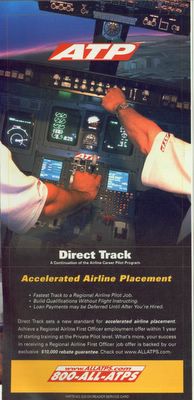
First up: All-ATPs. "Direct Track...Accelerated Airline Placement....Fastest Track to a Regional Airline Pilot Job...Build Qualifications Without Flight Instructing." Heh, God forbid that one should lower themselves to flight instructing to "build their qualifications." Of course...if you instruct, you get paid. This way you get to keep shelling out money to build those hours. Convenient how that works, no?
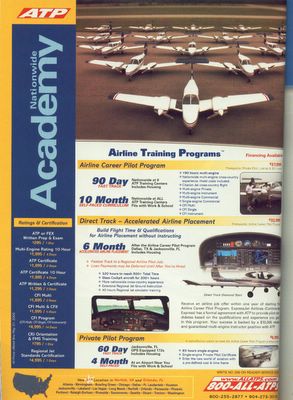
A slightly more illuminative ad from All-ATPs. Check out the incredible cost involved: if you start with zero hours, it takes $77,985 to do all three programs. This leaves you with your Commercial and CFI/II/MEI, plus 600 hours, 190 of which are multi-engine. That qualifies you for an interview with ExpressJet, making $19,800 your first year if they hire you. Funny how the ad doesn't mention that, eh? If they don't hire you, plan on keep shelling out money to get yourself to around 1000 hours - or, gasp, do some instructing so you actually have an aviation job on your resume before you interview with another company.
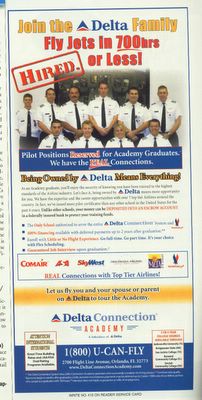
Ooh, it has the Delta logo on it! Everyone knows that Delta pilots make a ton of money! Heh, perhaps with Delta in bankruptcy they'll redesign this ad next month. Like ALL-ATPs, Delta Academy guarantees a job interview - in this case, with Comair, ASA, American Eagle. etc. What students don't realize is that these airlines hire less than half of the applicants they interview. The airline is simply agreeing to spend a few hours with Acadamy grads, talking and giving them a sim ride. They can then offer a job offer, or not, and the school's obligation is complete.

Besides the interesting concept of affordability, a few things jump out of this ad from Orlando Flight Training. 200 hr Jet First Officer? Are they completely mad? There is not a commercial jet FO is the world with 200 hours. Not one. And "Jet/FO Part 121 certification?" There is no such thing. Under FAR 121, you are qualified in equipment by your airline after they hire you. Even if you have a type rating, you are not Part 121 qualified until you complete that airline's approved syllabus. So basically they used terminology that, while incorrect, is calculated to make a young pilot's drool reflex kick in. Jet! FO! Part 121!
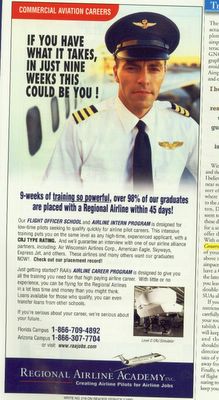
This could be you! In just nine weeks! Standing proudly next to a real jet airplane in snappy uniform, epaulets, and spiffy hat...the dude that guys wanna be and girls wanna be with! All because your nine weeks of training were so powerful. Seriously, this RAA ad is pretty disingenuous with it's claim that your CRJ type rating will "put you on the same level as any high time, experienced applicant." All things being equal, most regionals would far prefer a 2000-hour guy with multi-engine Part 135 experience to a 500 hour kid with a CRJ type rating. I also got a chuckle out of this ad's reference to "that high paying airline career."

This isn't a deceptive ad, I'm just amused that the model from the RAA ad is apparently a 747 captain this time!

My all-time favorite, straight from PanAm International Flight Academy. "Airline Pilot Careers: Fast, Flexible, and For Sure." Excuse me?!? Do they believe that? An airline career is none of those things! It's seldom fast, particularly if a major airline is the intended destination. It's often a very inflexible job. And For Sure? Are they stark raving mad? Tell the thousands of furloughed pilots on the streets that this career is for sure. Tell the pilots whose careers were ended by accidents, enforcement actions, and denied medicals. Tell the flight instructor who's barely making enough money to live on and can't seem to get a lucky break. Fast, Flexible, and For Sure. I hope none of their students actually believe that, because they are being set up for disillusionment and failure.
Jeeze, it's not even a very good alliteration.
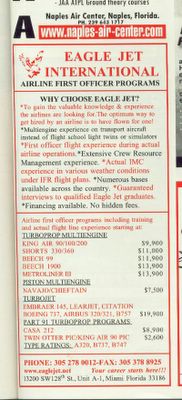
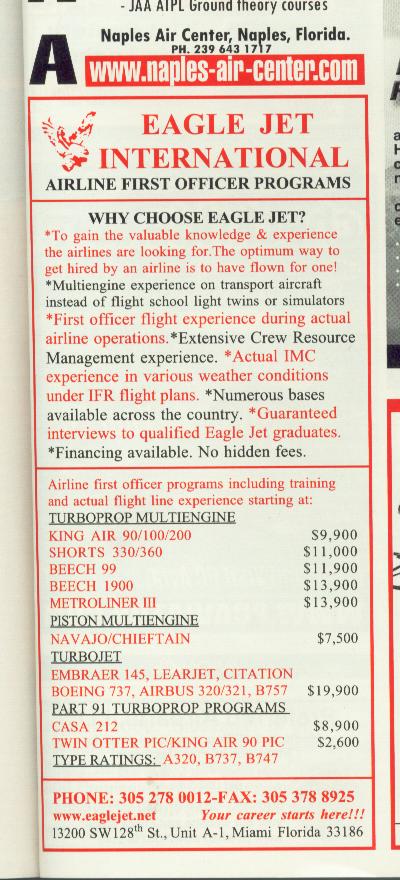
Of course, your career will be considerably more for sure if you don't expect to be paid for your commercial flying; even moreso if you pay to do it. Enter Eagle Jet International. You, too, can be a first officer on a Beech 1900, flying freight in godawful weather at all hours of night...for only $13,900 out of pocket! But hey, at least you won't have to flight instruct.
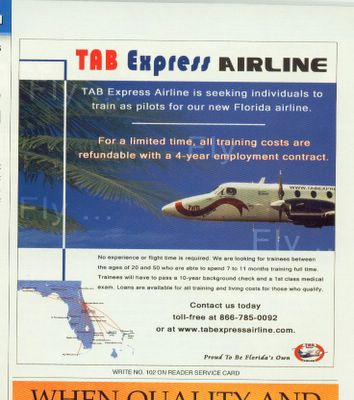
Our final entry, from the late, great, TAB Express. This was another "pay-for-your-job" outfit, with the additional "enticement" of four years' indentured servitude. Either this ad was placed much earlier, or TAB is absolutely shameless, because the venture closed down some time before this ad appeared, before the "airline" flew a single revenue flight. They took a lot of people's money with them, including the deposits of some folks who hadn't even started training. Such are the risks of trying to buy your way out of demeaning jobs like flight instructing, jump flying, banner towing, freight haulting, etc.
Okay, that's enough for tonight. I could go dig up some old "Flight Training" magazines for some real doozies, but you probably get the idea. It's disheartening to see the dishonest way that many flight training organizations sell the airline pilot dream. To be sure, many of these schools have good programs that've helped capable pilots achieve realistic goals. At the same time, though, they've pumped out a number of starry eyed greenhorns who expect a high paying jet job to immediately fall into their lap, and it usually just doesn't happen that way. For that matter, when they do get the job, it's seldom what they expected once the initial glamour wears off.
I know I'm running the risk of sounding bitter with this post. I'm not; despite the perils of this industry, I'm glad I chose this career. I do think, however, that a realistic outlook has made the rough patches that much easier to overcome. And that's part of the reason for this blog: to inject a little realism into aspiring pilots' plans, to provide a counterbalance to the marketing hype. In the next week or two, I'll be posting about the various paths to an airline career, and some of the struggles and pitfalls along the way. Hopefully it'll be useful information to anybody considering a flying career, as well as interesting for those smart enough to stay away but curious enough to read about it!
The following are advertisements in two recent issues of Flying Magazine. The thumbnails are a bit small; click on the pictures to see them close up. Let's do a little fisking, shall we?
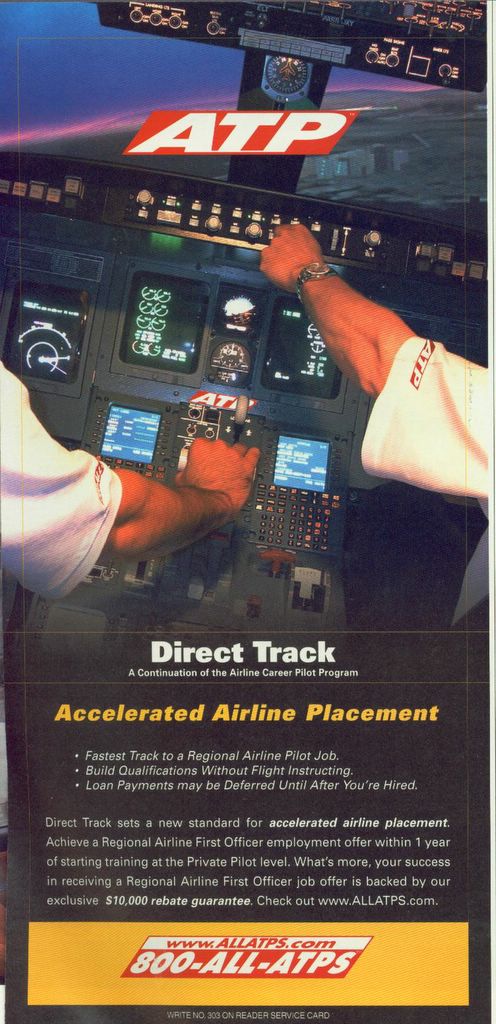
First up: All-ATPs. "Direct Track...Accelerated Airline Placement....Fastest Track to a Regional Airline Pilot Job...Build Qualifications Without Flight Instructing." Heh, God forbid that one should lower themselves to flight instructing to "build their qualifications." Of course...if you instruct, you get paid. This way you get to keep shelling out money to build those hours. Convenient how that works, no?
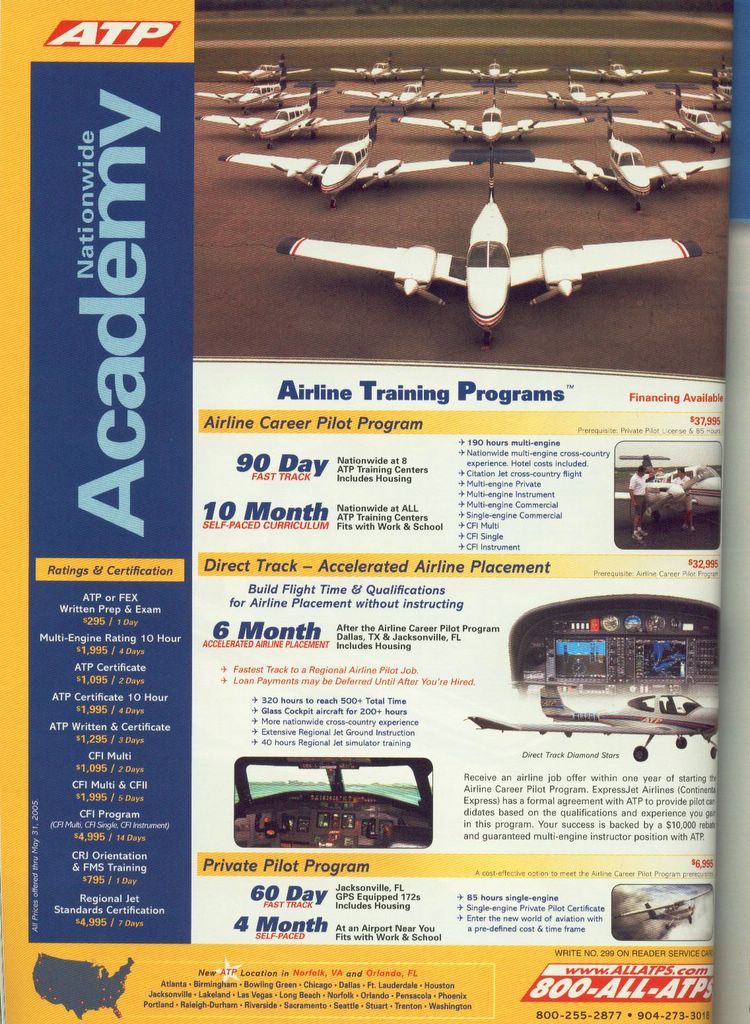
A slightly more illuminative ad from All-ATPs. Check out the incredible cost involved: if you start with zero hours, it takes $77,985 to do all three programs. This leaves you with your Commercial and CFI/II/MEI, plus 600 hours, 190 of which are multi-engine. That qualifies you for an interview with ExpressJet, making $19,800 your first year if they hire you. Funny how the ad doesn't mention that, eh? If they don't hire you, plan on keep shelling out money to get yourself to around 1000 hours - or, gasp, do some instructing so you actually have an aviation job on your resume before you interview with another company.
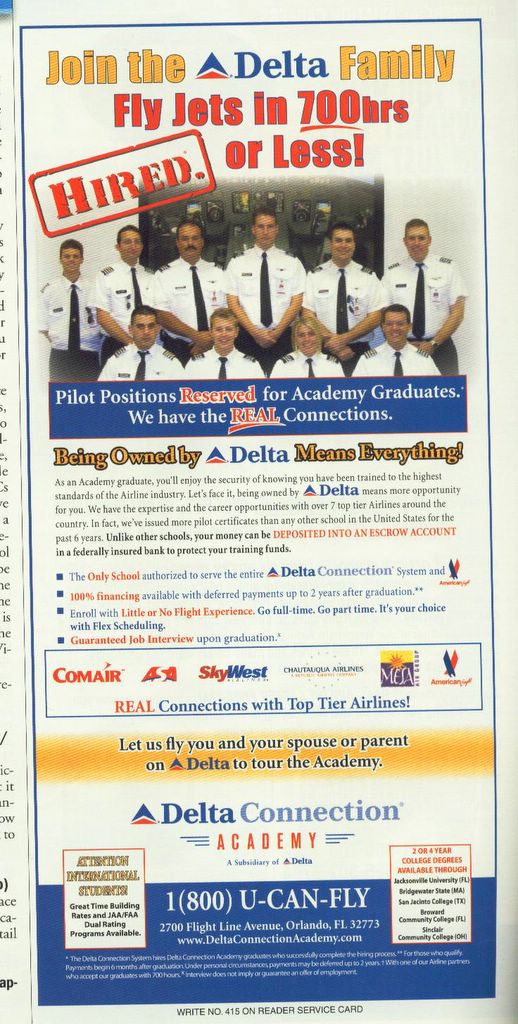
Ooh, it has the Delta logo on it! Everyone knows that Delta pilots make a ton of money! Heh, perhaps with Delta in bankruptcy they'll redesign this ad next month. Like ALL-ATPs, Delta Academy guarantees a job interview - in this case, with Comair, ASA, American Eagle. etc. What students don't realize is that these airlines hire less than half of the applicants they interview. The airline is simply agreeing to spend a few hours with Acadamy grads, talking and giving them a sim ride. They can then offer a job offer, or not, and the school's obligation is complete.

Besides the interesting concept of affordability, a few things jump out of this ad from Orlando Flight Training. 200 hr Jet First Officer? Are they completely mad? There is not a commercial jet FO is the world with 200 hours. Not one. And "Jet/FO Part 121 certification?" There is no such thing. Under FAR 121, you are qualified in equipment by your airline after they hire you. Even if you have a type rating, you are not Part 121 qualified until you complete that airline's approved syllabus. So basically they used terminology that, while incorrect, is calculated to make a young pilot's drool reflex kick in. Jet! FO! Part 121!
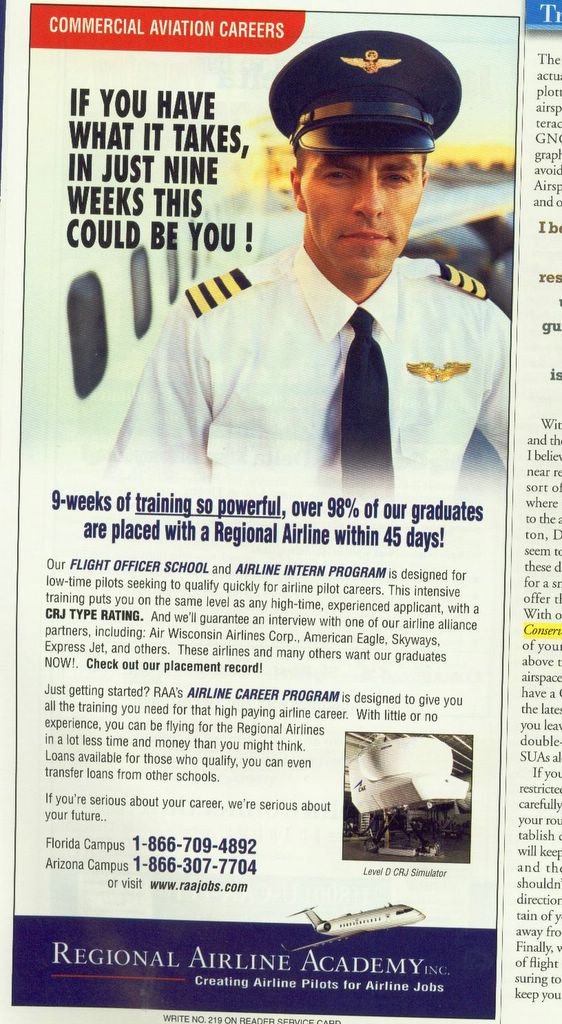
This could be you! In just nine weeks! Standing proudly next to a real jet airplane in snappy uniform, epaulets, and spiffy hat...the dude that guys wanna be and girls wanna be with! All because your nine weeks of training were so powerful. Seriously, this RAA ad is pretty disingenuous with it's claim that your CRJ type rating will "put you on the same level as any high time, experienced applicant." All things being equal, most regionals would far prefer a 2000-hour guy with multi-engine Part 135 experience to a 500 hour kid with a CRJ type rating. I also got a chuckle out of this ad's reference to "that high paying airline career."
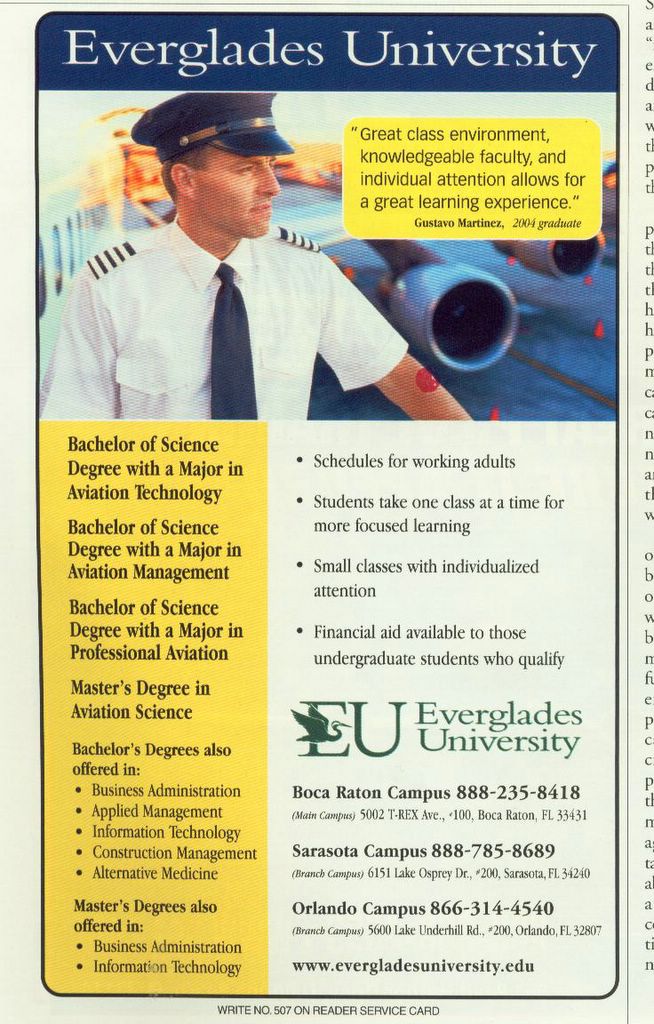
This isn't a deceptive ad, I'm just amused that the model from the RAA ad is apparently a 747 captain this time!
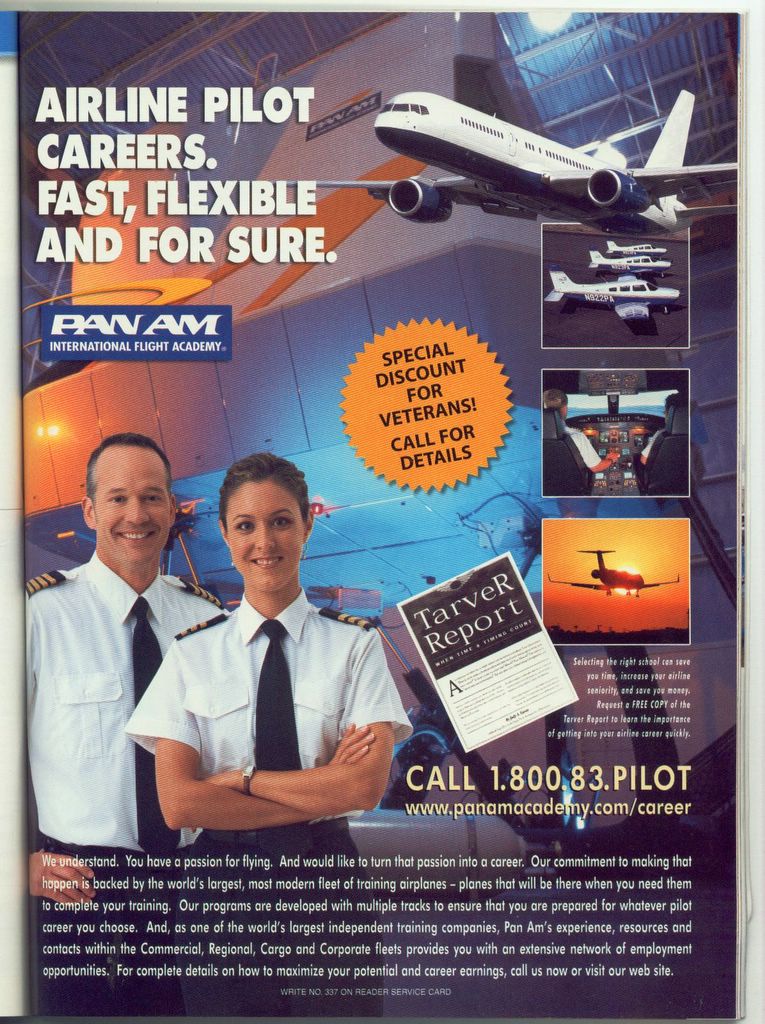
My all-time favorite, straight from PanAm International Flight Academy. "Airline Pilot Careers: Fast, Flexible, and For Sure." Excuse me?!? Do they believe that? An airline career is none of those things! It's seldom fast, particularly if a major airline is the intended destination. It's often a very inflexible job. And For Sure? Are they stark raving mad? Tell the thousands of furloughed pilots on the streets that this career is for sure. Tell the pilots whose careers were ended by accidents, enforcement actions, and denied medicals. Tell the flight instructor who's barely making enough money to live on and can't seem to get a lucky break. Fast, Flexible, and For Sure. I hope none of their students actually believe that, because they are being set up for disillusionment and failure.
Jeeze, it's not even a very good alliteration.
Of course, your career will be considerably more for sure if you don't expect to be paid for your commercial flying; even moreso if you pay to do it. Enter Eagle Jet International. You, too, can be a first officer on a Beech 1900, flying freight in godawful weather at all hours of night...for only $13,900 out of pocket! But hey, at least you won't have to flight instruct.

Our final entry, from the late, great, TAB Express. This was another "pay-for-your-job" outfit, with the additional "enticement" of four years' indentured servitude. Either this ad was placed much earlier, or TAB is absolutely shameless, because the venture closed down some time before this ad appeared, before the "airline" flew a single revenue flight. They took a lot of people's money with them, including the deposits of some folks who hadn't even started training. Such are the risks of trying to buy your way out of demeaning jobs like flight instructing, jump flying, banner towing, freight haulting, etc.
Okay, that's enough for tonight. I could go dig up some old "Flight Training" magazines for some real doozies, but you probably get the idea. It's disheartening to see the dishonest way that many flight training organizations sell the airline pilot dream. To be sure, many of these schools have good programs that've helped capable pilots achieve realistic goals. At the same time, though, they've pumped out a number of starry eyed greenhorns who expect a high paying jet job to immediately fall into their lap, and it usually just doesn't happen that way. For that matter, when they do get the job, it's seldom what they expected once the initial glamour wears off.
I know I'm running the risk of sounding bitter with this post. I'm not; despite the perils of this industry, I'm glad I chose this career. I do think, however, that a realistic outlook has made the rough patches that much easier to overcome. And that's part of the reason for this blog: to inject a little realism into aspiring pilots' plans, to provide a counterbalance to the marketing hype. In the next week or two, I'll be posting about the various paths to an airline career, and some of the struggles and pitfalls along the way. Hopefully it'll be useful information to anybody considering a flying career, as well as interesting for those smart enough to stay away but curious enough to read about it!
Saturday, October 01, 2005
LA Story: a long-winded rant.
Since my company started adding service at Los Angeles earlier this year, a number of our pilots have started to consciously bid away from it. They'll look at a line they're interested in, check the trips, see that it has a bunch of LA turns, and look elsewhere. It's not that the Northwest has given us vampire-line reactions to excessive sunshine or anything. Rather, doing a LAX turn is a surefire way to screw up your day thanks to a ramp operation that is 100% FUBAR. Our experience there last night was more of the same.
A little background. LAX has far more XYZ Co. flights than ABC Co. flights, so they handle our operations. Alaska gate agents work our flights. XYZ Ops prints out our releases and serves as our main point of communication. And Menzies Aviation, contracted by XYZ Co. to provide their ramp service, handles our ramp service. These duties include marshalling airplanes into parking, connecting ground power if needed, loading and unloading bags, servicing the lavatory and potable water when applicable, and performing pushbacks. Menzies seems to take the position that these are very basic functions that any high school dropout could do, so that's the kind of minimum-wage help they hire. XYZ Co. certainly appreciates the price that they can do it for.
A little more background for those without airline experience. For airliners, having a source of electrical power other than the batteries is very important. We can run on the batteries for short periods of time, but we really try to avoid putting any great load on them, such as an engine start. When our engines are shut down, their generators do not operate, so we must get power from alternative sources to avoid depleting the batteries. A Ground Power Unit (GPU) is often used. It's essentially a little cart with a cord that plugs into a receptacle somewhere on the airplane. For my airplane, the preferred type is solid-state and converts AC power from the terminal into 28 volt DC power that the airplane can use. Diesel-powered GPUs are a self-contained alternative, but we try not to use them because they're noisy, smelly, and are not reliable in providing good 28-volt power. If faced with a diesel-powered GPU, we'll often opt instead to use the Auxiliary Power Unit (APU), a small jet engine installed in the tail for the sole purpose of providing DC power and heating/cooling on the ground. At LAX, we usually use the APU. Because of congestion around the gates, the usual procedure at LAX is to push back and then start the engines, which is not possible with a GPU. Until yesterday, I'd never used a GPU at LAX.
Yesterday, when preflighting the airplane in Portland, we discovered that the APU was inoperative and deferred. Knowing that we'd be in LAX a few legs later, the captain called dispatch. They assured him that a GPU would be available at LAX, available by prior request. Hours later, as we approached the LA basin, the captain called LAX operations to alert them of our revised time of arrival. He made sure to communicate our need for a GPU. They said they'd pass that request along to ramp service; the captain and I were both skeptical that it'd be there.
When we landed at 8:00PM, our gate was still occupied by a late-running MD80. Ground Control gave us the dreaded "continue straight on E, turn right on D10, right again on D and hold short of the alley until your gate opens up." Within a minute or two, I contacted LAX operations to let them know we would be holding for the gate, and to reiterate our need for a GPU when we arrived. They acknowledged. Twenty minutes later, our gate opened up, and not a minute too soon: the passengers were about to mutiny for the right to get up and use the restroom. As we taxied in, we looked for a GPU; sure enough, nowhere in sight. When parked, the captain gave the rampers the established "Connect ground power" hand signal. They looked at him in utter confusion and kept responding with the "Your wheels are chocked" hand signal.
Further attempts at hand communication were futile. I radioed operations and told them that we were still missing a GPU. They said they'd call ramp and let them know. In the meantime, our passengers could not deplane so long as our engines were running. We decided to shut them down, get the passengers off, and power down the airplane to protect the batteries if a GPU was not quickly forthcoming. I got off with the first passengers and flagged down a ramper to tell him we needed a GPU, NOW! He took off and returned with a diesel-powered GPU a few minutes later. About five rampers stood around trying to figure out how to fire it up. They finally succeeded and plugged the cord into the receptacle. I flashed the captain the "ground power connected" hand signal. In the cockpit, I saw him flip the external power switch.
No good. The GPU wasn't putting out any current; the aircraft remained on battery power. The rampers all stood around scratching their heads and flipping switches; I doublechecked that the cord was plugged in securely. I returned to the cockpit and called operations to let them know we're killing our batteries, we need somebody who knows the GPU out here now. The woman on the radio gave a knowing chuckle and said she'd call a supervisor. In the meantime, we couldn't depower the airplane because one passenger remained on board, an elderly woman who informed the FA's at the last minute that she needed a wheelchair. We turned off the cabin lights to save battery power; I felt bad for the woman, sitting alone in the dark cabin, waiting for a wheelchair that never seemed to come. It reminded me of the scene in Office Space where Lumburgh leaves Milton muttering in the dark at his new desk in the basement.
The Menzies supervisor arrived and now a little crowd stood around the mysterious GPU, fiddling with switches and knobs. Our battery voltage started dropping. The old woman sat quietly in the darkened cabin. A few gate agents ran out and urgently whispered to the flight attendants. We shut down the cockpit avionics in preparation for depowering, and wondered how much longer the batteries could discharge before they needed replacing. Our scheduled departure time to Medford approached. I felt very tired.
Finally, success: somebody divined the magic combination of knob twists that convinced the wayward GPU that it should indeed put out 28 volts DC. Well, almost. Like most diesel GPU's, the voltage swung up and down, sometimes dipping to 24.5 volts. The captain had doubts about whether it'd charge the batteries enough by departure, and I wondered whether the thing would puke out when we put a load on it by starting the engines. There didn't seem to be any alternative to giving it a go, though, so we turned the lights back on. The wheelchair finally came and took the old woman, so we began boarding for Medford.
The GPU held on during engine start, and although the battery loads stayed high for a while, a slow taxi helped them get below the departure limit before we got to our runway. Before we left the alleyway, though, we got to witness Menzies' next blunder: attempting to marshall another flight into gate 31B when it was assigned gate 32. We blocked out almost 30 minutes late; favorable winds and a great turn by the good folks in Medford helped us make up most of that by the time we arrived in Eugene after midnight.
In the race to get costs down, many airlines have turned to outsourcing functions that well-paid employees used to do. There are certainly financial advantages to outsourcing in many industries; the one huge disadvantage is that you lose a certain amount of control over your product. Outsourcing only makes financial sense if you put the mechanisms into place to ensure that your vendors are providing you with a quality product. This is one prime example of a vendor providing horrible service with no apparent repercussions. Menzies employs uneducated, minimum-wage labor from the poor areas around the airport, trains them poorly, and neglects to provide oversight by knowledgable supervisors. The operation can truly be described as dysfunctional. Menzies' reward? A bigger contract, this time for ramp service in Seattle. Up there, they've wreaked havoc on the operation with a string of damaged airplanes, misplaced priority cargo, and even a gang fight on the ramp (!).
Hey management, would you care for a suggestion from a lowly junior FO? Go take a close look at the ramp operations in Spokane and Boise. These people are experts at turning airplanes quickly, efficiently, and safely. They are proficient at dealing with unusual situations; they're well-trained guys and gals who can think on their feet without being babysat. They take pride in the great job they do. And our company is considerably better for it. Do they cost more than Menzies? I'm sure they do. Are they worth it? Every penny. They contribute to the quality of our operation rather than detract from it. Keeping in mind our companies' roles as smaller, niche providers of high-quality air travel in our region, a quality operation is paramount. Without it, we won't survive. You know the barbarians are at the gates - you know, the guys with ugly airplanes and cheap fares and smart management and a well-run operation. I'm proud to fly for you guys. I want this airline to survive and prosper. Please, please, please: realize that our success depends on far more than getting costs down. Do not outsource this operation to the people who will trash it.
A little background. LAX has far more XYZ Co. flights than ABC Co. flights, so they handle our operations. Alaska gate agents work our flights. XYZ Ops prints out our releases and serves as our main point of communication. And Menzies Aviation, contracted by XYZ Co. to provide their ramp service, handles our ramp service. These duties include marshalling airplanes into parking, connecting ground power if needed, loading and unloading bags, servicing the lavatory and potable water when applicable, and performing pushbacks. Menzies seems to take the position that these are very basic functions that any high school dropout could do, so that's the kind of minimum-wage help they hire. XYZ Co. certainly appreciates the price that they can do it for.
A little more background for those without airline experience. For airliners, having a source of electrical power other than the batteries is very important. We can run on the batteries for short periods of time, but we really try to avoid putting any great load on them, such as an engine start. When our engines are shut down, their generators do not operate, so we must get power from alternative sources to avoid depleting the batteries. A Ground Power Unit (GPU) is often used. It's essentially a little cart with a cord that plugs into a receptacle somewhere on the airplane. For my airplane, the preferred type is solid-state and converts AC power from the terminal into 28 volt DC power that the airplane can use. Diesel-powered GPUs are a self-contained alternative, but we try not to use them because they're noisy, smelly, and are not reliable in providing good 28-volt power. If faced with a diesel-powered GPU, we'll often opt instead to use the Auxiliary Power Unit (APU), a small jet engine installed in the tail for the sole purpose of providing DC power and heating/cooling on the ground. At LAX, we usually use the APU. Because of congestion around the gates, the usual procedure at LAX is to push back and then start the engines, which is not possible with a GPU. Until yesterday, I'd never used a GPU at LAX.
Yesterday, when preflighting the airplane in Portland, we discovered that the APU was inoperative and deferred. Knowing that we'd be in LAX a few legs later, the captain called dispatch. They assured him that a GPU would be available at LAX, available by prior request. Hours later, as we approached the LA basin, the captain called LAX operations to alert them of our revised time of arrival. He made sure to communicate our need for a GPU. They said they'd pass that request along to ramp service; the captain and I were both skeptical that it'd be there.
When we landed at 8:00PM, our gate was still occupied by a late-running MD80. Ground Control gave us the dreaded "continue straight on E, turn right on D10, right again on D and hold short of the alley until your gate opens up." Within a minute or two, I contacted LAX operations to let them know we would be holding for the gate, and to reiterate our need for a GPU when we arrived. They acknowledged. Twenty minutes later, our gate opened up, and not a minute too soon: the passengers were about to mutiny for the right to get up and use the restroom. As we taxied in, we looked for a GPU; sure enough, nowhere in sight. When parked, the captain gave the rampers the established "Connect ground power" hand signal. They looked at him in utter confusion and kept responding with the "Your wheels are chocked" hand signal.
Further attempts at hand communication were futile. I radioed operations and told them that we were still missing a GPU. They said they'd call ramp and let them know. In the meantime, our passengers could not deplane so long as our engines were running. We decided to shut them down, get the passengers off, and power down the airplane to protect the batteries if a GPU was not quickly forthcoming. I got off with the first passengers and flagged down a ramper to tell him we needed a GPU, NOW! He took off and returned with a diesel-powered GPU a few minutes later. About five rampers stood around trying to figure out how to fire it up. They finally succeeded and plugged the cord into the receptacle. I flashed the captain the "ground power connected" hand signal. In the cockpit, I saw him flip the external power switch.
No good. The GPU wasn't putting out any current; the aircraft remained on battery power. The rampers all stood around scratching their heads and flipping switches; I doublechecked that the cord was plugged in securely. I returned to the cockpit and called operations to let them know we're killing our batteries, we need somebody who knows the GPU out here now. The woman on the radio gave a knowing chuckle and said she'd call a supervisor. In the meantime, we couldn't depower the airplane because one passenger remained on board, an elderly woman who informed the FA's at the last minute that she needed a wheelchair. We turned off the cabin lights to save battery power; I felt bad for the woman, sitting alone in the dark cabin, waiting for a wheelchair that never seemed to come. It reminded me of the scene in Office Space where Lumburgh leaves Milton muttering in the dark at his new desk in the basement.
The Menzies supervisor arrived and now a little crowd stood around the mysterious GPU, fiddling with switches and knobs. Our battery voltage started dropping. The old woman sat quietly in the darkened cabin. A few gate agents ran out and urgently whispered to the flight attendants. We shut down the cockpit avionics in preparation for depowering, and wondered how much longer the batteries could discharge before they needed replacing. Our scheduled departure time to Medford approached. I felt very tired.
Finally, success: somebody divined the magic combination of knob twists that convinced the wayward GPU that it should indeed put out 28 volts DC. Well, almost. Like most diesel GPU's, the voltage swung up and down, sometimes dipping to 24.5 volts. The captain had doubts about whether it'd charge the batteries enough by departure, and I wondered whether the thing would puke out when we put a load on it by starting the engines. There didn't seem to be any alternative to giving it a go, though, so we turned the lights back on. The wheelchair finally came and took the old woman, so we began boarding for Medford.
The GPU held on during engine start, and although the battery loads stayed high for a while, a slow taxi helped them get below the departure limit before we got to our runway. Before we left the alleyway, though, we got to witness Menzies' next blunder: attempting to marshall another flight into gate 31B when it was assigned gate 32. We blocked out almost 30 minutes late; favorable winds and a great turn by the good folks in Medford helped us make up most of that by the time we arrived in Eugene after midnight.
In the race to get costs down, many airlines have turned to outsourcing functions that well-paid employees used to do. There are certainly financial advantages to outsourcing in many industries; the one huge disadvantage is that you lose a certain amount of control over your product. Outsourcing only makes financial sense if you put the mechanisms into place to ensure that your vendors are providing you with a quality product. This is one prime example of a vendor providing horrible service with no apparent repercussions. Menzies employs uneducated, minimum-wage labor from the poor areas around the airport, trains them poorly, and neglects to provide oversight by knowledgable supervisors. The operation can truly be described as dysfunctional. Menzies' reward? A bigger contract, this time for ramp service in Seattle. Up there, they've wreaked havoc on the operation with a string of damaged airplanes, misplaced priority cargo, and even a gang fight on the ramp (!).
Hey management, would you care for a suggestion from a lowly junior FO? Go take a close look at the ramp operations in Spokane and Boise. These people are experts at turning airplanes quickly, efficiently, and safely. They are proficient at dealing with unusual situations; they're well-trained guys and gals who can think on their feet without being babysat. They take pride in the great job they do. And our company is considerably better for it. Do they cost more than Menzies? I'm sure they do. Are they worth it? Every penny. They contribute to the quality of our operation rather than detract from it. Keeping in mind our companies' roles as smaller, niche providers of high-quality air travel in our region, a quality operation is paramount. Without it, we won't survive. You know the barbarians are at the gates - you know, the guys with ugly airplanes and cheap fares and smart management and a well-run operation. I'm proud to fly for you guys. I want this airline to survive and prosper. Please, please, please: realize that our success depends on far more than getting costs down. Do not outsource this operation to the people who will trash it.
Subscribe to:
Posts (Atom)


