Friday, June 29, 2012

Return of the Yellow Cub

With the spring rains tapering off and the arrival of another gorgeous Minnesota summer, I've been flying a lot. I should rephrase that: I've been flying a lot for fun. It should go without saying that I've been flying a lot for work - and work it has been, with all the thunderstorms to dodge. No, on my days off I've had the Cessna 170 up quite a bit. I've taken Dawn on romantic sunset rides, brought friends on tours of Lake Minnetonka and the Twin Cities, gone up solo to practice landings, and did a bit of formation flying with my friend Logan and his club 1946 Piper J3 Cub to various grass strips around the area. I've even taken up First Officers up while playing hookey during lengthy MSP "productivity breaks" (and yes, I've received a few strange looks preflighting the Cessna in full NewCo uniform). All the practice has helped hone my taildragger wrangling skills - I'm even making decent wheel landings on pavement with the 170s notoriously bouncy steel spring landing gear.

I really enjoy flying the 170, but that said, it's never given me the sensation of pure, unadulterated stick-and-rudder fun that comes from flying the Cub. Fortunately, I've been able to fly the Cub with Logan from time to time (and he with me in the 170). That came to an end last month when Logan announced that he was moving back to his hometown of Chicago and selling his 1/12th share of the Cub. He offered it to me first. It was a very good deal, the club is well run and enjoys good finances, the plane is extremely cheap to run, and I realized that for most of the kind of small-plane flying I do, a Cub can't be beat. I bought the share, and last weekend got checked out by the club's instructor. This Wednesday I took Dawn for her first sunset cruise on a warm evening with the door and windows open. It was lovely.


So, now I'm a bona fide airplane owner, even if it's only 1/12th of an airplane. I suppose this is another intermediate step to Dawn and I someday owning a little Cub or Champ or Luscombe of our own. In the meantime, I'm looking forward to having lots of adventures with this one, as well as the 170 when I have more than one passenger or want to venture further afield. I'm tempted to bring the Cub to Oshkosh this year for the planned 75th anniversary celebration, but it's a bit far to take such a slow airplane (and there's no room for camping gear) so I'll likely fly the 170 into OSH again. The rest of the summer, though, I plan to keep the Cub busy terrorizing the grass strips of Minnesota!

Wednesday, May 30, 2012

Delayed

When I think about all the complexities of an airline, all the moving parts that need to work together for a flight to get out, and how "lean" most operations are these days, I'm frankly amazed that we ever run on time. Yet, this is the case far more often than not. The U.S. Department of Transportation has collected data on airline performance since 1995, and most years at least 75% of airline flights operated on-time (defined as arrival within 14 minutes of scheduled time). So far this year we're at nearly 84%. Typically between 1% and 3% of flights are cancelled, and around 1 in 500 are diverted enroute.

NewCo turns in frequent on-time performance of 90% or more, but it's not necessarily due to superior management or pilots (as much as I'd like to claim the latter). It's mostly a function of where we fly. I've landed the JungleBus at 83 airports in 40 states and five Canadian provinces, which is amazing for a small airline of 42 airplanes (and there are a dozen additional destinations I've never landed at). This is because WidgetCo is a bit schizophrenic about how to use us, as they are with all ten of their regional partners. Right now we're doing a lot of west coast flying out of Salt Lake City, which is very good for on-time performance. Last year, though, we did a lot of flying up and down the east coast out of Washington-National Airport. The year before that, we did a ton of flying out of New York's LaGuardia Airport, to the extent that we nearly opened a crew base there. Our on-time rating took a huge hit then.

The northeast airports - particularly PHL, EWR, LGA, JFK, and BOS - have the most air traffic congestion, along with mega-hubs ORD and ATL. This has such a big impact on airline operations that when WidgetCo wanted to rid themselves of a troublesome long-term contract with Mesa Airlines, they simply moved their airplanes to JFK, waited for the inevitable, and then terminated the contract for poor performance. During JFKs evening peak, a two-hour taxi is fairly common - and that's without weather. In the summer, a single air-mass thunderstorm 100 miles west can shut down most departures. In the winter, it doesn't take much snow to bring ground traffic to a grinding halt. The DOT's three-hour rule further complicates things. Even on decent weather days, it's pretty common to have a EDCT (Expect Departure Clearance Time) to the northeast airports.

Most places outside the northeast, though, delays are usually weather-related, and tend to vary seasonally. Minneapolis, Chicago, and Detroit suffer in the winter. Thunderstorms regularly shut down Dallas and Atlanta in the spring and summer. Los Angeles hums right along in all seasons.

Behind weather and air traffic control, unplanned maintenance is a common cause of delays. Most of the time, airplanes are scheduled for maximum utilization with few breaks, so any unplanned maintenance results in a rolling delay for the rest of the day unless the airline has a spare airframe handy somewhere along the way. For this reason, many minor items can be deferred for later repair through the use of a Minimum Equipment List (MEL). When I find that something has broken, the first thing I reach for is the MEL book, followed shortly thereafter by the aircraft logbook and my phone to call Maintenance Control. We discuss whether the discrepancy can be deferred, whether it should be deferred, and if not, what our plan of action is. I try to get an estimate of how long it'll take mechanics to arrive at the airplane and how long it will then take them to either fix the discrepancy or at least arrive at a diagnosis. If passengers on board, I try to give them an update on our status every fifteen minutes or so. If we haven't started boarding, I pass along information to the gate agent.

With experience, one develops a sense of which maintenance problems will be resolved quickly and which ones will have you sitting a while, and you can act accordingly. With a long anticipated delay, both passengers and cabin crew will be happier with the passengers off the airplane. If at a hub, I'll start bugging dispatch about getting a different airplane in these cases. If I think it'll be resolved quickly, I'll start or continue boarding and have everything ready to go on my end as soon as we get the logbook back. It's important to communicate with the ground crew, as they otherwise often get left out of the loop and will wander off to other airplanes; you can find yourself finally ready to go but with no personnel to load the last bags or push back the aircraft. Over time, I've learned to overestimate maintenance delays when talking to passengers, as they have a way of dragging out long than expected; best to under-promise and over-deliver.

In my experience, the most common source of delays is simply receiving the airplane late from another crew at the start of your day. I've had days where this has occurred three times, every time I had a plane swap. It's frustrating, especially during an already-long day when delays cut into already-short rest time.

Once delayed, your goal is to get back on-time or as close to it as possible, although always within the bounds of safety. It is possible to get so fixated with going fast that you make mistakes. There are usually some easy, common-sense steps, though. You can request a more convenient runway from ATC. You can request more direct routing from center. You can change your altitude based on aircraft performance and winds aloft, and you can fly at a faster cruise mach number. This may result in worse efficiency, but sometimes it's worth it to get the airplane back on time - particularly early in the day, when making up fifteen minutes makes all subsequent flights that day fifteen minutes closer to on-time. On long flights that tend to be over-blocked, it's possible to make up 30 to 45 minutes in one flight. That said, it's important is to make sure you don't short yourself on fuel you might need later. I'm far more likely to cruise at Mach .81 and FL300 going to Billings on a clear day than I am going to Newark with forecast thunderstorms. You need to coordinate with your dispatcher, and take on extra fuel if necessary.

The other time to make up delays is on subsequent ground turns. The key here is communicating with ground personnel. They'll know you're coming in late, but expressing the need for a quick turn and the crew's willingness to pitch in helps put them in high gear. Small things like starting the APU early to shut the engines down quickly, helping clean the cabin, and running gate-check bags out to the rampers can help shave off minutes.

One thing I do find a bit ludicrous is the obsession many airlines, most gate agents, and some pilots have with "On-Time Zero" or "D-0," basically making sure the airplane isn't even one minute late in departing. Some people go to extraordinary lengths to get the door closed and the parking brake dropped by departure time, even if there's still a lot that needs to be done and the airplane can't actually move for another five or ten minutes. Mind you, all that's at stake is the airline's own internal records. So far as the DOT is concerned, the airplane is on-time until it's fifteen minutes late. The gate agent, however, is often called to account by their supervisors if the plane is even one minute late. This was particularly bad at Northwest; Widget is a bit less extreme about it, although some gate agents still get really wrapped around the axle about it. My own philosophy is that I'll do my job efficiently and will do what I can to help get the flight out on time, but won't cut corners just for the sake of some meaningless internal record that has absolutely no effect on whether we actually get to our destination on-time or not. I've been called by the chief pilots office over very minor delays in the past, and that's always the answer I've given them. I've never been in trouble over it.

As you can see, most delays are out of the crew's control, and we typically do a lot to help mitigate them. There is one exception to this rule: a withdrawal of enthusiasm, or WOE. It usually occurs during contentious contract negotiations. The idea is that if the company is stonewalling or applying undue pressure to the pilot group, the pilots do their job as defined in the contract, and nothing more. You don't have to try to deliberately delay the airline, that takes care of itself. You simply fly the same way whether the plane is delayed or not. Because airlines have become so used to pilots going above and beyond and have built their schedules accordingly, the operation falls apart when the pilots don't make the extra effort. It can be very effective; as recently as 2007 a WOE campaign resulted in Northwest deleting some of the most onerous provisions of their pilots' bankruptcy contract. Whether it's legal is another matter entirely, as a number of judges have ruled that even a withdrawal of enthusiasm constitutes an illegal work action under the Railway Labor Act. This interpretation, however, hinges on the WOE being coordinated. It's apparently hard for management and their accomplices in the legal profession to imagine that pilots who are being told how little they are worth to their companies might be a bit less than willing to go the extra mile, on their own and without the urging of their union.

Friday, April 27, 2012

End Game

Well my, it's certainly been an interesting few weeks in the old "bums in seats" business, eh? WidgetCo pilots started contract negotiations about six months early, Southwest/Airtran possibly reached a deal with WidgetCo to offload their MD-95s B-717s, and the UCAL pilots got so fed up with their own joint contract negotiations that they announced they'll be seeking a release to strike from the NMB (good luck!). The biggest and juiciest piece of news involved the APA and several other unions at American Airlines forming an unholy alliance with USAirways' "Drunk Dougie" Parker to potentially disrupt Tom Horton & Co's plans to rape and pillage the employees in bankruptcy court. Under the agreement, the AA employees will lend their considerable influence on the creditors' committee in support of a merger with USAirways in exchange for slight raises (as opposed to the 20%+ cuts AA is seeking). It's not that AA management is opposed to a merger; they just want to wring every possible cent in bonuses, stock options, and golden parachutes out of the bankruptcy process before they do it. I think we'll see a few more twists before this particular chapter is through.

Of most interest to me, however, was Pinnacle Airline Corp's own bankruptcy filing on April 1. This is the second bankruptcy filing in several years by a major regional holding company (the first being Mesa) and it reflects the huge challenges that have developed across the entire regional airline industry in recent years. I first wrote about these challenges two years ago, and was accused by a few readers of being a negative Nellie (although I personally consider the regionals' demise to be a net positive for aspiring airline pilots). The trends I noted then have continued and intensified. The regionals' cost structures have continued to increase, major airlines have continued to cancel and not renew contracts for 40-50 seat feed, and additional growth in the 70-90 seat segment has been extremely limited due to scope constraints.

The regional airline industry has tried numerous strategies to cope with these challenges, with dubious results. One idea is to branch out from fee-per-departure flying to perform at-risk independent flying, sometimes with larger aircraft. ACA tried this with Independence Air, ExpressJet attempted their own brand, and Mesa entered the intra-Hawaii market with go!. All were failures. A variation on this strategy is to purchase a mainline carrier to essentially act as a shock absorber for surplus regional aircraft and a hedge against losses from fee-per-departure operations. Republic Airways Holdings did this by purchasing bankrupt carriers (and erstwhile clients) Midwest Airlines and Frontier Airlines and replacing some of the mainline service with Republic-operated E190s and E145s. It hasn't worked out well, with Frontier posting consistent losses and RAH now looking to spin them off.

The other tack taken has been to acquire multiple additional certificates as a means of diversifying one's contract portfolio, reducing one's exposure to the tumultuous 50-seat market, and as a means of securing 70-90 seat growth. Skywest started the consolidation trend with their purchase of ASA and then ExpressJet. The usually-profitable Skywest subsequently posted a loss in 2011. The company I call Osage Holdings started a new certificate ("Pariah Air") and then bought my own airline, NewCo, from WidgetCo in July 2010, an event I wrote about a few months later in the context of industry consolidation. Osage is privately owned and does not file SEC reports, so I have no idea how that's working out for them.

Pinnacle Airlines, meanwhile, purchased Colgan Air in 2007 and Mesaba Airlines (from WidgetCo) in July 2010. It made sense at the time; Colgan diversified Pinnacle's portfolio to include Continental Airlines and the Q400 airframe, while Mesaba decreased Pinnacle's exposure to the 50-seat market. The Mesaba acquisition was at a particularly attractive price, and was financed by WidgetCo, but involved a new fee-per-departure agreement that was not made public at the time but apparently included industry-low compensation rates. This was WidgetCo's quid pro quo for Pinnacle expanding their 70-90 seat business. Unfortunately, it meant Pinnacle began hemorrhaging money when merging the airlines proved costlier than expected. In the first months of the year, Pinnacle tried renegotiating their contracts to stave off bankruptcy. WidgetCo refused to modify the agreements, and Pinnacle filed bankruptcy on April 1.

Here's where things get really fascinating. The bankruptcy filing included $74 million in debtor-in-possession financing by none other than, you guessed it, WidgetCo. Pinnacle announced that among other things, this money would repay a $44 million debt owed to, yep, WidgetCo - so that WidgetCo needn't vie with other creditors for repayment. Pinnacle then moved to terminate its feed agreements with United/Continental and USAirways - incidentally killing the entire Colgan operation and leaving a gaping hole in United's Newark feed at the same time Widget is ramping up operations at LaGuardia - and reject the associated aircraft leases. There is widespread speculation that Pinnacle will emerge from bankruptcy as a whole-owned subsidiary of WidgetCo.

If this all seems a little familiar, it's because we've heard this story before. In 2005, Northwest Airlines filed for bankruptcy and stopped payments to longtime contractor Mesaba Airlines. It forced the otherwise healthy Mesaba into bankruptcy, where Northwest bought them for pennies on the dollar. WidgetCo inherited Mesaba in the merger, then sold them off to Pinnacle, thereby sowing the seeds of Pinnacle's demise. In any other country this would be a national scandal. Here, playing dirty pool is just good business. I fully expect other major airlines to follow suit in dealing with their own costly regional contractors and unwanted 50-seat feed. Consolidation having failed, the regional airlines are essentially left without any good options for survival.

I feel very badly for the hundreds of Pinnacle, Colgan, and Mesaba pilots who are soon to be out of jobs, downgraded, or displaced - particularly Mesaba pilots, given their recent history. At the same time, the majors are essentially tearing down a system that they themselves created. It was natural that they would maintain it only as long as it was advantageous to do so - which it manifestly is not in a world with $105+/bbl oil and consolidated mega-airlines. I think there will always be a certain role for regional airlines, but it's going to be a niche rather than as the mainstay of major airlines' domestic networks. For those pilots who have seen the two-tier system up close and experienced the havoc it has wrought on the piloting profession, the destruction of that system can only be a good thing. It will ultimately mean more jobs at the major airline level, less downward pressure on those jobs' wages, and very possibly a shorter career path to the majors.

Friday, April 13, 2012

Around the World

Longtime readers likely know that my teacher-wife Dawn and I usually take overseas trips every year during her spring break. Or at least we try to...two years ago, we were going to Vietnam, got stuck in Moscow, had to come back to the States, and rode my motorcycle through the Southeast instead. Last year, we were going to China, had a death in the family that cancelled that trip, and did a motorcycle trip down the west coast from Portland. This year, we weren't really intending to take a trip, because Dawn is busy working on her Masters Degree. At the last minute we decided to go anyways, returning to Thailand since it's pretty cheap and easy, and we loved it the first time we went in 2007. Our friends and recent travel buddies Brad and Amber happened to have the same days free, so they joined us for this trip.

This ended up being our first round-the-world trip. The MSP-Tokyo flight filled up so we went to Amsterdam instead, took the train to Düsseldorf, and then caught airberlin to Bangkok, where we met up with Brad and Amber who had nonrevved over via LAX and Taipei. We rode the overnight train to Surat Thani, caught a bus to Phuket, and due to delays missed the overnight boat to Koh Phi Phi. After spending the night in Patpong, we caught the morning boat to Phi Phi. It was as beautiful as described, and as popular. We beat the Tonsai crowds by staying on nearby Long Beach, which was gorgeous and uncrowded. The snorkeling right off the beach was quite good; Brad and I saw reef sharks.

The next morning we moved on to Koh Lanta, a tranquil island whose beauty and popularity are more subdued than Phi Phi. The rainy season has started a little early on Thailand's Andaman coast, for there were thunderstorms every evening, but the days were quite nice and actually not that horribly hot. Our second day on Koh Lanta, I started my PADI Open Water Diver course, which I've been wanting to do ever since doing an intro dive on Koh Tao five years ago. The first day consisted of coursework and pool dives. The second day, Brad went diving with me at Koh Haa, a group of six islands about 15 miles southeast of Koh Lanta. I did well on the dives, and even got to go in an underwater cave ("The Cathedral") on the second dive. The third day, Brad and Amber headed up to Bangkok, while I completed the third and fourth dives required for the OWC near Koh Phi Phi, and even got in a third tank for a long and very good day of diving.

It wasn't all underwater adventures. We also rented scooters (and on Wednesday, a tuk tuk!) to explore the island. On Thursday, the girls went elephant trekking. On Friday, once Brad and Amber left to catch their flight out of Trang, Dawn enjoyed zooming around the island on her own scooter - "I can't wait to get home and ride my motorcycle!" she told me afterwards. That night, we went to a rather chilled-out full moon party at a little jungle bar on the south side of the island.

Rather than mess around with non-revving intra-Thailand, I bought full-fare tickets from Krabi to Bangkok for Saturday afternoon. We arrived early enough to head into town and check out the massive, entertaining Chutachak Weekend Market. We ate tons of delicious street food and bought a few neat trinkets for well under $20 total. Back at the airport, we happily got on the first flight we tried, a Thai Airways 747 to Tokyo. We'd been thinking we'd have to two-hop it from Tokyo, but the direct 777 to MSP turned out to be emptier than expected, and we were back home "only" some 40 hours after leaving Koh Lanta. The travel time meant we had significantly less time in Thailand than we'd have liked, but it was a very good spring break nonetheless, and all the better for having shared it with friends. Here are some of my favorite photos from the trip.

Wednesday, March 28, 2012

Cross Country

It's an enormous, wide spread land we Americans inhabit, and we seldom recognize that fact. We think little of flying from coast to coast in five or six hours, and many coastal denizens derisively refer to the massive expanse in between as "flyover country." In this country, a two or three hundred mile drive is practically local. Embarking on that cherished American tradition, the cross-country road trip, gives one some idea of the size of the continent - but even then, one can cover the 2800 miles from New York to LA in three or four long days on fast, smooth interstates. In 2010, I rode my old BMW motorcycle around the circumference of the Lower 48, much of it on slower byways, and it took 41 days of riding, several of them 500-1000 miles long. It was a great way to reconnect with my homeland and discover its beauty, variety, and sheer immensity anew.

The entire time I was riding, though, I was thinking "I wonder what this looks like from the air?". The funny thing is that I had already flown over nearly all the roads I was traveling, but from six or seven miles high while speeding along at nine or ten miles a minute. That lofty perspective shrinks the land, both literally and figuratively, beyond all recognition. What I really wanted to do was fly the breadth of the U.S. by small airplane. I do not, however, own a small airplane. Even after I started flying the club C170, $6 avgas put a big cross-country trip out of my budget.

And then Johnny G, who I taught to fly ten years ago, emailed me out of the blue, excited that he had finally secured hangar space for his beloved 1984 Piper Warrior in his hometown in Connecticut. The plane was currently hangared in California, where Johnny formerly lived and still visited often for business. He had flown it all of six hours in 2011, and thus was very excited to get it back to CT where he would use it more. Owing to his relative lack of currency, though, he didn't want to do the trip alone, and in any case would like to do some IFR training along the way. Would I be interested in coming along as his CFI, Johnny wanted to know.

Boy, would I! There were only two problems. The first was that my CFI certificate was lapsed. The second is that my airline doesn't allow me to do outside commercial flying, and even if I could get them to make an exception it is doubtful there would be any month where I could legally fit a 25 hour cross country into my monthly and weekly flight time limits. Johnny fixed the first problem by suggesting I use his airplane to get my CFI reinstated with one of the SoCal examiners I used to send students to. Done. I solved the second problem by agreeing to provide instruction, but not receive compensation for it, making it non-commercial flying. Johnny balked at that, so I suggested that if it was really that important to him, he could make a donation to EAA's scholarship fund instead of paying me.

Thus, a beautifully clear SoCal morning found us breaking ground from Brackett Field, just off old Route 66 near its western terminus, climbing southeast on the departure procedure to Paradise VOR. We had decided to do as much of the flying as possible under IFR. This was challenging at first due to high Minimum Enroute Altitudes (MEAs), warm temperatures, and a 160 hp Warrior with full fuel, two adults, and a bunch of cargo that put us about 100 lbs under max gross weight. The old girl made it up to V64's MEA of 11,000 feet though, and later that day to 10,000 feet at ISA+15 temps. At that altitude we enjoyed a hefty tailwind and miserly fuel burns.


The other challenge of doing it all IFR was that I hadn't had a chance to do any instrument instruction with Johnny prior to setting out, other than a string of emails, phone calls, and a two-hour crash course in IFR flight planning that morning. Usually a student has 20 or 25 hours of instrument instruction under their belt before starting IFR cross-countries. I warned Johnny that it would be intensive and not necessarily the best environment to learn the basics; best to view it as a real-world introduction to IFR flight, with the serious training to be done back in CT with a full-time instructor. Johnny agreed, saying that anything learned in the course of the trip would be a better use of the time than droning along VFR. Thus, our first few flights used a very unorthodox method of IFR instruction. Initially I navigated and communicated, telling Johnny which headings to turn to and altitudes to intercept and maintain. Then I put him under the hood and had him do the same. Then I turned over enroute communication, and later all communication including copying clearances on the ground and in the air. Meanwhile I (re)taught him how to intercept and track VOR radials, and then had him take over all navigation duties using the enroute chart. I occasionally covered up instruments to give him partial-panel practice. I talked him though a few VOR approaches, although I knew a long cross-country is suited very poorly to teaching approaches so I didn't take it much further than that. To maximize learning, minimize rushing, and make it an overall more enjoyable experience, I split the route into four days of about six hours apiece, generally two three-hour flights.

Along the way Johnny got nearly two hours of actual IMC, experienced flying instruments during moderate turbulence, encountered some mountain wave, and flew into a wide variety of airports from sleepy Big Spring TX to bustling El Paso Int'l, Dallas Executive, and Knoxville. The third day we planned our way around and behind a large line of severe thunderstorms, and the fourth day dealt with widespread fog in the morning. We never encountered airframe icing but got a little in the carb, and had a good discussion on how to avoid and exit icing conditions in a single-engine airplane. We called flightwatch several times, and used it to make an airborne continue-or-land decision. All in all, it was exactly the sort of experience I sorely wished I had before I first got my instrument ticket.

The first day we departed late to Chandler, Arizona, arrived just after the on-field restaurant closed at 2pm, and borrowed a hilariously dilapidated Mercury Grand Marquis very much like my old Buick LeSabre "Grandpamobile" to drive to lunch. After departure, the wrinkled topography of eastern Arizona and western New Mexico was beautifully rendered in late afternoon light, and then the sky faded to velvet as we paralleled lonely NM Highway 9 on our way into El Paso.


The next morning we called a mechanic to lube what we thought was a binding trim wheel, which turned out to be a huge, five-hour ordeal to disable a sticking electric trim servo. It was a five-minute job; most of the extra time was spent removing almost all of Johnny's beautiful, custom leather interior which failed to retain the factory access to the tailcone! It was 2pm by the time the little Warrior clawed its way into the hot, thin air. Fortunately this was our shortest day. It was about two and a half hours to Big Spring TX, a quiet uncontrolled oil-country field with an enormous runway (ex-AFB), and then another two hours plus to Dallas Executive Airport. We scarfed vending machine "food" before taking off from El Paso, didn't get lunch in Big Spring, and were both tired and ravenous by the time we landed in Dallas at nearly 8pm. The field was one of the darkest I've ever seen - we could barely see the runway lights even when one mile away - and it was amazingly deserted. Nobody answered the radio at Ambassador Jet Center, and it took a while to find anyone after we shut down. They redeemed themselves with fairly cheap gas, free hangar storage for the night, and giving us a ride to a nearby Holiday Inn Express that night and picking us up in the morning. The pizza and beer went down easy that night.


We finally got an early start the next morning, launching into a 900' overcast and breaking out into bright sunlight around 3000 feet. We were hoping to get to Ashville, NC for the night, but thunderstorms were forecast and indeed already raging over western and central Tennessee. We initially considered going around them to the west and north, but thunderstorms were forecast up north later that day, and in fact spawned several tornadoes near Detroit. We stayed south, initially aiming for Greenwood, MS. We landed there just before noon and were met at Cotton Belt Aviation by a friendly but amusingly slow-talking and moving old southern gentleman who lent us his Chrysler minivan and directed us to Crystal Diner, "the best cooking in the Mississippi Delta."


We were hurried for time due to the festering thunderstorms and decided to skip Crystal for something quicker, until we took a wrong turn into the bad part of town, accidentally wandered up an unmarked one-way street, and unexpectedly found ourselves smack-dab in front of Crystal despite ourselves. We decided to sample the best cooking in the Delta after all, because nothing else in Greenwood looked remotely appealing. In my previous foray across Mississippi on the BMW, I somehow managed to only visit nice-looking towns with little of Mississippi's noted poverty on display. If I'd been looking for that, turns out I only needed to visit Greenwood. The food was indeed fantastic at Crystal, but we didn't linger in town afterwards. Mississippi looked beautiful from 5000 feet, though. Everything was extremely green from the early spring.

Ashville looked increasingly improbable due to thunderstorms, and also because any weather could easily trap us in the deep valley the next morning. Both Knoxville and Atlanta had weather popping up and passing through. We decided to go as far east as we dared, refuel and regroup, and then decide on our final destination for the night, based on what the storms were doing. We took off for Gadsden, AL, an easy two-hour flight away. It seemed like much longer than that, given that we were battered by moderate turbulence the whole way. We went up to 9000' and weren't even close to topping out the towering cumulus, so went back down and rode it out. I was actually feeling a little green when we landed in Gadsden, where the tarmac was still wet from recently passing thunderstorms. We had called flightwatch to inquire about the advisability of continuing to Knoxville, but it sounded like another line was closing in on them. At Gadsden we refueled, called the wives, refreshed ourselves with sodas, watched a C130 land to pick up a company of national guardsmen, and looked at the radar. There was indeed a line of heavy weather about to thrash Knoxville, but it was moving off of our route pretty quickly, and there was a sizable gap of four or five hours before the next line of dissipating storms would arrive. Knoxville would make a good destination for the night.

We were already tired when we took off for Knoxville - we would be landing after sunset for the third night in a row, my best intentions notwithstanding - but ended up enjoying the flight immensely. The green rolling hills, horse farms, nearby foothills and mountains were all thrown into sharp relief by the setting sunlight slanting under the rainclouds. It was incredibly dramatic, and it made the 90 minute flight pass very quickly. As predicted, the thunderstorms had left Knoxville by the time we arrived, although they made an impressive light show on the eastern horizon. Exhausted by over seven hours of flying, we turned in soon after our late dinner.


We decided to start early the next morning in order to arrive in Connecticut by mid-afternoon, but our plans were foiled by dense fog in Knoxville and all along our first leg. The TAFs called for it all to burn off by mid-morning, but fog can be a tricky thing to forecast. We went to the airport a little later than planned and then tarried, keeping a close eye on the METARs to make sure things were progressing satisfactorily. The fog actually burned off in Knoxville quicker than planned, and our destination and alternate were shaping up nicely. We loaded up and launched. This flight, like the previous night's, was stunning. I couldn't bear to keep Johnny under the hood for very long at all. The mountains were silhouetted by the eastern sun, throwing long shadows across deep valleys still blanketed in fog. This was all country I'm fairly familiar with from airline flying and the motorcycle trip, but this flight gave me an entirely new perspective and appreciation for the beauty of eastern TN, western NC, WV, and western VA.


The beautiful little airport at Front Royal was teeming with glider activity when we landed from the steep circling VOR approach. We hoofed it a half-mile to a country store for lunch, then filled up at the self-service pumps, filed, and took off to retrieve our clearance from Potomac Approach in the air. The afternoon had turned hazy, so this flight wasn't nearly as pretty as the morning's. We were also venturing north of the green, back into the brown. Nevertheless we flew near some interesting spots, including Camp David, Gettysburg, and Johnny's original hometown of Lancaster, PA. Just north of there we were given a very extensive reroute. As I fumbled with enroute charts, trying to trace the improbable routing, Johnny flew on unpreturbed through rather lumpy cumulus clouds, "aviating, navigating, and communicating." I felt a flush of pride and remembered the part of flight instructing I always loved.


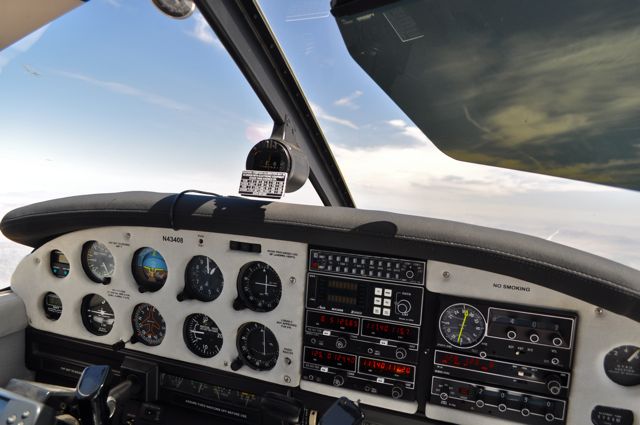
We ultimately ended up dropping below the clouds and cancelling IFR to avoid going far out of our way - welcome to the Northeast, eh? - and had a very nice VFR flight across New Jersey, New York, and Connecticut. It was only a bit after 4pm - daylight! - when we approached Johnny's hometown, circled over his house, waved to his wife and kids, and landed at nearby Chester Airport. It was a blustery, squirrely day at the surprisingly tiny but busy field, and our first approach resulted in a go-around. The next attempt was successful, and N43408 was finally home after 24.8 hours of flying. We opened Johnny's new hangar, restacked the Champ and 172 that are his PA28's new stablemates, and I patted the good old bird on the nose as we parted company. It's a big country, after all, and you have to appreciate a good machine that can take you the distance in safety and comfort.