Monday, September 20, 2010

The Show, Part 2

On Tuesday morning, I woke to the considerable racket of a early-model Learjet departing Runway 18. I wanted to beat the morning rush to Ripon, so we got up, broke camp, and packed everything back into Foxtrot Zulu. Our neighbors helped us push her out of the wet grass and up onto the taxiway. Taxiing the full length of the flight line to Runway 36 was like being in a parade, given how many people were sitting in front of their airplanes eating breakfast and waving to passing aircraft. We lifted off and turned westward toward Ripon at 7:30am.

The airspace over Ripon was much calmer than the previous evening. I spotted a Ercoupe following a Tri-Pacer, and fell into line. A Cessna 150 approaching from our 3-o'clock position s-turned to follow me. We proceeded up the tracks to Fisk, where both vintage aircraft were sent east along Fisk Avenue, while I kept trucking northeast by myself for the right downwind to 27. Approaching the numbers, Tower told me to follow a TBM on a two-mile final, follow him, and land on the green dot. I scanned the shoreline of Lake Winnebago for the svelte single-engine turboprop, and instead spied a chunky, dark-blue radial-engined warbird. Of course, a TBM Avenger, not a TBM-700! I followed close behind and put Foxtrot Zulu right on the green dot, making a much nicer landing than the previous evening's effort in Fond du Lac. After ten minutes of following EAA flagpersons down a narrow service road, I was marshalled onto very soft grass on the northeastern side of 9/27; a mighty blast of throttle was required to keep moving until we reached our parking spot. I shut down with a happy sigh. We had made it, after all.


The North 40 was shockingly empty. Usually by Tuesday every square foot of grass around Runway 9/27 is filled with airplanes and tents, but when we arrived there were no more than 100 airplanes in our immediate vicinity, plus a few early arrivals scattered around the south side of the runway, stranded in the bog. Over the week, the entire area eventually did dry up enough to accommodate campers, but I don't think the North 40 ever completely filled up after Tuesday.

We attended the show on Tuesday, Wednesday, and Thursday, and then flew home on Friday morning. Here are some of my favorite pictures from the show.

2010 is the 75th anniversary of the venerable DC-3, so there many DC-3's and C-47's in attendance.

Never was an overpriced burger so good as on a hot Wisconsin afternoon filled with the noise of radial engines.

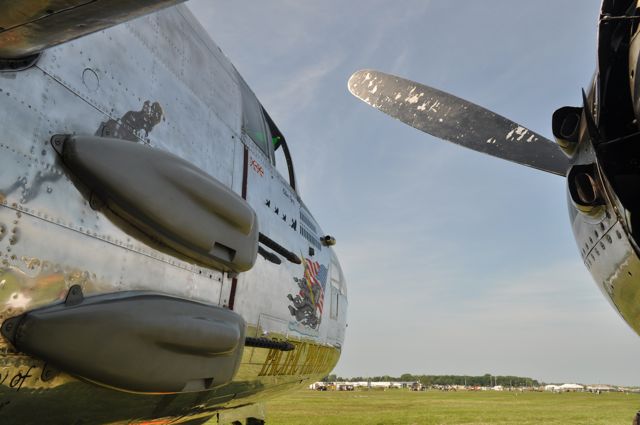
The history of this airplane is rather astounding.

Dawn's favorite airplane, she's been begging me for a ride in one for a while. So, uh, anyone here own a Stearman?

Did you know Wacos are still in production? I didn't! When I hit the jackpot....

The ultralight field is, for my money, the most fun you can have at Oshkosh. Crazy people giving rides around the patch in questionable machines while funny old dudes kibitz over the loudspeaker? What's not to love?On the other hand, when you need to get away from the heat & crowds, you can't beat the seaplane base. I took a really nice nap on the grass, dangling my feet in the water, occasionally opening an eye to peek at whatever was taking off or landing.
I can't imagine the expense of owning and operating an F-4, but I'm glad that at least one guy considers it a worthwhile use of his money.
Sean Tucker is a no-name chump, real men do Akro in a Beech 18! One of our favorite acts.
This is just...unnatural. I mean, even moreso than normal helicopters.

Don't try this at home, kids....

Covering an elevator at the Stitts Poly-Fiber fabric workshop.

All in all, it was a great time, if a bit overwhelming at times. Oshkosh has that reputation. Dawn said she had a lot of fun and would like to go back sometime, but maybe we should skip a year or two first.

Our flight back on Friday was smooth and relaxing. On my way back in '99, I let my ten-year-old brother Josiah do most of the flying, and taught him how to navigate VOR-to-VOR. This time, I had Dawn do most of the flying and navigation using dead reckoning and pilotage. She did a great job.


On the way back, we stopped in Siren WI to pick up my seven-year-old nephew, Dylan. We were bringing him to Grandma and Grandpa's house for the weekend, and it was his first airplane ride ever. The afternoon air was a little turbulent, but Dylan did great. I promised him that he could sit up front with me next time, and I'd show him how to fly.

Friday, September 17, 2010

The Show

In the summer of 1999, when I was 18 years old and freshly graduated from high school, I flew a Cessna 172 to the Experimental Aircraft Association's Annual Convention and Fly-In - then newly branded as "EAA AirVenture Oshkosh" - in Oshkosh, Wisconsin. I along brought my little brother Josiah (then ten years old), and we camped under N738FZ's wing for the week. For a plane-obsessed kid about to head to college for aviation, it was absolute heaven.

I didn't make it back for eleven years. I got busy with flight training, and then moved to the west coast. Although I stayed current in small planes for a while, it wasn't a priority, and by this summer it'd been over three years since I'd flown one. My work tends to scratch my flying itch, so I never felt any overwhelming need to go back to Oshkosh.

It turns out that I've been blessed with a wife with a flying itch of her own, and my job doesn't do anything for her. Dawn had been nudging me to get checked out in a light plane here in Minneapolis, but most of the FBOs and flight schools of my youth have withered away and the survivors' rental rates are painfully high. In July, though, I got back in touch with my first flight instructor and had the chance to get reacquainted with N738FZ. My first few landings, it must be admitted, were humbling, but before long I got the hang of Cessna wrangling again. I meekly asked my old CFI what he'd think of me stealing Foxtrot Zulu for a week and taking Dawn to Oshkosh. He said yes without batting an eye.

The plan was to fly in on Sunday 25 July, the day before the show begins. Mother Nature had other ideas. Eastern Wisconsin, already the recipient of record rainfall in July, got an utter drenching that Thursday night. On the very eve of the world's largest airshow and fly-in, virtually every unpaved inch of Oshkosh Airport was either underwater or was a bottomless mud bog. There was no place to park the 12,000 expected aircraft, no place for RVs and tent trailers, few places even suitable for parking cars. I checked the uniformly grim site updates through the weekend. Maybe we should throw in the towel and just head to Spain instead? My friend in Girona invited us to come on over. We almost did, until insane loads to Atlanta made the open flight to Barcelona a moot point. Finally, EAA announced that general aviation camping would be opening at some point on Monday. We decided to take off from on Monday morning and head that way.


The air was still as lifted off Runway 16 at CBG and turned eastward to climb out over the St Croix River. We leveled off at 5500 feet and admired the stunningly green Wisconsin scenery as it passed slowly by. Dawn helped me identify landmarks from the WAC chart; no GPS in this old bird! Past Eau Claire, scattered cumulus started popping up around us. I weaved around them for a while until they became too numerous to avoid, then descended to 2500 ft and followed a high-tension powerline eastward. Approaching Wisconsin Rapids, I tuned up the Oshkosh ATIS. It was still faint but I picked out the words "General Aviation Camping closed." Oh well. I chopped the throttle and banked into the downwind for Runway 20 at KISW.


There was only one spot to park N738FZ, for we weren't the only ones waiting to go to the show. I talked to a couple of guys in Super Cubs with bush tires, one of whom had come from Edmonton. Long flight. A couple of ultralight trikes landed for gas. I checked the OSH site update page on my Palm obsessively; frequent updates kept promising an imminent opening but suggested it might be after the airshow. Dawn and I walked into town for lunch. Sure enough, while we were at lunch Oshkosh opened briefly for general aviation campers, but we didn't have enough time to get back to the airport and fly to OSH before it closed for the daily airshow. I figured we'd take off around 5:30pm to arrive over Ripon around 6PM, when the airport usually reopens.


Everyone at Wisconsin Rapids had the same idea; we all took off in quick succession and proceeded southeast en masse. Approaching the start of the VFR arrival procedure at Ripon, it quickly became apparent that everyone within a hundred-mile radius of Oshkosh had the same idea. The approach control frequency was utterly clogged with pilots self-announcing their arrival over Ripon and holding over Green Lake, contrary to the NOTAM's instructions and the approach controller's exasperated admonitions. "OK, we have entirely too many airplanes over Green Lake," she finally declared. "Everyone pick a spot near you and circle it until we reopen the airport and get Green Lake cleared out!" I spotted a Mooney circling under us, and dropped down to stalk him around his circuit of a large marsh, playing with his wake. Within a few minutes I saw a Cherokee doing the same thing behind us.

The airport reopened shortly after 6PM, as expected. At first the line out of Green Lake, over Ripon, and up the railroad tracks seemed to proceed in an orderly fashion. Then somebody cut in line, and a speedster caught up to a slowpoke, and soon the frequency was again utter chaos. The approach controller kept admonishing the pilots to listen rather than speak, then gave up in frustration and was relieved by another controller. Finally the end of the line was reached and all of us holding outside Ripon were given clearance to proceed inbound. I stayed behind the Mooney, establishing a half-mile in trail at 90 knots and 1800'. With any luck, I thought, I'll be able to follow him into the line and up the tracks. That turned out to be wishful thinking.

As we approached Ripon, an utterly incredible sight unfolded. The airspace above the small town was positively swarming with dozens of airplanes buzzing about in every which direction with no sense of order whatsoever. It strongly reminded me of a dogfight sequence in an old WWI film. As we closed in, even more airplanes appeared, more than I've ever seen flying in close proximity; for a few seconds I was filled with utter dread, and then we were in the thick of it, planes all around us. I followed my Mooney guide toward the tracks, my head on a constant swivel. There were five or six of us roughly abreast of each other, all converging on the tracks. This was not going to work. The Mooney had some competition of his own and bugged out to the left. I had just rolled into a left bank to follow him back around the northern edge of Ripon when a C210 flashed by right-to-left a hundred feet or so ahead of us, cutting into the slot between me and the Mooney. I slowed five knots to increase the separation, then kept following the interloper in the absence of any other semblance of order around us. Our little conga line again made a move towards the tracks and was again thwarted, then snaked off to the southwest around the west side of Green Lake. Another conga line was going the other way, up the east side. When it ended, the Mooney swung around to follow, with the Centurion and Foxtrot Zulu close behind. Ah, order out of chaos! There were still planes on every side, above and below, many of whom attempted to cut in, but our impromptu squadron held formation through the gauntlet.

The radio was strangely calm during this frenetic fifteen minutes, for the approach controllers had mostly succeeded in berating the pilots into holding their tongues and waving their wings in reply. Now, as we closed in on the town of Fisk, I listened intently for them to call Brown and White Cessna. "Red RV4, follow Fisk Avenue for left downwind 18L, monitor tower 126.6. Yellow Cub, wag your wings. Thank you, Yellow Cub, follow the tracks for right downwind 27, tower 118.5. Blue and Yellow Biplane, rock your wings...good rock, sir! Follow the RV4 for 18L, tower 126.6....OK, white Mooney, rock your wings!" I perked up - the Mooney was two ahead of us. "OK, Mooney, Oshkosh is saturated, break left, start holding at Rush Lake." Uh-oh. "Retractable Cessna, follow the Mooney. Brown and white Cessna, follow him, everyone hold at Rush Lake."

We didn't even get to Rush Lake when the controller announced that General Aviation camping was closed for the night, but showplanes could proceed inbound. Technically, any airplane built until 1970 qualifies as a showplane - and we later saw many beat-up spam cans in showplane camping - but Foxtrot Zulu is a '78 model. The door had slammed shut. I decided to beat a quick path to Fond du Lac before everyone else got the same idea. I climbed well above the swarm at Ripon and then turned east and began descending to FLD.

Fond du Lac was as busy as I expected, with the controllers issuing the same continuous stream of instructions to anonymous aircraft as Fisk Approach was. Our downwind was extended to follow a flight of T-28s, and then on a three mile final were told to maintain at least 90 knots for a P-51 breathing down our neck. I kept the airspeed high all the way to the numbers, then bled it off seemingly forever in ground effect before making an embarrassingly flat, skittish landing. I braked hard to turn off and was barely clear when the P-51 went roaring behind us. Our timing was fortuitous, for we claimed the third-to-last camping spot on the airport. As we set up camp, representatives of the local EAA chapter came by to fleece us to the tune of $50 (!); this, in addition to $25 per person per day to shuttle to Oshkosh. The airport had very basic facilities, no potable water for cooking, one food stand, and nothing else nearby. After the adrenaline rush of aerial warfare over Ripon, this was a bit disheartening.


Dawn and I talked about it over burgers and cheese curds. We hadn't come all this way to camp at Fond du Lac and take a bus to Oshkosh, we decided. Tomorrow we would break camp and brave the crowded skies above Ripon once again. It would be Oshkosh or bust!

(Next: The Show part of The Show)

Monday, September 13, 2010

Big Apple Arrival

If I had my way, I'd never fly anywhere but Montana. The scenery is beautiful, the people friendly; the flying is just challenging enough to be interesting, but ATC is relaxed and delays are few, making for a pretty stress-free experience. All this is true of most of the west coast, actually, but Montana has all these qualities in spades. Alas, I don't get to fly west all that often anymore.

Instead, the great majority of my trips these days send me east from Minneapolis. Flow control, holding, last-minute reroutes, ATC inflexibility, clogged frequencies, postage-stamp sized sectors, gridlocked taxiways and ramps - these are a few of my least favorite things, and they are all permanent features of east coast flying. In fact, the severity of these problems seems to vary in direct relationship with one's proximity to New York City. Flying to any of the NYC airports - JFK, LGA, and EWR, "The Trifecta of Suck" - is just asking for a screaming migraine. I can't imagine being based there, which probably guarantees I will be at some point.

Although I've long been well acquainted with Newark's wonders, thus far I've managed to mostly avoid JFK and stay completely away from LaGuardia. This has been through a combination of lucky and purposeful bidding, as well as the occasional strategic trip trade. A lot of other guys see a New York airport and dollar signs flash before their eyes: there's an excellent chance of picking up over-block on these flights. I'm more than willing to help them out, as the hassle and stress isn't worth the extra money to me. With NewCo's increasing presence in New York over the last few months, it's getting tougher to stay out. The last few months, I've flown into JFK several times. And then last week, I could avoid LaGuardia no longer.

I actually had two LaGuardia turns, one at dusk on Wednesday night and the other at dawn on Friday morning. Keith, the FO I was flying with, had been into LGA a number of times so I had him fly the first turn, while I took the second. We got some holding on the arrival on Friday night due to gusty winds forcing a runway configuration change; after landing, taxiway gridlock and a last-minute gate change (to a remote pad, utilizing air stairs and a bus) upped the stress level for a few minutes. On departure a few hours later, it took 20 minutes to push back and over an hour to taxi out thanks to extreme congestion and some VIP activity on the airport (we departed #2 behind Air Force Two). The turn on Friday morning involved quite a bit less hassle, but the lineup for departure was still fairly long. Congestion is an unavoidable fact of life at an extremely popular airport that is inherently limited by its configuration and is hemmed in between Queens and Flushing Bay with no room for expansion.

Despite the hassle factor, I rather enjoyed the visits to LGA thanks to being able to fly the famous Expressway Visual approach to 31. LaGuardia actually uses another neat approach, the River Visual, whereby one steams up the Hudson at low altitude for the full length of Manhattan before cutting straight across the Bronx on final to Runway 13. The Expressway Visual offers a little less in the way of skyline appreciation but makes up for it with nice seat-of-the-pants flying that's a rare treat in a transport category aircraft.

You can find the approach plate here. Approaching from the southwest on the Milton Three arrival, we were cleared to DIALS early on and spotted the twin white tanks before we reached the Verrazano-Narrows Bridge. Cleared for the visual approach, we descended to 2500 feet until reaching the tanks, then turned right to intercept and follow the Long Island Expressway through Queens. Approach handed us off to tower, who told us we were #2 to land after traffic on left base and cleared us to land. I clicked off the autopilot, cleared the flight director, and called for "Flaps 3, Speed 160" as I began a 3-degree descent. There is no vertical guidance on this approach until you pick up Runway 31's VASI at relatively low altitude, so you take a guesstimate of flying miles remaining and maintain a descent that puts you at 300 feet for every mile to the runway.

Passing through 1500 feet, I called "Gear Down, V-Approach, Landing Check" and Keith read the landing checklist as we slowed to our approach speed of 131 knots. Coming abeam Meadow Lake, I rolled into a 20-degree left bank to follow the Flushing River out of Flushing Meadows Park, pirouetting nicely around
Shea StadiumCiti Field. Passing 500 feet, I shallowed my bank to make a sort of slightly curving final approach all the way to the runway; tall cranes by the mouth of the Flushing River prevent us from making a straight-in final the last 500 feet, as is usual practice. The VASI came into view; we were right on glidepath. On about a half-mile final, I finally leveled the wings completely. The winds were gusting out of the north, and as I came over the threshold I kicked in left rudder to align the nose on runway heading while using right aileron to keep the upwind wing slightly down. Squeak-squeak-squeak went the right main, left main, and nosewheel, just the way I like it; our light weight allowed me to use minimum reverse and medium braking to slow in time to make the taxiway Tango turnoff, just the way tower likes it.

I'm sure a lot of my GA pilot readers are looking over my description and thinking "What's the big deal?" Visual approaches by reference to surface features are the rule rather than the exception in light planes. The context that you're missing is the stultifying routine of the great majority of airliner arrivals. For us, the rule is being vectored onto a 20-mile final for an ILS-served runway 10,000 feet long, 3 miles in trail, 160 knots to the marker - over and over again. Turning off the autopilot, flight director, or even autothrottles (gasp!) are about all you can do to provide some variety, and even this is barely enough to keep the rust off. Good stick and rudder skills are seldom needed in the airline world; here, being a good pilot is primarily about effective crew coordination and decision-making skills. Chances to go beyond being a cockpit manager, to go back to being a pilot, are relatively rare and genuinely cherished. The Expressway Visual 31, or the River Visual 13, or the Carnesie Visual 13L/R at JFK, or the River Visual 19 at DCA are what passes for fun flying in the airline world. Well, that and flying to Montana!

If you'd like to see what the Expressway Visual looks like the cockpit, here's an excellent video on youtube. This crew is approaching from the northeast, so they overfly LaGuardia and Manhattan before turning in at Prospect Park, but the approach is otherwise the same from about the 5:40 mark.

Friday, September 10, 2010

(R)Evolution

I've put off writing this post for two months, with good reason. When NewCo was unexpectedly sold off on July 1st, I was so emotional about the whole thing, so utterly pissed off, that anything I cared to write would have been a fireball launched directly into the face of my new employer, daring them to fire me. Since then, I've had time to simmer down and think through what this sale, and even more disruptive recent events, mean for the industry. There have also been some positive developments that are making me think that perhaps I'd like to keep my job, after all.

On the morning of July 1st, I was flying from Houston to Minneapolis on day three of four. I was paired with Mike, an excellent FO and great guy with whom I'd flown a number of times. We'd just pulled into gate G18, completed the shutdown checklist, and turned on our phones; they both began going crazy with multiple texts and voicemails we'd missed during the flight. We looked at each either; it was obvious something big was up. My first text was from a friend who flies for Pinnacle. "What the heck...you guys are screwed!" it exclaimed. When a Pinnacle guy says you're screwed, he isn't kidding. I loaded up the company website and discovered that WidgetCo had sold NewCo late the previous night. That wasn't the shocker; there had been swirling rumors of an impending sale. The unexpected part was who we were sold to.

Our new parent company has been around for some 30 years. I'll give them the pseudonym "Osage Airlines," in honor of their early days flying to Lake of the Ozarks. They are privately owned by one individual, who built the airline from the ground up. They do not have a good reputation among pilots. Part of it is their industry-wide reputation for being cheap. There are lots of cheap regionals, though; most of the animosity stems from something that happened about five years ago. Osage had been awarded new CRJ-700 flying for a major airline. Because of a scope clause at one of their existing mainline partners, they were forced to start a new certificate. The original plan was to use Osage pilots; however, when their ALPA MEC refused to fly for below-market rates, Osage decided to bypass them by using non-Osage pilots. This appeared to be against the Osage pilots' contract, which stipulated they were to do all flying controlled by Osage Airlines. Osage management got around this by creating a new holding company to own both Osage Airlines and the new company, and then successfully arguing that the contract was between the pilots and Osage Airlines, not the new Osage Holdings. The new airline - let's not sugarcoat it, I'll call it Pariah Air - took delivery of 25 CRJ-700s and hired pilots while Osage was getting rid of older turboprops and furloughing. It created an enormous amount of ill will among pilots, and those who went to Pariah are despised by many regional pilots - including the many Osage furloughees that ended up at NewCo. My First Officer, Mike, was one of these furloughees. You can imagine his reaction to learning that WidgetCo sold NewCo to Osage Holdings.

We had a three hour break after our arrival from Houston, so we packed up and walked down to the crew room. The mood there was veering between bleak and apoplectic. Between the press release and an employee FAQ, we got a few details. NewCo was sold for a paltry $20 million, which was financed by WidgetCo, who also leased the aircraft back to Osage Holdings. We were to be operated as a separate airline, alongside Osage Airlines and Pariah Air. Our nonrev benefits were to be slashed to those of a contract carrier. Most alarmingly, the flowthrough agreement to WidgetCo - our senior-most 60 pilots were scheduled to flow yet this year, with me close behind - was revealed to be subject to cancellation due to the sale. Although the FAQ said that all parties would meet soon to determine the future of the flow agreement, the consensus that morning was that it was toast. Delta didn't want it and Osage didn't want it, we believed, and we were the suckers for ever thinking it might work despite the failure of other flowthrough agreements across the industry. Our company president, to his credit, showed up in the crew room to deflect angry inquiries from an increasingly hostile crowed. I didn't believe one of his answers and made it clear to him. Finally, Mike and I headed out for the flight to our Columbus overnight. During the crew briefing, I told him: "If there was ever a flight in which we were distracted a dangerous level, this is it. Let's both be extra vigilant and watch out for each other." We did, and got to Columbus just fine, where we promptly headed to the nearest brewpub to commiserate over beers.

It helped to empathize with our colleagues at Mesaba, for NewCo wasn't the only airline that WidgetCo sold on 1 July. A little history is in order. Mesaba was forced into bankruptcy in 2005 after the bankrupt RedCo withheld millions of dollars in payments owed them; RedCo subsequently purchased Mesaba for mere pennies on the dollar. Fast-forward to 1 July 2010: WidgetCo, having bought all of NewCo's assets including Mesaba, sells Mesaba to Pinnacle Holdings for $62 million. I would say a lot more about this but everything I could type would constitute more of those fireballs I was talking about.

It turned out that this double sale was only the start of interesting developments for the regional industry this summer - or perhaps the continuation of trends I noted earlier this spring. Skywest recently announced the purchase of erstwhile industry giant ExpressJet Airlines, which it plans to merge into subsidiary Atlantic Southeast Airlines (ASA). Meanwhile, Freedom Airlines shut down after WidgetCo won litigation allowing it to cancel its contract for poor performance; the survival of Freedom's parent Mesa Air Group seems increasingly in doubt. American has made it increasingly clear that Eagle is for sale if someone would just make a reasonable offer. Just last week, Comair (still wholly-owned by WidgetCo) announced that it would slash its fleet to half of its already-diminished number and furlough a substantial portion of its workforce.

Just what is going on here? A key component is the increasingly obvious obsolescence of the ubiquitous 30-50 seat regional jet. The $150/bbl oil of 2007 felled the first blow, the depressed revenue environment of 2008-2009 gave the RJ a further bludgeoning, and major airline consolidation into 2010 just may have put the final nail in the coffin. Mind you, 30-50 seat RJs will always have a niche to fill, but it has become apparent that there are far too many in use today for roles they do not fill well. This has left many regional airlines desperately exposed; as 30-50 seat contacts come due and are not renewed, these airlines stand to shrink significantly, with an accompanying explosion of their cost structure and subsequent loss of competitiveness in all seat categories (see: Mesa Airlines).

So what to do? I think there are essentially four choices out there for those who own or manage regional airlines. You can try to go independent, either with existing aircraft or by acquiring larger aircraft. From Independence Air to go! to branded ExpressJet, the track record is not encouraging here. You can acquire larger national airlines and use them to compete with mainline "partners," as Republic Holdings has done. The jury's still out on that one. You can acquire other regional airlines in an effort to diversify your air service agreement portfolio, obtain synergistic cost savings, and decrease competition for increasingly scarce RFPs. This seems to be the tack taken by Skywest, Osage, and Pinnacle. Or, you can position yourself to be acquired. I think this is what WidgetCo is doing with Comair, and American with Eagle.

So I get what Osage and Pinnacle were thinking when they picked up NewCo and Mesaba. The real question is what was Widget looking to gain by selling these airlines off - particularly for a paltry $82 million, a tiny fraction of WidgetCo's total debt? I'm still trying to figure this one out. You could take Widget's CEO at his word when he told investors that it was simply a way to decrease Widget's liability. Think about that one for a sec. It implies that the bean-counters were so concerned about the possibility of a crash and ensuing liability from one of the regional airlines 100% under their control that they chose to move those airlines out from under their control, and ostensibly decrease their liability in case of a mishap. Doesn't give one the warm fuzzies, does it?

In the week after the sale, surprise and confusion gave way to seething anger. Dawn said she had never seen me so negative about my career in the decade she's known me. That's no way to go through life, though, and I've cooled off considerably since. Thus far it's looking like Osage is willing to let NewCo keep running the way it's been run - which isn't perfect, mind you, but has improved considerably since I started and is at present a pretty decent operation that backs up its pilots when they make safe decisions. Furthermore, I was pleasantly surprised when WidgetCo agreed to keep the flowthrough agreement for all NewCo pilots on property as of the sale. If current hiring projections hold, there is a real chance that I'll be at the controls of a Diesel 9 or Mad Dog or Fifi sometime next year. I sure hope it happens - the regional industry is getting far too interesting for me as of late!

I haven't mentioned one potentially truly revolutionary development. The Continental and United pilots are demanding, as a condition of cooperating in the merger between their airlines, a gradual end to outsourcing, with all regional flying eventually to be flown by pilots on the combined seniority list. I consider this a definite long-shot to actually happen, but if it does you will see a great deal more turmoil in the regional industry as well as great celebration from airline pilots of all descriptions.

Monday, August 09, 2010

The Long Road Home, Part 2 Photos


Dawn at Horseshoe Falls in Niagara Falls, ON.


American Falls, seen from the Canadian side.


On the MS Chi-Cheemaun near Tobermory, Ontario.


Trying to figure out how we're going to get around Lake Huron now that the ferry is returning to port with its bow stuck open.


Lake Huron near Au Sable, Michigan. I fly over Au Sable every time I work EWR-MSP but had never seen Lake Huron from the ground before this trip.

Riding over the Mackinac Bridge between Michigan's Lower & Upper Peninsulas.


Lighthouse on Lake Michigan at Manistique, MI.


Soggy morning at Indian Lake near Manistique.


Minneapolis at last! Left 10 July 2009, Returned 31 May 2010.


14,679 miles, 4 oil changes, 2 sets of tires, and a rebuilt transmission later...the Beamer is home.

Saturday, August 07, 2010

The Long Road Home, Part 2

Nonrevving back to Buffalo two weeks later proved much easier than anticipated, and we touched down shortly after 11PM on Friday, May 29. The final leg of my adventure was planned to go up Canada's Bruce Peninsula, across the top of Lake Huron, back into the US at Sault Ste Marie, and across Michigan's Upper Peninsula and northern Wisconsin to Minneapolis. The only potential hitch was the ferry ride across Georgian Bay's Main Channel; there are but two crossings a day, the latest at 1:30PM, which we would need to catch on Saturday in order to make it back over the three-day Memorial Day weekend. Consequently, we rode the 40 miles to Niagara Falls on Friday despite the late hour of our arrival, crossed into Canada at the Rainbow Bridge, and rented a cheap room at the Day's Inn for a very short night of sleep.

Despite the need to put some kilometres behind us early on, Dawn and I took some time in the morning to view Niagara Falls, which until now I'd only viewed from the air and Dawn not at all. Having been forewarned not to expect much more than a touristy town next to a really big waterfall, I didn't come away disappointed. The alloted half-hour was more than enough time to enjoy the view, and we were soon in the saddle and heading north out of town on Queen Elizabeth Way. Soon Lake Ontario came into view, and as the QEW transited its west end towards Toronto, the traffic became both heavier and faster. In Hamilton we turned off on ON-6, the highway that would take us up the Bruce, and the pace immediately relaxed. I was happy to find the traffic light and the road in good condition. The scenery consisted mostly of flat farmland, but was punctuated occasionally by picturesque towns with ancient stone-and-timber shops, churches, and ramparts. Past Owen Sound, the countryside became progressively less populated as we entered the peninsula proper, and the last forty miles took us through a wild-looking forest of scrub-pine.

Our worries about making the ferry were needless, for we reached the end of the peninsula at Tobermory by noontime. After buying our ferry tickets, we ate lunch at a dockside Fish-N-Chips joint and wandered around the quiet town until the ferry's horn summoned us back to the quay. We and a few other motorcyclists were the first vehicles onto the ferry; after tying the Beamer down securely, we headed up top to poke around the 365-foot MS Chi-Cheemaun and claim some Adirondack chairs near the stern. The last vehicles loaded, the ship gave a parting blast from her horn and cast off. I was thoroughly enjoying the beautiful sunny day and the spectacular scenery of Fathom Five National Marine Park when Dawn mentioned that we didn't seem to be going very fast. She was right; the thirty-mile crossing normally takes two hours but we were making no more than five knots. Within a few minutes, we stopped completely, and then began a slow 180 degree turn. "Ladies and Gentleman, this is your Captain speaking," cackled a loudspeaker on deck. "We have encountered a problem with the bow of the ship that is not allowing it to latch closed, and therefore it is unsafe to continue to South Baymouth. We will be returning to Tobermory, everyone will need to disembark, and your fare will be refunded."

Hundreds of miles from the nearest NewCo airplane, the announcement suddenly gave me the feeling that I was at work. The irony of being on the receiving end now didn't escape me. I talked to a crewmember who said that the nearest mechanic was several hours away and that parts might need to be special ordered; even the following morning's sailing was in doubt. I didn't feel like an indefinite wait on a remote peninsula in the middle of Lake Huron, which left two options: going around Georgian Bay to the east and joining our original route, or riding around the south end of Lake Huron and heading to Chicago, then Minneapolis. I got out my Palm; Google Maps said the Georgian Bay detour was considerably longer. That made the decision for us; Chicago it would be. As soon as we collected our fare refund, we saddled up and headed back down the Bruce Peninsula. It was just after 3PM, and I figured we could knock out another 200 miles before sundown.

As soon as possible, I deviated off of ON-6 to the west and followed ON-21 around the eastern shore of Lake Huron. The road wasn't right on the lake but allowed occasional glimpses of it, the riding was pleasant, and the miles went by quickly. As the sun sank lower, fatigue began to set in, but we pressed on. The more miles we rode now, the fewer miles to ride in Memorial Day traffic on Monday. At the south end of the lake, we joined the ON-402 freeway westbound, which faced us into the late-afternoon sun for an extra dose of drowsy. I pulled out my iPod, synced it to my bluetooth helmet intercom, blasted a Tiesto album, and saddle-danced my way to the border crossing at Port Huron. We crossed the border behind two old guys on late-model Honda ST-1300s, both of which had higher mileages than the not-inconsiderable number on my 25-year-old BMW. Two miles after entering the US, we exited at Port Huron, Michigan, to make camp at the municipal campground - really an RV park, but nonetheless a decent grassy spot to camp for not much coin. We had ridden 475 miles since Niagara Falls.

After making camp we rode downtown to a microbrewery by the port, where we had a fine dinner and I sampled a tasty IPA. I talked about my disappointment at being unable to explore the northern shore of Lake Huron and at how comparatively dull the mostly freeway-bound new route would be. "Well, we don't have to go through Chicago, right?" Dawn queried. "You could still go through the Upper Peninsula, right?" It seemed like an awful long detour to go that way, but when I checked Google Maps it was a difference of only about 50 miles. That seemed like a very reasonable tradeoff for an infinitely more enjoyable route. And then I realized that rather than taking I-75 all the way up to the Mackinac Straights, we could hang a right on US-23 and hug the shore of Lake Huron. This would add on another 50 miles, but it was another area I'd flown over often but never seen from the ground. In for a dime, in for a dollar, as they say.

I slept well that night despite the busy freeway next door, and felt well rested as we broke camp early the next morning. It promised to be another long day of riding. I put on my chaps and thick gloves and pressed my legs tight against the engine as we accelerated onto I-69 in the chilly morning air. The first sixty miles passed by quickly despite some heavy construction as we approached Flint, then we skirted the city on I-475 and joined I-75 northbound. We passed through Saginaw, which I've flown into and overnighted at often, but the area looked entirely different from the freeway. Shortly after exiting onto US-23, we stopped for breakfast at the North Forest Cafe in Standish. The joint was packed with old-timers, and we enjoyed people-watching from our small two-top to the side of the bustling room as much as we enjoyed the $2.99 breakfast special and 99-cent steaming coffee.

The first half of the ride up the coast took us through an unbroken vacation-land of lake cabins, resorts, B&Bs, various tourist businesses, and occasional small towns. The road never strayed far from the lake, and the glinting waves often flickered invitingly through the pines. Past Harrisville, the development petered out and the road backed off into the hills, thick forests hugging both sides. The sunny day was getting quite warm, and I stripped off my chaps and took the liner out of my leather jacket when we stopped for gas near Alpena. I subsequently rode off without paying for the gas - no pay at the pump out here! - and got several miles away before I realized my mistake. The cashier still hadn't called the cops by the time I returned with a profuse apology.

We rolled into Mackinaw City a bit after 3pm, stopped to cool off with ice cream cones, and rode across the magnificent Mackinac Bridge to St Ignace. I landed here on a long cross-country flight in a Warrior ten years ago. Low on gas, I waited in an FBO attended only by an old golden retriever for over an hour until the fueler showed up, then took off over the straights at dusk as the lights on the bridge twinkled to life. Back then it seemed like making a long trip by small plane was the ultimate adventure. I think it still could be, but it's been a long time since I've flown small aircraft, and I associate flying too closely with work.

I had a bad scare about an hour after I turned westward on US-2, at around our 400th mile for the day. I rounded a sharp, rolling corner around a cliffside without backing off of my 65 mph pace, only to discover the Buick I'd previously been following by several hundred feet was stopped in the middle of the road, waiting for oncoming traffic to pass before making a left turn. Actually it took me a few seconds to realize that he was stopped, as the Buick had neither left turn signal nor brake lights on. By the time I jammed on my brakes, he was perhaps 100 feet away and I quickly realized I would not stop in time. I had to make a snap decision between two unsavory options: I could swerve to the right, where there was a ton of loose rock and not much room between the Buick and a small shoulder bordered by a yawning chasm of a ditch, all placed at the entrance to a left-hand curve to make staying on the road especially doubtful. Or, I could swerve inside of the Buick, straight towards the oncoming traffic, and then jerk back into my own lane before they hit me.

In a fraction of a second I let go of the brakes, snapped the throttle open, and leaned hard to the left. "Don't turn now, don't turn now!" I prayed as we blew by the unsuspecting Buick. The moment we were past him, I leaned back hard to the right and swerved back into my own lane with a good second to spare before the Ford cargo van roared by, horn blaring. It was several seconds before our intercom crackled to life. "That happened quickly," Dawn said. I didn't say anything for a while. I could have stopped if I'd seen the Buick as soon as I rounded the curve - but I didn't. The lack of brake lights were partially to blame, but I had also been cruising along fat, dumb, and happy, my attention span wilted in the late afternoon sun. At least I reacted very quickly and correctly. I rode on feeling curiously calm about the incident. I think it was over too quickly to produce much adrenaline.

We camped for the night on the shores of Indian Lake in Manistique. The town itself was pretty quiet on Sunday night, and the pub that a park ranger recommended was closed. We rode further downtown and found the unapologetically divey Buckshot Bar open for 99 cent Old Milwaukee and all manner of fried food. The Twins were playing on the old TV over the bar so we lingered to watch them complete a home sweep of the Rangers before retiring to camp for the night. On our return, our older neighbors invited us to sit by their fire and eat smores with them and their grandson.

Sometime during the night it began raining and had yet to abate when we could put off rising no longer. Breaking camp was a soggy affair, and it looked like my 41st and last day of riding around the States might be a wet, cold ordeal. By Escanaba, though, the western sky had begun to lighten, and the road was perfectly dry by the time we crossed into Wisconsin, the 32nd state of the trip. After turning onto US-8 at Norway, we quickly found ourselves plunged deep into the Wisconsin Northwoods. We looked for breakfast in a tiny town and came up with only a gas station diner (which proved surprisingly good). Deer sightings were quite frequent. Twenty miles out of Rhinelander, a black bear scampered across the road and up the opposing bank.

After Prentice, the more familiar landscape of northwestern Wisconsin began to unfold, and it finally started to feel like the trip was really coming to an end. When I'd set out westward from Minneapolis last July, I had no idea that so much time or so many miles would pass before I rode into town again - or that I'd be coming from the east. As we approached the Minnesota border at Taylor's Falls, the Memorial Day traffic got progressively worse, as I feared. At least we had made good time across Wisconsin, and I was still feeling alert. I needed it for the last forty miles of heavy traffic on I-35 and I-35W.

And then...I rounded a corner in the freeway, and there sat the Minneapolis skyline across the river. A few minutes later I exited I-94 onto Hennepin Avenue, rode the last few blocks, parked in front of our apartment, and turned off the Beamer. It was finished. I looked at the odometer. My trip around the states totaled 14,679 miles, an average of 360 miles per day of riding. Dawn rode along on 5000 of those miles, and my friend Brad rode alongside for 2500. As adventures go, this was an excellent one; I'll cherish the experience for the rest of my life. The last five years, Dawn and I have primarily done our traveling overseas, so it was good to be reminded how big and beautiful and varied my own country is. There's a lot left to be explored, and there are few better ways to do it than from the saddle of a trusty motorcycle.

(Photos to follow)