Thursday, June 17, 2010

Long Day

Louisville, 1:06 AM. I am lying back in a chair in my cheerfully nondescript hotel room, feeling the adrenaline seep out of my limbs. I've been running at one hundred and ten percent for hours now, and it's almost impossible to go straight from that to sleepfulness, so I sit here trying to decompress. A drink helps. The crew and I were planning on having a nightcap - our show time isn't until late tomorrow - but the hotel bar was closed by the time we finally arrived, and there's nothing else open nearby. Instead, I pour myself a short glass of scotch from my own flask. The ice crackles and tinkles softly, accentuating the silence of my room. I take a sip and think back on the long day.

I woke up at 6:30am and set about the familiar routine of preparing for a morning show: showering, grooming, ironing, dressing, making my lunches, packing my overnight bag - always in the same order, lest I forget something. Alas, I did forget my cell phone charger, so I will be raiding the hotel's lost and found tomorrow. Dawn gave me a ride to the airport before her 9am doctor's appointment, so I arrived quite early for my 9:20 show. This was my first time back to work since NewCo switched to a completely new, electronic system for weight & balance and takeoff & landing performance calculations to replace our tried-and-true manual method using paper, long addition, and a whiz wheel. I intended to use the extra time to get to the airplane early and see if the system really worked the way our training materials said it would, but I ran into some old friends in the crew room, talked for longer than I realized, and ended up having to hustle to make it to the plane by our scheduled show time. I chatted with the gate agent a little, checked the radar and upper air charts on his computer, collected our paperwork, and walked down the jet bridge to meet my crew. The only one I'd flown with before was Linda, a retired schoolteacher whose former profession obviously endowed her with the patience that makes her an exceptional flight attendant. Our other flight attendant, Trisha, is brand new, having just come off of OE. Our FO, Kevin, is a middle-aged family man who spent ten years at Air Wisconsin and finally made the jump to United two years ago, only to be furloughed a day before completing his initial training. Rounding out our quintet for this leg was Steve, a friendly United captain I last gave a ride to O'Hare only a few weeks ago. The flight was full, and he would again be sitting in the flight deck jumpseat.

Our day got off to a late start thanks to cleaners who neglected to show up for the first hour of a 90-minute turn, subsequent late boarding, passenger-counting difficulties, and some grappling with the new W&B system on my and Kevin's part. We pushed ten minutes late, then got a last-minute taxi change to the far runway. Within a few minutes, though, we were whistling down 30R, rearing into the air at 141 knots, and turning southeastward towards Chicago shortly thereafter.

While Chicago-Midway was one of our very first destinations, my company only began flying to O'Hare a few months ago. It has quickly become one of the mainstays of our trips. I originally approached O'Hare with some trepidation, given its reputation for heavy traffic, a complex layout, and no-nonsense controllers. I quickly discovered that O'Hare, like all big, busy airports, has a well-developed, predictable flow to its operations, and is actually pretty easy to fly out of once you learn the logic. The one thing I haven't figured out yet is how they assign departure runways; there are occasionally up to five in use, and which one you are assigned seems to have little relationship to your position on the airport or your direction of flight. Even this lack of predictability is handled easily enough: you brief all the possible runways and taxi routes, get takeoff performance for every possibility, and taxi out on both engines. That leaves less to do when you are inevitably switched to an inexplicable runway choice. Nothing seems to please O'Hare controllers more than a crew that's ready to roll at a moment's notice.

The one thing we did today that I hadn't yet experienced was landing on the "new" runway, 27R. It is a good two miles north of the main complex, making for a long, circuitous taxi to the terminals. Fortunately, it's only used during peak periods, which today at 11 AM definitely was. The taxi instructions to our gate were a little bewildering: "Charlie One, Charlie, Uniform, Echo, Zulu, hold short of Tango, monitor ground one three two point seven" then "Tango, Whiskey, hold short 4 Left", then "Cross 4 Left, Echo, Bravo, Alpha Ten to the gate". Go ahead, try to trace it on the airport diagram. Now try to figure it out while taxiing a plane and stealing only occasional glances at the chart (the cardinal rule of ORD is "Don't Ever Stop"). Having a sharp, experienced FO who was once based at O'Hare helps a lot!

Our ops people turned the full plane surprisingly quickly, Kevin and I again flubbed the weight and balance calculation on our first try, and we again pushed around ten minutes late. For once, I correctly guessed our taxi route and departure runway: A, A7, T, 32R at T10. We nibbled at a United Airbus' wake turbulence on takeoff - they weren't even off the runway when tower cleared us to roll - but quickly got upwind of it as we turned snappily to our assigned 360 heading. Soon we were arcing out over Lake Michigan, weaving around afternoon buildups before picking up the Muskegon transition to Detroit's Polar Three Arrival.

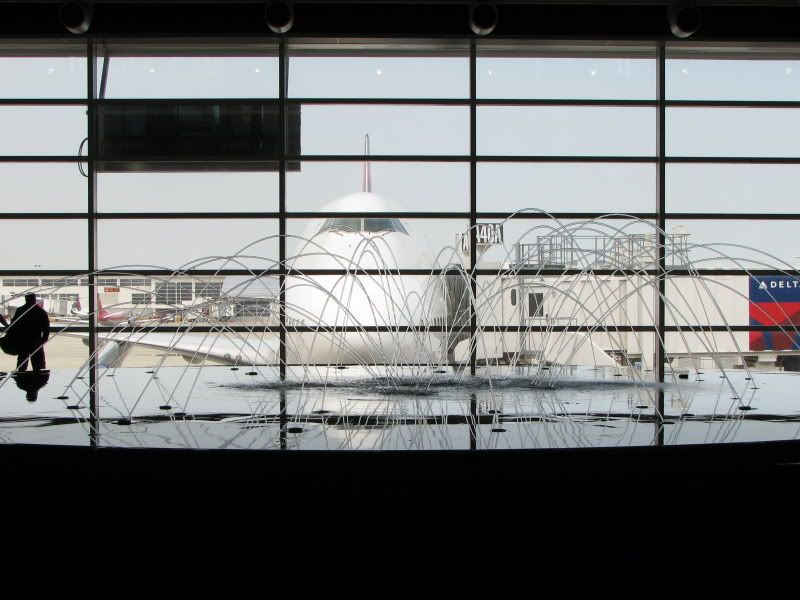
I really enjoy flying into Detroit. It's a fairly busy airport, but a well-laid out one, and operations generally flow freely and predictably. The McNamara Terminal still gleams and echoes with the songs of birds who have flitted inside, and the sight of a 747 behind the dancing water fountain has already become an iconic image of aviation. The only downside, for me, is that the airport's taxiways look and feel more bombed out than Beirut circa 1982. Fortunately, the airport has undergone a steady program of resurfacing over the last few years. This time, taxiway Foxtrot just north of NewCo's northeast gates was ripped up. To provide an alternate route to our gates, A75 through A77 have been taken out of service so aircraft can use the ramp to transition from Uniform to Uniform Eight. The system seems to be working pretty well.

We had a three hour "productivity break" in Detroit, even after our late arrival. NewCo has a crew base there, but Minneapolis crews can't normally access the crew room as it is located in an area accessible only to holders of Detroit SIDA badges. Fortunately for us, Kevin had been based in Detroit for a month and had exactly such a badge so he could escort us to the crew room. I spent my break trying to figure out a way to get my little brother Steve and his girlfriend Torrie home from Hawaii. They'd flown to Honolulu on my buddy passes over Memorial Day weekend, lured by the promise of wide-open flights coming and going, only to find themselves on the bottom of an 80+ person standby list for every flight they tried to take out. After talking to a family of five that had been trying to get out of Honolulu on buddy passes for nearly two weeks, Steve decided to bite the bullet and buy positive-space tickets back to Minneapolis. The price was surprisingly cheap for a same-day one-way ticket: $585. Once again, Honolulu confirms that its reputation as a non-rev black hole is well-deserved.

Our plane arrived only 25 minutes before our departure to Charlotte, so our third consecutive leg blocked out about ten minutes late. Every seat was once again full, and we were also carrying quite a bit of extra fuel in anticipation of possible thunderstorms developing near Charlotte. The northern portion of the route featured typical late-afternoon buildups that were still well below our cruise altitude, but as we crossed into Tennessee we started spying 45,000 foot giants further ahead. I pulled up the ATIS at Charlotte: "3/4SM +TSRA". We wouldn't be landing in that. I texted our dispatcher to inquire about what she was seeing on radar, and she promptly replied that the thunderstorm was relatively small, but parked directly over the airport with very little movement. She also changed our alternate from Raleigh-Durham to Knoxville due to another thunderstorm developing just west of RDU. I love getting one of the good dispatchers.

Shortly thereafter, Atlanta Center changed our transition for the JOHNS2 arrival and cleared us to hold at BURLS. No surprise here. I entered the hold in the FMS, verified it with Kevin, and activated it. Kevin started slowing early to save some gas, and I began calculating our bingo fuel. Generally, I compute two "Bingo" numbers when holding for thunderstorms at the destination. The first number is traditional bingo fuel, meaning that required to proceed from the hold to the airport, shoot an approach, go missed, proceed to the alternate airport, and have a 45 minute reserve remaining. If the airport is still questionable when we leave the hold, I won't proceed with less than this traditional bingo number. On the other hand, the weather may clear very quickly after the passage of a storm. If the weather is good and there is no question of being able to land, I am willing to proceed from the hold with less fuel than the traditional bingo number so long as I will land with a conservative reserve. In no case, however, will I hold beyond the time at which I have enough fuel to proceed from the hold straight to the alternate and still have a reasonable reserve on landing. I call this my "drop dead bingo" - once the fuel tanks indicate this number, I'm headed for my alternate no matter how quickly ATC says they'll be getting me out of the hold. The spread between the two numbers can be significant, particularly when holding at a point between my destination and alternate airports. This was now the case.

I texted our holding point, altitude, expect further clearance time (EFC), and fuel on board to our dispatcher. Her reply a few minutes later included a bingo fuel number very close to what I had computed for my traditional bingo. We had approximately 45 minutes of holding fuel above that number. If further holding was necessary, my "drop dead bingo" number was over 1500 lbs less, and our proximity to Knoxville would allow me to either coordinate our diversion in a leisurely fashion or arrange for the deletion of our alternate if the weather in Charlotte had improved sufficiently. As we entered the hold over BLISS, I composed a short PA in my mind and then pressed the "transmit" button to deliver the bad news to our passengers.

As it turned out, the news wasn't all bad. Thirty minutes after we entered the hold, Charlotte began accepting arrivals again. We had initially held at FL330 but had been descended as aircraft below us diverted to their alternates. Only ten minutes after Charlotte reopened, we were cleared out of the hold and back on the arrival; a last minute clearance to cross SHINE at 11000' required a steep, nearly full-spoiler descent. As nice as the JungleBus' Vertical Navigation (VNAV) capability is, it can bite you on such late descent clearances. By the time you actually get your crossing limit set up in the box, you may be too high to make it. For this reason, I apply the tried-and-true "3-to-1" litmus test to any crossing clearance before anyone messes around with VNAV. This is a simple method of computing a 3 degree descent: You take the altitude to be lost in tens of thousands of feet, and multiply it by three to get the distance required in nautical miles. If you need to lose 10,000 feet, you need 30 miles for a 3 degree descent. If my quick-and-dirty computation shows a 3 degree or steeper angle required, I will establish the aircraft in a 2500 foot-per-minute descent (or direct the pilot flying to do so) before setting up VNAV. Technology can make life on the line easier, but Rule One is still and always will be: "Fly the Airplane!"

Lightning crackled just to the east over downtown Charlotte as we landed on Runway 18R. This would have been a full, eventful day even if we were done in Charlotte, but we still had two legs left and were now a full hour behind schedule. At least we were keeping the airplane to Atlanta, making for an easy quick turn - or so I thought! When I followed the last of our passengers up the jet bridge to retrieve our paperwork, I found the gate in a state of bedlam, with a long line of harried travelers querying a lone, distressed gate agent. The board behind him advertised a delayed Minneapolis flight, with a departure time well in the past. "Umm, isn't this airplane going to Atlanta?" I asked.

"I don't know anything about that!" the gate agent exclaimed. "Nothing's going to Atlanta. This airplane is going to Minneapolis, but the crew already timed out. Can't you fly it?" Immediately, a half-dozen passengers surrounded me, imploring me to fly them to Minneapolis. "Hold on a sec, folks, I'm going to call our dispatch office and see if that's what they want us to do." I very much doubted that dispatch wanted us to fly to Minneapolis, or our phones would've been ringing off the proverbial hook already; I mostly wanted to know what in tarnation was going on. I walked down the concourse - out of earshot of the passengers - and called dispatch. No answer. I tried a few other desks. Same results. A glance at a national radar display on one of the flight information boards suggested why: a bright red blob was sitting squarely over Atlanta. It's always toughest to get ahold of SOC during Irregular Operations. I just might have to get answers for myself. I walked up to another WidgetCo gate, this one advertising a seriously overdue departure to Atlanta. "Where is 5750 to Atlanta going out of?" I asked. The gate agent pulled up the flight; "It's going out of A7, and the plane is actually already here. It landed almost a half-hour ago!" I chuckled at that. "Well, that's our plane, and you might want to get the agent down at A7 on the same page, because he thinks he's keeping that plane for Minneapolis!"

The change had been announced by the time I walked back over to A7. Now the Minneapolis passengers were upset at their lack of an airplane as well as a crew, newly arrived Atlanta passengers were utterly confused that the gate was still advertising Minneapolis, and that poor lone gate agent tried mightily to be polite in the face of an onslaught of questions and accusations even as he struggled to switch the computer system from the MSP flight to ours. I stood by the gate and fielded as many questions as I could. Many simply wanted to know if Atlanta was open yet, a very good question I was wondering about myself. I still couldn't raise dispatch on the phone. Again, taking the self-sufficient tack seemed best. I retreated down the jetbridge to fill in my bewildered crew on developments thus far, and to call Clearance Delivery regarding our flow time to Atlanta. Clearance confirmed that Atlanta was opening, but our EDCT time was approximately 70 minutes hence and subject to further change. This was better than I was expecting. I headed back up the jetbridge to tell the gate agent that we could start boarding in 20 minutes; I usually plan on getting out to the runway about 15 minutes before any EDCT time so that unforeseen delays don't cause us to miss our slot.

Our EDCT ended up changing three times before we got out. First it was moved back by 90 minutes, then to only twenty-two minutes from the time I got the change. This might have been doable if we had the passengers on board, but a recent arbitrary and capricious rule change by unelected bureaucrats at the Department of Transportation has made us all a little gun-shy about early boarding. This is a lengthy subject meriting its own post, but suffice it to say that nobody wants to be the Captain who keeps his passengers on board for more than three hours between boarding and takeoff and accidentally subjects his airline to a draconian fine (over $2 million in the case of a full JungleBus, or more than one of our engines costs!). Obviously, twenty-two minutes wasn't enough time to board 76 passengers, run our numbers, and taxi out to the runway. Fortunately our final EDCT change was for only fifteen minutes later. A last-minute runway change resulted in taxiing the long way around a dark, unfamiliar ramp while Kevin grappled with the new takeoff performance system. We completed the Before Takeoff Checklist just as Charlotte Tower cleared us for takeoff on 18L, and I taxied onto the runway very slowly so we could take a moment to compose ourselves and double-check our work before hurtling down a darkened, rain-slicked runway at 160 mph.

Soon after we turned right onto the departure, lightning began flickering off to the east. I knew the thunderstorms that closed Atlanta were moving northeast, or roughly onto our arrival route. I have a certain fascination with thunderstorms, but prefer to observe from the ground; this is doubly true at night. Of course we have radar, but the best means of avoidance is the 'ole "Mark 2 Eyeball," and it doesn't work so well on dark nights when lightning appears to fill the sky and you can't see developing buildups. I turned the instrument lights down low and sat forward on my haunches, peering out into the blackness. South of Spartanburg at FL300, we stumbled upon a towering behemoth that materialized out of the ether like an iceburg in the foggy North Atlantic. We turned thirty degrees right without waiting for Atlanta Center's belated approval. There was no lightning and no precipitation to register on our radar, but I don't doubt this pubescent thunderstorm would have given us a ride to remember had we blundered into it. Further along the arrival, the giant cell that closed Atlanta for hours slid by twenty miles to our right, spitting out lightning menacingly the whole time. I wondered what our passengers thought about it.

We were vectored onto the final for Runway 26R surprisingly quickly and I took advantage of the wet runway to make an admirably soft touchdown. Our seventy-six passengers scampered off the airplane in record time in hopes of making their connecting flights. I stifled a yawn as I collected our paperwork at the gate and checked the radar. I'd now been awake for over sixteen hours and on duty for thirteen. Legally, I could be on duty for another three hours! Over a year after the FAA promised to have new duty and rest time regulations in place and the industry publicly promised to support changes in an effort to contain the media fallout from Colgan 3407, the airlines have been successful in fighting a rear-guard delaying action at the Office of Management and Budget. In the meantime, those of us at the pointy end of things do what we've always done (with varying degrees of effectiveness): decide whether we're safe to fly at the time when we're rendered least capable to make an objective judgment. This time I felt fairly alert - but was it just the fatigue talking?

We quickly loaded up, pushed back, and taxied down to 26L for our fifth takeoff of the day. The lights of the terminals flashing by my window seemed to put me in a momentary trance; a gentle prompt from Kevin snapped me back to reality, and I belatedly commanded "Positive Rate, Gear Up." Perhaps I was a little less alert than I previously believed. The route up to Louisville was blessedly clear of thunderstorms; however, that left less to do, and several times I found myself jerking my head up with a start after nodding off into a micro-sleep. Not good. One of my least favorite memories as a pilot is waking up at the controls of a Navajo on a half-mile final to Burbank and not being able to remember the previous half-hour. Having a First Officer on board makes that scenario potentially less dangerous to life and limb but even more hazardous to career and reputation. I put on the oxygen mask on in the descent to get a few puffs of 100% O2, then turned the autopilot off early. I was expecting a straight in approach at Louisville, but I had forgot that our late arrival would put us squarely in the middle of the UPS rush. It was the busiest I've ever seen Louisville. Approach Control made us fly all the way to IIU VOR, then south for twenty miles before turning in to a twenty-five mile final. At long last, we touched down on Runway 35R and made the short taxi to the gate. The passengers seemed to take forever to file sleepily off the airplane. We were hard on their heels.

After all that, one would think I should be able to go to sleep quickly and soundly. Yet the day somehow feels incomplete. Delivering nearly 400 souls safely to their destinations over five legs and 2000 miles through some of the world's busiest airspace and around its wildest weather feels like a real accomplishment, even if it's done on a thoroughly routine basis. I still occasionally feel myself in complete awe that man can fly at all, much less do so with a high degree of comfort, safety, and reliability in a pressurized aluminum tube hurtling through the outer reaches of the atmosphere. Whatever my opinions on the state of my industry and profession, I still feel extraordinarily privileged to be part of the brotherhood of the air, never more so than after a long, tiring day of duty performed well. I permit myself the small celebration of my glass of single-malt, and then turn in for the night.

Tuesday, June 01, 2010

Appalachian Trail (Part 3)

Our first night of camping was relatively warm (ie 35 degrees) compared to what I endured on my way across the southern states this winter, and I had finally brought along a mummy bag. Brad had a lighter bag but stayed warm by discovering a new motorcycle camping technique: sleeping with his helmet on. We broke camp in record time - I didn't know Brad could move that fast in the morning! - and rode to a nearby Burger King to warm up with coffee, charge our bluetooth intercom systems, and talk about our route. This was our fourth day of riding, and we weren't even done with the Blue Ridge Parkway. Brad needed to get home to Portland by Sunday night, preferably sooner, and the flights out of Boston were full on Sunday. There was an open direct flight on Saturday afternoon, however, and he voiced a hope of making that flight. There was little chance we could complete the original route through northern New England and still make it to Boston in time. We agreed to see how far into northeastern Pennsylvania we could ride today and then decide on our arrival date in Boston and the route to take there. I was hoping that if we got far enough, we might yet be able to put in two long days of riding through New England for a late Saturday arrival.

The sun was warming the morning considerably as we rode the winding road to the Parkway up the Blue Ridge. Upon pulling onto the Parkway, Brad couldn't resist the urge to pass me up and let the beast loose, pulling up into a screaming wheelie right past a couple of park rangers. I meekly followed at 45 mph, avoiding the rangers' steely looks. The last fifty miles of the Parkway were exceptionally pleasant, winding along the top of the ridge for most of the duration, and we reached the end all too soon. We rode directly onto Skyline Drive, a 105 mile ride which is very similar to the BRP except that it lies within Shenandoah National Park, so you pay $10 to enter and the road is posted at 35 mph for its entirety. I can't say we were entirely observant of the speed limit, but we did back off considerably from our Parkway pace in light of the many deer we saw along Skyline Drive. Our northern progress was now noticeable, for many of the trees at higher elevations were still bare. The last five miles of the road from the ridge top to Front Royal were like a time-lapse video of the progression of the season as we descended precipitously through increasingly lush foliage.


The vast majority of our miles since Chattanooga had been through sparsely populated areas, or skirting around cities on the BRP. Riding out of Front Royal on US-340 toward Frederick, the reappearance of heavy traffic and roadside congestion was a little jarring. We passed through the West Virginia, Maryland, and Pennsylvania borders in quick succession, and Brad pulled over to take photos at each "Welcome to..." sign, as is his custom. The steady train of 18-wheelers screaming by without budging from their position in the right lane made me more than a little uneasy. I had selected this route over Interstate 81 mainly because I had expected it to be a quiet, rural stretch of highway; this was our first encounter with Northeastern "suburban sprawl."

We reached Gettysburg by 3pm. Brad and I had agreed before the start of the trip that a stop at the Gettysburg battlefield was mandatory, and my visit to Chickamauga had further stirred my interest. Now, with five hours of light remaining and again falling well short of the mileage I'd hoped to ride today, I considered skipping it. The reality, though, was that there wasn't much chance of getting to northern New England on this leg no matter what I did, so we might as well make the most of the places we did ride to. We spent about two hours riding around the battlefield and stopping at the Gettysburg National Cemetery, site of Lincoln's famous address. The battlefield was recreated in the 1880s and 90s by veterans of the battle, and has since been painstakingly preserved by the National Park Service; it retains many of the original buildings, most of the original network of roads, fields, and fences, and a similar layout of forested areas as in 1863. Looking out across the open fields, it is easy to understand why this was the bloodiest battle of the Civil War: there was simply nothing out there to stop cannon and rifle fire but the bodies of the desperately charging men.


We were back on the road around 5pm, and initially made good time northbound on US-15, a four-lane divided highway. A strong westerly wind had come up, and we were now riding permanently leaned over, weaving occasionally in the gusts. Twenty miles down the road, I hit a small bump and my left mirror glass came out of its housing and tumbled to the roadway. I looked back in time to see it shattering; no point to stopping now. This was the second time it happened on this trip; the mirror is a poor design with the glass held in by friction, and it occasionally vibrates loose on bumpy roads. My aggravation over the loss of the mirror was increased by heavy congestion into Harrisburg, and then construction and clueless drivers on the roads bypassing it. Finally the traffic on I-81 eased and we were able to knock off a final 80 mile run in an hour. It was very clear to me by now that we'd come up well short of the mileage needed to consider making a go at the New England route, so I figured we may as well stop with an hour or so of light left so we could find a nice spot to camp.

We pulled off the Interstate at Hazleton and I used my Palm to search for campgrounds. The only one nearby was the private Sandy Valley Campground fifteen miles away, just outside the run-down hamlet of Freeland. A sign at the city limits declared Freeland to be the "highest borough in Pennsylvania" - just our luck, we'd been hoping for a warmer night! The campground was pretty interesting - from the road, it appeared as though somebody had simply created a campground from five acres in their backyard. We turned out to be the only ones staying the night, although most of the campsites had RVs semi-permanently parked in them for the summer. The rough, loose gravel-covered roads down the hill to our campsite were a challenge to negotiate on the bikes, particularly later that night. The lakeside campsite itself was very nice, with soft flat ground to pitch our tents on.


After making camp, we road back into Freeland to find a place to eat and have a few brews. We selected "The Other Side," the diveyest-looking bar in a divey-looking town. It was packed. We found two open stools, ordered some wings and beer, and talked over our plans for the next day. Brad was pretty set on making the Saturday afternoon flight; he was needed on the home front. Once we got to Boston, Brad was hoping to sell his bike, and if that didn't happen we needed to at least wash them and find some storage on Saturday morning, meaning we should ride to Boston on Friday, the very next day. I had accepted the fact that we wouldn't be able to do New England on this leg; I would simply go back to my original plan of doing it on the last leg from Boston to Minneapolis. In this case, however, we could go through the Catskills on our way to Boston tomorrow, cross the Hudson at Poughkeepsie, wind our way through Connecticut to New Haven, and pick our way up the coast from there for a little over 400 miles of riding. Armed with a plan for the next day, we rode back to the campground and built a campfire to sit around for a few hours, talking and drinking the last of our beer.


The next morning was chilly but we started riding quite early nonetheless. We hopped onto I-81 for forty miles to Scranton - yes, "The Office" theme song was playing in my head - and stopped to fuel up. I reached for wallet and was surprised to find my debit card missing. I thought back and realized that I had given it to the bartender at The Other Side to start a tab, but had then paid in cash without remembering to ask for my card back. I called my bank to cancel the card, and used my remaining cash and backup credit card for the rest of the trip.

The ride through the Pennsylvania countryside northeast of Scranton was a pleasant surprise. Up until now most of our riding in Pennsylvania had been on the Interstate, the rocky hills were starkly nude as the trees were still budding, and the few towns we saw all appeared to be severely down at the heels, brutally industrial, or both. It hadn't left the most positive impression on me. In the northeastern corner of the state, however, we took minor state highways for sixty miles and were rewarded with great roads, beautifully rolling landscapes, and a steady parade of stately picket-fenced farmhouses, picturesque red barns, fieldstone fences, and whitewashed old churches. Crossing the Delaware River at Hancock, NY, the rolling Pocanos gave way to the rockier Catskills. A few miles down the road, we turned northeast on NY-30, which follows the East Branch of the Delaware river, and then southeast on NY-28 to Kingston. This is a beautiful stretch to cruise on a motorcycle, not least for the 55 mph speed limit through many tight sweepers. The only downer was the swarms of insects we rode through. A few were big enough to render me temporarily blinded by loud, messy, green and yellow explosions on my face shield; wiping it off with my glove allowed for occasional glimpses of the road through the smeared bug juice. After the ride through the Catskills, the Beemer was in desperate need of a wash.


From Kingston, we rode along the Hudson River for a short stretch of US-9W. I can certainly see why the Hudson is nicknamed "America's Rhine River," for its resemblance to the section of the Rhine between Mainz and Köln is uncanny. We crossed the river at Poughkeepsie and stopped for lunch at a pizza parlor shortly thereafter. The proprietor took a keen interest in our trip, and talked rather wistfully about how he used to jump on his bike and ride cross-country for days on a whim. Back on NY-55 eastbound, we kept waiting for the congestion around Poughkeepsie to ease, but it never really did. I'd expected the area along the Connecticut border to be rather rural, but it was unrelentingly suburban and the going was slow on NY-55 and NY-22. We jumped on I-84 and raced across the state line, thrilled to be going faster than 40 mph and with no stoplights. Twenty miles later we exited onto CT-34, which on the map looked like a fun road along the Housatonic River but was in fact choked with heavy traffic through endless development. Now I recalled flying from Memphis to Boston at night and seeing the bright river of light of the BosWash corridor; why had I expected Connecticut to be anything other than one big suburb?

It was late in the afternoon when Brad and I finally spied the Atlantic Ocean from I-95 through New Haven. We had been planning on jumping off the freeway to ride along the coastline, but it was now clear that these miles would be long and frustrating, with a late-night arrival to Boston inevitable. No, best to stick to the interstate, we agreed when we stopped to fill up for gas in Madison Center. Despite being rush hour, I-95 was moving freely and we were able to make one final, speedy push of 135 miles through Rhode Island and into Boston as the sun sank into the western horizon. It was nearly 8pm by the time we pulled into the parking lot of NewCo's crew hotel. We had made it, 5 days and 1600 miles since setting out from Atlanta.


The next morning we slept in rather late, had a leisurely breakfast, then took the bikes to a self-service car wash and scrubbed the dirt and bugs off of them. The Beemer hadn't gleamed this brightly since setting out from Minneapolis last July. Brad had a few people reply to the craigslist ad he'd posted a few days earlier, but nobody came to see the FZ-1 on Saturday afternoon; he ended up flying back to sell it for a tidy profit two weekends later. We found a self-storage place a few blocks from the crew hotel with a "first month free" promotion, which was perfect since we'd only need it for two or three weeks. After putting the bikes to bed we caught the hotel van to the airport, went through security, had one last celebratory brew at the Harpoon Tap Room, and parted ways as Brad boarded his flight to Portland. Any lingering disappointment over cutting the trip short was overshadowed by gratefulness that we had finally been able to do a big ride together, we had a great time, and we made it to the end safely. As I boarded the Airbus to Minneapolis, I knew I'd be returning within a few weeks for the spectacular ride through New England and into the Great Lakes states. Better yet, next time I'd be accompanied by my very favorite riding partner.

Monday, May 24, 2010

Appalachian Trail (Part 2)

The sun woke me up before my alarm clock on Wednesday morning; the sky was cloudless and deceptively warm looking, making for a breathtaking surprise when I stepped outside. Asheville was under a freeze warning until mid-morning, which surely meant the Parkway would be treacherous until around noon. We had plenty of time for breakfast, so before Daphne left for work at the Sunny Point Cafe she suggested that we come by. It was a special morning at the Cafe: Good Morning America was filming there for their "Best Breakfast in America" feature, of which Sunny Point was one of the four finalists. When we swung the bikes into their lot at 9am, there was a long and enthusiastic line of diners, but we were seated and served surprisingly quickly. Both Brad and I tried the dish which earned Sunny Point the "Best Breakfast" nomination, Huevos Rancheros with black bean cakes, chorizo, and tortilla chips. It certainly got my vote. The film crew actually filmed Brad and I being served our plates, but when the segment aired on May 15 we were nowhere to be seen. Apparently two wild-haired, scruffy-bearded bikers straight off the road weren't quite what the producer was looking for!


After we said our goodbyes to Daphne and the crew at Sunny Point, we rode to a nearby auto parts store so Brad could change his oil. He didn't know when it had last been changed, as he had bought the bike specifically for the trip a few weeks prior in Nashville. This store didn't have an oil pan we could borrow, but a discarded windshield washer fluid bottle with the top cut off worked nicely and we were on the road a half hour later.


As soon as we got on the Parkway, it was obvious that we had made the right decision in stopping early the previous day. The downwind side of every exposed tree branch was coated with a half-inch of rime ice. We stopped at an overlook to take pictures when the wind began flaking the ice off the trees, creating the effect of snow despite the blue skies. Brad pointed out a group of Harleys with Minnesota plates, so I went over to talk to the riders. They asked where I was coming from, so I launched into the by-now familiar catalogue of places I'd been and roads I'd ridden over almost 11,000 miles. "Which way did you come?" I asked my fellow Minnesotans. They sheepishly admitted they had trailered their bikes the whole way and had ridden 25 miles so far.


The first forty miles of Parkway followed the ridge at between 4000 and 5000 feet elevation, and there was still ice in the shadows; we rode more carefully than we might have on the undulating sweepers. We had just started to descent to lower, warmer altitudes when we came across a "Road Closed Ahead" sign. The Minnesotan Harley riders were stopped at the closure, discussing their options for bypassing the areas of the Parkway closed by the prior day's rains. After talking to them, Brad and I decided on taking NC-80 to US-19E to NC-226, rejoining the Parkway to Linville Falls, and then bypassing it on US-221 until Linville. From here, the Parkway was open to its terminus at Waynesboro, Virginia.

North of Blowing Rock, the Parkway descended into rolling woodland, yet the still-curvy road was no less enjoyable for the scarcity of overlooks. We'd been exceeding the ridiculously low speed limit all day, but now our tempo crept steadily upward into freeway territory. Neither of us said anything about it at the time, but both of us were thinking the same thing: what if a deer jumps out? What if there's stopped traffic around one of these blind curves? In light of events later that day, we talked about this as we drifted off to sleep in our tents that night. It struck me that we, two airline pilots, were both thinking in terms of risk mitigation, yet neither of us was really inclined to slow down.


Along the North Carolina / Virginia border, we rode through at least twenty miles of heavily storm-damaged forest, and crossed at least two narrow swaths of utter destruction that were the unmistakable work of tornadoes. I asked about it at a gas station down the road in Meadows of Dan, VA, and the clerk said the storm came through nearly a year ago. The terrain continued to descend and the countryside became more populous as we approached Roanoke, which the Parkway skirts to the east. We stopped at an overlook around mile marker 105 to call the wives, eat a cereal bar, and decide how much further we wanted to go. At this point it was after 5pm and we had ridden nearly 300 miles since Asheville. I had hoped to reach the end of the Parkway that day but the late start meant we would come up about 50 miles short. I slowly rose off the soft grass where I'd been basking in the late-afternoon sun and climbed back on the bike for one last fifty-mile push.

Shortly after we got back on the Parkway, it climbed dramatically to nearly 4000 ft elevation and followed the top of the Blue Ridge for over twenty miles. The road meandered through strands of birch and poplar trees that occasionally gave way to open sections with vertiginous views of the countryside below. This stretch of Parkway was on par with the most spectacular sections we had seen just out of Asheville earlier in the day. Again our speed crept steadily upward in the absence of traffic or sharp curves. I was getting hungry and was eager to reach Buena Vista, our destination for the night. Twenty-five miles away, the road left the ridge top and started dropping down the eastern flank in its way to the James River crossing, the entire Parkway's lowest elevation. The blacktop became curvier as it followed the terrain, but the first few turns were sweepers and I barely slowed going into them, for most of nearly 350 miles that day had been spent riding the edges of my tires and I was feeling pretty confident. That was the final ingredient needed for what was about to take place.

Much of the descent took place along exposed cliffsides, some turns protected by guardrails and others not. Now we descended into woodland and the ridge's flanks became less vertical. I saw that the next curve was tighter than the rest, so I slowed a bit going into it. As I leaned over and looked into the turn, I realized that it was much tighter than I had anticipated, and I kept off the throttle. I leaned harder and harder, keeping my head turned and eyes out around the curve, and noticed with consternation that no matter how hard I leaned, I was drifting way outside. Suddenly I felt my wheels drop off the pavement and into the dirt, and they began slipping out from under me. My first reaction was panic, then disbelief. "Aw, $#@&!" I exclaimed as I stood the bike up to keep from low-siding and turned my eyes ahead to survey what I was about to crash into. There was a bit of a ditch alongside the road and then an earthen berm perhaps two feet tall; beyond that, the hill dropped away steeply with only hard tree trunks to stop one's progress. I plowed through the ditch and popped up onto the berm, getting airborne for a split second before slamming down, my rear wheel fishtailing about. "Ride it, ride it, ride it!" was the only thing going through my mind. I fully expected for this to end with me and the bike on the ground, but I hoped to at least be somewhat slowed by the time that happened. The berm was maybe a foot wide, and although it was quite bumpy along the top I was actually able to keep the heavy bike upright and pointed in the right direction. Before I realized it, I had slowed to a quite survivable speed, and then a perfect little ramp appeared off the edge of the berm. I rolled down the ramp and back onto the road, no worse for the wear. I slowed to a halt and looked over at Brad as he pulled up alongside, shaking his head. The backside of a blind curve is a bad place to stop, so Brad motioned for me to follow and headed down the hill, pulling over a mile later.

"I was getting bored with the Parkway so I thought I'd try a little off-roading!" I cracked as we turned off the bikes and flipped up our visors. Brad smiled at my weak attempt at humor, then shook his head in amazement. "Dude, I cannot believe you didn't go down right there. I've never seen anything like it! That was some good riding, but you also got really, really lucky." I knew exactly what he meant. That was the first curve in several miles where going off the road was even survivable, to say nothing of being rideable. I inspected my bike for damage; there was a little dirt in the tire treads but no other signs of my close scrape. Brad and I talked about what caused me to go off the road in the first place. Although the curve was tight, I'd gone around several equally tight turns throughout the day, scraping my pegs a few times; I couldn't lean over far enough to do so this time. Brad provided a big clue why: I'd been using my front brakes well into the turn. I didn't even realize I was doing it, but he was right behind me and clearly saw me doing so. I knew this was a big no-no, but didn't have a clear understanding of exactly why it's such a bad idea. Brad explained that using any front brake compresses the front tire, squaring it off and making it much, much harder to get on edge no matter how far you lean. I didn't know that, I thought that using brakes in a turn simply uses up available traction. He told me to do an experiment on the next tight curve we came across: enter it with front brakes applied, then release them smoothly and feel how much easier the bike is to lean over. The difference was astounding, and I'm a little ashamed to say I went 20,000 miles over the last three years before finally understanding why it is so critical to stay off the front brake once you enter a turn.

I tried to put the incident out of mind and concentrated on riding well the last twenty-five miles to Buena Vista, although I certainly backed off a bit from our previous pace. It was dusk by the time we made camp on the banks of the Maury River in Glen Maury Park. We rode back into town to an interesting-looking bar we had passed on the way to the campground. The Stone Grey Pub is located in a unique triangular brick building that was built by a retired ship captain in the late 1800s. When we entered the packed pub, it was obvious that this was the hot spot for nightlife in an otherwise slumbering town. A middle aged man in a plaid shirt and a ballcap was strumming an acoustic guitar and softly crooning into a microphone, accompanied by an old-timer deftly plucking an upright bass. We shared a table with a burly white-bearded man picking on a second acoustic guitar; later he took the microphone, and the original singer went to drink at the bar but would occasionally stand up from his beer, wander over to the microphone, and harmonize on a chorus. An emaciated-looking guy in a tattered t-shirt had an array of harmonicas in every key laid out on the table across from us, and every once in a while he'd pick one up and add a few haunting notes. As everyone seemed to know each other, we were obvious outsiders and an older woman behind us asked where we were coming from and where we were going. Before I knew it, she was taking our picture and writing in a notepad; she turned out to be a reporter for the local paper. She introduced us to her son, her best friend, and several of the other patrons. Brad got talking to Dave, the harmonica guy, who turned out to be a pretty interesting character. He is from central Pennsylvania but has been living a nomadic life in his camper van for some time now, traveling up and down the Blue Ridge doing odd jobs, playing music gigs, and hiking portions of the Appalachian Trail whenever he can. The conversation, the music, the Yuenglings and hot chicken dumpling soup (just like mom used to make!) all made for a very nice end to the day, and I felt immensely grateful to have made it through my close call unscathed.


After last call at 9:30pm (!), Brad and I rode back to the campground and settled into our tents for the cold night. I called Dawn and we talked for a few minutes about our respective days. Against my better judgement, I told her about my off-road adventure but left out the juiciest details, like how steep and wooded the hill beyond the berm was. She sounded surprisingly unconcerned but told me to ride carefully. After I hung up, Brad and I talked a little bit between our tents as we drifted off to sleep. Despite the near-disaster on the Parkway, it had been a very good day, one of the best of my trip so far. As for my screwup, I learned a valuable lesson at about as cheap of a cost as could be imagined. Usage of brakes in turns was part of it, but so was riding faster than prudence dictated on an unfamiliar road. Best to take that lesson and move on, for it has been my experience in flying and in life that dwelling too long on my mistakes leads to distraction and more serious mistakes.

To Be Continued....

Wednesday, May 19, 2010

Appalachian Trail

There are two people to thank for igniting my current motorcycling obsession. The first is my Dad; he was an avid motorcyclist back in the 70s, owning several British and Italian bikes that would be collectors items today before acquiring a Harley Electra Glide that was his pride and joy. He sold it when I was born and didn't ride again until a few years ago, when my brothers found a good deal on an '87 BMW K75S and bought it for him as a Christmas present. He encouraged me when I showed interest in learning to ride and even let me learn on his tall, heavy K75 when I knew frightfully little about riding. He now rides a '98 BMW R1100RT, my brother Josiah owns the K75, my brother Jon rides a Yamaha R6, and my brother Steve is perpetually between bikes. We are all blessed with wives and girlfriends who enjoy riding, making for some very enjoyable family outings.

Well before my dad started riding again, my good friend Brad was pestering me to buy a bike. Brad has been riding since he was 16 years old, and has had a plethora of bikes pass through his garage since we met while instructing in Southern California. After I followed Brad to Horizon and Portland, we hung out a lot but seemed to do little but drink each other's beer. "If only you had a bike," he'd say, "it'd be a gorgeous day for riding." I didn't know what I was missing out on. I was interested in motorcycles but it was too low on my list of priorities to merit a chunk of my limited disposable income. Brad was simultaneously pleased and aghast when I learned to ride and bought a bike only months after moving back to Minnesota.

Since then we've been trying to do a motorcycle trip together. Shortly after I bought the BMW in October 2008, we planned a ride down the east coast for the next spring. That fell through when Brad's father became severely ill and passed away shortly before we were to leave. When my bike was in Portland last year, we did some riding together, including a three day trip around the Olympic Mountains and San Juan Islands after we somehow convinced our spouses to spend their anniversaries on the backs of our bikes. When I started considering a Round-the-USA ride last fall, the inclusion of an east coast trip with Brad in the spring was the major motivation. I bid vacation for the last week of April and rode around the country with that timeline in mind; Brad worked his charm on Horizon crew planners to get the whole week off as well.

It almost all came undone in the silliest way possible on the morning of my departure to Atlanta. I was walking across our living room floor as I was packing, and suddenly collapsed to the floor with excruciating pain to my lower back. I was able to get up and walk only with great difficulty. This has happened to me a handful of times since I injured my back in high school; the pain has always come on unexpectedly and inexplicably, and has always faded within a day or two. I decided to fly to Atlanta anyways and see whether I could ride through the pain. Unfortunately the flights to Atlanta were all packed, so I spent a good part of the day hobbling around the Minneapolis airport bent over like a hunchback, dragging my heavy saddlebag along. I ended up making it south only by connecting through Grand Rapids. It was dark when I emerged from Atlanta's midtown MARTA station; I could barely walk by now, and the four blocks to my friend Jeff's condo were painful and slow. I had real doubts about starting the trip the next day.


Monday, April 26 dawned bright and clear over Atlanta, and I woke to almost no back pain. It returned somewhat over the course of each day, but was completely gone by the end of the week. I set out for Chattanooga shortly after 7AM. Once clear of the rush hour traffic, the riding was good on I-75. I was due to meet Brad in Chattanooga later in the day; his bike was in Decatur and he had a chain problem he needed to sort out before riding up to meet me. In the meantime, I needed to get my engine, transmission, and final drive oil changed. I stopped in Dalton GA to eat breakfast and search for an open bike shop (most close on Mondays); I found one nearby but they work exclusively on Hondas and refused to lend me an oil pan so I could do the change myself. Instead, I rode to the nearest O'Reilly's Auto Parts. They had my preferred oil in stock, let me use their oil pan, and recycled the used oil. I was back on the road in 45 minutes.

I called Brad; he suggested it might be a long wait in Chattanooga, as his bike's chain was definitely not being cooperative. On the prior suggestion of an acquaintance, I swung over to the Chickamauga & Chattanooga National Military Park, site of one of the largest battles of the Civil War. I spent most of the afternoon browsing the museum and riding around the expansive battlefield, examining the memorials erected by Civil War veterans in 1890 and reading the plaques that explained the flow of battle. For some reason, I've never been quite as interested in Civil War history as other periods of American History, but visiting the battlefield piqued my interest. It is one thing to look at orderly blue and red lines across a map, and quite another to stare up a wooded hill that men fought their way up inch by bloody inch.


It was after 6pm by the time Brad made it to Chattanooga. I had been hoping to at least make it across the Great Smoky Mountains near Robbinsville that night, but that would now require negotiating the Cherohala Skyway in rapidly fading light. Instead, we decided to stop for the night in Tellico Plains TN, at the base of the Skyway. We took several wrong turns on the way there due to poor signage, and then rain started to fall. It was almost dark when we pulled into Hunt's Lodge Motorcycle Campground. Camping in the rain our first night didn't sound too appealing, so we rented a cozy cabin, complete with a bike shelter, for $50. The town was almost completely shut down when we rode back in for dinner; instead we got brats and buns and beer at the grocery store and returned to the resort to use their grill and picnic shelter.


It rained off and on through the night, stopped at dawn, and began again as we prepared to leave in the morning. The skies were leaden and threatening; it did not look like a good day for riding. Due to the late start the prior day, I had hoped to put in some good miles. We lingered, waiting for a break in the rain, then left around 9AM. The first portion of the Cherohala Skyway was good riding despite the wet road, but then we went into the clouds. Visibility was cut to 100 feet, our face shields fogged up, and our pace slowed to a crawl. When we stopped at the crest for a photo, Brad declared he was ready to throw in the towel on The Dragon. He was referring to the stretch of US-129 known as "The Tail of the Dragon," famous in motorcycling and sports car circles for its 318 curves in 11 miles. A rockslide had recently closed it from the west side, but it could still be accessed from the east via a detour from the Cherohala Skyway. If the Dragon was shrouded in fog and rain like the Skyway, though, there was little reason to make the side trip over there.


We didn't have to descend very far down the eastern side of the Skyway before we popped out of clouds, and little bits of blue sky had even started to poke out between the clouds by the time we stopped at the turnoff to the Dragon. We turned off the bikes and nearly talked ourselves out of doing it - "The road will be wet, we won't be able to ride it like we wanted, we might detour only to find it fogged in, we're already running late," etc - when my "when in doubt, adventure wins out" maxim started bouncing around the back of my mind and I knew I'd later regret skipping the Dragon. "Argh, we came this far," I said. "Let's go see what all the fuss is about." We started the bikes and headed down the road past Santeelah Lake.

The Dragon is but an eleven mile stretch of curvy road - one of many in the area - but it has an outsized reputation among bikers. It's a self-perpetuating legend, actually: everyone sees the YouTube videos and hears the stories, many come to ride it with macho determination to "slay the Dragon," and a portion of these exceed the limits of their abilities or their luck, further adding to the legend. I was a little hesitant to take on such a notorious road on a rainy day, but the combination of weather and the rockslide served to minimize the Dragon's real hazard: traffic. We saw only three bikers - slow-cruising Harley riders who graciously pulled over to let us pass - and a couple of tricked-out Mini Coopers in the area for a Mini convention. The road has very good, unusually sticky pavement that didn't seem to be any slipperier for being damp. I was riding fairly conservatively, but constantly throwing my 630-pound bike around 22 miles of tightly twisting turns was still exhausting work. Brad patiently followed behind me; my pace was using but a fraction of his late-model FZ-1's amazing performance. In the end, the Dragon was well worth the detour, but not necessarily any better than a half-dozen other fantastic but less well known roads I've been on over the course of this trip.


North Carolina Route 28, nicknamed the "Moonshiner 28," was an unexpected treat with nonstop fast, sweeping turns. I really enjoy this sort of road; the K100's heavy weight isn't nearly as noticeable as it is on snarly roads like the Dragon. After about 20 miles, the road straightened out and widened to four lanes; then we joined US-74 into Cherokee. We stopped here for lunch before heading to the start of the main feature of the trip, the Blue Ridge Parkway. From the time we starting riding the Dragon until now, the day had turned sunny and warm, but in the time it took to eat a six inch sub sandwich, dark clouds again covered the sun and began spitting out rain.

We still had our rain gear on from the morning, so we didn't pay the rain much attention as we rode the few miles west of town to the start of the Parkway. At first, there was only sporadic drizzle, not enough to really wet the road. In these conditions, the start of the Parkway was immensely enjoyable. I was somehow expecting a tight, slow winding mountain road and instead found a wide open, sweeping road just built for speed (albeit posted at 45 mph for its entire length). After twenty miles, the rain returned with a vengeance; we were at higher elevation now and it was definitely colder, but I didn't think it was anywhere near freezing. Then, we turned a sharp corner onto the exposed side of a ridge and the rain instantly turned to sleet. The slap of pellets against my faceshield so surprised me that I didn't see the half-inch accumulation of icy slush on the road until several seconds later, right about the time my rear tire started sliding sideways. I stood up in the pegs and eased off the throttle, the tire caught traction again and fell in line, and I rolled to a halt just as Brad exclaimed "ice, ice, ice!" into my helmet. He had seen it as soon as we rounded the curve, but our intercom system was in standby mode and took three seconds to wake up. I very gingerly turned the bike around on the narrow, slippery road, and we retreated a few miles back down the road to US-19.

I had really hoped to do the entire length of the Blue Ridge Parkway, 469 miles in all, but it was obvious that at least the section between here and Asheville would be impassable for the day. We rode the forty miles of US-19 and US-74 into Asheville, then stopped to gas up and discuss our options. The rain wasn't constant but the heavy showers were not getting any less frequent and more threatening clouds appeared over the ridge to the northwest. The section of the Blue Ridge Parkway north of Asheville has elevations over 5000 feet, which was where we had encountered the sleet further south, and there was no easy way off the Parkway up there. We could bypass the Parkway on US-221 - but hadn't we come here to ride the Parkway? If we pressed on further for the day, the miles were sure to be cold and wet, with only the promise of cold, wet camping at days' end. Brad had a cousin in town; he called her and she immediately invited us to spend the night. A warm, dry bed sounded great, but I couldn't help rueing our lack of progress thus far. I didn't have any plan set in stone, but I had a 2300 mile route in mind that would take us up the Blue Ridge Parkway and Skyline Drive into Virginia, then across central Pennsylvania to New York's Adirondacks, Vermont's Green Mountains and New Hampshire's White Mountains, through rural Maine to Bar Harbor and Acadia National Park, then down the coast to Boston. With two days gone and not 400 miles up the road from Atlanta, the math wasn't looking promising.

I tried to put that out of mind as Brad's cousin Daphne showed us around Asheville. Once I figured out the layout that had so confused me when Dawn and I rode through a few weeks prior, I found it to be a really charming, inviting town that seems to have a ton of stuff to do if you'd stick around for a bit. With only one evening open, though, we settled for our second favorite activity after motorcycling: quaffing craft beers in several of the town's 36 microbreweries and brewpubs. Asheville only recently overtook Portland Oregon for "Microbrew Capital of the US." When we came back to Daphne's apartment, I noted with some satisfaction that the rain had done a passable job of washing several thousand miles worth of dirt off the Beemer. I went to sleep to the sound of rain on the roof, hoping for better weather in the morning to put some decent miles under our wheels.

To be continued....

Thursday, May 13, 2010

Merger Mania!

In an unusually transparent move which analysts believe is a response to the government's renewed watchfulness against corporate fraud, anti-competitive behavior, and profit motive, United Airlines and Continental Airlines management yesterday posted to unitedcontinentalmerger.com an audio recording and transcript which details the process by which top executives agreed to the proposed merger between the companies. Although the date and location of the recording is unspecified, company insiders say the conversation took place in the steam room at St. Moritz's Palace Hotel during an IATA function there in March 2010. The following is true to the original transcript except for the added explanatory remarks in brackets.

[beginning of recording]

Doug Parker [USAirways]: ..."and after that, all I remember is waking up in Central Park the next morning with a raging hangover and wearing only a leather gimp suit."

[uproarious laughter, multiple voices]

Gerard Arpey [American]: "Ol' Bob was quite the prankster. Between that night, the time he tied Lorenzo's shoelaces together, and the B-scale, we really miss him over at American."

Parker: "Yeah, we had some good times. Hey Jeff, you gonna bogart that bottle of Remy? Pass it down!"

Jeff Smisek [Continental]: "Um, you already have my fifth of Blue Label."

Parker: "Drank it all!" [sound of shattering glass]

Smisek: "You almost hit me with that, you crazy drunkard! Now who's going to clean up this mess?"

[sound of door opening]

Richard Anderson [Delta]: [calling] "Oh Glen! Come here for a moment and do bring a broom, won't you?"

Glen Hauenstein [Delta]: "Right away, sir."

Smisek: "You gotta be kidding me. You couldn't just bring your mistress like everyone else, Rich?"

Anderson: "I've found Glen to be absolutely indispensable. I don't go anywhere without him."

Glenn Tilton [United]: [shouting suddenly] "Consolidation is our salvation!"

Smisek: [groans] "Oh jeeze. Don't start up with that consolidation crap again, Tilton. Seriously, give it a rest, man!"

Anderson: "Mr. Tilton isn't entirely wrong, you know."

Smisek: "Don't encourage him, Rich. And for what it's worth, your merger has really kinda turned you into a smarmy prick. Not that you weren't before."

Anderson: "Don't be that way, Jeffery, jealousy doesn't become you. Nothing's stopping you from merging Continental."

Smisek: [laughs] "Oh, exactly which one of these winners do you propose I merge with?"

Tilton: "Pick me, pick me!"

Smisek: "Not freaking likely. You couldn't even get USAirways to merge with you. No offense, Dougie."

Parker: "Naw, it's okay man. I just wish I could go back to the happy days of running America West and driving around Phoenix blitzed out of my skull." [sighs]

[sound of door opening]

Hauenstein: "Your broom, sir. Oh, hi Jeff."

Anderson: "Be a good man and sweep up the broken glass, won't you Glen?"

Smisek: "Good Lord. You left me for this schmuck, Glen? I never treated you like that."

[awkward pause, sound of glass being swept]

Tilton: [shouting] "Consolidation will finally enable capacity discipline!"

Arpey: "Of course, the death of United would do the same thing."

Parker: "Or USAirways. I don't really care anymore." [sobs quietly]

Smisek: "It really pains me to see you like this, Dougie. Here, have a nice glass of cognac."

Hauenstein: "If that's all, sir, I ought to be going. Oh, hello there, Mr. LaHood. Come on on."

Ray LaHood [US Secretary of Transportation]: "Hiya, Fellas! How's the airline biz?"

Anderson: [groans] "Dear heavens, who invited this vile man to our function?"

Arpey: "Don't be rude, Richard. Mr. LaHood is here on my invitation. Glad you could make it, Ray!"

LaHood: "Thanks a bunch, Jerry! Always wanted to come on one of these junkets."

Anderson: "Do close the door, you're letting the steam out."

[sound of door closing]

Tilton: [shouting] "Consolidation will finally raise yields to profitable levels!"

LaHood: "Whoa! Hiya Glenn, you surprised me! Good to see you though, buddy. You're dead on about the yield stuff."

Anderson: "You know what else would help push yields to profitable levels? Letting the LaGuardia/National slot swap between Delta and USAirways go through."

Parker: [slurred] "Yeah! What he said!"

LaHood: "Now, now, fellas. We're perfectly happy to let your little swap go through. We just want to confiscate a quarter of the slots and redistribute them the carriers of our choosing to finally bring some competition to two of the most under-served airports in the country. Back in Chicago, we call that the price of doing business!"

Anderson: "How does one even respond to that?"

Arpey: "Sound like a reasonable position to me, Ray."

[sound of door opening]

Anderson: "Why, what a pleasant surprise, William! Come, come, I've saved you a spot next to me!"

Arpey: "Bill! I've been looking all over for you! Come on in, I have an idea to bounce off of you!"

Anderson: "No, No, No! Don't listen to him, William, at least not until you've heard me out."

Arpey: "Bill can listen to whoever he darn well pleases, you're not his boss just yet!"

Bill Ayers [Alaska]: "Oh jeeze. Um, can you guys put your towels back on, or at least sit back down or something?"

Anderson: "Oh dear, my apologies. I just got a little careless in my great excitement over seeing you!"

Ayers: "Uh, yeah, I noticed. Um, I just remembered...I forgot something...uh, in my room...sooo...."

[sound of door slamming shut]

Smisek: "That was awkward."

Tilton: [shouting] "Without consolidation our industry is doomed to an endless cycle of boom and bust!"

Smisek: "You're really starting to get on my nerves, Tilton. It's pretty cold outside in the snowbank. I'm just saying."

[door opens]

Gary Kelly [Southwest]: "Howdy, ya'll!"

[mumbled greetings; door closes]

Kelly: "I just saw the darndest thing. Bill Ayers from Alaska was running the other way, barefoot and half-naked in the snow!"

[Parker laughs hysterically]

Arpey: "How are you enjoying St. Moritz, Mr. Kelly?"

Kelly: "Well, it ain't too bad I suppose. Kinda purty here. Ain't much like Texas, though, that's for sure!"

Anderson: "Oh dear, where to begin?"

Kelly: "I had a bit o trouble finding a McDonalds, with all the winding streets and all. And when I found it, those crazy buggers wouldn't even take my dollars!"

Anderson: "Who could've anticipated that the Swiss might prefer to be paid in their own currency?"

Kelly: "So I went to a bank - there were five within a half-block - and traded my greenbacks for this funny-colored money. Problem is, it took twenty bucks worth to buy a Big Mac and a Coke!"

Arpey: "Switzerland is an expensive country on an expensive continent."

Kelly: "It got me thinkin', though. If Europe is so rich and dandy, and if their money buys so many dollars, why don't we price our tickets in their money?"

Arpey: "We do, for tickets originating in Europe."

Kelly: "Well that's just downright smart. In fact, come to think of it, Southwest really oughtta fly here."

[all gasp in alarm]

Anderson: "Honestly, Mr Kelly, Southwest's structure doesn't lend itself very well to international operations. Your aircraft are too small to fly across the Atlantic and your network is too dispersed to feed widebodies."

Kelly: "Well darn it, I need to fix that somehow."

Tilton: [shouting] "Consolidation is the answer to all our problems!"

Kelly: "Glenn, you ol' sly dog, you're a genius! United has the jumbos and the hubs to bring the Southwest Effect to the rest of the world!"

Smisek: "What!? No, no, no, no, no!"

Kelly: "Whaddaya say, pardner? Southwest and United?"

Tilton: "I'll sign this very minute!"

Smisek: "Somebody tell me this is a bad dream!"

Anderson: "Let's not be hasty, do remember any such deal will require DOT and DOJ approval, which seems unlikely."

LaHood: "Actually, Mr. Tilton has shown himself to be very, erm, flexible. I'm sure we can work something out."

Smisek: "No, stop! I'll do it! I'll merge Continental and United!"

Parker: [burps] "Are you drunk out of your mind or what, man?"

Smisek: [moans] "What choice do I have!?"

LaHood: "It looks like you have two offers, Mr. Tilton. Who will it be?"

Tilton: "I pick Southwest!"

Kelly: "You got yerself a deal!"

Tilton: "We'll name the merged airline United to retain its stellar reputation for customer service, and replace all those godawful poop brown 737s with super-efficient outsourced RJs, and I get to be co-CEO!"

Kelly: "Are you insane? You already ran one airline into the ground, pardner, I'll be whooped if you're gonna ruin mine too!"

Anderson: "Your move, Jeffery."

Smisek: "OK Glenn, here's the deal. We take the United name but keep the Continental paint. My niece is good with computers, she should be able to photoshop United onto the side of a Continental 787 or something. No more RJs but we'll keep the ones you have. I'll run the airline, but we'll give you a big bonus and an important-sounding title. How does 'Non-Executive Chairman' sound?"

Tilton: "Do I still get to come to these IATA parties?"

Smisek: "Of course! Even Doug Steenland still tags along. Tell him, Richard."

Anderson: "Yes, he's around here somewhere. Last I heard, he was hot-tubbing with the Swiss beach volleyball team. The women's team, I think."

Tilton: "It's a deal!"

[door opens]

Smisek: "Dave! What are you doing here? I thought you were out of the industry!"

David Neeleman [former jetBlue]: "I'm back, baby! I'm starting up a hot new airline, and I have some great new ideas that have never been tried before! We're going to base it at one of the busiest airports in the US, where we can cherry-pick the most profitable routes. And we'll fly brand-new airplanes with spiffy leather seats and entertainment systems. We'll employ young, attractive crewmembers, all at starting pay. We'll offer the cheapest tickets, and everyone will love us!"

Arpey: "Not to burst your bubble, Dave, but I foresee real problems raising venture capital in this economy."

Tilton: "I want in! I have a big bonus check on the way!"

Smisek: "Well, there's also the small matter of procuring slots. All the popular airports are at capacity."

Parker: "I'll sell you our LaGuardia operation for a case of Jack!"

Anderson: "Doug, the DOT won't let you sell those slots, remember?"

LaHood: "No, we won't let him sell to Delta. A new entrant, we'd have no problem with."

Neeleman: "We're in business, baby!"

Smisek: "God help us all. What are you going to call it?"

Neeleman: "I was thinking something with people in the name, and something fast-sounding. What do you think of People Express?"

[end of recording]

Saturday, April 24, 2010

South by Southeast (Part 2)

Like all my plans for this continent-crossing odyssey, the leg from Dallas to Atlanta was originally supposed to be short and simple, but soon took on a life of its own. What was once intended to be a two-day, 800 mile repositioning leg on freeways mushroomed into three months and 3400 miles of wanderings about the south (actually, it's more if you include the day that I rode my friend Sylvia's glittery pink Ducati Monster 750 miles from Dallas to eastern Alabama, a story perhaps best left for another time). The reality is that once you've committed to something as massive as a ride completely around the country, you can't help but add a plethora of destinations and roads that each add "just a few more miles." Since I was passing through Alabama, I had to visit Sylv at Fort Rucker. It was only another 70 miles from there to Florida. As long as I was visiting the Sunshine State, why not enjoy a nice warm ride down to Miami? Once I was that far south, Key West became obligatory. And so on.

Before the Vietnam trip fell through, my April was shaping up to be very busy indeed. I had only two days open to ferry the Beemer from Miami to Atlanta, where I was planning to start the next leg with my friend Brad later in the month. There would be little sightseeing along the way. Even once we flew to Miami with nine days of spring break left, I was thinking something along the lines of a week spent exploring the Keys and then a day or two of hard riding to reposition to Atlanta. However, we ended up back in Miami within three days, and were riding hard to the north a day after that. It turns out that while the Keys are nice and all, a 100-mile highway that combines few curves, hordes of geriatric RVers, and scarce passing lanes turns out to be a fairly boring ride. That's not good when a limited budget makes riding your primary form of entertainment! There were still plenty of sights to be seen in the Keys, plenty of beaches to lounge on, but my brain can't help but think in terms of opportunity-cost: Sure, five days of sunbathing sounds nice, but how many curvy roads could I ride and new cities could I explore in that time? Neither Dawn nor I had spent much time in Georgia or the Carolinas outside of airports. She was eager to head north.

The relative lack of Floridian drivers outside the state of Florida was the deal-clincher for me. They'd been driving me absolutely bonkers from the moment I crossed into the state. Never in my life have I seen such a deadly mix of aggressive, dawdling, distracted, indecisive, lawbreaking, addled, apparently lost, reckless, and inattentive drivers, united only by mind-boggling stupidity. Californians can't hold a candle to the Floridians; I've seen some really silly stuff on SoCal freeways but at least everyone's fairly uniform in their aggressiveness and inattentiveness. In Florida all the competing modes of idiocy could bring a ten-lane rural freeway to a standstill at three in the morning. The motorcycling community has a derogatory term for automobile drivers who do reckless or inexplicably mindless things, particularly those who endanger motorcyclists in the process: cagers. I have decided to personally retire that term in favor of floridians (ie "Did you see that crazy floridian roll through the red light and almost hit me back there!?"). I met some nice and seemingly intelligent people in Florida but I have to assume that handing them the keys to a motor vehicle triggers some sort of Jekyll & Hyde-like transformation.

We planned our escape from Florida to the southern charms of Georgia and the Carolinas over drinks at our Miami Beach hotel on Monday night, and were hurtling northward on I-95 by 8am on Tuesday morning. I've tried to avoid freeways on this trip when the schedule allows and I'm not passing through, say, West Texas. Riding a motorcycle on the freeway isn't much more interesting than driving on one in a car, and a fair amount less comfortable. In this case, however, I-95 made for a handy detour past the congestion of the beach communities north of Miami. At Fort Pierce we exited onto the coast-hugging Florida A1A and rode that as far as Cape Canaveral, where we veered back across the Intercoastal Waterway to pick up US-1 north to Daytona Beach.

Throughout the day, I was stopping to call motorcycle shops in Daytona, Jacksonville, and Savannah in search of new tires for my bike. The current ones had almost 10,000 miles on them, having been replaced in Minnesota before starting the trip, and the rear tire in particular was getting alarmingly bald (motorcycle tires don't last nearly as long as car tires). I wasn't having any success; nobody stocked the tall, skinny tires used by 1980s-vintage BMWs and few bikes since. A friendly Honda dealer in Daytona checked around for us, eventually leading to a BMW dealership with a ridiculously overpriced Metzeler rear tire. I passed, and we returned to Route A1A to continue north toward Jacksonville.

It was late afternoon as we approached St Augustine; I reasoned that all the motorcycle shops in Jacksonville would be closed by the time we got there, so why not stop to enjoy an evening in North America's oldest city? Both Dawn and I had visited before, but never together. The only downside was spending my fifth night of camping at a KOA since arriving in Florida. I despise KOAs but Florida State Park campgrounds are booked solid by RVers for months in advance and few other campgrounds accept lowly tent campers. This particular KOA was essentially a dirt lot behind a strip mall. We pitched our tent and headed into town for dinner and a stroll, and within a half-mile I started spying perfectly charming little motor lodges advertising rates less than I paid for our cramped slice of dirt at the KOA. Sometimes my cheap streak is entirely counterproductive.


We had a very nice dinner and walked around the old Spanish Quarter, enjoying the beautiful evening, then rode back to camp and turned in for a solid night of sleep despite markedly cooler temperatures. In the morning, the rear wall of the strip mall didn't inspire us to stick around any longer than needed to break camp, and we soon headed out of St Augustine on an especially scenic stretch of Florida A1A. It initially hugged the shore, then dropped inland and was just starting to get interestingly curvy when we hit a slew of stoplights at the outskirts of Jacksonville. No matter, I needed to find some tires before we did too much knee-dragging. The first motorcycle dealer we tried didn't have my size of tires but was able to direct me to a small shop only a few blocks away. Not only did they have both front and rear tires in stock, they had them at a very reasonable price, and were able to mount them both immediately for a small fee. We ate breakfast at a Mexican bakery while we waited for the shop to finish, and then rode out of town on new shoes much earlier in the day than I had expected.


Our goal for the day, Savannah Georgia, was but 140 miles away via I-95. Instead we detoured east on Highway 105 once we crossed the Jacksonville River, and were rewarded with a beautiful ride around Talbot and Amelia Islands before rejoining the freeway at the Georgia state line. From this point the interstate was the easternmost route to Savannah, and the only somewhat direct route, thanks to countless tidal estuaries that render the Georgian coastline impassable. This was unfortunate, for we were obliged to ride through the longest construction zone I've ever experienced, complete with lengthy grooved surfaces that tested the design of my new tires (they did quite well). We still arrived at our destination by early afternoon.


I'd always heard of Savannah's charm and beauty but had no idea just how lovely it is until now. It is the most attractive city I've seen since leaving the Pacific Northwest. Even the more derelict, run-down part of town (which I rode through in search of a library for internet access) has a certain faded grace to it. I wish we'd had more time, for other than eating lunch at the City Market and walking around Ellis Square, we were resigned to seeing most of it from the saddle of the Beemer. Mind you, cruising through tunnels of Spanish moss and bouncing around the green squares on heaving streets of ancient pavers is in itself good entertainment. After checking into a cheap-but-cheerful motel west of town - I refused to camp another night at a KOA - we met up with my old friend Steph and her husband and baby girl for dinner at the excellent Moon River brewpub. After our abbreviated visit, I'm very glad that NewCo is starting Savannah overnights in May.


The next morning's crisp air was a bracing reminder of our increasing latitude as we accelerated onto I-95. Within a few minutes we entered South Carolina, and thirty miles after that exited the freeway on US-17 to Charleston. The road was officially under construction for most of its length despite an utter lack of men and heavy equipment, the only regular sign of its status being lowered speed limits and orange "speeding fines double" signs. I've noticed this phenomenon a lot this trip, and my conspirational side wonders if it isn't a fundraising mechanism for cash-strapped localities. It was a fine, cool morning to cruise slowly and enjoy the sights, so for once I made a poor target for the local constabulary.


Charleston was scenic and interesting but somehow much different than I expected. I suppose I thought it'd be similar to Savannah, but instead seemed an odd mixture of Boston and New Orleans. Our visit was very brief, basically a ride down the length of King Street and back up Bay Street to the Cooper River bridge with a short stop at the Battery to peer out at Fort Sumter (interestingly, the Battery features a prominent neoclassical statue pointedly dedicated "to the Confederate defenders of Charleston"). The surprise highlight was a stop for lunch across the river in Mount Pleasant. I was just getting hungry when I spied a barn-shaped building that obviously used to be a Dairy Queen, except that the red DQ sign out front was painted white and hand-lettered as the "Boulevard Diner." This was too amusing, too local-yokel, too southern to miss, so I pulled over immediately. Imagine my surprise at opening the menu to find entrees like "Cashew-crusted chicken with sauteed spinach and cranberry/sweet-pepper chutney." The packed parking lot should have tipped me off that this wasn't your usual greasy spoon. The food was delicious, but not too spendy; I love roadtrip finds like this.


We departed Charleston to the northwest shortly after noon, jumping off the interstate as soon as we were out of the bulk of suburbia. Instead we took US-176, the two-lane blacktop precursor to I-26 that runs parallel about ten miles to the northeast. It's an arrow-straight road, and the scenery between Charleston and Columbia isn't that interesting, but the little towns along the way broke up the trip and provided some local flavor. My bright-red 1980s vintage BMW with Minnesota plates seems to attract attention wherever I go, but particularly out in the sticks. This is one of the bigger differences between motorcycle and automobile roadtrips: being on a bike tends to open people up, make them curious about where you're from and where you're going. Nowhere was this truer than in the South, I was very impressed by the friendliness and openness of the people. I had several conversations with curious locals who rolled down their windows to talk to me at stoplights. People from the upper Midwest tend to be much more reserved; there is a reason "Minnesota Nice" is not called "Minnesota Friendly."

Highway 176 merged back onto I-26 until we were past Columbia's sprawl, then split off again and meandered into the hills to the north. By now the skies were covered with threatening, waterlogged clouds; a gas station clerk told me that a squall line was forecast to come through later. For now, though, the rain held off, and I enjoyed the curvy, rolling road through Sumter National Forest. By 5pm, we were approaching Spartanburg and decided to stop for the night, a choice that was borne out when it started raining immediately after we pulled into the campground at Croft State Park. I very nearly dumped the bike while riding down the hill to our lakefront campsite, for the road abruptly went from pavement to very loose, dry gravel about three inches thick. We pitched the tent and rode into town through increasingly heavy rain; it was pouring by the time we parked downtown and made a dash for one of the few open eateries. Shortly thereafter, sirens went off; a tornado had been spotted just south of town, headed directly for our campground. Fortunately, our tent was still standing when we returned, although the floor was a little soggy.


The squall line that went through was the leading edge of a cold front, and this turned out to be the coldest night of camping since Jackson, MS. The good news was that the next day featured crystal clear skies, and the bright sun took the edge off of a potentially very chilly ride. Highway 9 to Lake Lure looked more interesting than the standard route from Spartanburg to Asheville, and it turned out to be a delightful road with little traffic on a Friday morning. We couldn't help but notice that the road surface improved and the properties became more stately as soon as we hit the North Carolina state line. We stopped for breakfast at the amusingly named town of Bat Cave, then continued on US-74 up and over the Blue Ridge Mountains to Asheville. The layout of the city utterly confused me and I made a few loops through the outskirts before I found the way downtown, via a tunnel through a ridge. We didn't linger long in Asheville and were soon headed westward to the foot of the Great Smoky Mountains.

My only goal for the day was to find some fun and scenic roads to ride on, while finishing the day within easy striking distance of Atlanta. In this, I succeeded beyond my wildest expectations, for every single road we took was utterly spectacular. US-19 from Lake Junaluska to Cherokee was by turns lazily pastoral and challengingly snarly, with light enough traffic to get myself in trouble if I failed to detect one of the road's personality shifts. US-441 through Great Smoky Mountain National Park was predictably congested and slow, but made up for it with spectacular views from Newfound Gap. Little River Road from Sugarlands Visitor Center to Townsend (TN) was a rollicking riot of endless hairpin turns following the improbably twisty, fast-flowing Little River. The Foothills Parkway, selected merely as a convenient means of conveyance from Point A to Point B, was an unexpected treat. Blessed with good asphalt, no development, few crossroads, little traffic, and no discernible police presence, this road made in motorcycle heaven follows a high ridgeline for 17 miles of fast sweeping turns and spectacular vistas across the valley to the Great Smoky Mountains. More than once I rounded a turn whooping at the top of my lungs for the pure joy of it, and only 1000cc's of howling German power kept Dawn from hearing and suspecting her husband had gone of the deep end. I was deeply saddened when the Parkway descended to its terminus at US-129.


I was planning on recrossing the mountains via the legendary Tail of the Dragon road at Deal's Gap, but it turned out to be closed due to a rockslide earlier in the year. I was forced to backtrack westbound on US-129, not quite sure where I should go until I stopped at a gas station and a friendly old-timer directed me to the Cherohala Skyway, which in his opinion was superior even to Deal's Gap. My route there via Highways 72 and 360 was enjoyably pastoral, but the Cherohala itself proved to be simply breathtaking from the very start. It was getting late in the day and we were racing the sunset so there was very little traffic as we climbed ever upward on the twisting road. The turns on the Tennessee side seemed to all have the same perfect, constant radius that could be taken at speed. Finally, at some 5400 feet elevation, the road flattened out to breathtaking views along several miles of ridgeline, then started the long trek downhill on the shady, North Carolina side of the ridge.

Here the road became snarly and unpredictable, with some nasty increasing-radius blind turns. Downhill turns are much more challenging on a motorcycle than uphill turns because proper entry speed is critical to avoid using your brakes during the turn, where they rob critical traction. My riding skills have improved considerably over the 14,000 miles I've owned this bike, but tight downhill turns still give me pause. Here I had a breakthrough, however: I realized that unconsciously flinching away from the bottom of the hill was causing me to not shift my weight or lean as much as I ought to be doing - exactly the thing that kept me from skiing steep hills for a long time. With this realization, I concentrated on the mechanics of my riding and it just clicked; I settled into a comfortable rhythm, no longer needing to think as I slung the bike from one tightly banked turn into the next. As the road flattened at the bottom of the ridge, I suddenly realized that Dawn had been shifting her weight and leaning aggressively right along with me. Good girl. I need to get my FZ600 fixed up so she has something to ride once she takes the MSF course this summer.


After the cold of the previous night, I had promised Dawn a nice warm hotel room in Robbinsville, our stopping point for the day. We shuttled between a few options before deciding on the cozy, quirky Phillips Motel. The similarities between its rooms and Grandma's house made sense once we met the proprietress, an authentic Grandma right down to the disapproving glare when we requested a queen bed (she became friendlier after I registered us as "Mr and Mrs Samuel W.). The BBQ plate at Carolina Kitchen just down the hill made for a delicious late dinner before turning in for the night after a 320 mile day of mostly challenging riding.

Our last day of riding dawned clear and cold, and I held off starting out for Atlanta until after 9am. By then, the sun was high enough to warm us as we wound our way south on US Highways 129, 74, and 19. This last road, in particular, was surprisingly good. I was expecting a fairly undramatic thoroughfare to Atlanta, but I hadn't counted on just how mountainous northern Georgia is. It was a Saturday morning, and hordes of motorcycles and sport cars passed us going the other way. I was having too much fun in my own blessedly traffic-free lane to wave back to many of them. The one thing that did make me slow down and stare was about twenty restored classic Ferraris racing each other up the mountain at incredible speed. Finally, we came out of the mountains, the road straightened and widened, and then it was the last hour into Atlanta through increasingly heavy traffic.


There we met an old friend, in fact the friend who introduced us ten years ago. We hadn't seen him in six years, so it was great to catch up as he showed us around town. He surprised us with the news that he is leaving his successful career with a software developer to return to his first love, aviation. I had no idea he was still even interested in flying, but as he said: "Every time I board an airliner, it kills me to turn right when I'd rather turn left." We got steaks and grilled on the his rooftop patio overlooking downtown Atlanta, drinking beers and talking flying late into the night. I could think of dozens of reasons why ditching a good job to pursue an airline career is a mistake these days, but in the face of my friend's enthusiasm all my logic melted away. Any great love is going to be at least a little irrational, and there will always be reasons not to do what you love. Heck, I could think of many good reasons not to do a 15,000 mile, eleven month trip through 32 states on a 25-year old motorcycle, but here I am, loving every mile of it. Wouldn't it be hypocritical of me to rain on others dreams when those close to me have been so supportive of mine?

Dawn and I flew back to Minneapolis on Sunday morning, concluding a very different spring break from the one we started out on when we boarded the A330 to Amsterdam. We flew over 14,000 miles and rode more than 1800. I am blessed with a wife who seems to be up for any adventure, "so long as we're together." Unfortunately, she won't be coming on the next stage of my motorcycle trip, but my very good friend Brad of Horizon Air will be. Last month, he bought an FZ1 in Tennessee for the sole purpose of doing the 2400 mile epic leg up the spine of the Appalachians to Maine and back down to Boston with me. We leave tomorrow.


View 2009-2010 Round Robin in a larger map