Friday, April 29, 2005

Rock the Rockies

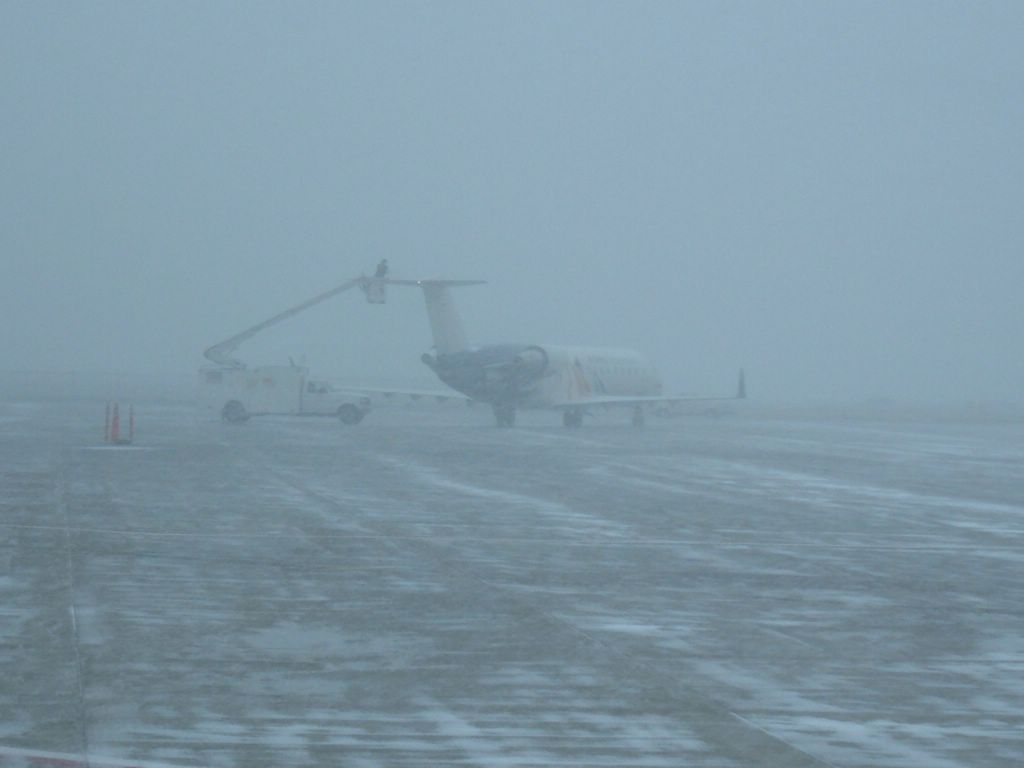
Flying in Montana is a bit of a two-edged sword: it's some gorgeous country, but you also get famously fickle & fierce mountain weather. Yesterday we flew SEA-GTF-HLN (Great Falls and Helena, respectively). The forecast called for 2000 BKN and 5 miles visibility in light snow at Great Falls; as we approached, the ATIS called it 3500 broken, 6 miles visibility in mist. I planned on a visual approach but briefed the ILS just in case. Sure nuff, we're 5 miles from the marker when tower says, "ABC 322, our weather is deteriorating fast. We now have 2 miles visibility in snow." I flew the ILS and ended up breaking out at only 400 feet. Ten minutes later, it was snowing hard.


But as they say in Montana, if you don't like our weather, just wait ten minutes - it'll change! By the time we left for Helena, the snow was ending. This morning dawned clear and cold, and the flight from HLN to GTF took only 13 minutes. The ramp showed no sign of yesterday's snowstorm.


After departing Great Falls, we crossed the Rockies just south of Flathead Lake, affording us a very nice morning view.


I'm in Edmonton right now. Somebody needs to get the word out to Montana & Canada that it's spring; it's been snowing here all day. Brr.

Dawn and I are moving into our townhouse this weekend (once I get back tomorrow afternoon). Yay! http://home.comcast.net/~sdweigel/home.html.

Wednesday, April 27, 2005

Bad Airplane Movies

From the early days of aviation, Hollywood has been fairly enamored with flying. This has resulted in some really good movies like Twelve O'Clock High, but the majority of them have been stinkers. You'd think they'd be able to get it right: many movie stars, writers, directors, and producers are pilots, and aviation consultants are a dime a dozen. I think a lot of pilots would consult for free, just to have the satisfaction of seeing a movie that gets it right. Still, bad airplane movies are like bad kung-fu movies: they can be entertaining by their very badness.

Last weekend I watched "Turbulence" on TNT, not realizing what it was when I first started watching. But then I started laughing, and I couldn't turn it off. It's not a comedy, it's just so bad there's nothing you can do but laugh. It involves a serial killer hijacking a 747 with the intention of crashing it into the detective who arrested him (yes, this was pre-9/11). Standing in his way is a flight attendant who outwits him and locks herself in the cockpit, where ATC and a 747 try to talk her down. After standing aghast at all the travesties in the plotline - the autopilot executes a perfect slow-roll as the FA struggles with the serial killer - you can't help but giggle when they work in a somewhat accurate depiction of programming the 747 FMS for arrival.

Some of the quotes are priceless. At one point ATC is trying to convince Teri (the FA) to change the airplane's heading to avoid bad weather, advising her that "you've got a level six storm." "Is that a six on a scale from one to 10?" she asks. "No, Teri...on a scale of one to six!"

Of course, flight attendants landing airplanes were a staple of the 1970's disaster movies, which were pretty uniformly bad. The Airport series got worse and worse with each subsequent release, although it did provide lots of great material for Airplane! to spoof.

Bad aviation movies often center on the military rather than the airlines. 1957's Jet Pilot, starring John Wayne and Janet Leigh, had some great flight footage but was sunk by a thin plot, ludicrous dialogue, and horrible acting. Of course, everybody has seen Top Gun, a film featuring great footage of F-14's strutting their stuff and not-so-great footage of Tom Cruise strutting his. Oh yeah, the flat spin that killed Goose? Totally implausible, the F-14's engines are close enough to centerline that compressor stall/flameout on one would not induce enough vertical instability to send it into a flat spin. However, when you see the world spinning around from Mav's point of view, that's an actual flat spin performed by aerobatic champ Art Scholl. He never recovered from it, and was killed in the crash.

But the all-time Super Silver Screen Stinker award has to go to Iron Eagle. You know, where the teenage Cessna pilot steals an F-16 to go save his dad. Yeah. I don't even know where to begin, it's so horrible and implausible throughout. A great movie for parties with lots of pilots present, you can all throw popcorn at the screen. My favorite scene has to be when he's racing the dirtbike through the canyon in his C150....with the flaps full down! I laugh myself silly every time I see it.

Tuesday, April 26, 2005

Happy/Sad Cities

One reason I dislike Hotmail is because when you log out, you have to see MSN's horrible portal page with banalities such as "10 ways to tell if your man is cheating on you." This one, however, caught my eye: The Twenty Happiest and Most Depressed Cities in the U.S., as measured by antidepressant sales, suicide rates, and reported cases of depression.

Top on the happy list: Laredo, TX. What the heck!? I've been to Laredo. There's not much to be happy about other than that you're not in Nuevo Laredo, just across the border in Mexico. Maybe that is what they're happy about. Ditto for #2, El Paso. No matter how bad things get, you're not in Juarez! The rest of the list I could accept - some good, wholesome happy midwest towns - until I got to Fresno and Bakersfield, CA. Especially Bakersfield. If you haven't spent any time there, it's basically the armpit of California. It's hot, dusty, smelly, crime-ridden, all the boredom of a small town with all the problems of the big city. Stockton is #13 on the list, and it's essentially just like Bakersfield but improved by being within decent driving distance of Tahoe. Sacramento, #19, is better than the other California cities (except San Jose)...but we're still in the San Juaquin Valley, folks!

Anchorage seemed a little funny to be on the happy list, too. My impression was that depression-fueled alcoholism was rampant in Alaska. Perhaps just not in Anchorage. Still, I'd think there'd be enough SADS (Seasonal Affective Disorder Syndrome) to go around in the winter.

I expected Portland to be on the depressed list, but #20 seems kind of far back. Between weeks of rain and gloom in the winter, and hordes of depression-prone angry left-wing artist types, you'd expect a higher depression rate. I was a little surprised to see Kansas City on the sad list when Omaha is on the happy list - c'mon, at least ya got better BBQ in KC!

I just realized that this list is scewed because it only recognizes depression that people are doing something about by seeing a doctor, taking meds, or killing themselves! You won't pick up slight depression that goes untreated, or somebody who is so depressed they can't even bother to commit suicide! Or, for that matter, the folks in Anchorage who self-medicate with the help of Johnny Walker.

Okay, here's Sam's list of Sad/Happy Layovers, as decided by my impression of the general mood of the town:

Happy: Boise, ID; San Jose, CA; Sacramento, CA; Spokane, WA; Missoula, MT; Kalispell, MT; Calgary, AB; Victoria, BC; Santa Barbara, CA

Sad: Seattle, WA; Fresno, CA; Butte, MT; Helena, MT; Billings, MT; Edmonton, AB; Vancouver, BC; Klammath Falls, OR

Monday, April 25, 2005

The Twentieth Hijacker

A few days ago, Zacharias Moussaoui plead guilty to charges against him regarding conspiracy with al-Qaida to perform terrorist acts against the US. Moussaoui is the infamous "twentieth hijacker" apprehended in Minnesota shortly before 9/11, although it now seems that he was to carry out a later attack.

Unlike the other hijackers, Moussaoui seems to have been a thoroughly incompetent pilot, having failed to solo a C172 after nearly 60 hours of training. After 9/11, there was a tremendous amount of attention on arab flight students...I often wondered about some of the students at the school where I'd taught the previous summer. I know the FBI was at the school several times and took records.

Moussaoui was apprehended due to a sharp ex-airline pilot working as an instructor for Pan-Am Int'l Flight Academy, Clancy Prevost. You can read an interesting article about it here. It is interesting to note that Prevost's suspicions were flared by both Moussaoui's incompetence and his ethnicity/apparent religion. Fast-forward to today, after thousands of lives lost to terrorism and four years of struggle against islamic fundamentalists, and political correctness still keeps airport security officials from profiling young arabic males for additional screening.

No, I'm not being reactionary and far-right about this. I'm not saying this out of hate for arabics or muslims. I'm not racist except in the sense that I recognize that a young arabic male is statistically much more likely to engage in terrorist acts than your 80-year old grandmother. Yet, behold, our airport security apparatus: still entirely incompetent in identifying and stopping weapons passing through checkpoints, only able to closely search a select few; and officialdom denies us the one weapon that might give us an upper hand: our knowledge of the enemy.

Folks, we're safer than we were 4 years ago, but it isn't because of the TSA's window dressing. It's because any terrorist will only gain access to an airline cockpit through a horde of angry passengers, determined flight attendants, a reinforced cockpit door that's staying locked, me weilding a crash axe, and increasingly often, the captain and his gun. No American airliner will again be used as a guided missile. Still, the twentieth hijacker is still out there somewhere. And I'd prefer the TSA stop him before he gets on my plane.

Wednesday, April 20, 2005

Kill a Commie for Mommy!

One of my early memories is from when I was about six years old, playing "war" with the older neighbor kid. He was the Russians and I was the Americans; we had all of our toy cars (tanks!), boats (ships!) and planes (F-14s!) in order on my living room floor, facing each other. We engaged in battles, their outcomes determined by the rapidly escalating volume of our sound effects. Finally, the neighbor kid took a plane, flew it over my formations, and with a deafening "BOOM!," scattered them all over the room.

"Ha! I dropped a nuclear bomb on you!"

I didn't know what he was talking about. "What's a nuclear bomb? You wrecked all my tanks!"

"A nuclear bomb can wipe out a whole country. The russians have lots of them!"

"Well," I said slyly while pulling an airplane from around the corner, "you didn't get this airplane, and it's gonna new-clear you! BOOM!"

That was probably my first realization of the existence of nuclear weaponry, or that the Soviets were our enemy in the 40-year old Cold War. As I got older, I became rather interested in foreign affairs and followed events closely. I'm thankful that I'm just old enough to have seen the liberation of Eastern Europe throughout 1989, and the fall of the Soviet Union in 1991. I distinctly remember watching the Berlin Wall come down on our little 12-inch black-and-white TV.

Right now I'm reading "Fifty Year War: Conflict and Strategy in the Cold War" by Norman Friedman. It's a comprehensive look at what he describes as World War III, fought at a much slower pace than usual "hot" wars. It's hard to find books on this subject that aren't slanted left or right, because especially in the last 20 years of the war, the left and right were often viruently opposed on foreign policy. Friedman, however, takes a pretty balanced approach that recognizes the victories and missteps of all parties involved. Here are some of the high points:

-- Truman wasn't negligent in "losing China," as Eisenhower claimed during the 1952 campaign, but the 1947 cease-fire imposed upon Mao and Chiang Kai-shek was ill-advised, since it allowed the communists critical time to regroup from a devastating defeat. Still, once war broke out later that year, Truman was right to not send massive aid to Kai-shek, who was unreliable and corrupt, and lacked much popular support.

-- Eisenhower was somewhat disengenuous in his 1952 campaign declaration that he had a plan to win the Korean War (echoed in Nixon's 1968 "secret plan" to end the Vietnam War). However, during Eisenhower's eight years in office, he proved to be a brilliant strategist who projected American strength during a crucial time. His "nuclear brinksmanship", decried by some as reckless, worked well in keeping Stalin and then Khrushchev at bay.

-- The "bomber gap" and subsequent "missile gap" of the late 50's never existed: American firepower at the time was far superior to the Soviets. The intelligence community miscalculated the number of missiles the Soviets had because they assumed prototype-to-production time was the same as for the West; in fact, because of Stalin's purges of the Soviet aircraft industry, their production capability was limited, and getting a prototype into production took considerable time.

-- By 1960, the CIA realized their error, and decided any "missile gap" was in favor of the Americans. John F. Kennedy was provided with this information, yet he continued to exploit the public perception of a missile gap in hammering away at the Eisenhower administration (and by extension, his opponent, Vice President Richard Nixon). Kennedy narrowly won the election; Eisenhower was disgusted by his tactics.

-- Kennedy was not an instinctive politician, and he relied heavily on his advisors. Unfortunately, much of the advice he got was poor, in particular that from Robert McNamara, his SecDef. In particular, their policy of escalating wars incrimentally to "send messages" to the Soviets was to have disasterous implications for Vietnam.

--Khruschev was a moderate compared to Stalin, and was mostly uninterested in directly waging war with the west. Rather, he was mainly interested in currying favor with client states, so they could wage war by proxy at his bidding, as Stalin had done with the Koreans. Placing missiles on Cuba was an attempt to bind Castro to him; when the missiles were withdraw, Castro was furious. Only after the Soviet's 1968 invasion of Czecheslovokia did Castro reconcile with the Soviets, realizing that it was dangerous to stray from the Soviet line.

-- Khruschev's attempts to deal with some of the inefficiencies of the Soviet system are what doomed him; it was too inconvenient for too many people. Brezhnev reversed Khruschev's reforms and gave Soviet industrialists laissez faire in production of military goods, in exchange for their loyalty. Thus, the huge Soviet military output in the late 1960's and 1970's and corresponding shortage of consumer goods. This weakened their economy considerably, which Reagan would exploit in the 1980's.

-- The war in Vietnam was very winnable, and through most of it the US and ARVN (South Vietnamese) were winning. The Viet Cong was virtually decimated and the North Vietnamese regulars were weak and demoralized by 1971, but by then public pressure to end the war precluded any escalation which would've done so. In particular, failure to take aggressive action against the Ho Chi Mihn trail in Laos for political reasons had immense consequences. The first mistake Johnson made, however, was deciding not to gain public and congressional support before escalating the war.

-- The western anti-war movement was not Soviet originated, but the Soviets found it extremely useful and eventually funded much of it and directed some activities. Ironically, the Soviets had very little control over the war; it was primarilly the Chinese, by then opposed to the Soviets, who were waging war by proxy via the North Vietnamese. The anti-war movement's public influence was one of the few bright spots for the North Vietnamese; the media portrayal of the Tet Offensive as a disaster for US forces (in reality, the Viet Cong & North Vietnamese got royally slaughtered) was one of the few things that convinced North Vietnam to try it again during later negotiations.

Anyways, the book has considerably fleshed out my world history knowledge for 1940-1975; I'm looking forward to reading what Friedman has to say about Reagan's military buildup and economic attacks on the Soviet Union.

(By the way, the title of this thread was a tattoo on the forearm of General Curtiss LeMay, for years the head of SAC (Strategic Air Command). Peace is our Profession, indeed!)
Sunday, April 17, 2005

April 17, 1997

"Cambridge traffic, Cessna 704XX departing runway 34, left closed traffic, Cambridge."

It's a clear, chilly April morning in Minnesota. The air is still, the silence broken only be chirping birds and the sound of an idling airplane. The airport is quiet this morning, and the only person visible is a middle-aged heavy set man, carrying a headset and looking over his shoulder at the airplane turning around at the end of the runway.

That airplane is a little yellow-and-white Cessna 150. In it is only one person - only a kid really, having turned 16 today. He doesn't have a driver's license yet, and he's struggling through algebra. Painfully shy at times, he's had little luck with girls, but that's okay, because he has one true love already: flight. He's been slowly working towards this day for three years now, and it scarcely seems real to him that he sits in this airplane alone, the sole master of the machine.

He's only a boy and he knows it, but there is nobody in that right seat to help him now. He holds his fate in his hands, and it makes him pause as he lines the Cessna up on the runway. It reminds him of the hesitation that comes when about to jump into water from a tall cliff. I know what I need to do, but the price for negligence is high. He breathes a quick prayer - don't let me screw up! - and pushes in the throttle.

*** *** ***

That was 8 years ago today - my first solo. After that first exhillarating takeoff, I don't remember a lot about it except a feeling of immense pride and happiness as I shut down the engine 30 minutes later. I was happy that I was safe and didn't let my instructor down, plus the happiness I always felt when I got to fly. I was proud that I had just done a very adult thing, and done it well.

I look at my 16-year old brother, Josiah, and marvel at what I was able to do at his age. I was so young and had a lot to learn in both flying and life. But, looking back to that day, I can see the beginnings of who I was to become. That first solo marked a transformation, or perhaps a step in evolution. I'll always remember that day as one of my finest.

Gizmos Gone Gonzo


Technology is great, when it works. My airplane has a ton of gee-whiz electronics to play with, a rather impressive array for a regional turboprop. It features an all-glass cockpit ("fly by watching TV!") with the latest and greatest in situational awareness. We have two very capable flight management systems in the airplane, which is rare for regional airlines in the US - most have an FMS for the captain only. We have a state of the art navigation system that lets us shoot precise GPS approaches with lateral and vertical guidance (LNAV/VNAV) without any ground-based navaids. Significantly, we have Cat III approach capability that lets us land with only 600 feet visibility. Usually Cat III approaches can only be done by a capable multi-channel autopilot with autoland features. Amazingly, we hand-fly ours - by use of a military-style Heads-up Guidance System (HGS).

The captain flies the approach while looking out the window, instead of looking down at the instrument panel. He looks through a clear glass plate, onto which is projected a display of aircraft attitude, airspeed, altitude, etc. A small pointer serves as an "intertia vector," showing where the plane is headed at any particular moment. A circle moves to show where the airplane should be heading to stay on the approach path. Keep the pointer in the circle, and voila! Precision, hand-flown Cat III approach in insanely crappy weather (600 ft is covered in under 3 seconds at our approach speeds). We're even certified for single-engine Cat III approaches - no other regional can do them.

Okay, so that's assuming everything works. What's really maddening is that it often won't, for no apparent reason. The HGS is programmed to not arm itself for Cat III if everything isn't set up perfectly, but it sometimes seems to think you've messed up even through you know everything is in order. Today we were flying into Seattle, and even though the weather was well above Cat I minimums (200 ft ceiling and 1800 ft visibility), the captain wanted to practice Cat III procedures. So I checked and double-checked that everything was set up, we ran the appropriate checklists - and it didn't arm! We reset the system a few times to no avail. This has happened to me several times before, fortunately always in decent weather. There are many foggy Northwest winter days, however, when we need the Cat III capability, and the HGS puking then could leave a crew with a poor choice: divert to the alternate - or cut into fuel supply on subsequent attempts, hoping the system finally decides you've set everything up right. (Note to future Captain Sam: Adding extra fuel on foggy days is a good idea!)

When my airline was first doing FMS approaches, they had a heck of a time with those, too. The FMS would wait until you were in the middle of the approach to decide it wasn't absolutely sure that it knew it's position, and would kick you back into enroute mode. Software upgrades have mostly fixed the problem, but everyone keeps a close eye on them when shooting FMS approaches. Whenever possible we just shoot the ILS.

So yes, my airplane has lots of electronic wizardry on board, but you know what? At Ameriflight I fly 1970's-era Chieftains with original analog avionics and they do quite alright. You'll never ask "what's it doing?" in the Chieftain so long as you know what you're doing. Plus, you never have to fly when it's so foggy that the birds are grounded.