Dave at Flight Level 390 proved to be prophetic with his post last night about aviation accidents happening in threes. At 3AM, a MD80 operated by West Carribean Airways crashed in Venezuela, killing all 160 on board. Apparently the crew had declared an emergency after having trouble with both engines (more likely, with fuel supply...).
Developing story here.
Tuesday, August 16, 2005


Job Description
Jennifer recently asked, via comments: "What is an FO? (you describe yourself in your job as one?)."
The aviation industry is chock-full of acronyms. If the average instrument-rated pilot reads that you called FSS to check the NOTAMs at KPOC and the LLZ was OTS on the ILS 26L so they were using the VOR-A approach, which restricted you to a MDA of 1800', which is 789' HAA, because your DME is INOP...they'd understand what you're talking about! What we all need to remember, then, is that those outside aviation have little or no exposure to the jargon, and simplify & explain lest we bore them all to death.
The short answer, Jennifer, is that "FO" stands for "First Officer," or what many people outside of aviation call the "co-pilot."
The term is nautical in origin, as are many things in aviation. The First Officer, otherwise known as the First Mate, was second-in-command, just below a ship's Captain, and was responsible for seeing that his orders were carried out. In aviation, the first officer is designated as second-in-command while the captain bears the authority and responsibility delegated to the pilot-in-command.
A common public misperception is that "co-pilots" are "pilot trainees," who've very recently learned to fly and must build the necessary time before they can be qualified as "pilots." While this may be true in a few very limited cases (here's looking at you, Gulfstream Int'l right-seaters!), usually an airline first officer has extensive experience as captain or pilot-in-command at a previous job. Because all airliners require both a captain and a first officer, newhire pilot at any airline start as first officers, and become captains once they are about half-way up that airline's seniority list. If they switch airlines, they start over as first officers.
A common quote in aviation is that airlines hire captains, not first officers. In other words, they want somebody with the experience, knowledge, and skill to be a competent captain, even though they may serve several years as a first officer before upgrading. After all, things change fast in the aviation world, and when airlines expand rapidly, you'll find first officers becoming captains rather soon after being hired (not a concern at my company, I'm afraid!).
So what makes my job different from the Captain's? Well, I'm paid about a third of what he (or she) is. Only they can taxi the airplane, since the nosewheel tiller is on their side of the cockpit (the left side). They're expected to make the tough decisions when in tight situations, and they take responsibility for those decisions - although, should something go wrong, the FO will surely share the blame. Other than that, though, it's pretty much the same job. On each flight, one pilot is designated "Pilot Flying" and the other is "Pilot Not Flying." The "PF" simply flies the airplane while the "PNF" take care of radio communications, navigation, and aircraft systems management. Usually, the captain will be PF on the first leg, I'll be PF on the second leg, and so on.
Hope this clarifies it for you, Jennifer. Any reader, always feel free to ask for clarification when the jargon gets to be a bit much.
The aviation industry is chock-full of acronyms. If the average instrument-rated pilot reads that you called FSS to check the NOTAMs at KPOC and the LLZ was OTS on the ILS 26L so they were using the VOR-A approach, which restricted you to a MDA of 1800', which is 789' HAA, because your DME is INOP...they'd understand what you're talking about! What we all need to remember, then, is that those outside aviation have little or no exposure to the jargon, and simplify & explain lest we bore them all to death.
The short answer, Jennifer, is that "FO" stands for "First Officer," or what many people outside of aviation call the "co-pilot."
The term is nautical in origin, as are many things in aviation. The First Officer, otherwise known as the First Mate, was second-in-command, just below a ship's Captain, and was responsible for seeing that his orders were carried out. In aviation, the first officer is designated as second-in-command while the captain bears the authority and responsibility delegated to the pilot-in-command.
A common public misperception is that "co-pilots" are "pilot trainees," who've very recently learned to fly and must build the necessary time before they can be qualified as "pilots." While this may be true in a few very limited cases (here's looking at you, Gulfstream Int'l right-seaters!), usually an airline first officer has extensive experience as captain or pilot-in-command at a previous job. Because all airliners require both a captain and a first officer, newhire pilot at any airline start as first officers, and become captains once they are about half-way up that airline's seniority list. If they switch airlines, they start over as first officers.
A common quote in aviation is that airlines hire captains, not first officers. In other words, they want somebody with the experience, knowledge, and skill to be a competent captain, even though they may serve several years as a first officer before upgrading. After all, things change fast in the aviation world, and when airlines expand rapidly, you'll find first officers becoming captains rather soon after being hired (not a concern at my company, I'm afraid!).
So what makes my job different from the Captain's? Well, I'm paid about a third of what he (or she) is. Only they can taxi the airplane, since the nosewheel tiller is on their side of the cockpit (the left side). They're expected to make the tough decisions when in tight situations, and they take responsibility for those decisions - although, should something go wrong, the FO will surely share the blame. Other than that, though, it's pretty much the same job. On each flight, one pilot is designated "Pilot Flying" and the other is "Pilot Not Flying." The "PF" simply flies the airplane while the "PNF" take care of radio communications, navigation, and aircraft systems management. Usually, the captain will be PF on the first leg, I'll be PF on the second leg, and so on.
Hope this clarifies it for you, Jennifer. Any reader, always feel free to ask for clarification when the jargon gets to be a bit much.
Friday, August 12, 2005
Whipping Boy No Longer!
As I mentioned in my last post, I'm off reserve next bid. Crew schedulers take note: You won't have me to kick around anymore!
This current bid, I'm doing the "AM split line," which is half airport reserve and half home reserve. This line used to result mostly in day trips, with few overnights, since they want to keep you around for your airport reserve days. This bid, though, I've only sat airport reserve twice...they're so short of reserves that they've had no choice but to take me off airport reserve to assign me 3 and 4 day trips. Worse yet, they keep switching me from AM to PM...so my body is used to getting up at 5am, and then I end up flying until midnight. It's maddening.
My buddy who jumped ship for Skywest is going through sim training right now. It looks like after IOE, he'll be on reserve for one or two months maximum. I've been reserve for 14 months. Greener grass, sour milk, and all that.
Actually, until lately, I haven't minded reserve that much. I was actually toying with the idea of intentionally staying on reserve so I'd be home more often, and so I had enough flight time left over to fly for Ameriflight occasionally. But like I said, neither is very true anymore with how much they're flying us. I might as well take a regular line and know when I'll be gone, and have a few more days off.
This current bid, I'm doing the "AM split line," which is half airport reserve and half home reserve. This line used to result mostly in day trips, with few overnights, since they want to keep you around for your airport reserve days. This bid, though, I've only sat airport reserve twice...they're so short of reserves that they've had no choice but to take me off airport reserve to assign me 3 and 4 day trips. Worse yet, they keep switching me from AM to PM...so my body is used to getting up at 5am, and then I end up flying until midnight. It's maddening.
My buddy who jumped ship for Skywest is going through sim training right now. It looks like after IOE, he'll be on reserve for one or two months maximum. I've been reserve for 14 months. Greener grass, sour milk, and all that.
Actually, until lately, I haven't minded reserve that much. I was actually toying with the idea of intentionally staying on reserve so I'd be home more often, and so I had enough flight time left over to fly for Ameriflight occasionally. But like I said, neither is very true anymore with how much they're flying us. I might as well take a regular line and know when I'll be gone, and have a few more days off.
Tuesday, August 09, 2005
Notes & Observations
- Jaime Lee Curtiss was on our flight on Saturday. Apparently the ladies next to her went gaga and kept telling her what big fans they were. And these women were in their 60s, you'd think they would act less teenybopperish.
- I was awarded my first non-reserve line yesterday! It's a surprisingly good line, with labor day weekend off and some good trips. Goodbye, reserve! Well, assuming I don't get it again next month.
- My brother Jon is going back to Iraq. He's been back from his yearlong stint since April, but decided to volunteer for another year. I have mixed emotions on that one.
- The airplane I fly is very fun when empty. Our last leg today was a reposition from SEA to PDX. It took 22 minutes from takeoff to landing.
- Yesterday kinda sucked. We waited for over 3 hrs for our plane to arrive from SEA. Apparently the problem was that the 34L and 34R glidepaths were out of service for maintenance at the same time 800 RVR fog showed up. Whoops. Then when we got into Seattle, we had a plane swap...and waited 1.5 hrs for our plane to show up before we could take off for Edmonton. We got there after 2am. Egh.
- We departed YEG an hour late today, and thanks to the wonderful rampers at GEG and BOI, were on time by our 6th leg...only to get a plane swap in SEA, to a plane running 45 mins late.
- There is nothing better than a good single-malt scotch after 2 frustrating days!
- I was awarded my first non-reserve line yesterday! It's a surprisingly good line, with labor day weekend off and some good trips. Goodbye, reserve! Well, assuming I don't get it again next month.
- My brother Jon is going back to Iraq. He's been back from his yearlong stint since April, but decided to volunteer for another year. I have mixed emotions on that one.
- The airplane I fly is very fun when empty. Our last leg today was a reposition from SEA to PDX. It took 22 minutes from takeoff to landing.
- Yesterday kinda sucked. We waited for over 3 hrs for our plane to arrive from SEA. Apparently the problem was that the 34L and 34R glidepaths were out of service for maintenance at the same time 800 RVR fog showed up. Whoops. Then when we got into Seattle, we had a plane swap...and waited 1.5 hrs for our plane to show up before we could take off for Edmonton. We got there after 2am. Egh.
- We departed YEG an hour late today, and thanks to the wonderful rampers at GEG and BOI, were on time by our 6th leg...only to get a plane swap in SEA, to a plane running 45 mins late.
- There is nothing better than a good single-malt scotch after 2 frustrating days!
Sunday, August 07, 2005
Blogging Live from KFCA

Greetings from Glacier Park International Airport in Kalispell, Montana. Dawn came with on the Kalispell overnight; our flight out is running about 3.5 hrs late due to really low visiblity in Seattle this morning. Nobody went in or out for over 3 hrs, apparently due to Cat III equipment being out of service. So, I spent some time talking to stranded passengers, and now we're just chilling at the gates. Yay for free WiFi at small town airports!
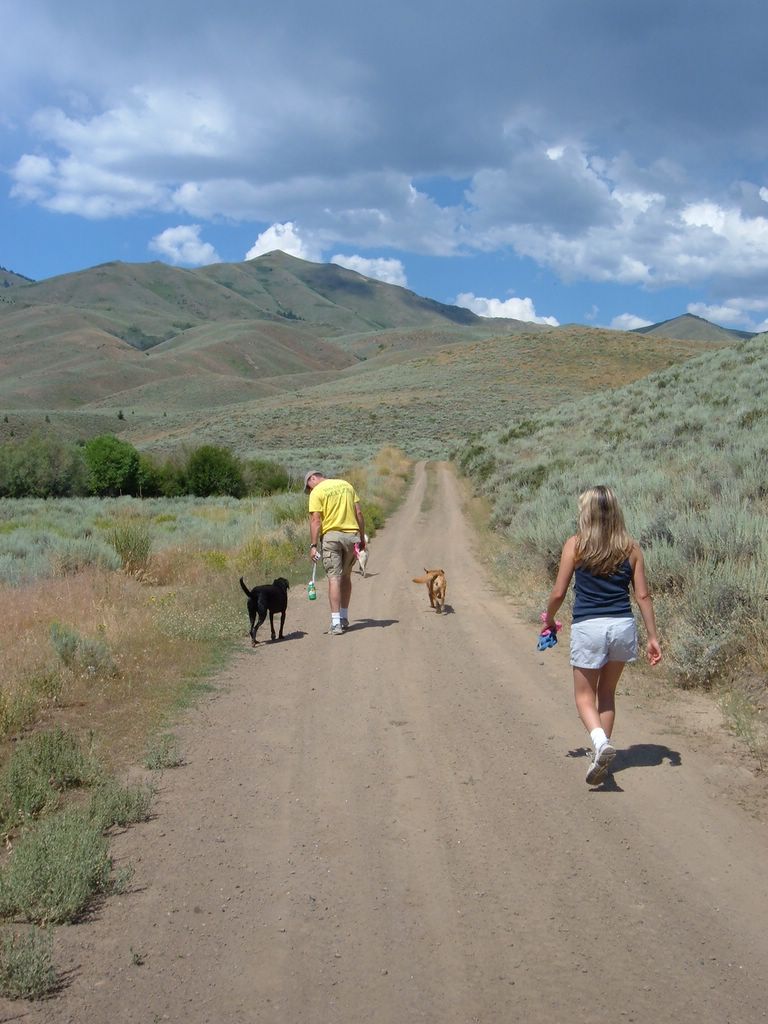
This is day 3 of a 4 day trip. I spent Friday night and Saturday in Sun Valley, Idaho, where we had a 24-hour layover. Yesterday, three of us went to the local animal shelter and volunteered to walk some of their dogs. We took a 2-hr walk up into the hills; it was a lot of fun and a rather unique layover activity. Below: Drew, Opie, Lori, Happy, and Cricket. You can guess which names belong to humans and which to canines.
Thursday, August 04, 2005
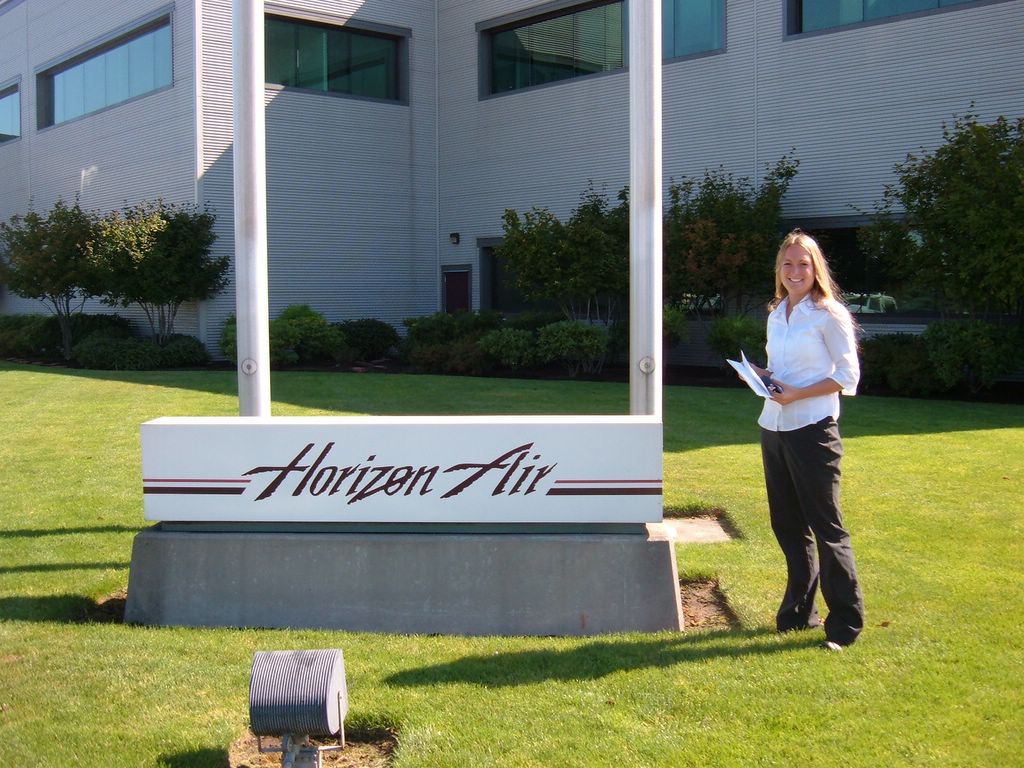
Everybody, meet Kelly...
...our newest & coolest aircraft mechanic!
I've known Kelly and her twin sister Lori for five or six years now. After graduating from college with a computer science degree, Kelly decided to become an aircraft mechanic and enrolled in A&P school. As she finished her schooling, I got her apps in at my company. They called her for an interview last week, she flew in yesterday, and her interview was today. She got the job and starts training soon. Way to rock, Kelly!

1/5/06: Pay no attention to that sign! Hehe....
I've known Kelly and her twin sister Lori for five or six years now. After graduating from college with a computer science degree, Kelly decided to become an aircraft mechanic and enrolled in A&P school. As she finished her schooling, I got her apps in at my company. They called her for an interview last week, she flew in yesterday, and her interview was today. She got the job and starts training soon. Way to rock, Kelly!
1/5/06: Pay no attention to that sign! Hehe....
Monday, August 01, 2005
The Twelve Minute Flight
At my company, we operate several triangle flights to cities that'd otherwise be too small to serve with any frequency. An example is Helena and Great Falls. Neither of these cities alone would be able to fill several aircraft to Seattle every day, but together they do. So we operate SEA-GTF-HLN-SEA. The middle leg is extremely short, since GTF and HLN are something like 56 nm from each other. A lot has to happen in that time, and you need to do some shrewed flying as well to make sure you're able to descend quickly enough after ATC keeps you high. One of my first legs on IOE was GTF-HLN. Fortunately I was the pilot flying - the PNF is the person who really has to work on these short legs. It was still pretty overwhelming.
Once you're comfortable with the airplane and familiar with the short legs, though, they can be pretty fun. It's airline flying distilled down to the interesting parts - takeoff, climb, descent, landing, with no hours of boredom in cruise involved. It's an exercise in efficiency.
Late last night, I flew the last leg of the day, the 57 miles between Bozeman and Butte. The weather was good VFR. Poor weather, while increasing the stress of the flight, gives you more time to think about it because you'll have to fly the departure procedure, fly further to the initial approach fix, slow down early for the approach, etc. In the short time from takeoff to touchdown, here's the tasks to be accomplished:
1. At 400', start climbing right turn on course. Keep up a steep climb at 200 kts so we can get to cruising altitude of 14,000 quickly. PNF retracts flaps at 1000'.
2. At 2500', PNF accomplishes after takeoff flow and checklist.
3. PNF checks in with Salt Lake Center; both pilots look for traffic that SLC points out.
4. PNF calls off times to Bozeman station.
5. In climb, both pilots reset airspeed and altitude bugs for landing, and set up nav radios for approach into BTM. PNF performs 10,000 foot flow.
6. Brief VOR/DME-A approach into Butte, with circle to Runway 15. Although the weather is good, the approach lets you get descend early so you're not caught insanely high.
7. Level at 14,000 feet. PNF gets Butte weather via ASOS. Accelerate to 280 kts.
8. PNF requests approach from Salt Lake, copies approach clearance and frequency change to CTAF. PNF reads descent checklist.
9. A few miles before Whitehall VOR, slow down in preparation for rapid descent. PNF performs early 10,000 foot flow. PNF makes in-range radio call to Butte station.
10. Crossing Whitehall, retard power levers to flight idle and begin descent to 9000'. PNF reads approach checklist.
11. A few miles past Whitehall, airport appears behind ridge. Call "Landing"; PNF reports position on CTAF.
12. Since it looks like it'll be tough to make the pattern altitude while going this fast, level off and have the PNF increase the condition levers for 1020 rpm. The extra drag helps you slow down to 200 kts, where you call for "Flaps 5, Gear Down, Landing Checklist."
13. PNF reads landing checklist. Aircraft rapidly descends to pattern altitude of 7100 as you cross midfield for the righthand downwind for Rwy 15.
14. Increase torque to maintain pattern altitude; keep wide enough to avoid 6400' hill just before turning base; call for Flaps 15, then Flaps 35 at 1000' AFE.
15. Stabilized approach at Vref by 500' AFE, touch down at exactly midnight, call it a night.
This flight reminds me of something my first flight instructor told me: - "Never take an airplane anywhere your brain hasn't been five minutes ago." My instrument instructor told me to always be thinking about the next three steps. Good advice on both counts.
Once you're comfortable with the airplane and familiar with the short legs, though, they can be pretty fun. It's airline flying distilled down to the interesting parts - takeoff, climb, descent, landing, with no hours of boredom in cruise involved. It's an exercise in efficiency.
Late last night, I flew the last leg of the day, the 57 miles between Bozeman and Butte. The weather was good VFR. Poor weather, while increasing the stress of the flight, gives you more time to think about it because you'll have to fly the departure procedure, fly further to the initial approach fix, slow down early for the approach, etc. In the short time from takeoff to touchdown, here's the tasks to be accomplished:
1. At 400', start climbing right turn on course. Keep up a steep climb at 200 kts so we can get to cruising altitude of 14,000 quickly. PNF retracts flaps at 1000'.
2. At 2500', PNF accomplishes after takeoff flow and checklist.
3. PNF checks in with Salt Lake Center; both pilots look for traffic that SLC points out.
4. PNF calls off times to Bozeman station.
5. In climb, both pilots reset airspeed and altitude bugs for landing, and set up nav radios for approach into BTM. PNF performs 10,000 foot flow.
6. Brief VOR/DME-A approach into Butte, with circle to Runway 15. Although the weather is good, the approach lets you get descend early so you're not caught insanely high.
7. Level at 14,000 feet. PNF gets Butte weather via ASOS. Accelerate to 280 kts.
8. PNF requests approach from Salt Lake, copies approach clearance and frequency change to CTAF. PNF reads descent checklist.
9. A few miles before Whitehall VOR, slow down in preparation for rapid descent. PNF performs early 10,000 foot flow. PNF makes in-range radio call to Butte station.
10. Crossing Whitehall, retard power levers to flight idle and begin descent to 9000'. PNF reads approach checklist.
11. A few miles past Whitehall, airport appears behind ridge. Call "Landing"; PNF reports position on CTAF.
12. Since it looks like it'll be tough to make the pattern altitude while going this fast, level off and have the PNF increase the condition levers for 1020 rpm. The extra drag helps you slow down to 200 kts, where you call for "Flaps 5, Gear Down, Landing Checklist."
13. PNF reads landing checklist. Aircraft rapidly descends to pattern altitude of 7100 as you cross midfield for the righthand downwind for Rwy 15.
14. Increase torque to maintain pattern altitude; keep wide enough to avoid 6400' hill just before turning base; call for Flaps 15, then Flaps 35 at 1000' AFE.
15. Stabilized approach at Vref by 500' AFE, touch down at exactly midnight, call it a night.
This flight reminds me of something my first flight instructor told me: - "Never take an airplane anywhere your brain hasn't been five minutes ago." My instrument instructor told me to always be thinking about the next three steps. Good advice on both counts.
Subscribe to:
Posts (Atom)


