
Monster Post Alert!
I ended my last post by suggesting that one way pilots can improve their profession is by getting involved with their union, if they work at a unionized carrier. Predictably, this drew some criticism from anti-union commenters. I say "predictably" because airline pilots have always been rather ambivalent about their unions, and at times downright hostile. Most airlines have a few notoriously outspoken union critics among their pilots.
There are several reasons for this. First, airline pilots tend to be politically conservative, although this was more pronounced when most pilots came from the military. Secondly, pilots are often independent and opinionated, and many bristle at "others" making important decisions that affect their careers. Finally, pilots have a long and distinguished history of cheapness, and there are plenty who feel that they aren't getting anything back for their 2% dues.
Growing up, I had no great love for unions. I come from a politically conservative family, and am still conservative on many matters. When I was young, my dad was in a carpenter's union but quit it in disgust over what he saw as a culture of petty corruption and laziness; the union thereafter made life miserable for him, sabotaging his vehicle and equipment and vandalizing job sites. I accepted the fact that I'd have to join a union someday as an airline pilot, but wasn't thrilled about it. Even now that I've changed my mind in favor of unionism, I am well aware of the shortcomings of various unions, the low points in the history of the movement, and some of the practical and philosophical sticking points to the whole system we have now. I can certainly understand where people like Big Country and Ryan are coming from.
The thing is, I haven't seen any better alternatives proposed. If you're going to do away with the current system, you'd better have something to replace it with, something that does a better job of protecting the things we hold dear: our careers, the profession, and our impressive record of safety. So far I haven't seen any workable proposals that do this.
Some people, like Big Country, propose to throw ourselves upon the mercies of the "free market." First, I'm not sure that unionism is truly at odds with the "free market system". Unionized airlines do not have a monopoly, so pilots are free to go to a non-union carrier if they wish. For that matter, no single union has a monopoly; ALPA competes with APA, SWAPA, Teamsters, etc. To me, a system which prohibited workers from banding together into unions would be the one that impedes the free market; after all, businesses and businessmen regularly enter into all sorts of arrangements to increase their buying power and exploit economies of scale, and unless these arrangements result in monopolies, nobody argues that they are an impediment to the freedom of the markets. Markets do not need to have a multitude of perfectly independent agents to be free. But this is an aside....
Ryan proclaims that we're in the information age, with the inference that codgy old unionism is not up to the demands of a dynamic, productive free market economy. An example that one might give is that of computer programmers, heroes of the new information age. Rather few programmers are unionized. Their job protection is according to their degree of competence. Productivity is rewarded: the best programmers are headhunted in a very free job market, where they can almost name their salary. Many change jobs regularly; some of the smartest become independent contractors and hire out to the highest bidder. The free market can be very good to smart programmers.
There is a temptation to take what's happening in the vibrant tech sector and proclaim it a "new paradigm" that applies to all industries and professions, including the airline world and professional piloting. There are a few glaring problems with doing so, ways in which aviation is very unlike the tech sector.
First, the free market rewards those who are seen as the most productive. In aviation, the most productive pilot is not necessarily the best pilot. One can be very productive by cutting corners when they think they can get away with it, bending the rules a little when they think nobody's watching. You could get away with it for years, and you'd be management's absolute favorite pilot. Meanwhile, the pilot who scrupulously follows the rules, takes his time, refuses to be rushed, and makes smart decisions is going to be less productive. Nevertheless, he is the better pilot. While the union system might not get him ahead, it will not penalize him either, and the pilots' unions at the airlines have been a primary factor in fostering the safety culture that exists today.
Secondly, a truly free labor market is dependent on workers being able to switch jobs easily with few penalties. If a good computer programmer is underpaid, he can be doing the same job elsewhere for more money next week; losing productive programmers is eventually going to force his former employer to up their wages. But computer programmers everywhere do essentially the same job, Nine to Five, Monday through Friday. Pilots do not. Airlines need pilots 24 hours a day, 7 days a week, 52 weeks a year. They need both first officers and captains. Because of this, seniority is just as important as salary, making for a powerful disincentive to switch jobs. An airline system without unions would not be a free labor market, just one in which management had all the mechanisms of control.
Ever since aviation began, it's been a nasty, brutish business. Ryan mentioned the book Hard Landing; it is an excellent chronicle of some of the uglier turns the industry has taken. The people who managed the early airlines were a hard nosed lot that didn't mind breaking rules and even racking up a body count in the search for elusive profits. Pilots were often seen as an obstacle in this quest, always gumming up the works with complaints about weather or maintenance or fatigue. Government oversight was minimal. In this free market, no manager thought twice about firing a pilot who wasn't compliant enough, not "productive" enough. This attitude led directly to the formation of the first pilot unions - a free market reaction if I ever saw one. But that was 70 years ago, you protest; times have changed and the reasons that led to unions no longer exist. Don't they? Profits are just as elusive. Ryan was spot on in his assessment of much of the upper management throughout the industry today. Given the opportunity, I think many of them would easily revert to the habits of their early predecessors, and the flying profession would suffer greatly in all regards.
Both Ryan and BC put the blame elsewhere. Ryan says that unions "combat the power of a team and ultimately hinder relationships between labor and management." BC suggests that unions killed the legacies by demanding higher wages than revenues could support, although to his credit he acknowledges the role management had to play. Now, there's a kernel of truth in both statements. The relationship unions have with management is often combative. I won't say it's always management's fault or entirely their fault, but there is a definite correlation between management's aggressiveness with labor and labor's aggressiveness with management. "Enlightened" CEOs like Kelleher and Bethune mostly kept things amicable with their unionized work groups and rewarded their employees when the company prospered; the unions responded in kind by showing flexibility and bargaining in good faith. Where management took an aggressive stance and tried to screw over their employee groups at every turn, those employees elected combative union leaders who sometimes took things farther than was good for the company or the employees. The painful concessions of the early 90's that went unrewarded in the mid 90's produced the prohibitively expensive contracts of the late 90's, which contributed - along with considerable mismanagement - to the legacies' current troubles, as BC mentioned.
The fact that this unhealthy cycle has taken place at some unionized airlines - does it condemn the unions, perhaps even the very principles of unionism? What role did management play in all this? Let's say that a Crandall or a Ferris was successful at breaking their pilots' union. Would they have suddenly blossomed into a benevolent Kelleher once the money was theirs for the taking? I think not. If anything, breaking the union at Continental made Lorenzo even more ravenous.
Of course, there are non-union carriers out there, and my dire predictions haven't played out there, have they? Ryan says he's going to work at a non-union carrier, and I applaud him for putting his money where his mouth is, so to speak. But I wonder if his non-union carrier would treat their pilots nearly so well if it wasn't for the hard work unions have done at all the other carriers. Management at Skywest, Allegiant, and even jetBlue offer their pilots just enough to keep unions off their property. What would happen if that disincentive was removed?
BC says that "strong unions don't make strong pilots, they make strong unions." In other words, they are for-profit organizations that are no better than management in screwing over workers for money. Again, there is a kernel of truth here. The main organizations have attracted a lot of greedy and corrupt individuals over the years - my own union, the Teamsters, got so bad it was put in federal trusteeship for a time. Even rather uncorrupted organizations like ALPA have shown favoritism towards whoever is paying the most dues money, principles be hanged. But the real strength of a union lies with its active membership, the volunteer pilots who serve and lead at the local level. This is where most of the decisions are made and where most of the work is done - and these pilots usually have only the interests of the membership in mind.
Unions are by no means perfect. Their history is spotted, their imperfections are currently glaring, and I doubt they'll be really fantastic in the future. In short, they are a human institution. They did a great deal of good in building up the aviation industry and the piloting profession - and they've done plenty to screw both up lately, too. That doesn't mean they should be discarded entirely. Aviation history has shown them to be all too necessary. We do, however, need to work to improve them. That's why I suggested that new pilots resolve to get involved in their unions: not because those unions are so great, but because we need them to be better for the good of the profession. There are encouraging signs. ALPA members just elected a reform-minded President. Teamsters Local 747 members, including myself, just elected an Executive Board with a reformist majority. I'm personally volunteering for my union as an editor and writer for our quarterly periodical, and I'm seeing more young pilots become similarly involved. Things like this make me hopeful that we'll be able to stem the tide using the system in place now - which is good, because I haven't seen any realistic alternative.
In short - I'd rather patch the roof than tear down the house and pray for sunny weather.
(...and that's the only short thing about this post!)
Monday, December 18, 2006


Tuesday, December 12, 2006
Make It Better
My last post and the response in the comments section made me realize something today.
I'm really getting tired of moaning and complaining about the downfall of the airline industry and the piloting profession.
True, things have become worse the last few years. Yes, old-timers would be appallled to see how far the profession has fallen. And yes, anybody considering a career in aviation needs to take a good look at the true cost of this career before jumping in.
But the reality is, it can still be a pretty good career. I very much enjoy what I do for a living. It's usually interesting, I work with great people, and I see breathtaking sights every day. Even at the "regional" level, it's paying the bills and I'm living comfortably, albeit with two incomes and without kids. I've had some neat adventures here and abroad thanks to this job.
Furthermore, I should be about the last guy to talk about the uncertainty and suffering that an aviation career can bring, because I haven't experienced any of it. The worst I've dealt with is some unexpected time freight-dogging, a little time in a hiring pool that didn't pan out, and the prospect of a longer-than-average upgrade. Boo-freaking-hoo. To learn about the worst that aviation can do, there are plenty of furloughees and merger survivors and newly pensionless retirees you can talk to. I really have no right to do so.
But the main reason I'm tired of complaining is that it really doesn't change anything. My blog posts, crew room gripe-fests, flightinfo.com bitterness - has it all done anything to reverse the slide? I'm not sure it has. What are we expecting to achieve, anyhow? Are we hoping that by making aviation look so horrible, we'll shrink the incoming labor pool and thereby improve our lot? If so, it's dishonest and unfair. Having achieved our goals, it's hypocritical to deny others theirs. When nice guys like LoadmasterC141 want to get into flying, I should be encouraging him, not dissuading him.
None of this is to say we should ignore the problems bedeviling aviation. It might still be a decent field but if the present slide continues, it will not always be. The generation that came before us did a pretty lousy job; we need to do better.This starts with educating the pilots coming up through the ranks. Those of us currently at the airlines need to do a better job of reaching out to those just starting their own careers, helping them in their advancement as well as educating them in the history and responsibilities of their chosen profession. Without hitting them over the head with gloom and doom, we need to make it clear to them that the future of this career is in their hands, and depends on them rolling up their sleeves and getting involved.
So those of you who are new to aviation, who are considering a career as a pilot, who are working their way up the ladder: I apologize for occasionally discouraging your dreams with gloomy pronouncements of what a shambles aviation is in. I should be encouraging and helping you. At the same time, I do want to urge you to get informed on what's going on in your profession, and do your part to make it better. "What can I do?" you ask. In general terms, consider yourself a caretaker of the profession and resolve to leave it better than you found it. Consider the effects each of your choices has not only on your career but also on those who come after you. Specifically, once you work at a unionized carrier, get involved in your union. They're only as good as their volunteers. They can use your skills. No part is too trivial - even seemingly boring jobs free up resources for other important tasks. This is a small price to pay for a rewarding career and a job that you love.
I'm really getting tired of moaning and complaining about the downfall of the airline industry and the piloting profession.
True, things have become worse the last few years. Yes, old-timers would be appallled to see how far the profession has fallen. And yes, anybody considering a career in aviation needs to take a good look at the true cost of this career before jumping in.
But the reality is, it can still be a pretty good career. I very much enjoy what I do for a living. It's usually interesting, I work with great people, and I see breathtaking sights every day. Even at the "regional" level, it's paying the bills and I'm living comfortably, albeit with two incomes and without kids. I've had some neat adventures here and abroad thanks to this job.
Furthermore, I should be about the last guy to talk about the uncertainty and suffering that an aviation career can bring, because I haven't experienced any of it. The worst I've dealt with is some unexpected time freight-dogging, a little time in a hiring pool that didn't pan out, and the prospect of a longer-than-average upgrade. Boo-freaking-hoo. To learn about the worst that aviation can do, there are plenty of furloughees and merger survivors and newly pensionless retirees you can talk to. I really have no right to do so.
But the main reason I'm tired of complaining is that it really doesn't change anything. My blog posts, crew room gripe-fests, flightinfo.com bitterness - has it all done anything to reverse the slide? I'm not sure it has. What are we expecting to achieve, anyhow? Are we hoping that by making aviation look so horrible, we'll shrink the incoming labor pool and thereby improve our lot? If so, it's dishonest and unfair. Having achieved our goals, it's hypocritical to deny others theirs. When nice guys like LoadmasterC141 want to get into flying, I should be encouraging him, not dissuading him.
None of this is to say we should ignore the problems bedeviling aviation. It might still be a decent field but if the present slide continues, it will not always be. The generation that came before us did a pretty lousy job; we need to do better.This starts with educating the pilots coming up through the ranks. Those of us currently at the airlines need to do a better job of reaching out to those just starting their own careers, helping them in their advancement as well as educating them in the history and responsibilities of their chosen profession. Without hitting them over the head with gloom and doom, we need to make it clear to them that the future of this career is in their hands, and depends on them rolling up their sleeves and getting involved.
So those of you who are new to aviation, who are considering a career as a pilot, who are working their way up the ladder: I apologize for occasionally discouraging your dreams with gloomy pronouncements of what a shambles aviation is in. I should be encouraging and helping you. At the same time, I do want to urge you to get informed on what's going on in your profession, and do your part to make it better. "What can I do?" you ask. In general terms, consider yourself a caretaker of the profession and resolve to leave it better than you found it. Consider the effects each of your choices has not only on your career but also on those who come after you. Specifically, once you work at a unionized carrier, get involved in your union. They're only as good as their volunteers. They can use your skills. No part is too trivial - even seemingly boring jobs free up resources for other important tasks. This is a small price to pay for a rewarding career and a job that you love.
Thursday, December 07, 2006
Monday, December 04, 2006
Return to Field
"Eighty Knots."
Caution and warning lights are extinguished, torque is set and steady, oil temps and pressures are looking good, and ITT is well under redline as our Megawhacker accelerates down Boise's Runway 28R.
"Vee One. Rotate."
The captain pulls back gently on the yoke and the machine lumbers into the early dawn sky.
"Positive Rate."
"Gear Up."
I reach for the gear handle on the instrument pnael, releasing the lock with my thumb and raising the handle with my palm in one practiced motion. The three yellow gear door lights illuminate, and the three green lights are replaced by red "gear unsafe" lights which go out one by one as each respective gear strut thumps into its wheelwell. Finally the yellow gear door lights go out as each gear door closes. Except for the right main. It's not going out. Hmm. It sometimes takes a few seconds, but never this long.
"Hey, check out the right main," I tell the captain. He glances where I'm pointing just in time to see the light extinguish, then come back on, and then cycle several times. A vibration accompanies each cycle, indicating that gear doors really are moving when they're not supposed to be.
"Hmm. Okay. Flaps up, climb power, after takeoff checklist," commands the captain, "and then run the appropriate emergency/abnormal checklist when you're ready. I'll keep it slow in the meantime."
The checklist runs us through a quick troubleshooting sequence that ends up telling us to put the gear down, leave it down, and keep the airspeed under 185 knots. Doesn't look like we're going to Seattle, I think. A quick call to maintenance control confirms that they'd like us to return to Boise.
A "return to field" is not in itself an emergency situation, but it is definately abnormal, with a higher workload than a normal arrival. The level of stress depends on the situation that precipitated the return to field, and how much time you have to complete the neccessary tasks. These pilots had just a few scant minutes to land the airplane before it burned up. In a non-emergency situation like our gear door, you can slow down or circle to give yourself more time and ease the workload.
The first step is communicating with Air Traffic Control. If it's not an emergency situation, you need to be clear about that; if they just hear "landing gear problem," they'll get a little excited. Tell them exactly what you want. Some delay vectors to give you time to run checklists and take care of other business can be a great help.
Next you have to communicate with company. Dispatch will want to know you're diverting. Station Ops needs to know to be ready for your return. Maintenance control will likely be involved in most returns to field. If they're playing "20 questions" with you at a critical time, be prepared to tell them you'll get back to them once you're on the ground.
Besides emergency/abnormal checklists, normal descent/approach/landing checklists need to be completed. The descent checklist can be easy to forget when you're already at pattern altitude, but you'll remember it when you land at a 3000' airport with a 500' cabin altitude!
You'll need to ensure you have adequate landing performance given current conditions. Dispatch calculated landing performance for your original destination, but you're not going there anymore. Make sure you're not over maximum landing weight - although in an emergency this is quite a secondary consideration.
Last but not least, you need to let the folks know what's going on. They'll notice you've turned around and are going back down, and are bound to be concerned. A long technical explanation isn't neccessary, but you don't want to be so vague that they're convinced the entire flight is doomed. If neccessary, brief your FAs on those details that are "unfit for public consumption."
And lastly, keep an eye on the other guy or gal. Mistakes are easy to make during periods of heightened stress, so you need to be watching each others' backs.
Our return to field turned out to be a no-brainer. We kept the plane slow, took time to communicate with everyone we had to, double-checked our work, and landed without further incident. Total flying time: 15 minutes. The problem was a broken uplock, which neccessitated a gear-down ferry flight back to PDX. Talk about the Slow Boat to China!
Caution and warning lights are extinguished, torque is set and steady, oil temps and pressures are looking good, and ITT is well under redline as our Megawhacker accelerates down Boise's Runway 28R.
"Vee One. Rotate."
The captain pulls back gently on the yoke and the machine lumbers into the early dawn sky.
"Positive Rate."
"Gear Up."
I reach for the gear handle on the instrument pnael, releasing the lock with my thumb and raising the handle with my palm in one practiced motion. The three yellow gear door lights illuminate, and the three green lights are replaced by red "gear unsafe" lights which go out one by one as each respective gear strut thumps into its wheelwell. Finally the yellow gear door lights go out as each gear door closes. Except for the right main. It's not going out. Hmm. It sometimes takes a few seconds, but never this long.
"Hey, check out the right main," I tell the captain. He glances where I'm pointing just in time to see the light extinguish, then come back on, and then cycle several times. A vibration accompanies each cycle, indicating that gear doors really are moving when they're not supposed to be.
"Hmm. Okay. Flaps up, climb power, after takeoff checklist," commands the captain, "and then run the appropriate emergency/abnormal checklist when you're ready. I'll keep it slow in the meantime."
The checklist runs us through a quick troubleshooting sequence that ends up telling us to put the gear down, leave it down, and keep the airspeed under 185 knots. Doesn't look like we're going to Seattle, I think. A quick call to maintenance control confirms that they'd like us to return to Boise.
A "return to field" is not in itself an emergency situation, but it is definately abnormal, with a higher workload than a normal arrival. The level of stress depends on the situation that precipitated the return to field, and how much time you have to complete the neccessary tasks. These pilots had just a few scant minutes to land the airplane before it burned up. In a non-emergency situation like our gear door, you can slow down or circle to give yourself more time and ease the workload.
The first step is communicating with Air Traffic Control. If it's not an emergency situation, you need to be clear about that; if they just hear "landing gear problem," they'll get a little excited. Tell them exactly what you want. Some delay vectors to give you time to run checklists and take care of other business can be a great help.
Next you have to communicate with company. Dispatch will want to know you're diverting. Station Ops needs to know to be ready for your return. Maintenance control will likely be involved in most returns to field. If they're playing "20 questions" with you at a critical time, be prepared to tell them you'll get back to them once you're on the ground.
Besides emergency/abnormal checklists, normal descent/approach/landing checklists need to be completed. The descent checklist can be easy to forget when you're already at pattern altitude, but you'll remember it when you land at a 3000' airport with a 500' cabin altitude!
You'll need to ensure you have adequate landing performance given current conditions. Dispatch calculated landing performance for your original destination, but you're not going there anymore. Make sure you're not over maximum landing weight - although in an emergency this is quite a secondary consideration.
Last but not least, you need to let the folks know what's going on. They'll notice you've turned around and are going back down, and are bound to be concerned. A long technical explanation isn't neccessary, but you don't want to be so vague that they're convinced the entire flight is doomed. If neccessary, brief your FAs on those details that are "unfit for public consumption."
And lastly, keep an eye on the other guy or gal. Mistakes are easy to make during periods of heightened stress, so you need to be watching each others' backs.
Our return to field turned out to be a no-brainer. We kept the plane slow, took time to communicate with everyone we had to, double-checked our work, and landed without further incident. Total flying time: 15 minutes. The problem was a broken uplock, which neccessitated a gear-down ferry flight back to PDX. Talk about the Slow Boat to China!
Sunday, December 03, 2006
'Tis the Season
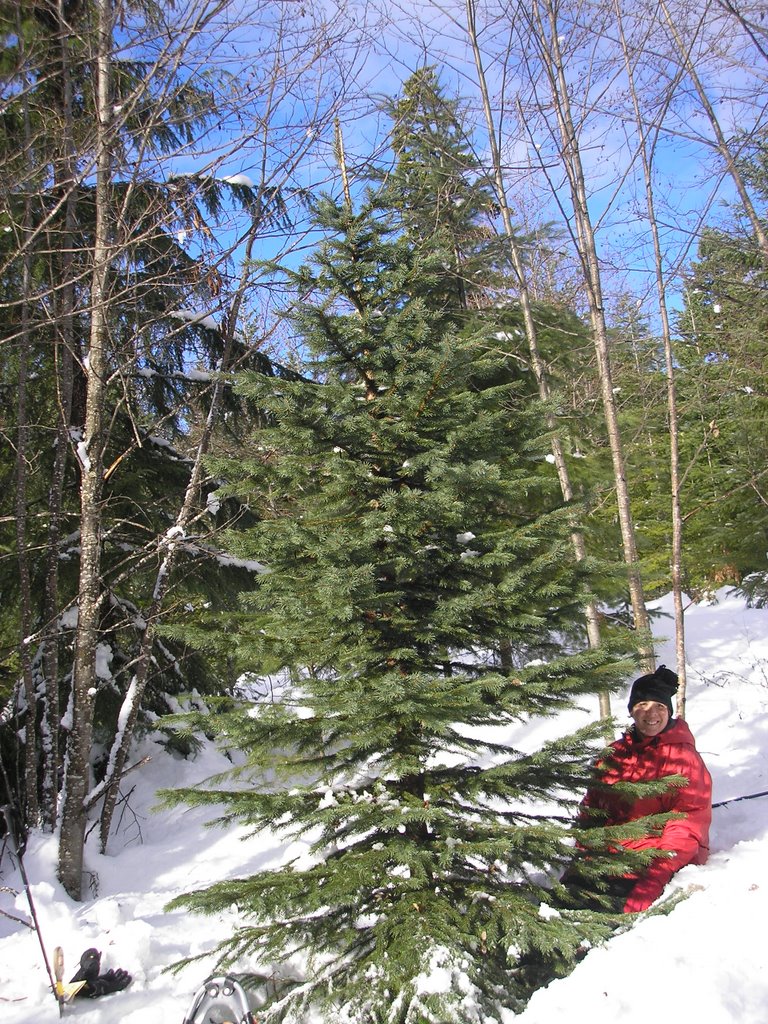
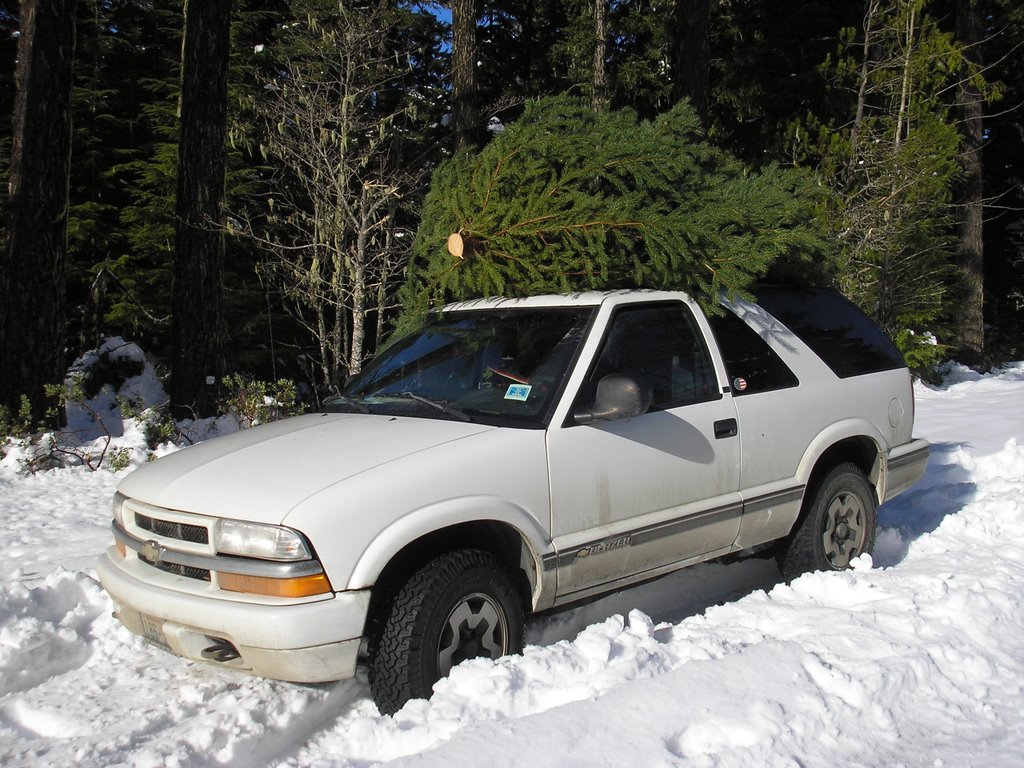
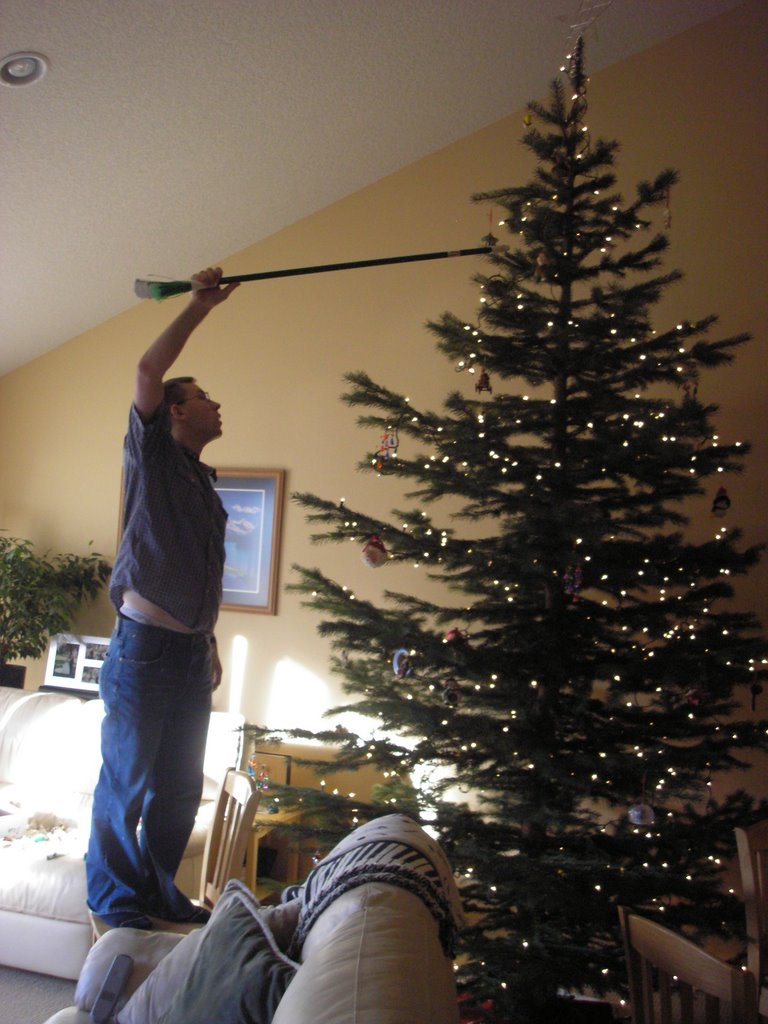
Yesterday was the only Saturday I have free this bid, so Dawn and I decided it was a good day to get a Christmas tree. Now, we have tons of tree sales going on in our neighborhood right now, and there are cut-your-own tree farms a few miles away - but what's the fun in that? We decided to continue the tradition we started last year, snowshoeing in the National Forest to find and cut down The Perfect Tree. A $5 permit and patience are all that's required.
Flood damage and massive recent snowfall kept us from the higher elevations of Gifford Pinchot National Forest, and there was enough snow at lower elevations to pose a challenge to our 4WD Blazer. We eventually parked the Blazer and struck out on showshoes; surprisingly, it only took us about an hour of searching to find a nice Blue Spruce. It wasn't until we got home that we realized just how big it was. It is almost of Griswoldian proportions. Fortunately we have 18' vaulted ceilings.
Have I mentioned recently that I love living in the Northwest? Yup.


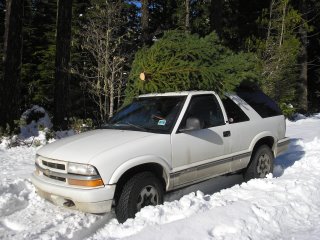
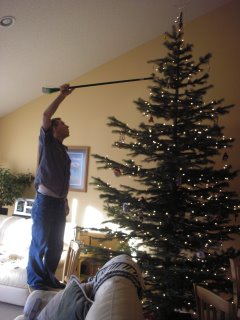

Flood damage and massive recent snowfall kept us from the higher elevations of Gifford Pinchot National Forest, and there was enough snow at lower elevations to pose a challenge to our 4WD Blazer. We eventually parked the Blazer and struck out on showshoes; surprisingly, it only took us about an hour of searching to find a nice Blue Spruce. It wasn't until we got home that we realized just how big it was. It is almost of Griswoldian proportions. Fortunately we have 18' vaulted ceilings.
Have I mentioned recently that I love living in the Northwest? Yup.


Subscribe to:
Posts (Atom)


