I mentioned in my last post that I jumpseated to Amsterdam - that is, in my desire to see how insanely cheap I could do a European trip, I didn't buy any non-rev passes. That was pretty risky given that I'm not horribly familiar with international jumpseating and I would've had no way to buy a non-rev pass once I was over there. I almost got bitten for it.
When I showed up at Schiphol Airport on Friday afternoon, I was planning on taking Northwest Airlines to Memphis, since I knew that Northwest offers international jumpseat and that flight had plenty of open seats. My first inkling of trouble was when I approached the KLM ticket counter to request the jumpseat and the agent said "Jumpseat? We don't do that in Europe. Do you have a nonrev pass?" I politely told her that although KLM doesn't do jumpseat, Northwest does. She found a supervisor who did know about jumpseating; she informed me if I wished to jumpseat, I'd need to have my own NWA jumpseat forms, because KLM does not stock them. Ouch. I'll know better next time.
There were only a few flights to the US left that day, at least on jumpseatable U.S. carriers. I tried United; their ticket agents mistakingly claimed that they don't offer international jumpseat. I tried Delta; they were full. At this point I had a very heavy, sinking feeling in the pit of my stomach. I'm going to get stuck here, miss work, and spend a ton of money. I'm an idiot for not buying a non-rev pass! Fortunately, the next carrier that I tried, USAirways, had jumpseat-savvy ticket agents and some seats available on their flight to Philadelphia. I had just enough time to pay the departure tax (€41! Ack!), go through customs and security, and get on the plane. The only reason it worked was that I took an earlier train to the airport than I originally planned. Otherwise I would've been stuck for the day, and possibly all weekend.
So have I learned my lesson? Will I never attempt to jumpseat internationally again? Eh, I'm a bit too much of a cheapskate to pass up a free ride. But I'll definately bring extra jumpseat passes with me next time, and do research on backup flights beforehand even if I'm trying for one that seems foolproof.
Sunday, February 26, 2006


Saturday, February 25, 2006
Doing the 'Dam
As you may have guessed from my last post, I spent the last few days in Europe...Amsterdam, to be exact. "A few days" is kind of misleading, as I spent 24 hours flying and 32 hours actually in A-Dam. Hey, it's an improvement on my trip to Cairo a few years back! (24 hours flying for 8 hours in country).
It was my first time in Amsterdam and I loved it. It's a very cool town - even if you're not into weed or prostitutes! I had fun just walking around and enjoying the laid back atmosphere, and meeting some cool people at the Flying Pig Hostel.
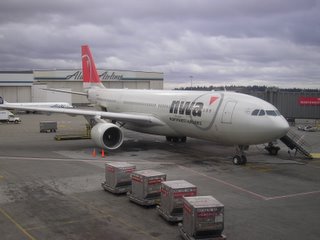
I caught Northwest Airlines flight 34 from Seattle. It was my first time on the A330, and it's a very nice airplane. I was planning on taking Northwest back to the states but ran into problems: KLM, which runs their gate in AMS, didn't have any jumpseat forms. I ended up jumpseating on USAirways to PHL, then taking Southwest PHL-MDW-PDX.
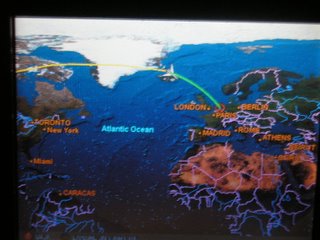
The A330's seatback entertainment system is cool! I built a playlist from the extensive music track collection, let it play, and set the map up for "follow the flight." Here we are 7 hours in, with three hours to go.
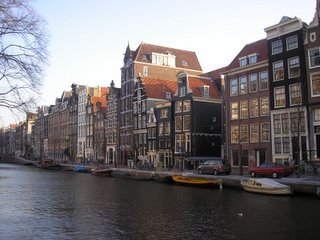
Sunrise over the stately homes alongside the Prinsengracht canal.
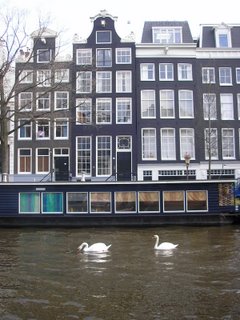
Swans swimming past a houseboat on the Prinsengracht canal.
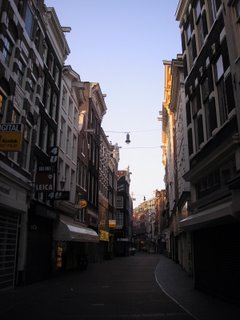
The narrow pedestrian-only street of Nieuwendijk, where the Flying Pig hostel is located among numerous small shops, cafes, "coffee shops," and "head / smart stores."
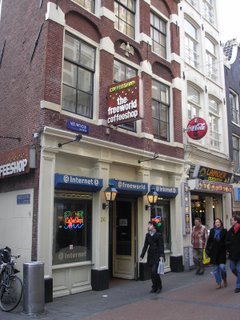
Funny, I didn't see anyone drinking coffee in here... [grin]
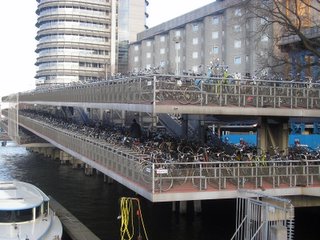
Somebody told me that the Dutch are avid bicyclists but I don't really believe it...
So yup. That's what you can do with jumpseat privledges, a few days off, and €70. Mind you, if you're not single, you'll need a loving wife/partner that urges you to travel somewhere on days off while they're working. Thanks, Dawn!
It was my first time in Amsterdam and I loved it. It's a very cool town - even if you're not into weed or prostitutes! I had fun just walking around and enjoying the laid back atmosphere, and meeting some cool people at the Flying Pig Hostel.
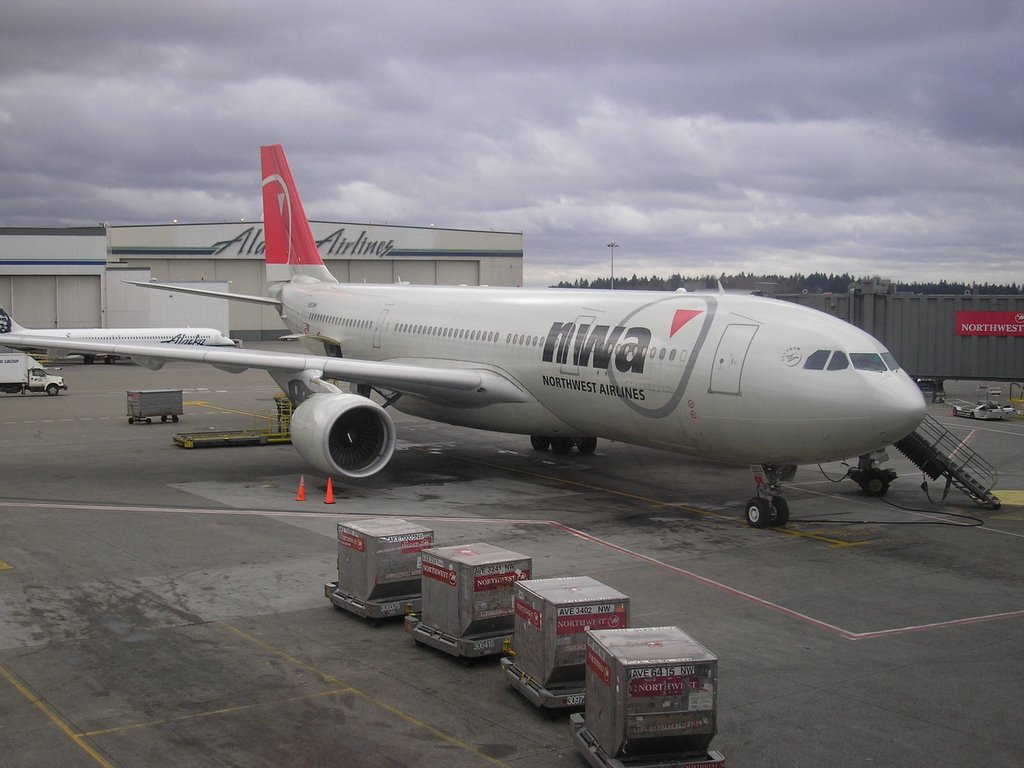
I caught Northwest Airlines flight 34 from Seattle. It was my first time on the A330, and it's a very nice airplane. I was planning on taking Northwest back to the states but ran into problems: KLM, which runs their gate in AMS, didn't have any jumpseat forms. I ended up jumpseating on USAirways to PHL, then taking Southwest PHL-MDW-PDX.

The A330's seatback entertainment system is cool! I built a playlist from the extensive music track collection, let it play, and set the map up for "follow the flight." Here we are 7 hours in, with three hours to go.
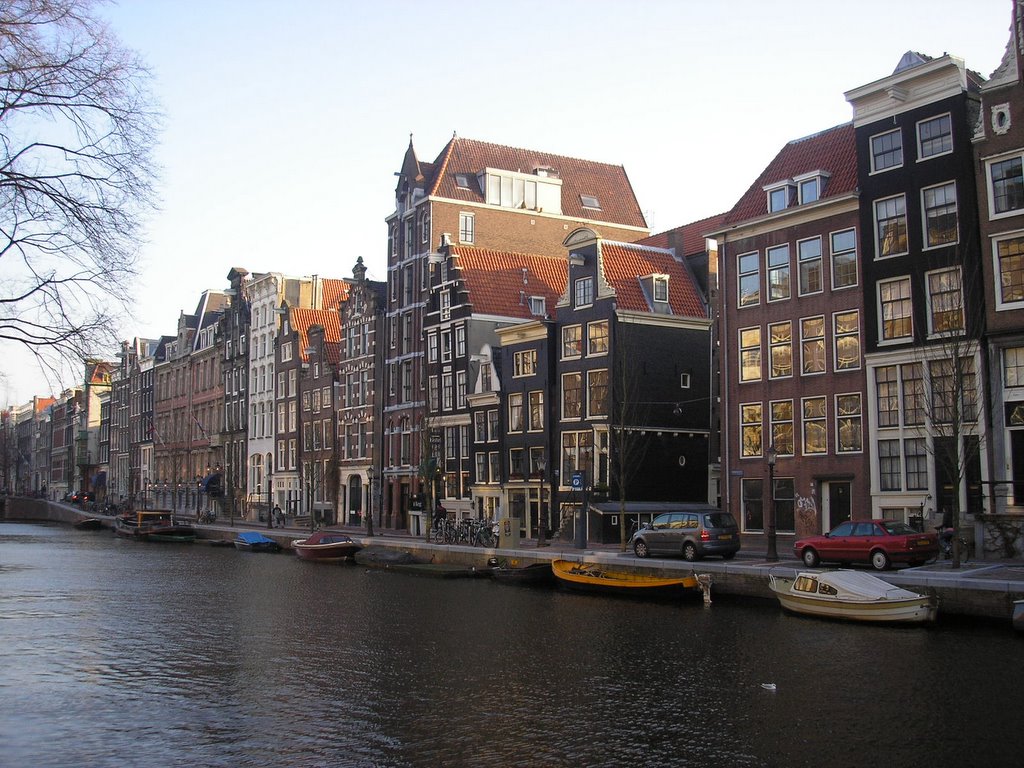
Sunrise over the stately homes alongside the Prinsengracht canal.
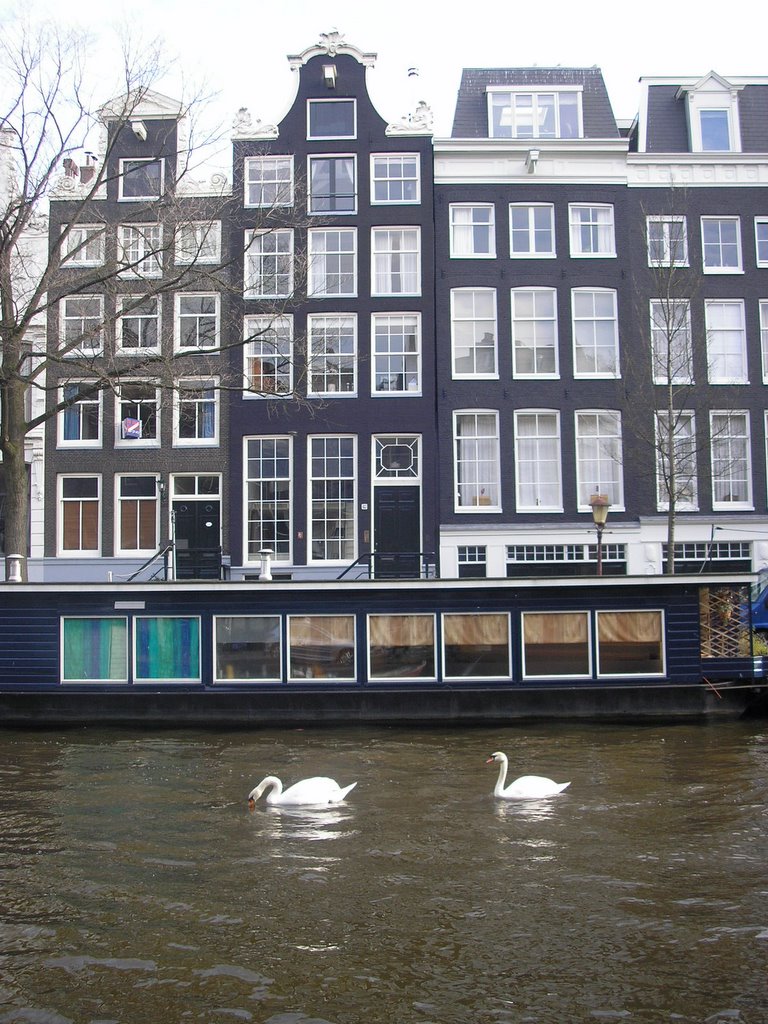
Swans swimming past a houseboat on the Prinsengracht canal.

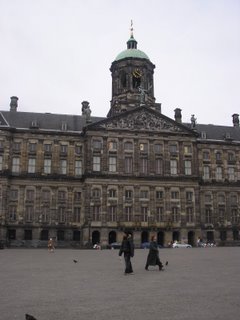
The Royal Palace in Dam Square.
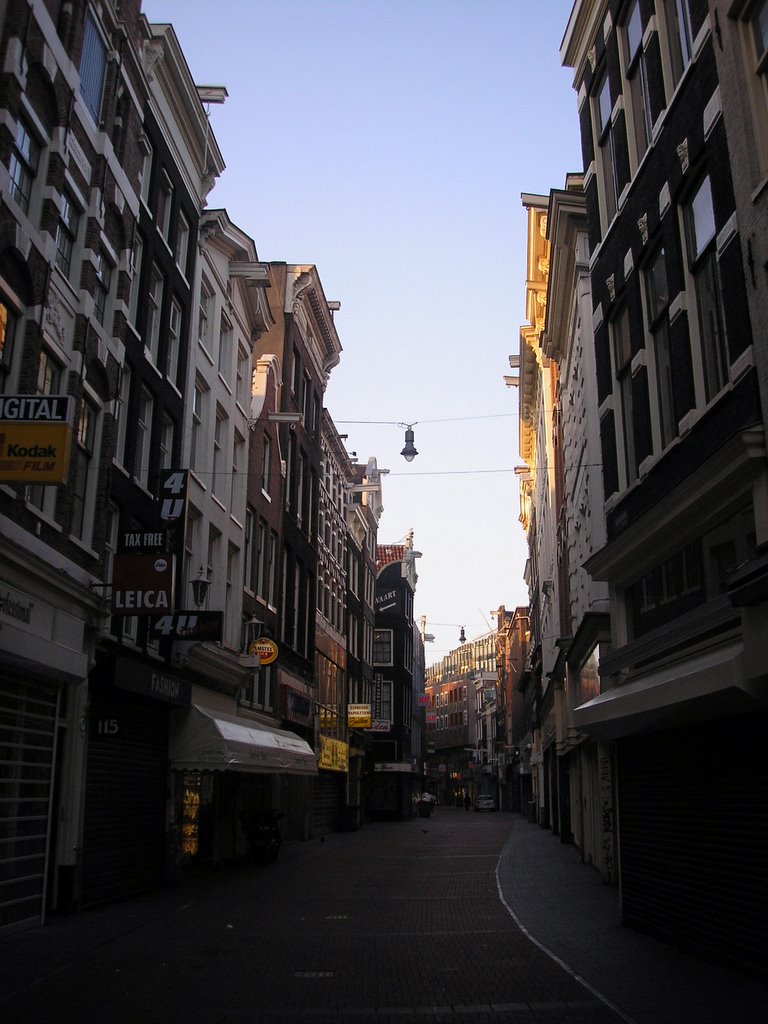
The narrow pedestrian-only street of Nieuwendijk, where the Flying Pig hostel is located among numerous small shops, cafes, "coffee shops," and "head / smart stores."

Funny, I didn't see anyone drinking coffee in here... [grin]
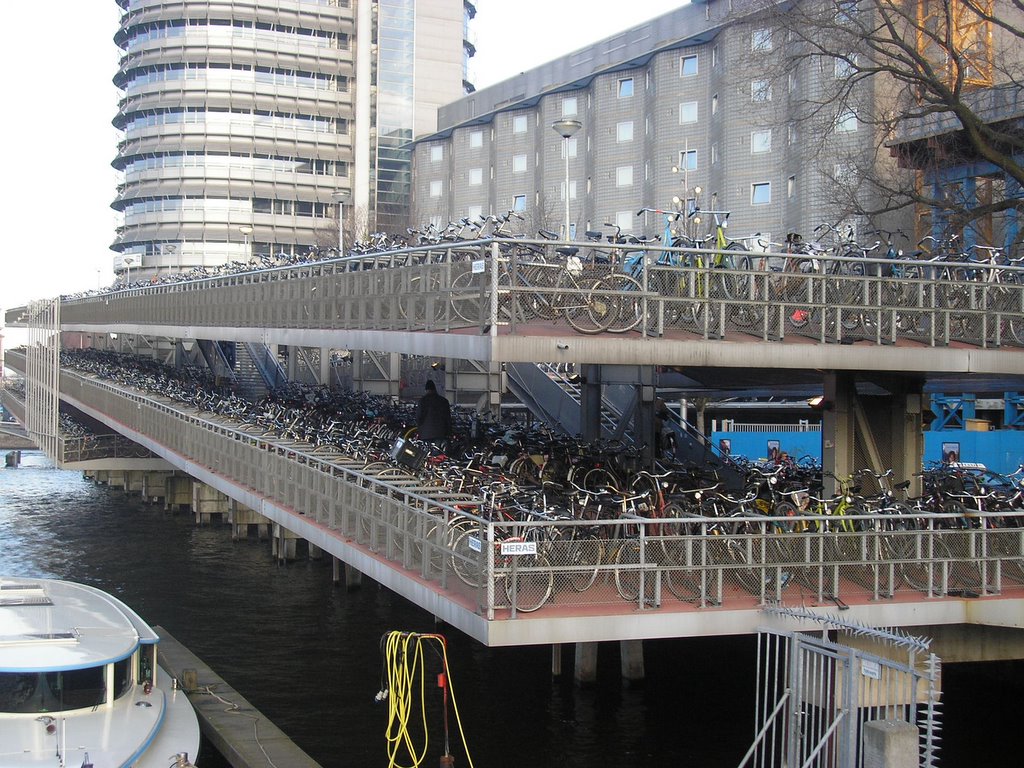
Somebody told me that the Dutch are avid bicyclists but I don't really believe it...
So yup. That's what you can do with jumpseat privledges, a few days off, and €70. Mind you, if you're not single, you'll need a loving wife/partner that urges you to travel somewhere on days off while they're working. Thanks, Dawn!
Thursday, February 23, 2006
Tuesday, February 21, 2006
One Year Old
Break out the balloons, party hats, and noisemakers; Blogging at FL250 turns one year old today. Thanks to everyone who's read and taken the time to comment or email, I really do appreciate your interest and input.
Sunday, February 19, 2006
The Right Approach
One of the more common questions we get from flight deck visitors is "how do you find the airport?" It's a good question, but it doesn't have a short answer. We have many ways of finding the desired patch of terra firma to land on, with technology ranging from rather crude to bleeding edge. Here's a discussion for those of you not familiar with IFR flying.
The majority of the time we simply fly visual approaches. As it's name would seem to indicate, a visual approach is flown by visual reference to the airport...simply "eye-balling it." Good weather is required, particularly in mountainous areas. The key is planning your descent so that you arrive at pattern altitude just far enough from the airport to slow down and configure for landing. If you find yourself too high to make a normal descent, a visual approach allows you to maneuver (S-turns, 360's, etc) or reconfiguring the airplane for higher drag.
When clouds or poor visibility preclude a visual approach, we'll shoot an instrument approach instead. I'll get to the various types of instrument approaches in a minute, but there are some shared characteristics to mention. All instrument approaches are created, tested, approved, and published by the FAA. At most airlines, pilots use "Jepp Charts," but these are simply another representation of the FAA-published data for each approach. Every approach has a standard course that each airplane must fly, as well as "feeder routes" and instructions in case of a "missed approach." There is a minimum visibility value that must be met before airline operators can even begin the approach. Finally, and quite importantly, there is a published minimum altitude based on obstructions and terrain. You cannot descend below this altitude until the airport is in sight.
The most common instrument approach is an ILS (Instrument Landing System). An ILS uses ground-based antennas to transmit several signals that guide airplanes right to the end of the runway. The localizer signal provides lateral ("right or left") guidance. The glideslope signal provides vertical guidance, usually for a 3 degree glidepath. In the airplane, these signals are picked up by a receiver and displayed for the pilot in the form of needles. The pilot follows the ILS to the ground by following the needles. For example, if the localizer needle is to the right, the pilot needs to go right to get on course. If the glideslope needle is down, the pilot needs to steepen the descent to get on glidepath. Both localizer and glideslope are quite sensitive; for this reason, a ILS approach usually provides a minimum altitude of 200 feet above touchdown elevation.
At my airline, we actually have extra equipment installed that allows us to fly special ILS approaches that have minimum altitudes of 50 to 100 feet above touchdown elevation. These are known as Category II and III ILS approaches ("Cat II" or "Cat III"). Most airlines use autoland-capable autopilots to fly Cat II/III approaches; at my airline we hand-fly these approaches using heads-up displays like you'd find in a military fighter. Only large airports, and some fog-prone smaller airports, have published Cat II/III approaches. Airports that don't have them are often inaccessible during fog.
The basic enroute navigational aid in the United States is the VOR - Very High Frequency Omnidirectional Range, if you care. Besides it's role in enroute navigation, this navaid also is used for VOR approaches. These are tricker than ILS's because there is no vertical guidance, so you descend in steps as you cross certain points on the approach. You navigate laterally with the same needle you'd fly an ILS with, except that you need to select the course. The lack of a glideslope, as well as the fact that VORs aren't nearly as sensitive as localizers, means that VOR approaches usually have much higher minimums than ILS approaches. Some airports are served by only VOR approaches, but they are rare in the airline world. Most of the airports we fly to have other approaches, and VOR's are just a backup to those.
The dinosaur of navaids is the non-directional beacon, or NDB. The NDB approach is like the VOR approach in that it lacks a glideslope, so descents must be made in steps. NDBs aren't very precise, so NDB approaches often have quite high minimums.
A relatively new option is the FMS approach. In general aviation these are known as GPS approaches, but at the airlines they are usually flown with a Flight Management System that utilizes GPS signals. In my airplane, FMS approaches provide both lateral and vertical guidance, just like an ILS - you follow the needles the same way. Some FMS approaches are "standalone," meaning that they were specifically designed to be FMS approaches; "overlay approaches" are actually laid over an existing VOR or NDB approach. In this case, you still use the VOR or NDB minimums, but at least you have the added safety and convenience of a glidepath.
The newest up-and-coming thing is RNP Approaches. These are similar to FMS approaches, in that they are dependent on GPS for navigation, but are more precise and incorporate neat things like curved or zigzagged courses. This will allow for low minimum altitudes, even in high terrain where an ILS would be impossible. Our sister airline is already using RNP approaches, and I'm told that we'll be getting approval sometime within the next year.
So what approach do we use? Whichever is most convenient and provides acceptible minimums given current weather conditions. Usually if there is an ILS available, we'll use it. If an FMS approach is quicker and the weather isn't too bad, we'll use that. We tend to stay away from VOR or NDB approaches unless the weather is pretty good or no other approach is available; of course, most of these approaches now have FMS approaches overlaid, so they're a lot easier these days. Of course, no matter which approach we use, we can't go below the minimum altitude until we see the airport. So once the gadgetry "finds the airport," it's back to good ole fashioned eye-ballin' it to safely land.
The majority of the time we simply fly visual approaches. As it's name would seem to indicate, a visual approach is flown by visual reference to the airport...simply "eye-balling it." Good weather is required, particularly in mountainous areas. The key is planning your descent so that you arrive at pattern altitude just far enough from the airport to slow down and configure for landing. If you find yourself too high to make a normal descent, a visual approach allows you to maneuver (S-turns, 360's, etc) or reconfiguring the airplane for higher drag.
When clouds or poor visibility preclude a visual approach, we'll shoot an instrument approach instead. I'll get to the various types of instrument approaches in a minute, but there are some shared characteristics to mention. All instrument approaches are created, tested, approved, and published by the FAA. At most airlines, pilots use "Jepp Charts," but these are simply another representation of the FAA-published data for each approach. Every approach has a standard course that each airplane must fly, as well as "feeder routes" and instructions in case of a "missed approach." There is a minimum visibility value that must be met before airline operators can even begin the approach. Finally, and quite importantly, there is a published minimum altitude based on obstructions and terrain. You cannot descend below this altitude until the airport is in sight.
The most common instrument approach is an ILS (Instrument Landing System). An ILS uses ground-based antennas to transmit several signals that guide airplanes right to the end of the runway. The localizer signal provides lateral ("right or left") guidance. The glideslope signal provides vertical guidance, usually for a 3 degree glidepath. In the airplane, these signals are picked up by a receiver and displayed for the pilot in the form of needles. The pilot follows the ILS to the ground by following the needles. For example, if the localizer needle is to the right, the pilot needs to go right to get on course. If the glideslope needle is down, the pilot needs to steepen the descent to get on glidepath. Both localizer and glideslope are quite sensitive; for this reason, a ILS approach usually provides a minimum altitude of 200 feet above touchdown elevation.
At my airline, we actually have extra equipment installed that allows us to fly special ILS approaches that have minimum altitudes of 50 to 100 feet above touchdown elevation. These are known as Category II and III ILS approaches ("Cat II" or "Cat III"). Most airlines use autoland-capable autopilots to fly Cat II/III approaches; at my airline we hand-fly these approaches using heads-up displays like you'd find in a military fighter. Only large airports, and some fog-prone smaller airports, have published Cat II/III approaches. Airports that don't have them are often inaccessible during fog.
The basic enroute navigational aid in the United States is the VOR - Very High Frequency Omnidirectional Range, if you care. Besides it's role in enroute navigation, this navaid also is used for VOR approaches. These are tricker than ILS's because there is no vertical guidance, so you descend in steps as you cross certain points on the approach. You navigate laterally with the same needle you'd fly an ILS with, except that you need to select the course. The lack of a glideslope, as well as the fact that VORs aren't nearly as sensitive as localizers, means that VOR approaches usually have much higher minimums than ILS approaches. Some airports are served by only VOR approaches, but they are rare in the airline world. Most of the airports we fly to have other approaches, and VOR's are just a backup to those.
The dinosaur of navaids is the non-directional beacon, or NDB. The NDB approach is like the VOR approach in that it lacks a glideslope, so descents must be made in steps. NDBs aren't very precise, so NDB approaches often have quite high minimums.
A relatively new option is the FMS approach. In general aviation these are known as GPS approaches, but at the airlines they are usually flown with a Flight Management System that utilizes GPS signals. In my airplane, FMS approaches provide both lateral and vertical guidance, just like an ILS - you follow the needles the same way. Some FMS approaches are "standalone," meaning that they were specifically designed to be FMS approaches; "overlay approaches" are actually laid over an existing VOR or NDB approach. In this case, you still use the VOR or NDB minimums, but at least you have the added safety and convenience of a glidepath.
The newest up-and-coming thing is RNP Approaches. These are similar to FMS approaches, in that they are dependent on GPS for navigation, but are more precise and incorporate neat things like curved or zigzagged courses. This will allow for low minimum altitudes, even in high terrain where an ILS would be impossible. Our sister airline is already using RNP approaches, and I'm told that we'll be getting approval sometime within the next year.
So what approach do we use? Whichever is most convenient and provides acceptible minimums given current weather conditions. Usually if there is an ILS available, we'll use it. If an FMS approach is quicker and the weather isn't too bad, we'll use that. We tend to stay away from VOR or NDB approaches unless the weather is pretty good or no other approach is available; of course, most of these approaches now have FMS approaches overlaid, so they're a lot easier these days. Of course, no matter which approach we use, we can't go below the minimum altitude until we see the airport. So once the gadgetry "finds the airport," it's back to good ole fashioned eye-ballin' it to safely land.
Friday, February 17, 2006
Freak Accident
Ground damage is a pretty common occurance in the airline world. Bag loaders, service trucks, and even gates regularly punch holes in airplanes. A few months ago, our sister airline suffered a depressurization incident caused by unreported ground damage, so it's a bit of a sensitive subject at our company. Besides the safety factor, ground damage costs airlines a lot of money, and it's mostly preventable. It's usually caused by time-pressed employees who get careless and make mistakes.
On Tuesday, though, I was involved in a ground damage incident that probably qualifies for freak occurence status. A chain of seemingly unrelated factors came together and resulted in a bent airplane. It started when we were deiced in Butte, resulting in a smudged windshield. Inbound to Seattle, we called for a window wash. I made a nice Flaps 15 landing and lowered the nosewheel softly; although I didn't realize it, the nosewheel strut did not compress fully.
At the parking spot, one of our ramp supervisors placed a wheeled ladder against the airplane to do the window wash. These ladders have padded handrails to prevent damage, but there are some sharp corners lower on the ladder. When it was first positioned, these corners were several inches below and away from the curved side of the airplane. The problem arose when enough passengers boarded to cause the nose strut to finally compress. The nose of the airplane sank several inches onto a corner of the ladder, which caused a nasty gash in the skin.
The airplane was taken out of service; fortunately, another airplane was available to get us on our way. I don't know how anybody could've foreseen this occurence; the ramp supervisor certainly wasn't negligent. Given the sensitivity of the ground damage issue these days, I was a little worried that he'd be tarred and feathered, despite being one of the friendliest and hardest working ramp sup's we have anywhere. It sounds like the company is dealing with it pretty reasonably, though.
Given how strong our airplanes are to structural loads, it can be alarming to see how susceptible their aluminum skin is to gouging and tearing. Fortunately, there aren't many things in the sky that gouge or tear, so we just have to look out for bag loaders and sharp edged ladders on the ground.
On Tuesday, though, I was involved in a ground damage incident that probably qualifies for freak occurence status. A chain of seemingly unrelated factors came together and resulted in a bent airplane. It started when we were deiced in Butte, resulting in a smudged windshield. Inbound to Seattle, we called for a window wash. I made a nice Flaps 15 landing and lowered the nosewheel softly; although I didn't realize it, the nosewheel strut did not compress fully.
At the parking spot, one of our ramp supervisors placed a wheeled ladder against the airplane to do the window wash. These ladders have padded handrails to prevent damage, but there are some sharp corners lower on the ladder. When it was first positioned, these corners were several inches below and away from the curved side of the airplane. The problem arose when enough passengers boarded to cause the nose strut to finally compress. The nose of the airplane sank several inches onto a corner of the ladder, which caused a nasty gash in the skin.
The airplane was taken out of service; fortunately, another airplane was available to get us on our way. I don't know how anybody could've foreseen this occurence; the ramp supervisor certainly wasn't negligent. Given the sensitivity of the ground damage issue these days, I was a little worried that he'd be tarred and feathered, despite being one of the friendliest and hardest working ramp sup's we have anywhere. It sounds like the company is dealing with it pretty reasonably, though.
Given how strong our airplanes are to structural loads, it can be alarming to see how susceptible their aluminum skin is to gouging and tearing. Fortunately, there aren't many things in the sky that gouge or tear, so we just have to look out for bag loaders and sharp edged ladders on the ground.
Wednesday, February 15, 2006
Anybody up for some skiing?
This Friday and Saturday, Dawn and I are going to be heading to Big White Ski Resort in Kelowna, BC. Dawn doesn't want to ski on Saturday, and none of my friends have this weekend off, so I'm still looking for a ski buddy.
You can get a cheap bed ($24 CDN) at the ski-in/ski-out SameSun Big White Hostel. If you get into town Friday morning or afternoon, you catch a ride from Kelowna to Big White with us. Kelowna's airport is served by WestJet, Horizon Air, and Air Canada/Jazz. Big White gives airline employees a 25% discount on lift tickets. So, if you're in the mood for some light Okanagan powder, drop me an email.
EDIT: Scatch that. All the rental car places are sold out so we'd have no way to get to the mountain. Guess we're gonna hang around here and ski locally.
You can get a cheap bed ($24 CDN) at the ski-in/ski-out SameSun Big White Hostel. If you get into town Friday morning or afternoon, you catch a ride from Kelowna to Big White with us. Kelowna's airport is served by WestJet, Horizon Air, and Air Canada/Jazz. Big White gives airline employees a 25% discount on lift tickets. So, if you're in the mood for some light Okanagan powder, drop me an email.
EDIT: Scatch that. All the rental car places are sold out so we'd have no way to get to the mountain. Guess we're gonna hang around here and ski locally.
Subscribe to:
Posts (Atom)


