When I jumpseat on other airlines, it's usually to get across the country, so I go in 737's or bigger. It's pretty rare that I ride in an airliner that is smaller than the one I fly for work. When I do, I enjoy noting the similarities and differences between other operations and our own.
Earlier this week, I rode a Saab 340 between Minneapolis and Watertown, SD. It was my first time in the SF340, and it seems like a neat little plane. The airplane says "Northwest Airlink" on its side, but the actual airline is Mesaba. They do all of Northwest's Saab and Avro RJ85 express flying. Pinnacle Airlines also operates under the "Airlink" brand name; they fly only CRJ-200's.
At Minneapolis, both Mesaba and Pinnacle operate out of the A and B concourses. The setup is very different from what I'm used to. The concourse is set up to look like a "regular" (ie mainline) operation. You have regularly spaced gates, each with its own waiting area that looks like all the other waiting areas at the airport, except in miniature; each one only holds 20 or 30 people. The gate itself leads to a comically short jetway, from which you board your airplane, whether it's a Saab or a CRJ. The effect is one of progressive claustrophobia: you go from a bright, airy hall to a smallish boarding area to a small jetway to an even smaller aircraft interior.
Now, I never thought I'd have an opinion on anything so trivial as how to board an airplane. But seeing the way Mesaba does it made me appreciate the way my own airline has it set up, at least for our turboprops. At our bigger stations, our gates tend to share large, open waiting areas. After the gate, you walk outside to your airplane; if it's a ways out on the ramp, you'll walk most of the way in a glass-paneled covered walkway. When you get to the plane, you'll board using the aircraft's stairs or ramp. At some airports we do use jetways, but you'll usually find stairs at the end of the jetway bringing you to ramp level, where you board the airplane.
Now I know some readers are scratching their heads, wondering why I would think our method is better. You end up with massive packed boarding rooms giving off a third world vibe, and then you have to negotiate a bunch of stairs, and go out into the elements, and then climb more stairs into the airplane. So you're right, from a practical standpoint, Mesaba has it set up much more practically - particularly for Minnesota winter conditions. But I'm thinking from an aesthetic standpoint.
My problem with jetways is that they insulate the passengers from realizing that they're about to strap on a thin aluminim tube and go blasting through the outer reaches of the atmosphere. Consider how you travel: you go from standing in line at the gate to standing in line on the jetway, then you duck through a little door into a jet cabin where you shuffle to your assigned seat. Some hours later, you shuffle back out the door, up another jetway, and into another airport terminal. The only indication that you just flew thousands of miles is that Grandma is there to pick you up. And really, most passengers like it that way.
In a turboprop like the Saab, you know you're flying. There's wind noise and engine noise and propeller noise, there's lots of vibration, you feel every gust and eddy, you can feel every sharp control movement. On every takeoff, you know whether the plane is light or heavy from its performance or lack thereof. There's no use pretending that you're doing anything other than flying.
And if you're going flying, you might as well get in a good look at the machine. Approaching from ramp level gives you time to appreciate its symmetry from various angles, to marvel at the engineering that goes into even "little planes," to get to know the quirky personality that all turboprops seem to have. Down here on the ramp, you can shake the hand of the mechanic that last turned a wrench on your craft, and say good morning to the ramper who will load your bag. Then, you step onto the airstairs, take one last look down the shimmering fuselage, and pull yourself up into the beast. There's no doubt about it - you're going flying!
Basically what I'm saying is that what most passengers consider to be turboprops' faults, I consider glorious features that do their little bit to connect us to a time when airline flying wasn't so commonplace or sterile or comfortable or even safe. If people embraced turboprops this way, they might discover that they actually enjoy flying without the adventure sucked out of it.
Wow, I kinda went all nostalgic on ya'll there, didn't I? Ironic given that the Megawhacker really has more in common with jets than turboprops. I doubt I'd be waxing poetic if I had to do 8 legs a day on the Saab.
Thursday, June 29, 2006


Sunday, June 25, 2006
The Big Picture?
Today was supposed to be a tough day to begin with; it ended up being nearly three hours longer than scheduled.
The airplane we started with this morning had its antiskid braking system deferred. It's really not a big deal, because the anti-skid only comes into play when heavy braking is used, and that's pretty rare for the airports we fly into. Inoperative antiskid, however, does affect takeoff and landing performance tables rather significantly.
Early in the day, I mentioned to the captain that this could potentially cause a problem on our fifth leg, when we'd be landing in Great Falls. That airport is undergoing a huge construction project; the 10,500 foot Runway 3/21 is completely torn up, so we've been using Runway 34/16 - 6300 feet long. With the right combination of temperature, winds, and aircraft weight, I realized that we might not be able to land in Great Falls. However, I had done this trip a number of times the last month, and we always had an airplane swap after leg four. I assumed this would be the case again, particularly since the short runway would prompt the router to send an airplane with operative antiskid.
Inbound to Seattle on leg four, we got a message from dispatch. My earlier fears turned out to be well-founded: the temperature and winds at Great Falls were such that our antiskid-less Megawhacker would be extremely weight limited for landing - and we had a full passenger load. Despite this, we were slated to keep the same airplane. Once we got on the ground, the captain called dispatch and sorted through our options. Maintenance could attempt to fix the antiskid system; minimum wait time, three hours. We could accept the weight penalty, and leave 30 passengers behind. We could just fly into Helena, our final destination for the day - but a bus for the Great Falls passengers couldn't be arranged soon enough. Or, we could wait for the next Megawhacker inbound to Seattle, and swap planes then. This was what we ended up doing, and it cost us about 2.5 hours.
Now, the antiskid system had been deferred for five days. One of the infuriating things about this situation is that you'd think someone would've seen it coming down the pike. I considered it obvious enough that I didn't think to alert anybody. Yet, the problem was not discovered until one hour before our scheduled departure, when the dispatcher tried to work up landing performance for Great Falls. Now granted, until she actually inputed the temperature and winds, nobody knew just what the performance restriction would be. But even the most favorable scenario would've made us leave passengers behind. You don't need exact numbers to realize that inop antiskid + short runway = weight restricted performance. It just seems that nobody outside of our crew realized that an airplane with inop antiskid was scheduled to fly to a short runway today.
When flight crews question puzzling decisions made by crew scheduling, dispatchers, and aircraft routers, we often hear the admonishment, "You just don't have the big picture." Okay, fair enough, we usually don't. But if you're going to tell us that we don't have the big picture and should therefore mind our own business, it'd be comforting to know that someone has the big picture!
The airplane we started with this morning had its antiskid braking system deferred. It's really not a big deal, because the anti-skid only comes into play when heavy braking is used, and that's pretty rare for the airports we fly into. Inoperative antiskid, however, does affect takeoff and landing performance tables rather significantly.
Early in the day, I mentioned to the captain that this could potentially cause a problem on our fifth leg, when we'd be landing in Great Falls. That airport is undergoing a huge construction project; the 10,500 foot Runway 3/21 is completely torn up, so we've been using Runway 34/16 - 6300 feet long. With the right combination of temperature, winds, and aircraft weight, I realized that we might not be able to land in Great Falls. However, I had done this trip a number of times the last month, and we always had an airplane swap after leg four. I assumed this would be the case again, particularly since the short runway would prompt the router to send an airplane with operative antiskid.
Inbound to Seattle on leg four, we got a message from dispatch. My earlier fears turned out to be well-founded: the temperature and winds at Great Falls were such that our antiskid-less Megawhacker would be extremely weight limited for landing - and we had a full passenger load. Despite this, we were slated to keep the same airplane. Once we got on the ground, the captain called dispatch and sorted through our options. Maintenance could attempt to fix the antiskid system; minimum wait time, three hours. We could accept the weight penalty, and leave 30 passengers behind. We could just fly into Helena, our final destination for the day - but a bus for the Great Falls passengers couldn't be arranged soon enough. Or, we could wait for the next Megawhacker inbound to Seattle, and swap planes then. This was what we ended up doing, and it cost us about 2.5 hours.
Now, the antiskid system had been deferred for five days. One of the infuriating things about this situation is that you'd think someone would've seen it coming down the pike. I considered it obvious enough that I didn't think to alert anybody. Yet, the problem was not discovered until one hour before our scheduled departure, when the dispatcher tried to work up landing performance for Great Falls. Now granted, until she actually inputed the temperature and winds, nobody knew just what the performance restriction would be. But even the most favorable scenario would've made us leave passengers behind. You don't need exact numbers to realize that inop antiskid + short runway = weight restricted performance. It just seems that nobody outside of our crew realized that an airplane with inop antiskid was scheduled to fly to a short runway today.
When flight crews question puzzling decisions made by crew scheduling, dispatchers, and aircraft routers, we often hear the admonishment, "You just don't have the big picture." Okay, fair enough, we usually don't. But if you're going to tell us that we don't have the big picture and should therefore mind our own business, it'd be comforting to know that someone has the big picture!
Saturday, June 24, 2006
Into The Woods
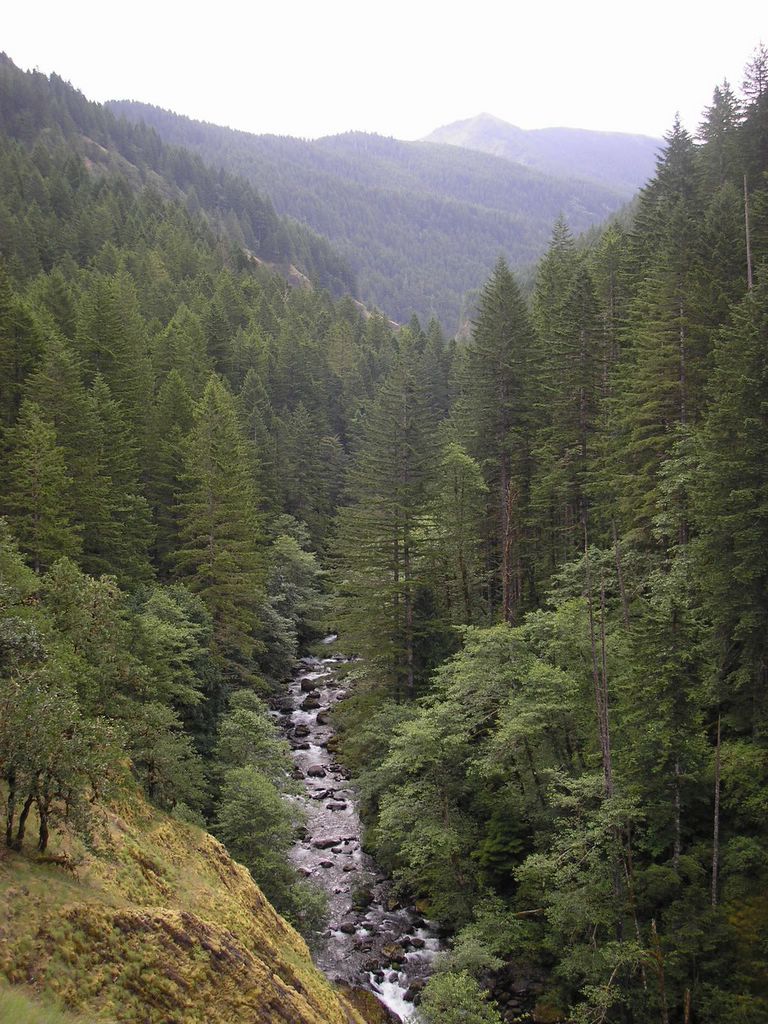
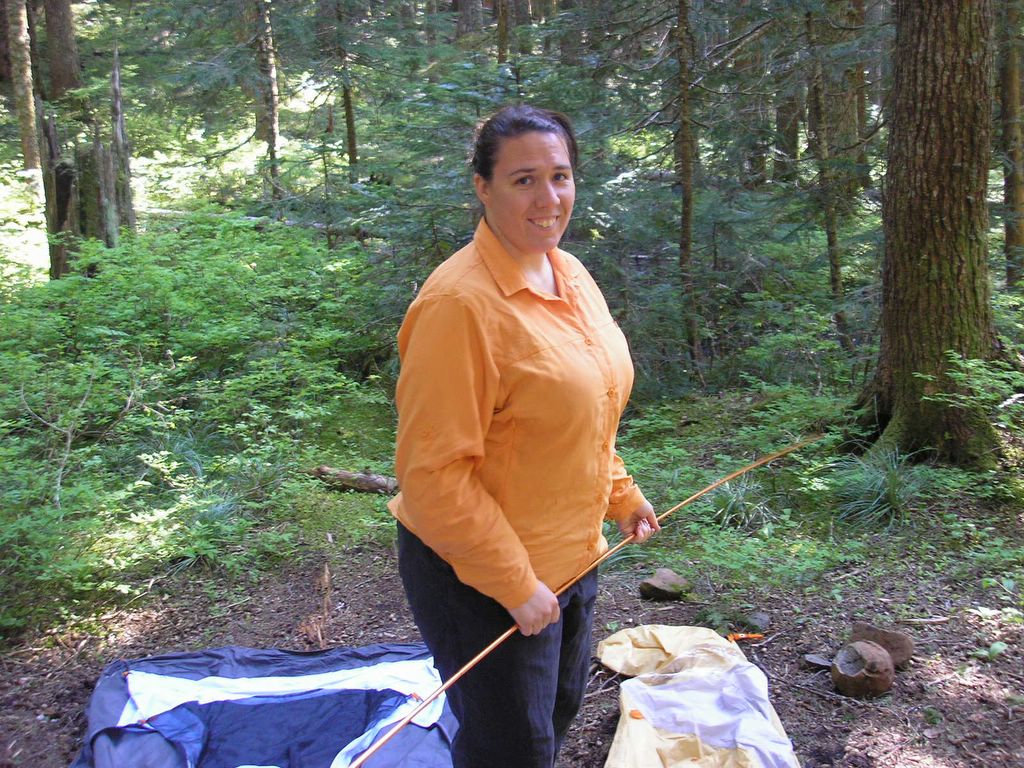
This last week, Dawn and I took our first backpacking trip of the year. The idea was to do a strenuous hike that'd help prepare us for the vertical-intensive hiking in Switzerland. Instead, it left me hobbling around like an old man.
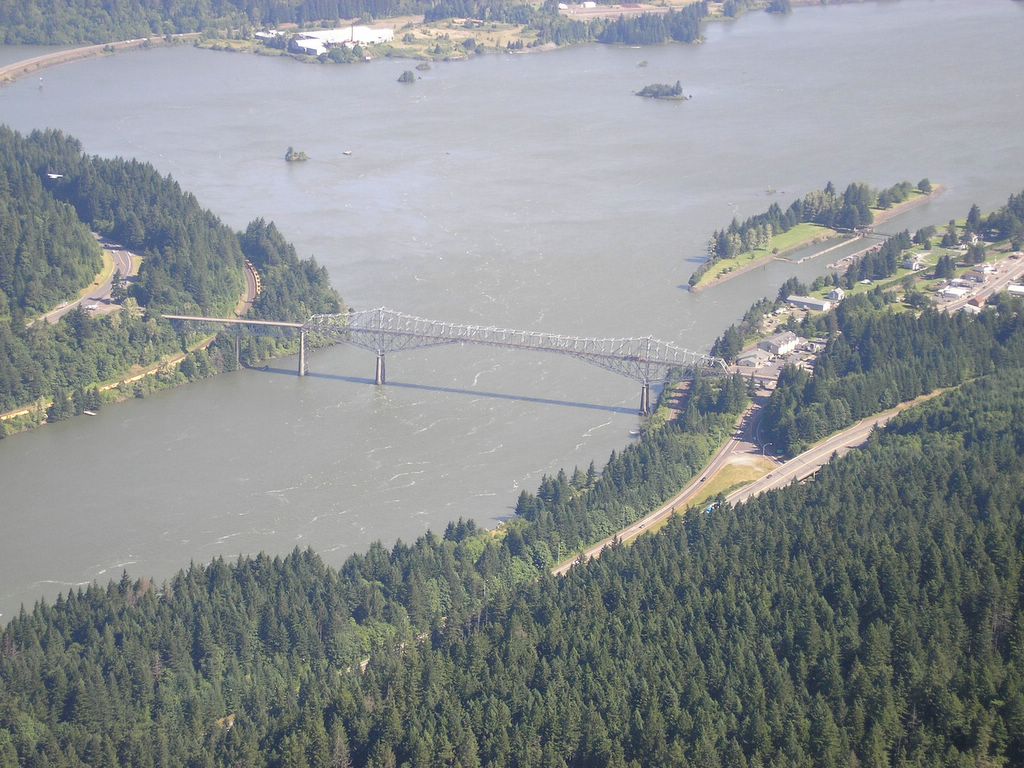
On Monday, Dawn picked me up at the airport after my trip, and we drove out to the Columbia River Gorge. We hiked an easy five miles on the popular Eagle Creek trail and pitched tent along the banks of Eagle Creek.
The next morning, we walked another mile up Eagle Creek to the Eagle-Benson trail. Even if well maintained, this would be a fairly strenuous trail; it gains 3500 feet in 3 miles on its way to the 4000' elevation Benson Plateau. For much of the way, though, the trail was little more than a goatpath. This wasn't a big deal until we reached an area that appeared to have been burned within the last 10 years; here, undergrowth choked the trail, and there was lots of fallen timber to climb over. It was infuriatingly slow going. At one point, I climbed a pretty big log and jumped off the other side - and felt a sharp twinge of pain in my knee. We had about 4 miles and 1000' vertical left until our intended campsite, and my knee steadily got worse the entire time. I spent that night wondering how I was going to get off this mountain with a bum knee. It was exactly like the situation with my Dad last September.
The hike out on Wednesday morning was only 6 miles long, but it included a loss of 3800 vertical feet. My right knee was hurting worse than the day before, but only when I bent the leg. By keeping my right leg perfectly straight, I could minimize the pain. Of course, this resulted in a weird lope that made some of the steeper sections rather awkward. I was awfully glad to get to the bottom of the trail.
Three days later, I'm still limping around with a straight right leg. Fortunately, I'm able to operate the Megawhacker's rudder pedals without pain, so I haven't had to call in sick. I'm just hoping that it's better in time for Switzerland - we depart on 6 July.
My dad had success with taking Glucosamine and Chondroitin Sulfate to strengthen his knee joints. I'm going to pick some up when I can get to a GNC. Does anybody have any experience with this?
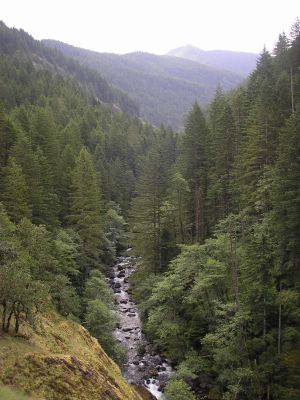
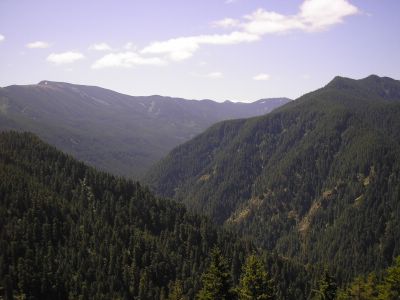
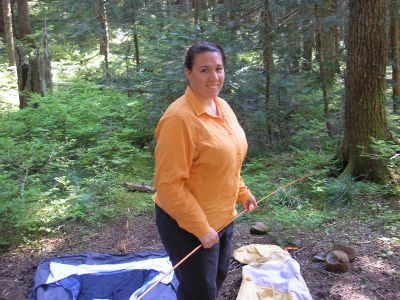
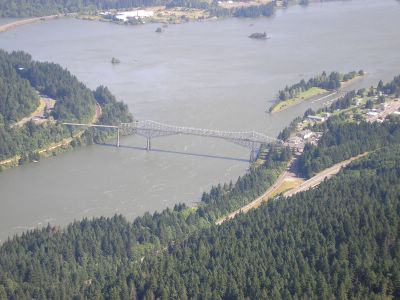
On Monday, Dawn picked me up at the airport after my trip, and we drove out to the Columbia River Gorge. We hiked an easy five miles on the popular Eagle Creek trail and pitched tent along the banks of Eagle Creek.
The next morning, we walked another mile up Eagle Creek to the Eagle-Benson trail. Even if well maintained, this would be a fairly strenuous trail; it gains 3500 feet in 3 miles on its way to the 4000' elevation Benson Plateau. For much of the way, though, the trail was little more than a goatpath. This wasn't a big deal until we reached an area that appeared to have been burned within the last 10 years; here, undergrowth choked the trail, and there was lots of fallen timber to climb over. It was infuriatingly slow going. At one point, I climbed a pretty big log and jumped off the other side - and felt a sharp twinge of pain in my knee. We had about 4 miles and 1000' vertical left until our intended campsite, and my knee steadily got worse the entire time. I spent that night wondering how I was going to get off this mountain with a bum knee. It was exactly like the situation with my Dad last September.
The hike out on Wednesday morning was only 6 miles long, but it included a loss of 3800 vertical feet. My right knee was hurting worse than the day before, but only when I bent the leg. By keeping my right leg perfectly straight, I could minimize the pain. Of course, this resulted in a weird lope that made some of the steeper sections rather awkward. I was awfully glad to get to the bottom of the trail.
Three days later, I'm still limping around with a straight right leg. Fortunately, I'm able to operate the Megawhacker's rudder pedals without pain, so I haven't had to call in sick. I'm just hoping that it's better in time for Switzerland - we depart on 6 July.
My dad had success with taking Glucosamine and Chondroitin Sulfate to strengthen his knee joints. I'm going to pick some up when I can get to a GNC. Does anybody have any experience with this?

Friday, June 23, 2006
Live from the Crew Room
Well, our summer has been officially kicked off with a backpacking trip that left Dawn and I more or less lame; all the brutal details with accompanying photos will probably be on the next post. For now, though, Dawn is taking the NWA redeye flight to MN, where she'll be helping her parents build their home's new addition over the next week and a half. As for me, I have a four day trip that ends on monday, when I head out to MN to hang with Dawn and in In-laws for a few days before coming back for my next four day trip. Once that's done, I'm home for a few days and then we head to Europe for three weeks. Sheesh, the summer hasn't even started and the schedule is making my head spin.
Because I had to drop Dawn off for her flight fairly late, and my trip has an early showtime tomorrow, I'm bedding down in the crew room at PDX. It's no big hardship.
Overstuffed La-Z-Boy? Check!
Blankets & pillows? Check!
Coke machine? Check!
Computer with internet access? Check!
Free breakfast? Check!
Well then, I'm as snug as a bug; just gotta set the alarm clock for 6:20am, at which time I'll stir myself awake enough to stumble across the hall to check in for my 6:25 showtime, jammies and all [grin].
Because I had to drop Dawn off for her flight fairly late, and my trip has an early showtime tomorrow, I'm bedding down in the crew room at PDX. It's no big hardship.
Overstuffed La-Z-Boy? Check!
Blankets & pillows? Check!
Coke machine? Check!
Computer with internet access? Check!
Free breakfast? Check!
Well then, I'm as snug as a bug; just gotta set the alarm clock for 6:20am, at which time I'll stir myself awake enough to stumble across the hall to check in for my 6:25 showtime, jammies and all [grin].
Wednesday, June 21, 2006
25th Anniversary
You'll never get me to admit flying for the carrier whose livery is on this airplane, or flying the type of aircraft pictured, but you should check it out anyways. My initial reaction was "that's the coolest ugly paint scheme I've ever seen!" Or maybe it was "that's the ugliest cool paint scheme I've ever seen."
Saturday, June 17, 2006
Butte Revisited
In response to my rather derogatory recent post about Butte, someone commented that they would've spent their layover "appreciating that which can never leave or be taken away from Butte- the natural beauty of the surrounding mountains and valleys." It's a good point. Until recently, our Butte layovers were quite short, which precluded much outdoor recreation. I had done some hiking on the hills west of town, but never had an opportunity to hike the big mountains to the east - until this week. Finally, I had a nice long Butte layover with good weather. It was time to make a date with Butte's most prominent landmark, Our Lady of the Rockies.
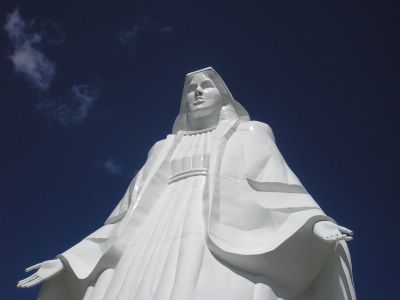
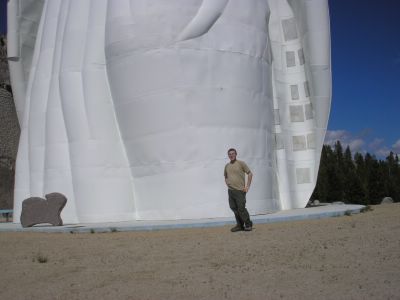
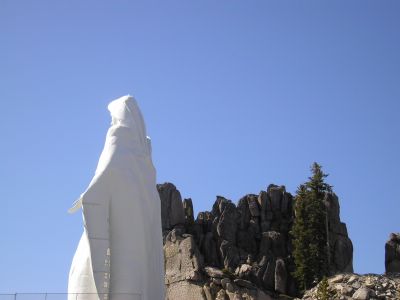
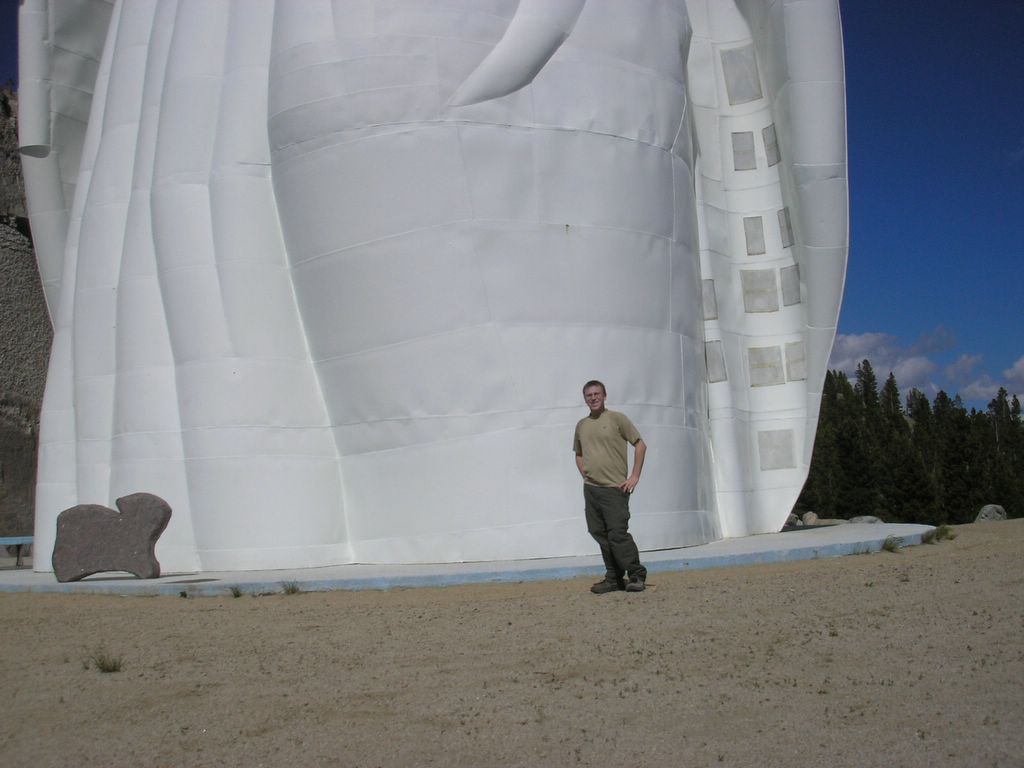
"Our Lady" is a 90 foot statue of the Virgin Mary that overlooks Butte from 8500 feet on a ridge that defines the continental divide in this area. At night the floodlit statue seems to float above the city. At my airline, she is often known as "Our Lady of Full-Scale Deflection" or "Our Lady of No Left Turn" because when shooting the ILS 15 approach at Butte, she is just to your left and above you. One of our captains tells a story from the Metroliner days. It was a dark and stormy night, and he was on the VOR-A approach, which takes you over the ridge a few miles south of Our Lady. Somehow they ended up off course, and through a break in the clouds he saw the statue just off their right wing. "I saw the Virgin," he says, "so I started praying!" Indeed.
Less intense encounters can be arranged through a tour company in Butte, which takes busses up the private road to Our Lady and the nearby chapel. Another option for the self-flagellating or the cheap is to climb the 3000 foot ridge on foot. I figured I'm doubly qualified, so I packed a lunch and got a ride to the outskirts of town from the hotel van. "There's an old Boy Scout trail that you should be able to follow," the van driver assured me as he dropped me off on a steep dirt road. "Just go up the road until it ends at a house, and follow the ridge next to it." Sounded easy. I walked a quarter mile up the road until it apparently deadended at someone's house, and duly started climbing a nearby ridge.

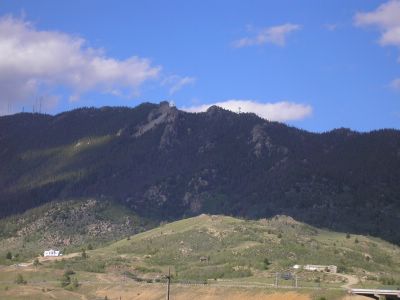
As I crossed this meadow, I thought I found the trail. As it reentered the trees, however, it quickly tapered off. I thought I picked it up again several times, but in each case I realized I was seeing many more deer and elk tracks than human ones. If there really was a boy scout trail, it wasn't on this ridge. Still I was able to make pretty steady progress upwards through an old burn without too much scrambling.


I knew that the line I was taking up the ridge would put me a ways south of the Lady, and I'd eventually have to traverse over. However, a large rock spine to my left kept the Lady out of view after I snapped the picture above. I appeared to be approaching the top of the ridge when I spotted a gap in the spine that was easily climbable.
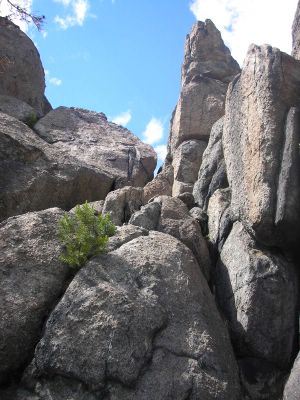
I scrambled up the gap, expecting to see the Lady at my elevation on the other side, a short traverse away.

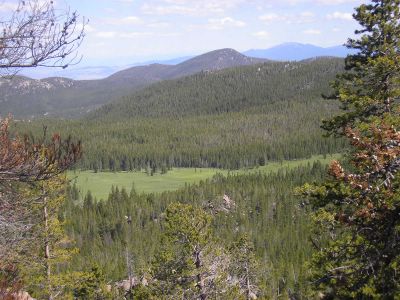
D'oH! I had a good 500 feet elevation left. I gingerly climbed down off the spine and continued my slog up the ridge. Once I reached the top, I realized I was standing on the continental divide. Expansive views to the east included a highland meadow that looks like a heck of a camping spot:
A short traverse later, I was up close and personal with Our Lady of the Rockies.

The Berkeley Pit: Superfund Site, Tourist Attraction.
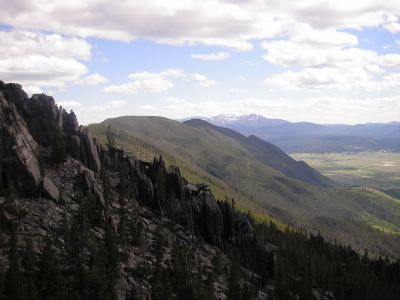
I sat for a while, taking in the views and eating my lunch. From this vantage point, I could see my mistake: the road I started on did not deadend where I thought it did, but continued into a valley. The actual deadend was almost directly below the statue. The slope below the statue looked passable, and if there was a Boy Scout trail, I figured it'd be there. The first portion of the slope consisted mostly of loose dirt and scree, and I rather gingerly worked my way down. After a few hundred feet, the trees thickened, providing more footholds. At one point, I realized that I was following what looked an awful lot like a trail, and then I saw boot prints, and then I saw orange ribbons tied on trees along the way. I'd found the Boy Scout trail.
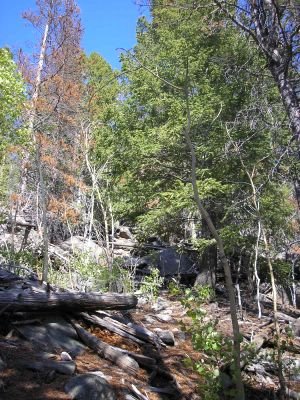
And what a trail! I gotta hand it to the Boy Scouts, they didn't waste any time in getting up and down the mountain. Their scant path makes no concessions to topography except to skirt sheer cliffs. I lost the trail quite a few times, but by following the fall line and looking for orange ribbons I'd pick it up again. Eventually it deposited me next to a prominent ridge at the end of the road, just like the van driver had said. There was a lot of old mining equipment scattered around the last house. I stopped at the house to chat with a woman watering plants outside; it turns out her husband founded the local mining museum. After that, it was a three mile hike back to the hotel.
So...anonymous commenter, thanks for the encouragement to get out and hike Butte's surroundings. While I still consider the town to be a rather dismal place, the prospect of further explorations in the mountains has me excited for my next Butte layover. Next time I think I'll check out that meadow on the east side of the ridge. It looks like a good place to see some elk.
"Our Lady" is a 90 foot statue of the Virgin Mary that overlooks Butte from 8500 feet on a ridge that defines the continental divide in this area. At night the floodlit statue seems to float above the city. At my airline, she is often known as "Our Lady of Full-Scale Deflection" or "Our Lady of No Left Turn" because when shooting the ILS 15 approach at Butte, she is just to your left and above you. One of our captains tells a story from the Metroliner days. It was a dark and stormy night, and he was on the VOR-A approach, which takes you over the ridge a few miles south of Our Lady. Somehow they ended up off course, and through a break in the clouds he saw the statue just off their right wing. "I saw the Virgin," he says, "so I started praying!" Indeed.
Less intense encounters can be arranged through a tour company in Butte, which takes busses up the private road to Our Lady and the nearby chapel. Another option for the self-flagellating or the cheap is to climb the 3000 foot ridge on foot. I figured I'm doubly qualified, so I packed a lunch and got a ride to the outskirts of town from the hotel van. "There's an old Boy Scout trail that you should be able to follow," the van driver assured me as he dropped me off on a steep dirt road. "Just go up the road until it ends at a house, and follow the ridge next to it." Sounded easy. I walked a quarter mile up the road until it apparently deadended at someone's house, and duly started climbing a nearby ridge.
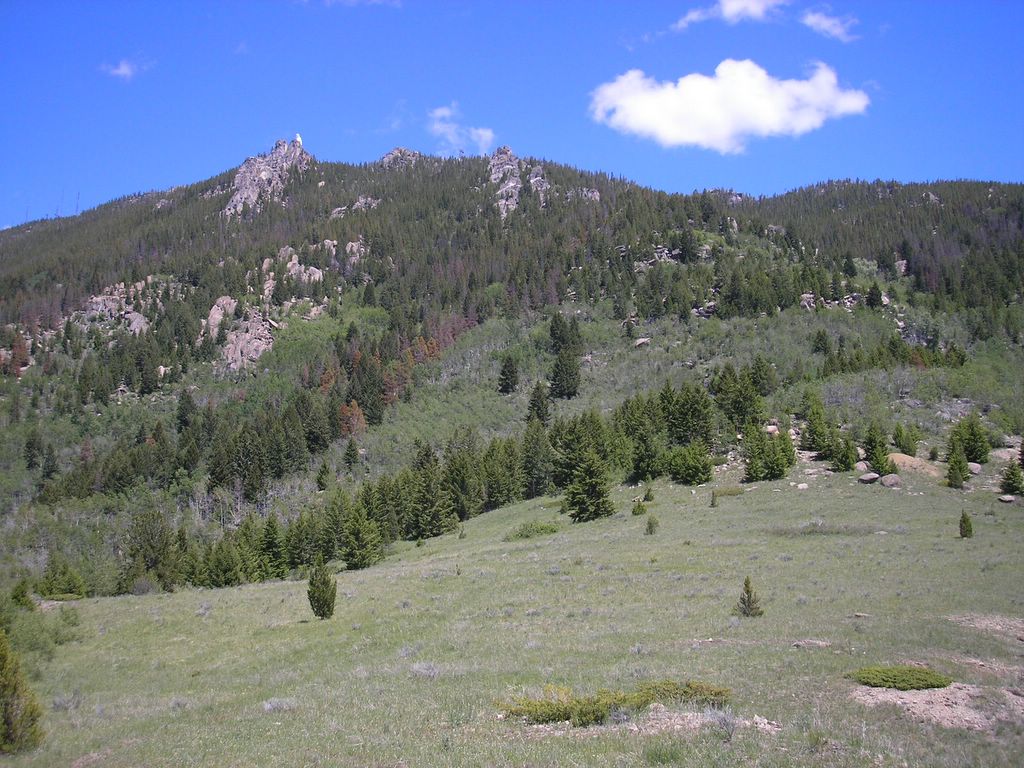
As I crossed this meadow, I thought I found the trail. As it reentered the trees, however, it quickly tapered off. I thought I picked it up again several times, but in each case I realized I was seeing many more deer and elk tracks than human ones. If there really was a boy scout trail, it wasn't on this ridge. Still I was able to make pretty steady progress upwards through an old burn without too much scrambling.
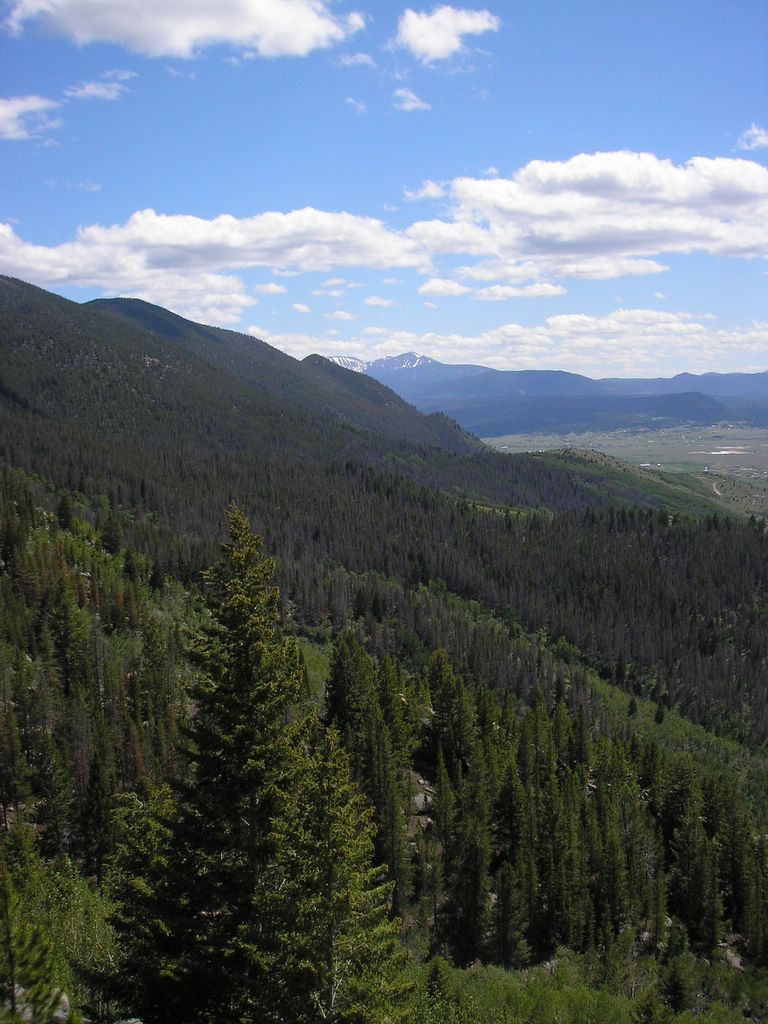
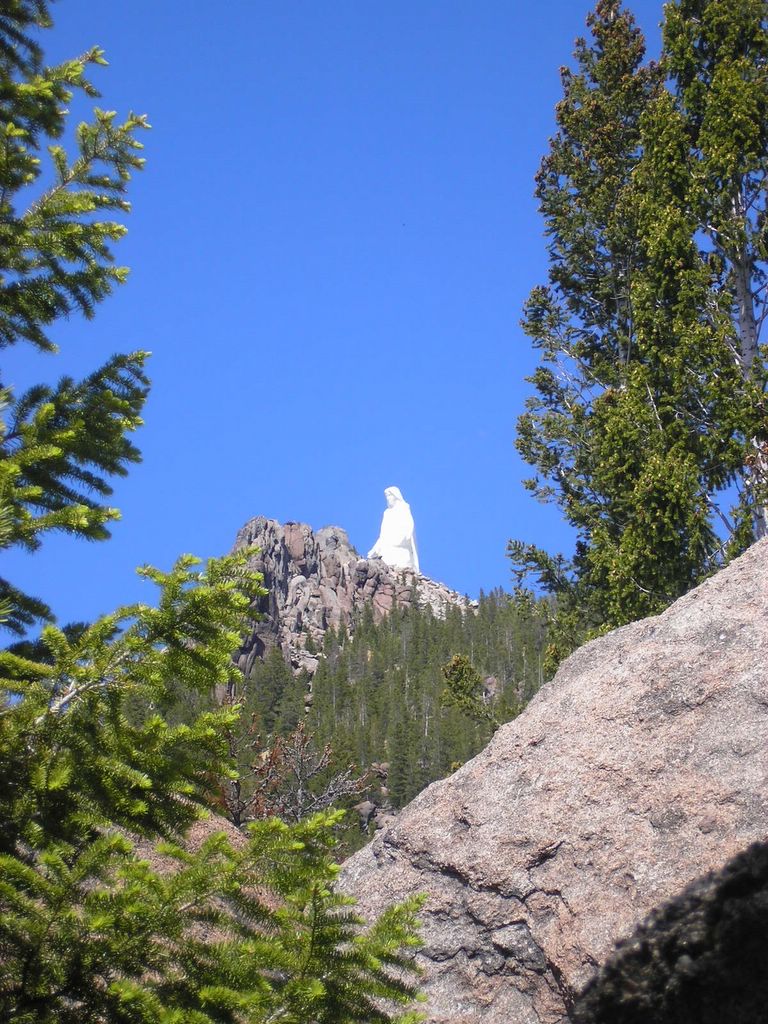
I knew that the line I was taking up the ridge would put me a ways south of the Lady, and I'd eventually have to traverse over. However, a large rock spine to my left kept the Lady out of view after I snapped the picture above. I appeared to be approaching the top of the ridge when I spotted a gap in the spine that was easily climbable.

I scrambled up the gap, expecting to see the Lady at my elevation on the other side, a short traverse away.
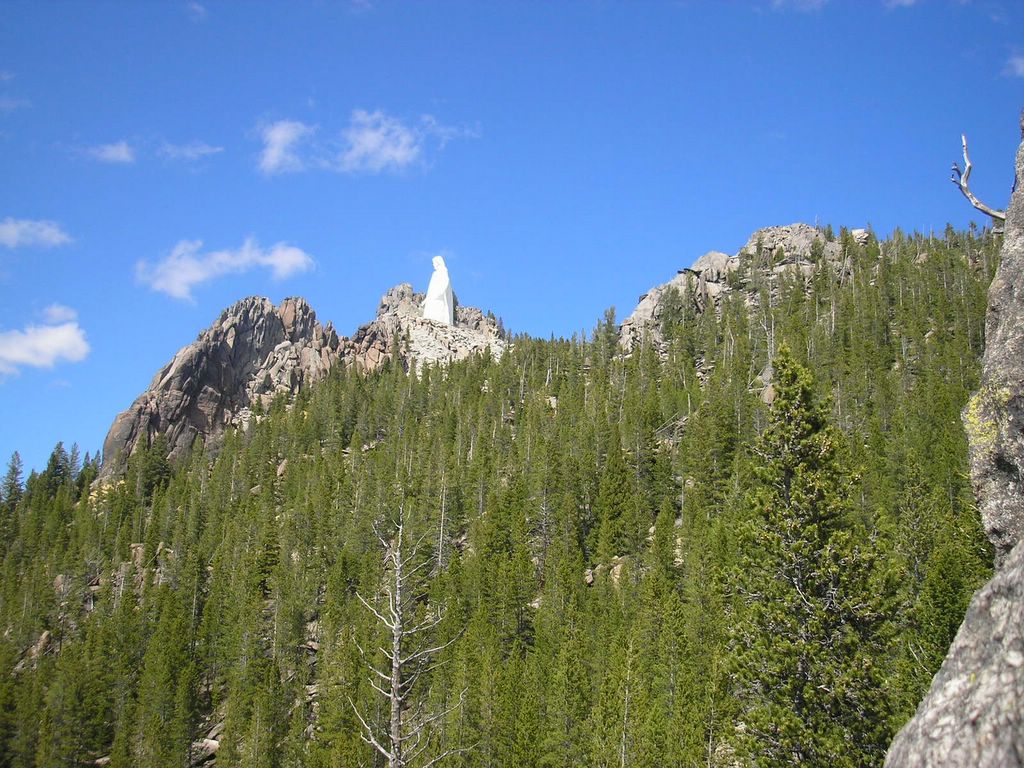
D'oH! I had a good 500 feet elevation left. I gingerly climbed down off the spine and continued my slog up the ridge. Once I reached the top, I realized I was standing on the continental divide. Expansive views to the east included a highland meadow that looks like a heck of a camping spot:

A short traverse later, I was up close and personal with Our Lady of the Rockies.


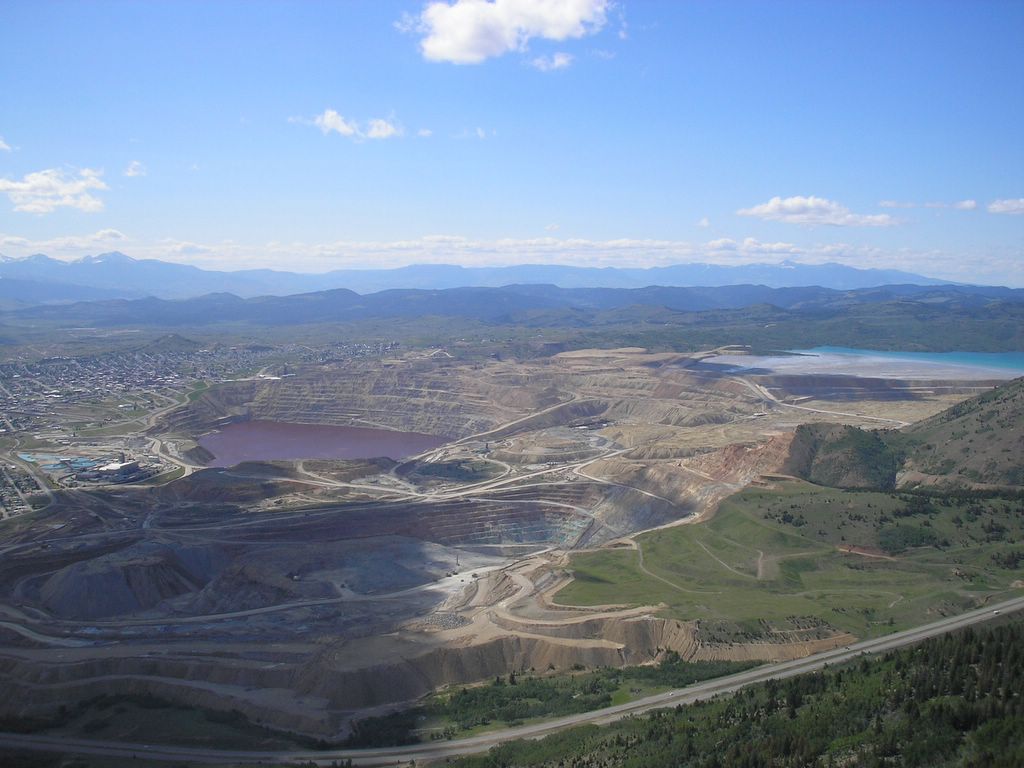
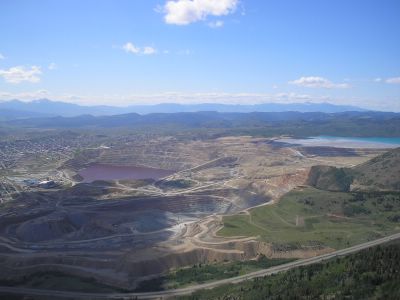
The Berkeley Pit: Superfund Site, Tourist Attraction.
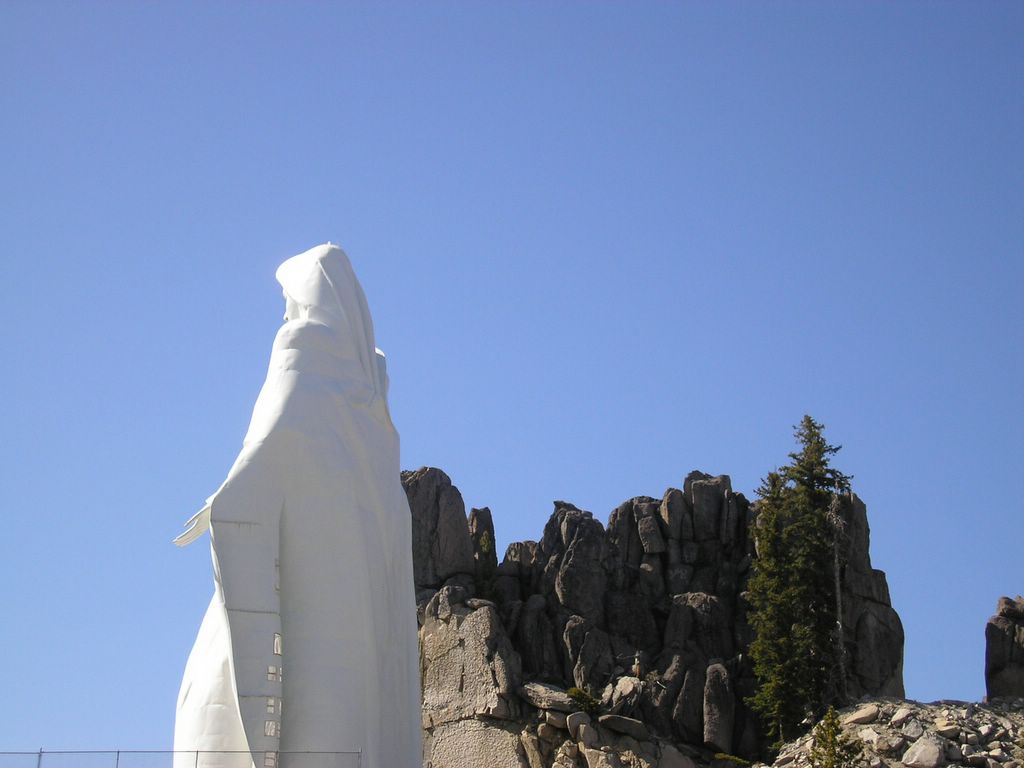

I sat for a while, taking in the views and eating my lunch. From this vantage point, I could see my mistake: the road I started on did not deadend where I thought it did, but continued into a valley. The actual deadend was almost directly below the statue. The slope below the statue looked passable, and if there was a Boy Scout trail, I figured it'd be there. The first portion of the slope consisted mostly of loose dirt and scree, and I rather gingerly worked my way down. After a few hundred feet, the trees thickened, providing more footholds. At one point, I realized that I was following what looked an awful lot like a trail, and then I saw boot prints, and then I saw orange ribbons tied on trees along the way. I'd found the Boy Scout trail.
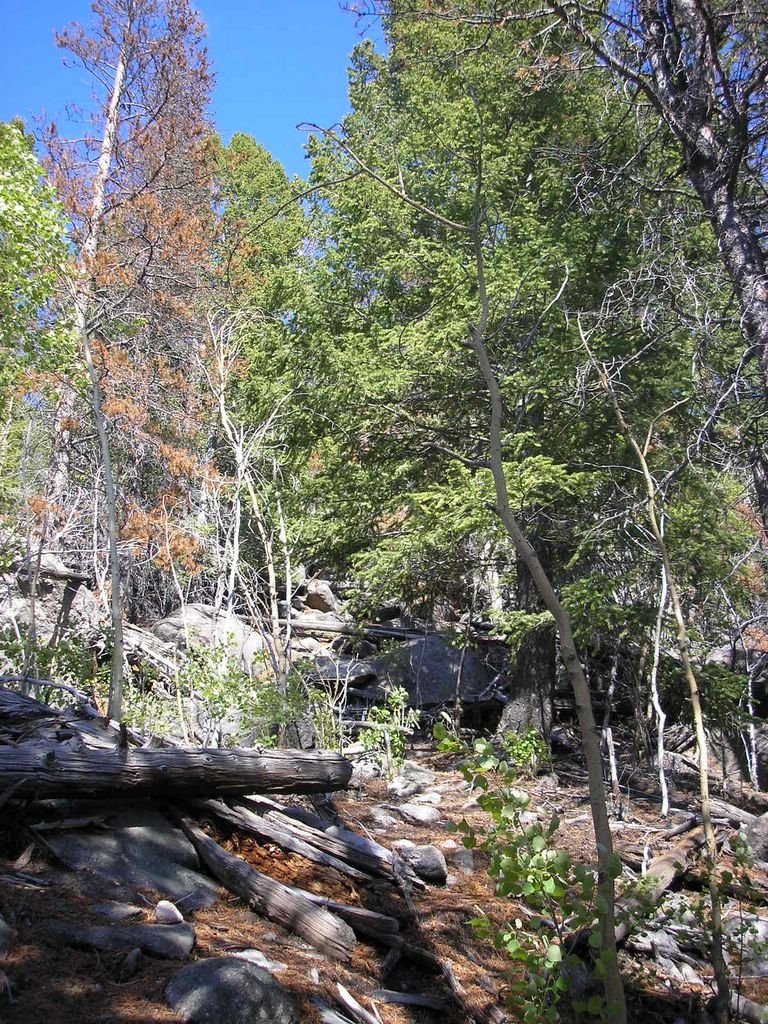
And what a trail! I gotta hand it to the Boy Scouts, they didn't waste any time in getting up and down the mountain. Their scant path makes no concessions to topography except to skirt sheer cliffs. I lost the trail quite a few times, but by following the fall line and looking for orange ribbons I'd pick it up again. Eventually it deposited me next to a prominent ridge at the end of the road, just like the van driver had said. There was a lot of old mining equipment scattered around the last house. I stopped at the house to chat with a woman watering plants outside; it turns out her husband founded the local mining museum. After that, it was a three mile hike back to the hotel.
So...anonymous commenter, thanks for the encouragement to get out and hike Butte's surroundings. While I still consider the town to be a rather dismal place, the prospect of further explorations in the mountains has me excited for my next Butte layover. Next time I think I'll check out that meadow on the east side of the ridge. It looks like a good place to see some elk.

Thursday, June 15, 2006
Standing Firm
This recent post by Aviatrix reminded me of a similar failure I had three or four years ago when I was flying the Weedwhacker for AEX. A little systems background on the Weedwhacker: Fuel is normally fed to each engine via an engine-driven fuel pump. If this fails, there is an electrically powered emergency boost pump. For normal operations, the boost pumps are used for priming before engine start. They are also required to be on for takeoff and landing; they are not deferrable items. When they're broke, you're grounded.
This particular incident happened in the middle of the night at the North Las Vegas airport. My first flight of the night repositioned the airplane there from my home airport in Southern California; then, having picked up about 1200 lbs of cancelled checks in Las Vegas, I was to fly them to Burbank. While doing the before start checklist, however, I discovered that the #1 emergency boost pump was inoperative. I checked circuit breakers and cycled the switch several times, but nothing happened. I reluctantly pulled out my cell phone and called the chief pilot. It was 3AM.
"Ummm....ahhh....hellooo?" mumbled my boss when he answered on the fourth ring. Once he woke up enough to remember who Sam was, he was obviously unhappy about me calling at 3AM.
"Hi Ari, I'm sorry to call at this hour," I began, "but the #1 fuel boost pump is inop. I'm in Vegas."
There was a pause at the other end of the line, and then: "Umm, do you need it for starting? You could use the crossfeed valve and the other fuel pump."
I didn't like where he was going with this. "Well, Ari, it's required for flight."
Again, a pause. "Hmmph. Well...there's no maintenance this late...Would you be comfortable flying one leg to get the plane back home?"
I really didn't like that question. First, it would be illegal. More importantly, I was about to take a Weedwhacker near max gross weight over the mountains and desert in the middle of the night. I was most assuredly not going without a backup fuel pump. I chose my words carefully. "I'd really rather not, Ari. The airplane is unairworthy."
"Fine," Ari grunted. "I'll be there in a few hours." Click.
I had a few hours to reflect on how PO'd my boss would be when he got here. The eastern sky was beginning to get light when another Weedwhacker landed and shut down next to mine. My boss clambered out and wordlessly began throwing bags out of my plane. Finally he spoke: "Take that airplane to Burbank. I'll fly your airplane home." He brusquely climbed onboard the broken aircraft, started up, and taxied out for takeoff, leaving me alone to load the new airplane and reflect on what the consequences would be for me. As it turns out, there were none. I never heard of the incident again.
There are three sources of pressure for professional pilots. Company pressure, like I experienced, is only one. It is most widespread in the lower echelons of aviation, particularly in the FAR 135 freight world. What I experienced was actually a pretty benign example of "pilot pushing." Other pilots have been fired for refusing unairworthy airplanes or flights into hazardous weather.
A second source is social pressure from fellow pilots. While nobody wants a reputation as the company daredevil, neither do you want to be known as the pilot who scraps flights at the drop of a pin. You run into situations where doing the right thing is sure to cause more work for your fellow pilots. Sometimes they will be pressured to take the same unairworthy airplane that you refused. You feel bad about putting them in that position.
Perhaps the most common source of pressure is not external, but internal. Pilots tend to be very goal-oriented people. We want to find a way to complete the mission. Additionally, saying "no" is bound to cause a lot of inconvenience and perhaps even conflict; it's just a lot easier to say "yes" and go with the flow even when it's not the right thing to do.
According to the FAA, it is always illegal to fly an airplane with anything broken until it gets fixed or deferred in accordance with an approved Minimum Equipment List. The reality is that if it doesn't affect safety of flight, most pilots will conveniently "discover" the inop equipment on the leg that they're inbound to a maintenance base. So there are a lot of grey areas, and knowing when to put your foot down takes good judgment born of experience.
When you've made a decision, you need to stick with it. Don't let yourself be talked into doing something you don't want to do. If you've made an exception once, you'll make it again and again, and you'll find it harder and harder to say "no" when you're asked to do something that's truly a bad idea.
I know that a lot of people who read this blog are in the process of becoming professional pilots. Someday, you will find yourself in a very uncomfortable situation where doing the right thing may cause a lot of inconvenience to yourself and others, may bring the scorn of coworkers and the wrath of your boss, may even cause you to lose your job. Standing firm will carry a price. It is important that you accept that right now as the price of being a professional pilot.
This particular incident happened in the middle of the night at the North Las Vegas airport. My first flight of the night repositioned the airplane there from my home airport in Southern California; then, having picked up about 1200 lbs of cancelled checks in Las Vegas, I was to fly them to Burbank. While doing the before start checklist, however, I discovered that the #1 emergency boost pump was inoperative. I checked circuit breakers and cycled the switch several times, but nothing happened. I reluctantly pulled out my cell phone and called the chief pilot. It was 3AM.
"Ummm....ahhh....hellooo?" mumbled my boss when he answered on the fourth ring. Once he woke up enough to remember who Sam was, he was obviously unhappy about me calling at 3AM.
"Hi Ari, I'm sorry to call at this hour," I began, "but the #1 fuel boost pump is inop. I'm in Vegas."
There was a pause at the other end of the line, and then: "Umm, do you need it for starting? You could use the crossfeed valve and the other fuel pump."
I didn't like where he was going with this. "Well, Ari, it's required for flight."
Again, a pause. "Hmmph. Well...there's no maintenance this late...Would you be comfortable flying one leg to get the plane back home?"
I really didn't like that question. First, it would be illegal. More importantly, I was about to take a Weedwhacker near max gross weight over the mountains and desert in the middle of the night. I was most assuredly not going without a backup fuel pump. I chose my words carefully. "I'd really rather not, Ari. The airplane is unairworthy."
"Fine," Ari grunted. "I'll be there in a few hours." Click.
I had a few hours to reflect on how PO'd my boss would be when he got here. The eastern sky was beginning to get light when another Weedwhacker landed and shut down next to mine. My boss clambered out and wordlessly began throwing bags out of my plane. Finally he spoke: "Take that airplane to Burbank. I'll fly your airplane home." He brusquely climbed onboard the broken aircraft, started up, and taxied out for takeoff, leaving me alone to load the new airplane and reflect on what the consequences would be for me. As it turns out, there were none. I never heard of the incident again.
There are three sources of pressure for professional pilots. Company pressure, like I experienced, is only one. It is most widespread in the lower echelons of aviation, particularly in the FAR 135 freight world. What I experienced was actually a pretty benign example of "pilot pushing." Other pilots have been fired for refusing unairworthy airplanes or flights into hazardous weather.
A second source is social pressure from fellow pilots. While nobody wants a reputation as the company daredevil, neither do you want to be known as the pilot who scraps flights at the drop of a pin. You run into situations where doing the right thing is sure to cause more work for your fellow pilots. Sometimes they will be pressured to take the same unairworthy airplane that you refused. You feel bad about putting them in that position.
Perhaps the most common source of pressure is not external, but internal. Pilots tend to be very goal-oriented people. We want to find a way to complete the mission. Additionally, saying "no" is bound to cause a lot of inconvenience and perhaps even conflict; it's just a lot easier to say "yes" and go with the flow even when it's not the right thing to do.
According to the FAA, it is always illegal to fly an airplane with anything broken until it gets fixed or deferred in accordance with an approved Minimum Equipment List. The reality is that if it doesn't affect safety of flight, most pilots will conveniently "discover" the inop equipment on the leg that they're inbound to a maintenance base. So there are a lot of grey areas, and knowing when to put your foot down takes good judgment born of experience.
When you've made a decision, you need to stick with it. Don't let yourself be talked into doing something you don't want to do. If you've made an exception once, you'll make it again and again, and you'll find it harder and harder to say "no" when you're asked to do something that's truly a bad idea.
I know that a lot of people who read this blog are in the process of becoming professional pilots. Someday, you will find yourself in a very uncomfortable situation where doing the right thing may cause a lot of inconvenience to yourself and others, may bring the scorn of coworkers and the wrath of your boss, may even cause you to lose your job. Standing firm will carry a price. It is important that you accept that right now as the price of being a professional pilot.
Subscribe to:
Posts (Atom)


