Louisville, 1:06 AM. I am lying back in a chair in my cheerfully nondescript hotel room, feeling the adrenaline seep out of my limbs. I've been running at one hundred and ten percent for hours now, and it's almost impossible to go straight from that to sleepfulness, so I sit here trying to decompress. A drink helps. The crew and I were planning on having a nightcap - our show time isn't until late tomorrow - but the hotel bar was closed by the time we finally arrived, and there's nothing else open nearby. Instead, I pour myself a short glass of scotch from my own flask. The ice crackles and tinkles softly, accentuating the silence of my room. I take a sip and think back on the long day.
I woke up at 6:30am and set about the familiar routine of preparing for a morning show: showering, grooming, ironing, dressing, making my lunches, packing my overnight bag - always in the same order, lest I forget something. Alas, I did forget my cell phone charger, so I will be raiding the hotel's lost and found tomorrow. Dawn gave me a ride to the airport before her 9am doctor's appointment, so I arrived quite early for my 9:20 show. This was my first time back to work since NewCo switched to a completely new, electronic system for weight & balance and takeoff & landing performance calculations to replace our tried-and-true manual method using paper, long addition, and a whiz wheel. I intended to use the extra time to get to the airplane early and see if the system really worked the way our training materials said it would, but I ran into some old friends in the crew room, talked for longer than I realized, and ended up having to hustle to make it to the plane by our scheduled show time. I chatted with the gate agent a little, checked the radar and upper air charts on his computer, collected our paperwork, and walked down the jet bridge to meet my crew. The only one I'd flown with before was Linda, a retired schoolteacher whose former profession obviously endowed her with the patience that makes her an exceptional flight attendant. Our other flight attendant, Trisha, is brand new, having just come off of OE. Our FO, Kevin, is a middle-aged family man who spent ten years at Air Wisconsin and finally made the jump to United two years ago, only to be furloughed a day before completing his initial training. Rounding out our quintet for this leg was Steve, a friendly United captain I last gave a ride to O'Hare only a few weeks ago. The flight was full, and he would again be sitting in the flight deck jumpseat.
Our day got off to a late start thanks to cleaners who neglected to show up for the first hour of a 90-minute turn, subsequent late boarding, passenger-counting difficulties, and some grappling with the new W&B system on my and Kevin's part. We pushed ten minutes late, then got a last-minute taxi change to the far runway. Within a few minutes, though, we were whistling down 30R, rearing into the air at 141 knots, and turning southeastward towards Chicago shortly thereafter.
While Chicago-Midway was one of our very first destinations, my company only began flying to O'Hare a few months ago. It has quickly become one of the mainstays of our trips. I originally approached O'Hare with some trepidation, given its reputation for heavy traffic, a complex layout, and no-nonsense controllers. I quickly discovered that O'Hare, like all big, busy airports, has a well-developed, predictable flow to its operations, and is actually pretty easy to fly out of once you learn the logic. The one thing I haven't figured out yet is how they assign departure runways; there are occasionally up to five in use, and which one you are assigned seems to have little relationship to your position on the airport or your direction of flight. Even this lack of predictability is handled easily enough: you brief all the possible runways and taxi routes, get takeoff performance for every possibility, and taxi out on both engines. That leaves less to do when you are inevitably switched to an inexplicable runway choice. Nothing seems to please O'Hare controllers more than a crew that's ready to roll at a moment's notice.
The one thing we did today that I hadn't yet experienced was landing on the "new" runway, 27R. It is a good two miles north of the main complex, making for a long, circuitous taxi to the terminals. Fortunately, it's only used during peak periods, which today at 11 AM definitely was. The taxi instructions to our gate were a little bewildering: "Charlie One, Charlie, Uniform, Echo, Zulu, hold short of Tango, monitor ground one three two point seven" then "Tango, Whiskey, hold short 4 Left", then "Cross 4 Left, Echo, Bravo, Alpha Ten to the gate". Go ahead,
try to trace it on the airport diagram. Now try to figure it out while taxiing a plane and stealing only occasional glances at the chart (the cardinal rule of ORD is "Don't Ever Stop"). Having a sharp, experienced FO who was once based at O'Hare helps a lot!
Our ops people turned the full plane surprisingly quickly, Kevin and I again flubbed the weight and balance calculation on our first try, and we again pushed around ten minutes late. For once, I correctly guessed our taxi route and departure runway: A, A7, T, 32R at T10. We nibbled at a United Airbus' wake turbulence on takeoff - they weren't even off the runway when tower cleared us to roll - but quickly got upwind of it as we turned snappily to our assigned 360 heading. Soon we were arcing out over Lake Michigan, weaving around afternoon buildups before picking up the Muskegon transition to Detroit's Polar Three Arrival.
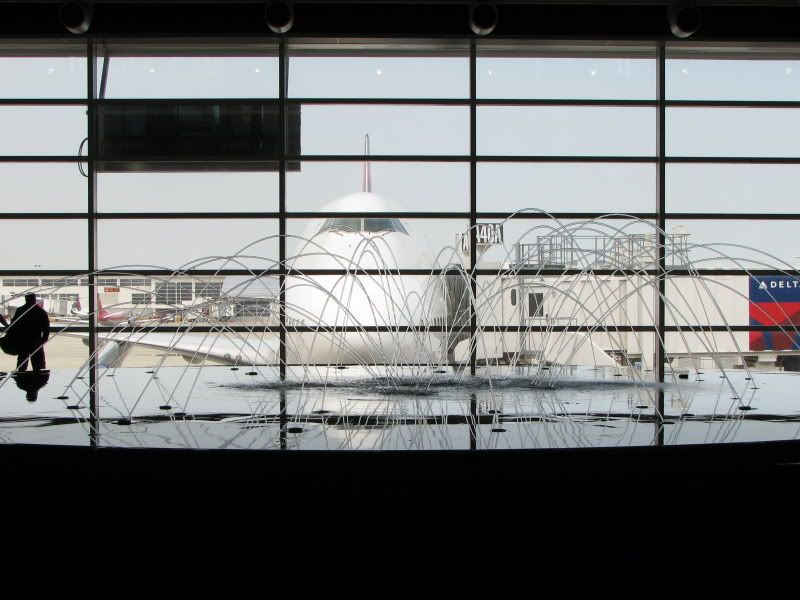
I really enjoy flying into Detroit. It's a fairly busy airport, but a well-laid out one, and operations generally flow freely and predictably. The McNamara Terminal still gleams and echoes with the songs of birds who have flitted inside, and the sight of a 747 behind the dancing water fountain has already become an
iconic image of aviation. The only downside, for me, is that the airport's taxiways look and feel more bombed out than Beirut circa 1982. Fortunately, the airport has undergone a steady program of resurfacing over the last few years. This time, taxiway Foxtrot just north of NewCo's northeast gates was ripped up. To provide an alternate route to our gates, A75 through A77 have been taken out of service so aircraft can use the ramp to transition from Uniform to Uniform Eight. The system seems to be working pretty well.
We had a three hour "productivity break" in Detroit, even after our late arrival. NewCo has a crew base there, but Minneapolis crews can't normally access the crew room as it is located in an area accessible only to holders of Detroit SIDA badges. Fortunately for us, Kevin had been based in Detroit for a month and had exactly such a badge so he could escort us to the crew room. I spent my break trying to figure out a way to get my little brother Steve and his girlfriend Torrie home from Hawaii. They'd flown to Honolulu on my buddy passes over Memorial Day weekend, lured by the promise of wide-open flights coming and going, only to find themselves on the bottom of an 80+ person standby list for every flight they tried to take out. After talking to a family of five that had been trying to get out of Honolulu on buddy passes for nearly two weeks, Steve decided to bite the bullet and buy positive-space tickets back to Minneapolis. The price was surprisingly cheap for a same-day one-way ticket: $585. Once again, Honolulu confirms that its reputation as a non-rev black hole is well-deserved.
Our plane arrived only 25 minutes before our departure to Charlotte, so our third consecutive leg blocked out about ten minutes late. Every seat was once again full, and we were also carrying quite a bit of extra fuel in anticipation of possible thunderstorms developing near Charlotte. The northern portion of the route featured typical late-afternoon buildups that were still well below our cruise altitude, but as we crossed into Tennessee we started spying 45,000 foot giants further ahead. I pulled up the ATIS at Charlotte: "3/4SM +TSRA". We wouldn't be landing in that. I texted our dispatcher to inquire about what she was seeing on radar, and she promptly replied that the thunderstorm was relatively small, but parked directly over the airport with very little movement. She also changed our alternate from Raleigh-Durham to Knoxville due to another thunderstorm developing just west of RDU. I love getting one of the good dispatchers.
Shortly thereafter, Atlanta Center changed our transition for the JOHNS2 arrival and cleared us to hold at BURLS. No surprise here. I entered the hold in the FMS, verified it with Kevin, and activated it. Kevin started slowing early to save some gas, and I began calculating our bingo fuel. Generally, I compute two "Bingo" numbers when holding for thunderstorms at the destination. The first number is traditional bingo fuel, meaning that required to proceed from the hold to the airport, shoot an approach, go missed, proceed to the alternate airport, and have a 45 minute reserve remaining. If the airport is still questionable when we leave the hold, I won't proceed with less than this traditional bingo number. On the other hand, the weather may clear very quickly after the passage of a storm. If the weather is good and there is no question of being able to land, I am willing to proceed from the hold with less fuel than the traditional bingo number so long as I will land with a conservative reserve. In no case, however, will I hold beyond the time at which I have enough fuel to proceed from the hold straight to the alternate and still have a reasonable reserve on landing. I call this my "drop dead bingo" - once the fuel tanks indicate this number, I'm headed for my alternate no matter how quickly ATC says they'll be getting me out of the hold. The spread between the two numbers can be significant, particularly when holding at a point between my destination and alternate airports. This was now the case.
I texted our holding point, altitude, expect further clearance time (EFC), and fuel on board to our dispatcher. Her reply a few minutes later included a bingo fuel number very close to what I had computed for my traditional bingo. We had approximately 45 minutes of holding fuel above that number. If further holding was necessary, my "drop dead bingo" number was over 1500 lbs less, and our proximity to Knoxville would allow me to either coordinate our diversion in a leisurely fashion or arrange for the deletion of our alternate if the weather in Charlotte had improved sufficiently. As we entered the hold over BLISS, I composed a short PA in my mind and then pressed the "transmit" button to deliver the bad news to our passengers.
As it turned out, the news wasn't all bad. Thirty minutes after we entered the hold, Charlotte began accepting arrivals again. We had initially held at FL330 but had been descended as aircraft below us diverted to their alternates. Only ten minutes after Charlotte reopened, we were cleared out of the hold and back on the arrival; a last minute clearance to cross SHINE at 11000' required a steep, nearly full-spoiler descent. As nice as the JungleBus' Vertical Navigation (VNAV) capability is, it can bite you on such late descent clearances. By the time you actually get your crossing limit set up in the box, you may be too high to make it. For this reason, I apply the tried-and-true "3-to-1" litmus test to any crossing clearance before anyone messes around with VNAV. This is a simple method of computing a 3 degree descent: You take the altitude to be lost in tens of thousands of feet, and multiply it by three to get the distance required in nautical miles. If you need to lose 10,000 feet, you need 30 miles for a 3 degree descent. If my quick-and-dirty computation shows a 3 degree or steeper angle required, I will establish the aircraft in a 2500 foot-per-minute descent (or direct the pilot flying to do so) before setting up VNAV. Technology can make life on the line easier, but Rule One is still and always will be: "Fly the Airplane!"
Lightning crackled just to the east over downtown Charlotte as we landed on Runway 18R. This would have been a full, eventful day even if we were done in Charlotte, but we still had two legs left and were now a full hour behind schedule. At least we were keeping the airplane to Atlanta, making for an easy quick turn - or so I thought! When I followed the last of our passengers up the jet bridge to retrieve our paperwork, I found the gate in a state of bedlam, with a long line of harried travelers querying a lone, distressed gate agent. The board behind him advertised a delayed Minneapolis flight, with a departure time well in the past. "Umm, isn't this airplane going to Atlanta?" I asked.
"I don't know anything about that!" the gate agent exclaimed. "Nothing's going to Atlanta. This airplane is going to Minneapolis, but the crew already timed out. Can't you fly it?" Immediately, a half-dozen passengers surrounded me, imploring me to fly them to Minneapolis. "Hold on a sec, folks, I'm going to call our dispatch office and see if that's what they want us to do." I very much doubted that dispatch wanted us to fly to Minneapolis, or our phones would've been ringing off the proverbial hook already; I mostly wanted to know what in tarnation was going on. I walked down the concourse - out of earshot of the passengers - and called dispatch. No answer. I tried a few other desks. Same results. A glance at a national radar display on one of the flight information boards suggested why: a bright red blob was sitting squarely over Atlanta. It's always toughest to get ahold of SOC during Irregular Operations. I just might have to get answers for myself. I walked up to another WidgetCo gate, this one advertising a seriously overdue departure to Atlanta. "Where is 5750 to Atlanta going out of?" I asked. The gate agent pulled up the flight; "It's going out of A7, and the plane is actually already here. It landed almost a half-hour ago!" I chuckled at that. "Well, that's our plane, and you might want to get the agent down at A7 on the same page, because he thinks he's keeping that plane for Minneapolis!"
The change had been announced by the time I walked back over to A7. Now the Minneapolis passengers were upset at their lack of an airplane as well as a crew, newly arrived Atlanta passengers were utterly confused that the gate was still advertising Minneapolis, and that poor lone gate agent tried mightily to be polite in the face of an onslaught of questions and accusations even as he struggled to switch the computer system from the MSP flight to ours. I stood by the gate and fielded as many questions as I could. Many simply wanted to know if Atlanta was open yet, a very good question I was wondering about myself. I still couldn't raise dispatch on the phone. Again, taking the self-sufficient tack seemed best. I retreated down the jetbridge to fill in my bewildered crew on developments thus far, and to call Clearance Delivery regarding our flow time to Atlanta. Clearance confirmed that Atlanta was opening, but our EDCT time was approximately 70 minutes hence and subject to further change. This was better than I was expecting. I headed back up the jetbridge to tell the gate agent that we could start boarding in 20 minutes; I usually plan on getting out to the runway about 15 minutes before any EDCT time so that unforeseen delays don't cause us to miss our slot.
Our EDCT ended up changing three times before we got out. First it was moved back by 90 minutes, then to only twenty-two minutes from the time I got the change. This might have been doable if we had the passengers on board, but a recent arbitrary and capricious rule change by unelected bureaucrats at the Department of Transportation has made us all a little gun-shy about early boarding. This is a lengthy subject meriting its own post, but suffice it to say that nobody wants to be the Captain who keeps his passengers on board for more than three hours between boarding and takeoff and accidentally subjects his airline to a draconian fine (over $2 million in the case of a full JungleBus, or more than one of our engines costs!). Obviously, twenty-two minutes wasn't enough time to board 76 passengers, run our numbers, and taxi out to the runway. Fortunately our final EDCT change was for only fifteen minutes later. A last-minute runway change resulted in taxiing the long way around a dark, unfamiliar ramp while Kevin grappled with the new takeoff performance system. We completed the Before Takeoff Checklist just as Charlotte Tower cleared us for takeoff on 18L, and I taxied onto the runway very slowly so we could take a moment to compose ourselves and double-check our work before hurtling down a darkened, rain-slicked runway at 160 mph.
Soon after we turned right onto the departure, lightning began flickering off to the east. I knew the thunderstorms that closed Atlanta were moving northeast, or roughly onto our arrival route. I have a certain fascination with thunderstorms, but prefer to observe from the ground; this is doubly true at night. Of course we have radar, but the best means of avoidance is the 'ole "Mark 2 Eyeball," and it doesn't work so well on dark nights when lightning appears to fill the sky and you can't see developing buildups. I turned the instrument lights down low and sat forward on my haunches, peering out into the blackness. South of Spartanburg at FL300, we stumbled upon a towering behemoth that materialized out of the ether like an iceburg in the foggy North Atlantic. We turned thirty degrees right without waiting for Atlanta Center's belated approval. There was no lightning and no precipitation to register on our radar, but I don't doubt this pubescent thunderstorm would have given us a ride to remember had we blundered into it. Further along the arrival, the giant cell that closed Atlanta for hours slid by twenty miles to our right, spitting out lightning menacingly the whole time. I wondered what our passengers thought about it.
We were vectored onto the final for Runway 26R surprisingly quickly and I took advantage of the wet runway to make an admirably soft touchdown. Our seventy-six passengers scampered off the airplane in record time in hopes of making their connecting flights. I stifled a yawn as I collected our paperwork at the gate and checked the radar. I'd now been awake for over sixteen hours and on duty for thirteen. Legally, I could be on duty for another three hours! Over a year after the FAA promised to have new duty and rest time regulations in place and the industry publicly promised to support changes in an effort to contain the media fallout from Colgan 3407, the airlines have been successful in fighting a rear-guard delaying action at the Office of Management and Budget. In the meantime, those of us at the pointy end of things do what we've always done (with varying degrees of effectiveness): decide whether we're safe to fly at the time when we're rendered least capable to make an objective judgment. This time I felt fairly alert - but was it just the fatigue talking?
We quickly loaded up, pushed back, and taxied down to 26L for our fifth takeoff of the day. The lights of the terminals flashing by my window seemed to put me in a momentary trance; a gentle prompt from Kevin snapped me back to reality, and I belatedly commanded "Positive Rate, Gear Up." Perhaps I was a little less alert than I previously believed. The route up to Louisville was blessedly clear of thunderstorms; however, that left less to do, and several times I found myself jerking my head up with a start after nodding off into a micro-sleep. Not good. One of my least favorite memories as a pilot is waking up at the controls of a Navajo on a half-mile final to Burbank and not being able to remember the previous half-hour. Having a First Officer on board makes that scenario potentially less dangerous to life and limb but even more hazardous to career and reputation. I put on the oxygen mask on in the descent to get a few puffs of 100% O2, then turned the autopilot off early. I was expecting a straight in approach at Louisville, but I had forgot that our late arrival would put us squarely in the middle of the UPS rush. It was the busiest I've ever seen Louisville. Approach Control made us fly all the way to IIU VOR, then south for twenty miles before turning in to a twenty-five mile final. At long last, we touched down on Runway 35R and made the short taxi to the gate. The passengers seemed to take forever to file sleepily off the airplane. We were hard on their heels.
After all that, one would think I should be able to go to sleep quickly and soundly. Yet the day somehow feels incomplete. Delivering nearly 400 souls safely to their destinations over five legs and 2000 miles through some of the world's busiest airspace and around its wildest weather feels like a real accomplishment, even if it's done on a thoroughly routine basis. I still occasionally feel myself in complete awe that man can fly at all, much less do so with a high degree of comfort, safety, and reliability in a pressurized aluminum tube hurtling through the outer reaches of the atmosphere. Whatever my opinions on the state of my industry and profession, I still feel extraordinarily privileged to be part of the brotherhood of the air, never more so than after a long, tiring day of duty performed well. I permit myself the small celebration of my glass of single-malt, and then turn in for the night.