People often ask me whether I ever came close to crashing. If they're not pilots, I usually laugh and say I've had a pretty boring career. Aviation gets enough of a bum rap without my sensationalized stories. That said, every pilot that's been around for very long has scared themselves a time or two. The fact that they've been around very long means they've learned from their mistakes.
The closest I came to making an agricultural real estate purchase was just after I got my private pilot's license, when I was 17. It was the summer between my junior and senior years of high school, and I was working at a lumber yard in Milaca, MN. I was good friends with several coworkers who were my age, and they had been begging me to take them flying. We finally made plans for an after-work excursion to Grand Casino Hinkley for a buffet dinner. It would be a quick 30 minute flight in a Cessna 172.
At this point I had my PPL for perhaps 5 months. During my training, I had flown the C172 a few times, but didn't get officially checked out until shortly before this flight. I had never flown a 172 anywhere near max gross weight, which this flight was right at. Additionally, Milaca had a fairly short grass strip with tall evergreen trees on all sides. I worked the performance calculations and concluded that there was more than enough space to take off. I also ran through the soft field procedures, reminding myself to get the nosewheel off the ground as soon as possible and lift off at a slow speed to accelerate in ground effect.
After picking up my companions in Milaca, I taxied to the very end of Runway 34, did a rolling runup, and was mindful to not stop as I turned around and advanced full throttle. The airplane was quite sluggish - it was 400 lbs heavier than I'd ever flown it - but the nose came up quick due to the aft CG. I was quite aware of the tall trees on the end of the field, so I breathed a sigh of relief when the airplane lifted off and began climbing.
My first indication that anything was wrong was the stall horn going off. My eyes flew to the airspeed indicator, and my heart jumped into my throat when I realized it was registering below 50 knots. Simultaneously, my peripheral vision began picking up trees to our left side...very, very close. There was little time for fear, only to react. I very gingerly lowered the nose and put the airplane in a shallow coordinated turn to the right. For the first time, I caught sight of just how close the trees were to my wingtip. It was close. Slowly I drifted back to the center of the runway as the airplane accelerated a few feet above the grass. By the time I reached Vx, I had just enough runway left to climb over the treetops at the end.
This whole time seemed to pass fairly slowly and I was almost detachedly observing what was happening. I was living by seconds and inches and minute control movements. It wasn't until the danger was past that the adrenaline swept over me. I realized what just about happened and what an idiotic mistake I'd made to cause it, and I felt physically ill. Chills swept over me and I started shaking. This was at about 500' above the ground. "I just about killed us!" I mumbled to my passengers, who up to this point hadn't even realized anything was wrong. It took a while to compose myself to the point that I felt comfortable continuing the flight.
My mistake, of course, had been that I lifted off at a slow speed proper for a soft field takeoff, but failed to accelerate prior to further climb. The slow speed plus my heavy weight meant I was at a much higher angle of attack than I was used to, and I didn't compensate for the additional P-factor with enough right rudder. I found myself near a stall in uncoordinated flight perilously close to the tops of 80' trees. The fact that I did everything perfect in the recovery was small comfort.
That flight haunted me for a while. The particular moment that I saw the trees next to my wingtip replayed often in my mind. Earlier advice from my flight instructor stuck with me, though. He had said, "Every pilot, no matter how good they are, makes mistakes. What separates the good ones is that they learn from every mistake, every flight." As I've gained experience, I've come to realize how true those words are. I'm continually finding ways to make new mistakes (not as bad as this story, mind you...it's still safe to fly my airline!). But analyzing those mistakes and coming up with ways to avoid repeating them has made me a much safer pilot.
Monday, August 21, 2006


Thursday, August 17, 2006
Where There's Smoke...
For those of us in the western US & Canada, summer has another name: fire season. To be sure, there are significant wildfires in the east and midwest, but the western states have a number of features that make wildfires a special concern: millions of acres of mature timber, many remote areas with limited access, rugged terrain, and significant property and population within fire-prone areas. When the West burns, the nation notices. When California burns, the world notices - and the rest of the West looks on with unabashed schadenfreude at the spectre of brand new mansions burning in the exact spot where fires have raged every few years since time immortal.
This season is shaping up to be a doosie. The National Interagency Fire Center reports that so far this year, over 76,000 fires have burned 6.3 million acres. As of today, there 53 active large fires involving a half million acres, prompting a NIFC national preparedness level of 5, defined as "several geographic areas are experiencing major incidents which have the potential to exhaust all agency fire resources." Thank God we have the heavy airtankers up and and running. They were grounded during the 2004 season due to safety concerns, and were only partially mobilized last year.
Fires affect aviation in the form of Temporary Flight Restrictions, or TFRs. These usually don't extend very high, so they affect general aviation a lot more than the airlines, unless the fire is in close proximity to an airport. Besides the obvious reasons you wouldn't want to fly directly over a large fire, the airspace tends to be very congested with many types of air attack & fire bomber aircraft operating in poor visibility. An airport near a major fire can be a pretty cool place to hang out, though - you'll get the rare opportunity to see classic airplanes like the DC-4 and PBY Catalina in action.
After weeks of fire season, the entire west coast has a brown shroud of smoke over it. It's pretty ugly from the air and ruins otherwise perfect sightseeing weather. I find myself hoping for a good cold front to come through and clear it all out. Rain would help the firefighters a lot, too.
It's fairly amusing to hear other pilots reporting "new" fires that have been raging for several weeks. Some of my airline's Megawhacker trips take us repeatedly up and down the west coast, so we can follow major fires' progress over time. Occasionally you do spot a really new fire. ATC has a direct line to NIFC, and passes along all reports promptly.
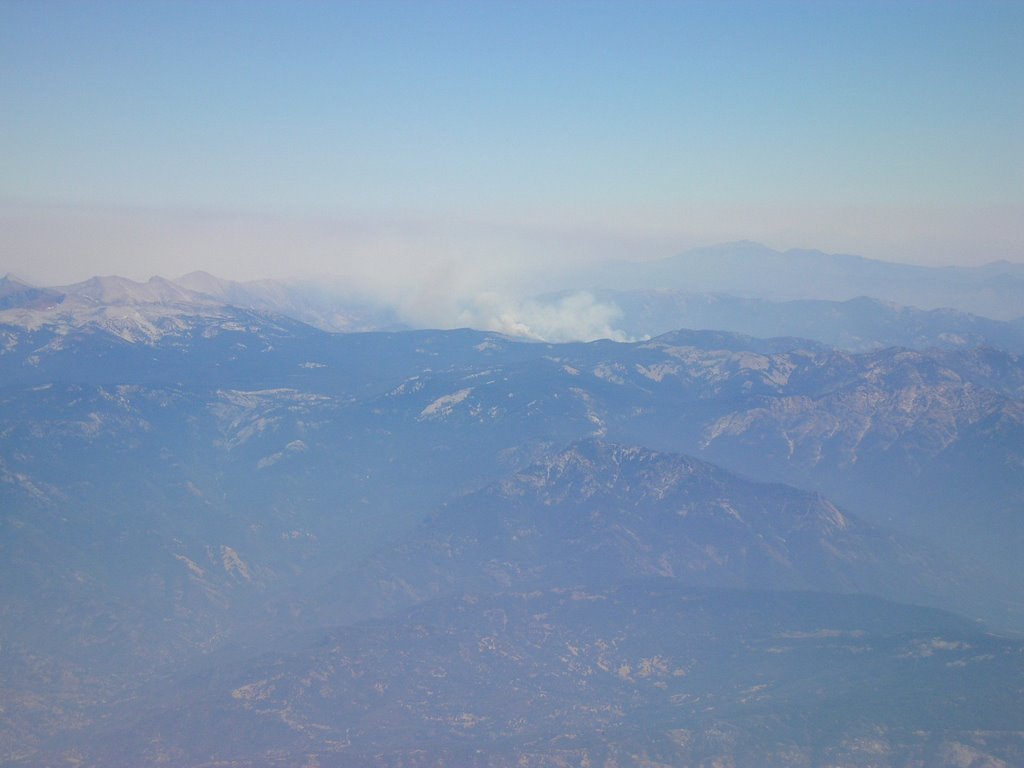
A few days ago we were cruising up the Sierras from LA to Reno. There's a large fire burning along the upper Kern River, very close to where a 150,000 acre fire burned a large portion of Sequoia National Forest in 2002. Futher north, we spotted a brand new fire just southeast of Half Dome in Yosemite National Park. Later in the trip, it was still burning but didn't appear to have spread significantly. My next trip takes me back down that way, I'll have to see whether they extinguished it.

This season is shaping up to be a doosie. The National Interagency Fire Center reports that so far this year, over 76,000 fires have burned 6.3 million acres. As of today, there 53 active large fires involving a half million acres, prompting a NIFC national preparedness level of 5, defined as "several geographic areas are experiencing major incidents which have the potential to exhaust all agency fire resources." Thank God we have the heavy airtankers up and and running. They were grounded during the 2004 season due to safety concerns, and were only partially mobilized last year.
Fires affect aviation in the form of Temporary Flight Restrictions, or TFRs. These usually don't extend very high, so they affect general aviation a lot more than the airlines, unless the fire is in close proximity to an airport. Besides the obvious reasons you wouldn't want to fly directly over a large fire, the airspace tends to be very congested with many types of air attack & fire bomber aircraft operating in poor visibility. An airport near a major fire can be a pretty cool place to hang out, though - you'll get the rare opportunity to see classic airplanes like the DC-4 and PBY Catalina in action.
After weeks of fire season, the entire west coast has a brown shroud of smoke over it. It's pretty ugly from the air and ruins otherwise perfect sightseeing weather. I find myself hoping for a good cold front to come through and clear it all out. Rain would help the firefighters a lot, too.
It's fairly amusing to hear other pilots reporting "new" fires that have been raging for several weeks. Some of my airline's Megawhacker trips take us repeatedly up and down the west coast, so we can follow major fires' progress over time. Occasionally you do spot a really new fire. ATC has a direct line to NIFC, and passes along all reports promptly.
A few days ago we were cruising up the Sierras from LA to Reno. There's a large fire burning along the upper Kern River, very close to where a 150,000 acre fire burned a large portion of Sequoia National Forest in 2002. Futher north, we spotted a brand new fire just southeast of Half Dome in Yosemite National Park. Later in the trip, it was still burning but didn't appear to have spread significantly. My next trip takes me back down that way, I'll have to see whether they extinguished it.
Sunday, August 13, 2006
Life Before Cell Phones
Losing my cell phone in Dallas this week has forced me to find the answer to the oft-asked question, "What did we do before cell phones?"
Say what you like about cell phones in relation to driving, dining, and movie watching. They have greatly improved the pilot's life. We tend to spend a lot of time away from home, seldom have access to a landline for very long, and our rest periods are often at odds with our family's sleep time. Before cell phones, contact with loved ones was pretty sparse during trips. This probably contributed to as many aviation-induced divorces as layover infidelity.
Nowadays, you can talk to your spouse and kids during breaks. You can let them know if you're running late, which reduces spousal worry a lot. When I'm flying late into the night, Dawn leaves messages on my voicemail just to say she hopes I had a good day & she loves me.
Cell phones can be incredibly handy for flying itself. Theoretically, you should be able to contact ATC at uncontrolled airports with instrument approaches, either directly or via a Remote Communications Outlet (RCO). That's not always the case. I've been on airfields late at night, unable to radio anyone for our clearance. In the old days, you'd probably blast off, try to avoid going through too many clouds VFR, & get your clearance ASAP. In my case, I merely pulled out my cell phone and dialed 1-800-WX-BRIEF. I've also used my cell phone twice due to lost communications at a towered airport (while instructing, in airplanes with ratty avionics).
The biggest problem I've had in losing my cell phone is that I don't have any numbers written down or memorized. I don't know my closest friends' phone numbers. The only way to get ahold of them is by emailing the ones I have email addresses for, and then following the chain of mutual friends as far as it'll take me. Yesterday I resorted to contacting an aquaintance by driving around Vancouver until I found his house, which I'd been to once, two years ago. There are people who I'll probably never talk to again if I don't find my cell phone. I need to start keeping a little black book.
I think I left my cell phone on a railway platform near Dallas. My last hope is calling the Lost & Found when they open on Monday. I'm keeping my fingers crossed!
On the other hand, it is kinda nice that crew sked can't get ahold of me so easily....
Say what you like about cell phones in relation to driving, dining, and movie watching. They have greatly improved the pilot's life. We tend to spend a lot of time away from home, seldom have access to a landline for very long, and our rest periods are often at odds with our family's sleep time. Before cell phones, contact with loved ones was pretty sparse during trips. This probably contributed to as many aviation-induced divorces as layover infidelity.
Nowadays, you can talk to your spouse and kids during breaks. You can let them know if you're running late, which reduces spousal worry a lot. When I'm flying late into the night, Dawn leaves messages on my voicemail just to say she hopes I had a good day & she loves me.
Cell phones can be incredibly handy for flying itself. Theoretically, you should be able to contact ATC at uncontrolled airports with instrument approaches, either directly or via a Remote Communications Outlet (RCO). That's not always the case. I've been on airfields late at night, unable to radio anyone for our clearance. In the old days, you'd probably blast off, try to avoid going through too many clouds VFR, & get your clearance ASAP. In my case, I merely pulled out my cell phone and dialed 1-800-WX-BRIEF. I've also used my cell phone twice due to lost communications at a towered airport (while instructing, in airplanes with ratty avionics).
The biggest problem I've had in losing my cell phone is that I don't have any numbers written down or memorized. I don't know my closest friends' phone numbers. The only way to get ahold of them is by emailing the ones I have email addresses for, and then following the chain of mutual friends as far as it'll take me. Yesterday I resorted to contacting an aquaintance by driving around Vancouver until I found his house, which I'd been to once, two years ago. There are people who I'll probably never talk to again if I don't find my cell phone. I need to start keeping a little black book.
I think I left my cell phone on a railway platform near Dallas. My last hope is calling the Lost & Found when they open on Monday. I'm keeping my fingers crossed!
On the other hand, it is kinda nice that crew sked can't get ahold of me so easily....
Friday, August 11, 2006
Bad Day to Jumpseat
Today wasn't a very good day to be jumpseating out of uniform. I hadn't seen the news before heading to the Minneapolis-St Paul airport, so I didn't know about the massive terror plot foiled in the UK. I was greeted by a TSA agent who told me to empty my carry-on of all liquids. At first I thought she was joking, I actually laughed. She motioned to a huge waste bin filled to the brim with bottles of every description. No joke. I dutifully handed over shampoo, lotion, and hair gel. Then I encountered two TSA agents who were rather suspicious over my airline ID, as they had never heard of my airline. It took a passing NWA pilot to convince them that yes, it IS a real airline even though we don't fly to MSP.
I flew to Dallas & had dinner with my friend Lori, and then hopped a late flight to Seattle. On my way through security I again had to convince the TSA that I flew for a real airline, plus they took my toothpaste and face cream. Looks like a trip to Target is in my near future.
If the disrupted plot was as big and as close to execution as initial reports make it out to be, this could have some uncomfortable implications for the airline industry. Many US airlines' newfound profitability has been at least partially brought about thanks to strong demand for international travel. The public's realization that al Qaeda is still out there planning intricate attacks on aviation could slacken demand for international travel from the US, and perhaps domestic air travel as well. Of course, the ill effects are nowhere near what they would've been if the plan had succeeded, and for that we can be thankful. A successful attack on US aviation would decimate the industry more than 9/11 did. The really big question, of course, is: what other plots are out there? Al Qaeda has been probing our defenses (Richard Reid, etc) & we've been lucky so far.
I'm sleeping in Seattle's terminal because the security code to get down to the crew room isn't working (no coincidence, I'm sure). Also, I lost my cell phone on a train in Dallas today. I feel naked without that thing.
I flew to Dallas & had dinner with my friend Lori, and then hopped a late flight to Seattle. On my way through security I again had to convince the TSA that I flew for a real airline, plus they took my toothpaste and face cream. Looks like a trip to Target is in my near future.
If the disrupted plot was as big and as close to execution as initial reports make it out to be, this could have some uncomfortable implications for the airline industry. Many US airlines' newfound profitability has been at least partially brought about thanks to strong demand for international travel. The public's realization that al Qaeda is still out there planning intricate attacks on aviation could slacken demand for international travel from the US, and perhaps domestic air travel as well. Of course, the ill effects are nowhere near what they would've been if the plan had succeeded, and for that we can be thankful. A successful attack on US aviation would decimate the industry more than 9/11 did. The really big question, of course, is: what other plots are out there? Al Qaeda has been probing our defenses (Richard Reid, etc) & we've been lucky so far.
I'm sleeping in Seattle's terminal because the security code to get down to the crew room isn't working (no coincidence, I'm sure). Also, I lost my cell phone on a train in Dallas today. I feel naked without that thing.
Tuesday, August 08, 2006
Last Flight Home
When you fly 15+ legs per trip, they tend to run together. Every flight has a familiar rhythm to it, reinforced by standardized procedures for each phase. Unless something unusual happens, they are often forgotten by the end of the day. I write on my trip key to keep track of my landings, instrument time, instrument approaches, etc; otherwise there's no way I'd remember enough to update my logbook.
The last leg of the trip has a different dynamic to it, though. Most of our trips are four days long, so by the end you're definately ready to go home, and you're grateful that after this flight you don't have to so much as think about airplanes for a few days. You're tired after four days and just want some time to recuperate. Then you'll by able to spend time with your spouse & family, get things that need done around the house, enjoy your free time.
Ontime performance is paramount on the last leg. Many crews try to depart 10 minutes early if all the passengers have shown up on time. Delays morph from nonevents into grating annoyances into personal affronts. When it's taking a long time to load cargo or confirm the passenger count, you look upon the station personnel with suspicion: They don't care that they're cutting into my free time! ATC delays: C'mon, it's like this controller knows it's the last leg! Major weather deviations: Great, now God hates me too. Particularly infurating are delays right at the end of the flight - when the final approach is inexplicably stacked up for 20 miles, or when you sit on a taxiway waiting for an open gate.
In General Aviation, this attitude has a name: Get-There-Itis. It's a major factor in accidents in the GA world. It's a credit to airline pilots that they don't let anxiousness to get home interfere with their professionalism or judgement. NTSB research has found that rather few airline accidents occur on the last day of a trip (the first day is most common).
After the parking checklist is complete, you suddenly realize that there's nothing left to do but clean up, grab your stuff, and go. Few crewmembers waste any time in doing just that. The end of the trip has a rhythm of it's own: walking through the airport, taking the crew bus to the employee lot, trying to remember where I parked my truck four days ago, admiring the sailboats on the Columbia as I cross the Glenn Jackson Bridge into Washington, checking up on the herd of sheep in the field as I turn onto my street, and finally turning into my driveway. I'm home! I don't have to even think about flying for another three days! Well, other than updating my blog, of course. :-)
The last leg of the trip has a different dynamic to it, though. Most of our trips are four days long, so by the end you're definately ready to go home, and you're grateful that after this flight you don't have to so much as think about airplanes for a few days. You're tired after four days and just want some time to recuperate. Then you'll by able to spend time with your spouse & family, get things that need done around the house, enjoy your free time.
Ontime performance is paramount on the last leg. Many crews try to depart 10 minutes early if all the passengers have shown up on time. Delays morph from nonevents into grating annoyances into personal affronts. When it's taking a long time to load cargo or confirm the passenger count, you look upon the station personnel with suspicion: They don't care that they're cutting into my free time! ATC delays: C'mon, it's like this controller knows it's the last leg! Major weather deviations: Great, now God hates me too. Particularly infurating are delays right at the end of the flight - when the final approach is inexplicably stacked up for 20 miles, or when you sit on a taxiway waiting for an open gate.
In General Aviation, this attitude has a name: Get-There-Itis. It's a major factor in accidents in the GA world. It's a credit to airline pilots that they don't let anxiousness to get home interfere with their professionalism or judgement. NTSB research has found that rather few airline accidents occur on the last day of a trip (the first day is most common).
After the parking checklist is complete, you suddenly realize that there's nothing left to do but clean up, grab your stuff, and go. Few crewmembers waste any time in doing just that. The end of the trip has a rhythm of it's own: walking through the airport, taking the crew bus to the employee lot, trying to remember where I parked my truck four days ago, admiring the sailboats on the Columbia as I cross the Glenn Jackson Bridge into Washington, checking up on the herd of sheep in the field as I turn onto my street, and finally turning into my driveway. I'm home! I don't have to even think about flying for another three days! Well, other than updating my blog, of course. :-)
Saturday, August 05, 2006
New Layover!
On 1 August, my airline started flying a new route: Los Angeles to Redmond/Bend, Oregon (RDM). With this came a brand new layover for the MegaWhacker in Redmond. It's not very often that we get new layovers so I was excited for my first stay there yesterday.
Redmond is on the east side of the Cascades, in Oregon's high desert. I think that most people not from the area imagine Oregon as being completely green and lush, with near constant rain, but the eastern two-thirds of the state is actually desert, scrub-land, and prairie. The Cascades are very effective at wringing out the rain from moisture-laden Pacific air. Redmond, only a few miles east of the Cascades, gets less than 20 inches of precipitation per year; some areas only 50 miles west get up to 120 inches (see this precipitation map).
Bend, 20 miles southwest of Redmond, has become a major recreational destination in Oregon, a sort of Palm Springs of the north. Nearby Mt Bachelor offers the best (well, actually the only) powder skiing in the Cascades; the Deschutes River draws rafters, kayakers, and fishermen; the Three Sisters Wilderness only 15 miles west attracts hikers, campers, and climbers. Bend has seen a population explosion over the last few years, with much of the growth coming from northward-migrating Californians. This was undoubtedly a large factor in my airline's decision to start service on the LAX-RDM route. I think it's going to make a ton of money - the route is brand new and bookings are already very heavy.
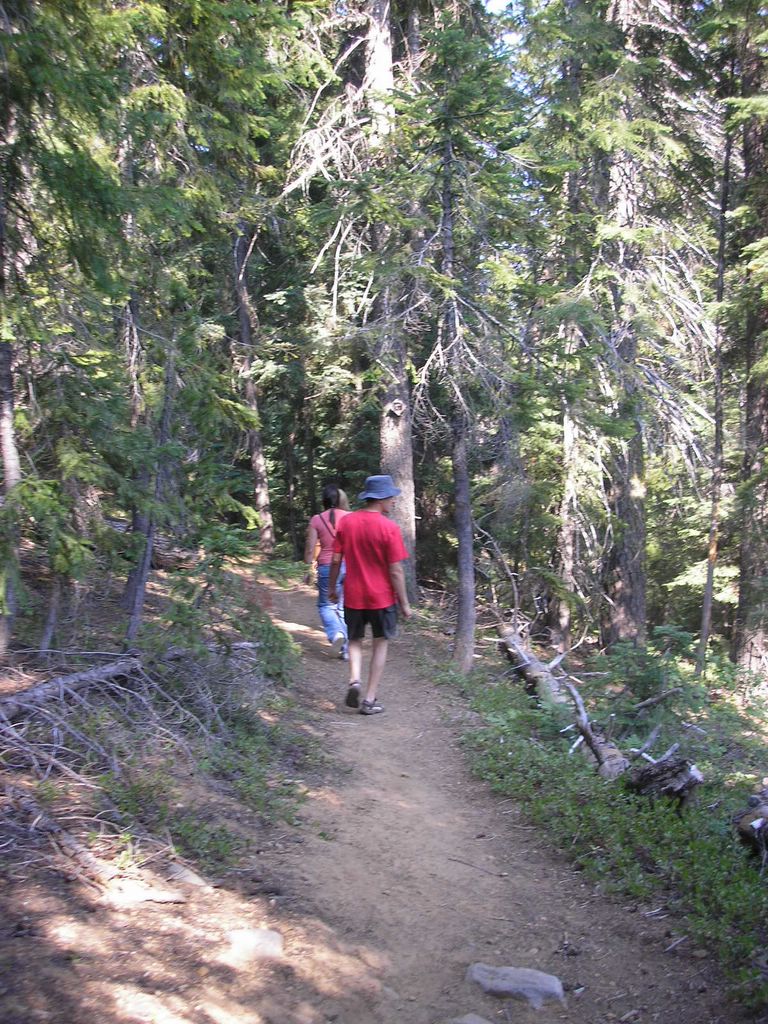
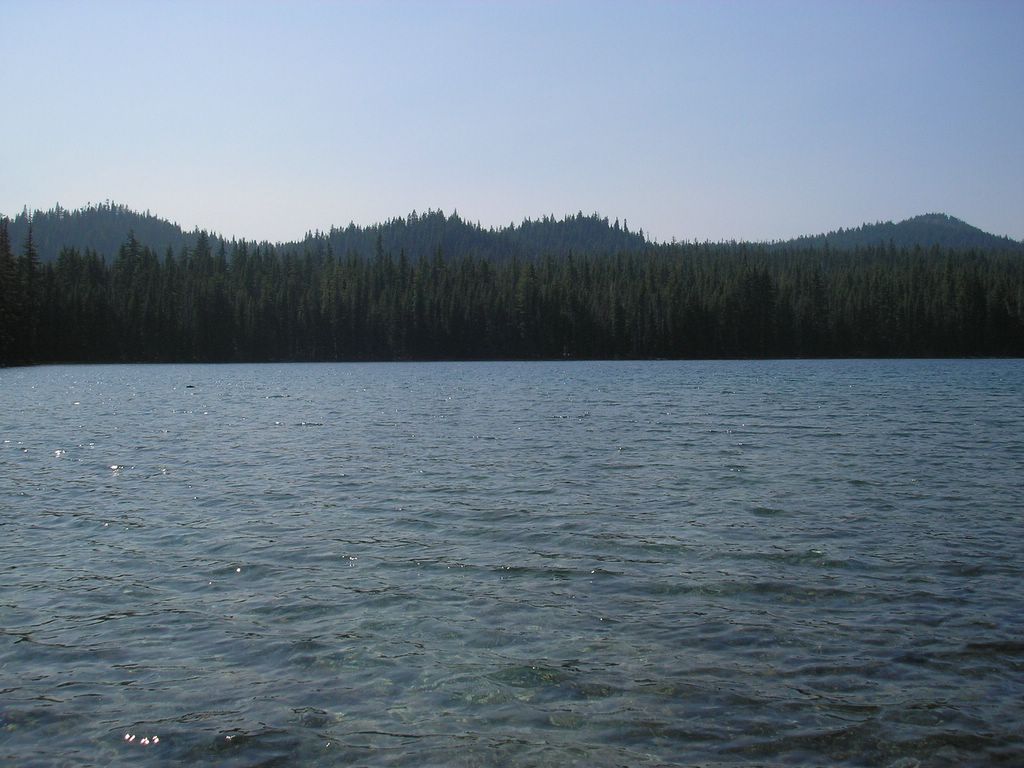
Friends who fly the MiniWhacker had warned me that Redmond itself was fairly boring, so I rented a car yesterday to get out and explore. The crew and I ate lunch at a great BBQ joint in Bend, and then we drove the Cascade Lakes Scenic Byway which took us west from Bend into the mountains near the Three Sisters. Forty miles from Bend, we parked at a trailhead and made the short hike to Lucky Lake, within the Three Sisters Wilderness Area. It was a sunny day, but not oppressively hot at 5000' elevation; the lake was warm enough to wade or (in my captain's case) swim. It was a great way to spend an afternoon, on the company's dime no less.
One thing I liked about working for Ameriflight was that we had a crew car wherever we went. I really wish my airline did that. Still, car rental is pretty cheap when you split it among four people. I'm hoping we keep the same long layover in Redmond, because there were a lot of very interesting-looking trailheads along the highway, mostly leading to alpine lakes. Also, in the winter I'll need to bring my skis on the layover & do Mt Bachelor.


Redmond is on the east side of the Cascades, in Oregon's high desert. I think that most people not from the area imagine Oregon as being completely green and lush, with near constant rain, but the eastern two-thirds of the state is actually desert, scrub-land, and prairie. The Cascades are very effective at wringing out the rain from moisture-laden Pacific air. Redmond, only a few miles east of the Cascades, gets less than 20 inches of precipitation per year; some areas only 50 miles west get up to 120 inches (see this precipitation map).
Bend, 20 miles southwest of Redmond, has become a major recreational destination in Oregon, a sort of Palm Springs of the north. Nearby Mt Bachelor offers the best (well, actually the only) powder skiing in the Cascades; the Deschutes River draws rafters, kayakers, and fishermen; the Three Sisters Wilderness only 15 miles west attracts hikers, campers, and climbers. Bend has seen a population explosion over the last few years, with much of the growth coming from northward-migrating Californians. This was undoubtedly a large factor in my airline's decision to start service on the LAX-RDM route. I think it's going to make a ton of money - the route is brand new and bookings are already very heavy.
Friends who fly the MiniWhacker had warned me that Redmond itself was fairly boring, so I rented a car yesterday to get out and explore. The crew and I ate lunch at a great BBQ joint in Bend, and then we drove the Cascade Lakes Scenic Byway which took us west from Bend into the mountains near the Three Sisters. Forty miles from Bend, we parked at a trailhead and made the short hike to Lucky Lake, within the Three Sisters Wilderness Area. It was a sunny day, but not oppressively hot at 5000' elevation; the lake was warm enough to wade or (in my captain's case) swim. It was a great way to spend an afternoon, on the company's dime no less.
One thing I liked about working for Ameriflight was that we had a crew car wherever we went. I really wish my airline did that. Still, car rental is pretty cheap when you split it among four people. I'm hoping we keep the same long layover in Redmond, because there were a lot of very interesting-looking trailheads along the highway, mostly leading to alpine lakes. Also, in the winter I'll need to bring my skis on the layover & do Mt Bachelor.
Wednesday, August 02, 2006
Intersection Departures
An old aviator's proverb states: "The three most useless things in aviation are altitude above you, runway behind you, and fuel left at the pump." Curmudgeonly advice aside, it is actually quite common to "leave runway behind you." Sit around most airports and you'll see all sorts of airplanes using less than full runway length for takeoff. The rationale behind intersection departures is simple: it saves time, both in taxiing and sometimes in waiting behind other aircraft.
I've known captains who categorically refuse to accept an intersection departure, ever. I've also seen aircraft depart from intersections under conditions I'd never accept. The prudent pilot, though, knows that intersection departures can be safely made under certain conditions, and weighs all the safety factors before deciding if this takeoff meets those conditions.
Personally, I'd go full length every single time if I was flying a light twin with marginal engine-out performance. In these airplanes, an engine failure just after takeoff is quite often fatal; only 1000' of extra pavement can make the difference between buying the farm and saving the day. An engine failure on takeoff in a single engine airplane is only half as likely and less prone to fatality, but I still go full length if there aren't suitable landing areas off the end of the runway.
My airline's MegaWhacker Flight Standards Manual says: "The [MegaWhacker] has certain performance characteristics that offer the flexibility and advantage of operating from runway intersections that are unsuitable for other aircraft. Substantial savings in time and fuel can be gained by using intersection departures. Therefore, if specific runway intersection departures are authorized in the performance, pilots are encouraged to use them."
At most of the airports we operate out of, performance almost always allows for departure from one intersection or another. If the paper performance was the only consideration, as our company's manual seems to argue, we'd do intersection departures all the time, no questions asked. The problem is, paper performance doesn't provide for very big margins, and it was computed using a brand new aircraft flown by a sharp test pilot. An intersection takeoff may still provide a huge margin over the minimum performance, or it may cut it very close. In the latter case, taking the time to taxi full length is cheap insurance. Many captains I fly with will refuse intersection departures with a wet or contaminated runway, or with a tailwind, or at heavy weights, even if the performance says we can do it.
Performance isn't the only consideration. At major airports, wake turbulence can be a big hazard, and intersection takeoffs increase the danger. When departing behind heavy aircraft, we can almost always outclimb their flight path, keeping the wake turbulence well below us. Departing from an intersection after a heavy, though, even the MegaWhacker may lift off further down the runway than the heavy did, meaning that there is a good chance of encountering heavy wake turbulence very early in the climb. Even smaller aircraft not classified as heavy can produce potentially dangerous wake turbulence. The MiniWhacker, for example, throws out a very impressive wake for it's small size.
So, when do I personally feel comfortable accepting or requesting an intersection departure? When the takeoff performance provides decent margins, when the aircraft isn't near max gross weight, when the weather is good, and when I don't expect wake turbulence to be a consideration. Any other conditions decrease safety unacceptably for a small time savings. Of course, accepting or declining an intersection departure is always the captain's call, but most captains will listen if their first officer would rather not take an intersection.
I've known captains who categorically refuse to accept an intersection departure, ever. I've also seen aircraft depart from intersections under conditions I'd never accept. The prudent pilot, though, knows that intersection departures can be safely made under certain conditions, and weighs all the safety factors before deciding if this takeoff meets those conditions.
Personally, I'd go full length every single time if I was flying a light twin with marginal engine-out performance. In these airplanes, an engine failure just after takeoff is quite often fatal; only 1000' of extra pavement can make the difference between buying the farm and saving the day. An engine failure on takeoff in a single engine airplane is only half as likely and less prone to fatality, but I still go full length if there aren't suitable landing areas off the end of the runway.
My airline's MegaWhacker Flight Standards Manual says: "The [MegaWhacker] has certain performance characteristics that offer the flexibility and advantage of operating from runway intersections that are unsuitable for other aircraft. Substantial savings in time and fuel can be gained by using intersection departures. Therefore, if specific runway intersection departures are authorized in the performance, pilots are encouraged to use them."
At most of the airports we operate out of, performance almost always allows for departure from one intersection or another. If the paper performance was the only consideration, as our company's manual seems to argue, we'd do intersection departures all the time, no questions asked. The problem is, paper performance doesn't provide for very big margins, and it was computed using a brand new aircraft flown by a sharp test pilot. An intersection takeoff may still provide a huge margin over the minimum performance, or it may cut it very close. In the latter case, taking the time to taxi full length is cheap insurance. Many captains I fly with will refuse intersection departures with a wet or contaminated runway, or with a tailwind, or at heavy weights, even if the performance says we can do it.
Performance isn't the only consideration. At major airports, wake turbulence can be a big hazard, and intersection takeoffs increase the danger. When departing behind heavy aircraft, we can almost always outclimb their flight path, keeping the wake turbulence well below us. Departing from an intersection after a heavy, though, even the MegaWhacker may lift off further down the runway than the heavy did, meaning that there is a good chance of encountering heavy wake turbulence very early in the climb. Even smaller aircraft not classified as heavy can produce potentially dangerous wake turbulence. The MiniWhacker, for example, throws out a very impressive wake for it's small size.
So, when do I personally feel comfortable accepting or requesting an intersection departure? When the takeoff performance provides decent margins, when the aircraft isn't near max gross weight, when the weather is good, and when I don't expect wake turbulence to be a consideration. Any other conditions decrease safety unacceptably for a small time savings. Of course, accepting or declining an intersection departure is always the captain's call, but most captains will listen if their first officer would rather not take an intersection.
Subscribe to:
Posts (Atom)


