The last two weeks, we've learned a few peices of interesting news at my airline.
First, the Megawhacker is getting another two seats. When I started flying it, there were 70 seats, with quite a lot of legroom. Last year, my airline put four additional seats in it, giving it the same (still sufficient) legroom as the Miniwhacker. Now, they're making it a 76 seater, reconfiguring the galley so they can do it with minimal loss of legroom. Additionally, we're purchasing a modification from the manufacterer that will increase max takeoff weight (MTOW) and max zero fuel weight (MZFW) to 65,500 lbs - an increase of 1000 lbs. We're occasionally weight-limited as a 74 seater; the mod should help us fill all 76 seats without running into weight restrictions. There are a number of markets where we consistently run full, so the extra two seats will help from both a revenue and non-rev standpoint.
Interestingly, the modification is only on paper. The Megawhacker already has published performance numbers for weights well over 64,500 lbs, and has already been tested up to those weights. We're paying the manufacterer a reportedly hefty sum simply to get a new type certificate. Also, it was recently reported that they're looking at stretching the Megawhacker to a 90-100 seat airframe, and my company has expressed interest. That would be one long airplane. Sheesh, we have to be careful about tailstrikes now, is the stretched version gonna have a 4 degree pitch limitation!?
The second bit of news is that with all the new Megawhackers we're getting, the company is opening a second base for the airplane, in Seattle. They haven't given a precise timeline, but said it'll happen by the time we get the last airplane late next year. About half of the fleet - 32 airplanes by that time - will be based there. I don't think I'll get involuntarily displaced, but that depends on the exact timing. Then again, if I'm junior in Portland but senior in Seattle, it may be worthwhile to commute. Wait and see, I guess.
The last, and most intriguing peice of news, is something the company intentionally leaked to the employees. Supposedly, they are looking at getting Embraer 190's, or possibly CRJ-900's. Now mind you, the company is normally very secretive about this sort of thing, which makes me wonder why they're suddenly so open about it. My gut feeling is that they want to use it as a carrot in the pilot contract negotiations, dangling it in front of junior FO's, hoping to inspire a little "Shiny Jet Syndrome" that'll get them in the mood for a paycut.
Personally, I'd rather not see 90 seat jets at my airline. Once we start flying anything that size, it's at the cost of better-paying jobs at "big sister," and I'm not interested in growth at their expense. It's not just about our little corner of the industry, either. The recent trend has been for 90 seaters to go to mainline (jetBlue and USAirways are two recent examples). I don't want my airline to set an example that other majors would be sure to follow, awarding more 90-seat flying to cut-rate operators like Mesa.
Thursday, April 20, 2006


Monday, April 17, 2006
Happy Birthday to Me!
I'm 25 years old today. Crew scheduling has given me the gift of 10 consecutive days without working: 3 days off, 3 days of reserve that I didn't get called on, and another 4 days off. Tomorrow I go back on reserve, and I'm kinda hoping I get used. The time off was nice and allowed me to catch up on some projects, but I'm going to go a little stir crazy if I continue to sit around the house (rainy weather has prevented me from getting in some early-season hiking).
Eight years ago today I was passing my Private Pilot checkride. Jeeze, where has the time gone?

Eight years ago today I was passing my Private Pilot checkride. Jeeze, where has the time gone?

17 April 1998
Friday, April 14, 2006
Immigration
With Congress attempting to come to grips with immigration reform, and highly visible protests and counterprotests taking place around the country, immigration is a subject that has pushed it's way to the forefront of the public consciousness in the last month or two. I think it's a bit like the age 60 issue: both sides have some good arguments, but neither side is entirely correct. I think the best solution would probably make both sides upset. Unlike the mostly civilized debate over the age 60 issue, debate over immigration tends to draw out some unsavory characters and dark prejudices that end up unfairly tainting the "good guys" in the debate.
My own position could be summed up as the following: I am pro-immigration. I think it's the lifeblood of this country, one of the things that make it great. I do believe, however, that there is a limit to how much immigration the country can absorb and still make it work. I believe that the country has a right and a responsibility to enforce it's borders. I don't think of illegal immigrants as criminals, although I think that their illegality creates a submerged culture that allows criminal elements to thrive. In short, I think that the US should make legal immigration much easier, with realistic procedures and quotas, while securing our borders and cutting down illegal immigration to a manageable rate, while at the same time looking hard at some of the issues that create a need for illegal immigration. It's not a position that fits well onto a protest sign, but is just right for an off-topic blog post [grin].
I think that the majority of Americans are generally pro-immigration. Most of us can easily trace our family trees to where we came across from "the old country." My dad's family, for example, is comprised of ethnic Germans that immigrated from the Ukraine in the late 1800s, settling near Napolean, ND. Right now I'm learning to speak German, partly because Dawn and I are visiting German-speaking areas of Europe this summer, but also as a way to connect to my heritage and understand where I came from. The descendents of Italian and Irish immigrants not only continue to celebrate their roots, but these celebrations have also permeated the larger American culture. It is in this context that most Americans realize the value of immigration to our country, and welcome new arrivals with open arms.
There is an anti-immigration movement in this country, although considerably smaller than in most other parts of the world. Some believe our country is too crowded already; others fear that immigrants will take "American jobs." Some are simply racist, whether it's conscious or unconscious. The racist element has tainted the entire immigration debate, to the point that anyone who opposes immigration is accused of racism. For that matter, the charge is often made against people like myself who are pro-immigration but leery of a laissez-faire border policy.
Right-wingers also sometimes make characterizations that amount to "guilt by association." Because many of the rallies of the last month have been organized by suspect organizations such as Communist-front International A.N.S.W.E.R., commentators may assume that the participants share the same radical ideology. Yet for every person chanting Marxist or Reconquistadora gibberish through the bullhorn, for every person screaming their demands at the American people, there are many more who are simply saying: "We're here for a better life, don't forget about us, we want to join you as American citizens."
I have a lot of sympathy for illegal immigrants, the majority of which come from Mexico. They are often the poorest citizens of that country, with little hope for them there. There is opportunity in their prosperous neighbor to the north, but the obstacles to legal immigration are almost insurmountable to a person of limited means. So they take the best route for them: they slip across the lightly guarded border. Does this make them criminals? They've broken the law, but they're not the same as thiefs or assailants. All the same, the fact of their illegality means that we have a huge subculture that is laying low, below the radar-scope of the law - and criminal and dangerous elements thrive in that environment. Consider, for example, that several of the 9/11 hijackers procured false I.D. through a criminal network that forged identification for mostly innocent illegal immigrants. You can see why most Americans, even many who support immigration in general, disapprove of illegal immigration.
But like it or not, millions of illegal immigrants are in this country. What is the solution? A mass amnesty? It seems as though this would encourage future illegal immigration, as happened after the 1986 amnesty. Step up enforcement and deportations? It would guarantee a lot of animosity from the immigrant community and drive it futher underground, again catering to the criminal elements that survive there and exploit the community. President Bush's guest worker proposal is an attempt to forge some middle ground, but I think our goal should be to assimilate our immigrants and turn them into U.S. citizens.
Assimilation is really at the core of this debate. A strong assimilation policy allowed the US to absorb large numbers of immigrants throughout the 1800s. Modern-day multiculturalists will argue that assimilation is a racist and inhumane concept that insists upon the stripping of one's identity to replace it with that of a foreign country. I would argue that assimilation is not about losing your identity, but retaining important elements of your roots while adding the culture of your new country, forming something new and wonderful. Assimilation is not a one way street: a country incorporates its immigrants' roots into its own culture. It takes time, and it takes a conscious decision to welcome immigrants and then incorporate them into your country, teaching them about its history, its values and mores, and yes, its common language.
One can see the consequences of failure to assimilate in Europe. In the 1960's, several European countries were suffering a manpower shortage so they opened their borders to a flood of immigration, often from former colonies. These new arrivals never really integrated into their host countries. They often lived in huge ghettos on the outskirts of large cities, with cultures that resembled rather little those of the host countries. They were never really accepted by the natives of their new countries, and often suffered discrimination and poor treatment, furthering their sense of alienation. When European economies stagnated, these immigrant communities were particularly hard hit. Among young Frenchmen of North African descent, for example, unemployment is currently over 40%. Is it any wonder that radical Islamism has taken a hold in the ghettos of Paris and Frankfurt and Hamburg and Manchester? Or that the unemployed sons and grandchildren of immigrants exploded in rage in the cities of France last year? Immigration itself was not to blame. The failure of the various countries to integrate new immigrants into their society was the problem.
In order to have a successful immigration program, one that produces assimilated and productive U.S. citizens, we need to be able to control the flow - legal and illegal. Ultimately, that means getting control over our borders. This needs to be the first step in any attempt at reform. Personally, I wish we didn't have to do it. A fenced and fortified border seems to carry the symbolism of a fearful, suspicious, and insular America - and I'm sure that's how it will play overseas. But if we're going to make life better for all our immigrants, we need to control the channels through which they arrive here. That means securing the border to the point that illegal immigration is a manageable trickle.
Secondly, we should turn our attention to the immigrants currently here, both legal and illegal. While I'm against a general amnesty, we should make it much easier for illegal immigrants to become documented. The law and order types will no matter grouse about rewarding their breaking of the law, but at this point the only real alternative is continued mass lawbreaking. Perhaps the sort of guest worker program that Bush proposed would be suitable if the borders were secured to prevent massive illegal immigration to take advantage of it, and if it was part of a comprehensive assimilation program that leads all immigrants towards citizenship.
Once we have reduced illegal immigration and are helping our current undocumented residents become legal residents and citizens, then we need to reform the system for those outside the country who want to come here. Right now it's a ridiculously lengthy and expensive process. For any hope of success, you need the money to hire an immigration lawyer, and preferably already have family here. That needs to change. We can put controls in place to reduce harmful effects of immigration - for example, those who are willing to settle in less-populous areas should jump to the head of the line. Depopulation is a concern throughout the prarie states; immigration provides a solution. And once here, there should be an apparatus in place to help our new immigrants assimilate. With these reforms made, our country can support greater levels of legal immigration than are currently allowed, and this would reduce the need for illegal immigration.
Finally, the root causes of illegal immigration need to be looked at. Primary is a poverty-striken, dysfunctional, and corrupt Mexico on our southern border. Mexico needs reform in its government, institutions, and economy. The US government needs to put pressure on Mexico to make these reforms. Trade and foreign aid can serve as both carrots and sticks. Incidently, the drug trade is a major force in keeping Mexico dysfunctional; increased border vigilance will have a strong effect on this. It will also have the side benefit of increasing homeland security.
Overall I think this is a common-sense, reasonable way of looking at the immigration issue. So, anybody wanna put together a rally for effective and fair immigration reform? Somehow I think I might have trouble coming up with a good bullhorn chant from this post....
My own position could be summed up as the following: I am pro-immigration. I think it's the lifeblood of this country, one of the things that make it great. I do believe, however, that there is a limit to how much immigration the country can absorb and still make it work. I believe that the country has a right and a responsibility to enforce it's borders. I don't think of illegal immigrants as criminals, although I think that their illegality creates a submerged culture that allows criminal elements to thrive. In short, I think that the US should make legal immigration much easier, with realistic procedures and quotas, while securing our borders and cutting down illegal immigration to a manageable rate, while at the same time looking hard at some of the issues that create a need for illegal immigration. It's not a position that fits well onto a protest sign, but is just right for an off-topic blog post [grin].
I think that the majority of Americans are generally pro-immigration. Most of us can easily trace our family trees to where we came across from "the old country." My dad's family, for example, is comprised of ethnic Germans that immigrated from the Ukraine in the late 1800s, settling near Napolean, ND. Right now I'm learning to speak German, partly because Dawn and I are visiting German-speaking areas of Europe this summer, but also as a way to connect to my heritage and understand where I came from. The descendents of Italian and Irish immigrants not only continue to celebrate their roots, but these celebrations have also permeated the larger American culture. It is in this context that most Americans realize the value of immigration to our country, and welcome new arrivals with open arms.
There is an anti-immigration movement in this country, although considerably smaller than in most other parts of the world. Some believe our country is too crowded already; others fear that immigrants will take "American jobs." Some are simply racist, whether it's conscious or unconscious. The racist element has tainted the entire immigration debate, to the point that anyone who opposes immigration is accused of racism. For that matter, the charge is often made against people like myself who are pro-immigration but leery of a laissez-faire border policy.
Right-wingers also sometimes make characterizations that amount to "guilt by association." Because many of the rallies of the last month have been organized by suspect organizations such as Communist-front International A.N.S.W.E.R., commentators may assume that the participants share the same radical ideology. Yet for every person chanting Marxist or Reconquistadora gibberish through the bullhorn, for every person screaming their demands at the American people, there are many more who are simply saying: "We're here for a better life, don't forget about us, we want to join you as American citizens."
I have a lot of sympathy for illegal immigrants, the majority of which come from Mexico. They are often the poorest citizens of that country, with little hope for them there. There is opportunity in their prosperous neighbor to the north, but the obstacles to legal immigration are almost insurmountable to a person of limited means. So they take the best route for them: they slip across the lightly guarded border. Does this make them criminals? They've broken the law, but they're not the same as thiefs or assailants. All the same, the fact of their illegality means that we have a huge subculture that is laying low, below the radar-scope of the law - and criminal and dangerous elements thrive in that environment. Consider, for example, that several of the 9/11 hijackers procured false I.D. through a criminal network that forged identification for mostly innocent illegal immigrants. You can see why most Americans, even many who support immigration in general, disapprove of illegal immigration.
But like it or not, millions of illegal immigrants are in this country. What is the solution? A mass amnesty? It seems as though this would encourage future illegal immigration, as happened after the 1986 amnesty. Step up enforcement and deportations? It would guarantee a lot of animosity from the immigrant community and drive it futher underground, again catering to the criminal elements that survive there and exploit the community. President Bush's guest worker proposal is an attempt to forge some middle ground, but I think our goal should be to assimilate our immigrants and turn them into U.S. citizens.
Assimilation is really at the core of this debate. A strong assimilation policy allowed the US to absorb large numbers of immigrants throughout the 1800s. Modern-day multiculturalists will argue that assimilation is a racist and inhumane concept that insists upon the stripping of one's identity to replace it with that of a foreign country. I would argue that assimilation is not about losing your identity, but retaining important elements of your roots while adding the culture of your new country, forming something new and wonderful. Assimilation is not a one way street: a country incorporates its immigrants' roots into its own culture. It takes time, and it takes a conscious decision to welcome immigrants and then incorporate them into your country, teaching them about its history, its values and mores, and yes, its common language.
One can see the consequences of failure to assimilate in Europe. In the 1960's, several European countries were suffering a manpower shortage so they opened their borders to a flood of immigration, often from former colonies. These new arrivals never really integrated into their host countries. They often lived in huge ghettos on the outskirts of large cities, with cultures that resembled rather little those of the host countries. They were never really accepted by the natives of their new countries, and often suffered discrimination and poor treatment, furthering their sense of alienation. When European economies stagnated, these immigrant communities were particularly hard hit. Among young Frenchmen of North African descent, for example, unemployment is currently over 40%. Is it any wonder that radical Islamism has taken a hold in the ghettos of Paris and Frankfurt and Hamburg and Manchester? Or that the unemployed sons and grandchildren of immigrants exploded in rage in the cities of France last year? Immigration itself was not to blame. The failure of the various countries to integrate new immigrants into their society was the problem.
In order to have a successful immigration program, one that produces assimilated and productive U.S. citizens, we need to be able to control the flow - legal and illegal. Ultimately, that means getting control over our borders. This needs to be the first step in any attempt at reform. Personally, I wish we didn't have to do it. A fenced and fortified border seems to carry the symbolism of a fearful, suspicious, and insular America - and I'm sure that's how it will play overseas. But if we're going to make life better for all our immigrants, we need to control the channels through which they arrive here. That means securing the border to the point that illegal immigration is a manageable trickle.
Secondly, we should turn our attention to the immigrants currently here, both legal and illegal. While I'm against a general amnesty, we should make it much easier for illegal immigrants to become documented. The law and order types will no matter grouse about rewarding their breaking of the law, but at this point the only real alternative is continued mass lawbreaking. Perhaps the sort of guest worker program that Bush proposed would be suitable if the borders were secured to prevent massive illegal immigration to take advantage of it, and if it was part of a comprehensive assimilation program that leads all immigrants towards citizenship.
Once we have reduced illegal immigration and are helping our current undocumented residents become legal residents and citizens, then we need to reform the system for those outside the country who want to come here. Right now it's a ridiculously lengthy and expensive process. For any hope of success, you need the money to hire an immigration lawyer, and preferably already have family here. That needs to change. We can put controls in place to reduce harmful effects of immigration - for example, those who are willing to settle in less-populous areas should jump to the head of the line. Depopulation is a concern throughout the prarie states; immigration provides a solution. And once here, there should be an apparatus in place to help our new immigrants assimilate. With these reforms made, our country can support greater levels of legal immigration than are currently allowed, and this would reduce the need for illegal immigration.
Finally, the root causes of illegal immigration need to be looked at. Primary is a poverty-striken, dysfunctional, and corrupt Mexico on our southern border. Mexico needs reform in its government, institutions, and economy. The US government needs to put pressure on Mexico to make these reforms. Trade and foreign aid can serve as both carrots and sticks. Incidently, the drug trade is a major force in keeping Mexico dysfunctional; increased border vigilance will have a strong effect on this. It will also have the side benefit of increasing homeland security.
Overall I think this is a common-sense, reasonable way of looking at the immigration issue. So, anybody wanna put together a rally for effective and fair immigration reform? Somehow I think I might have trouble coming up with a good bullhorn chant from this post....
Thursday, April 13, 2006
Tuesday, April 11, 2006
Greybeards vs. Whippersnappers
Ever since the FAA enacted the so-called "Age 60" rule in 1959, it has been a perenially debated issue among professional pilots, usually along generational lines. Here's the reg that has everyone up in arms:
A few months ago, the International Civil Aviation Organization (ICAO) recommended that it's member states increase their retirement ages to 65. Most members have done so; the United States is the most notable exception. This, along with the recent pension terminations at several major US airlines, has led Congress to begin work on legislation which would force the age to 65, against the wishes of the FAA.
Okay, so there's the background. Let the grudge match begin!
Here's an interesting tidbit of info that adds fuel to the fire: officials at the FAA's aeromedical bureau have indicated that if Congress forces the FAA to increase the retirement age, the FAA will respond by significantly toughening medical standards for pilots over 50. We could see an "astronaut physical" forcing many pilots to retire long before they're financially ready.
"No certificate holder may use the services of any person as a pilot on an airplane engaged in operations under this part if that person has reached his 60th birthday. No person may serve as a pilot on an airplane engaged in operations under this part if that person has reached his 60th birthday." CFR 14 § 121.383(c)This rule, which only applies to FAR 121 (airline) pilots, and not to FAR 135 or corporate pilots, ostensibly "was promulgated in order to maintain a high level of safety in part 121 operations" (FAA's quote). In fact, the rule came to be as the result of a backroom deal between American Airlines' C. R. Smith and then-FAA administrator Pete Quesada. Smith did this after ALPA struck his airline over it's imposition of a mandatory retirement age, among other issues; ironically, ALPA is now one of the age 60 rule's most staunch supporters.
A few months ago, the International Civil Aviation Organization (ICAO) recommended that it's member states increase their retirement ages to 65. Most members have done so; the United States is the most notable exception. This, along with the recent pension terminations at several major US airlines, has led Congress to begin work on legislation which would force the age to 65, against the wishes of the FAA.
Okay, so there's the background. Let the grudge match begin!
Greybeard: The age 60 rule is wrong, always has been. It has no basis in medical research, and is simply age discrimination meant to hold down labor costs.Yes, good fun. You can see that this is a tough issue that has some good points on both sides, but is fraught with self-interest. Where do I come down on it? Push comes to shove, I guess I support the change, but not very enthusiastically. I personally think I'll be ready to hang it up at age 60; by then I'll have been flying for 47 years, airliners for 38 of those. I'll be ready to either stay on the ground or close to it in a 100-yr old Cub.
Whippersnapper: No argument here, Pops. I agree that it's a bad rule. On the other hand, we have a lot of guys and gals on furlough, with retirements their only hope of recall. It's a bad time to be changing the law.
Greybeard: Hey, they're not the only ones affected by current industry troubles. My pension was terminated last year, and that latest paycut isn't making it any easier to save for retirement. The truth is, I can't afford to retire right now. I've got to keep working if I want to maintain my lifestyle.
Whippersnapper: Maintain your lifestyle!? I have furloughed friends bartending and selling used cars to make ends meet. You're willing to leave them in the gutter so you can keep your membership at the country club?
Greybeard: Whoa, kid! It's not that I'm unsympathetic to their fate. Remember, I've been there a few times myself. But that's just part of being junior at any airline. I've paid my dues at this company for 35 years; doesn't that count for anything?
Whippersnapper: Sure it does. You should get the same thing that 35 year captains got when you were a junior FO: employment until age 60. You knew what the score was when you signed up; you're trying to change the rules mid-game, after you've already benefited from a bunch of guys retiring at age 60.
Greybeard: Don't get mean. I would love exactly what those guys got at age 60: a nice fat pension and a boot out the door. The rules changed when our pension got yanked out from under us. Now, it's not unreasonable for us to work a bit longer.
Whippersnapper: Well, how long is enough? Is age 65 really enough? Isn't that just another unjust, arbitrary age? It's only a matter of time before somebody demands that it be upped again.
Greybeard: Well, if a guy can still pass an FAA medical....
Whippersnapper: (laughing) That's pretty funny, Gramps! You and I both know a few guys that are walking coronaries, yet they can still find someone to pencilwhip them a new medical every six months. I'll bet I could find an examiner to give my dead grandma a Class I medical.
Greybeard: Okay, so we still set an arbitrary age limit, make it 65. Still, it's more fair than what we have now. At least by age 65 you qualify for social security benefits.
Whippersnapper: For you, maybe. I'm not counting on them being around for me.
Greybeard: You said you agreed that it needed to be changed.
Whippersnapper: I said it's a bad rule, in a cosmic justice sense. Yeah, it should be changed. I just don't think it should be changed right now for the purpose of providing relief to one age group at the expense of all others. It's not just the current furloughees that will get screwed. Junior guys like me will be furlough fodder for that much longer. Senior FOs will be topping out on the payscales soon, finding their salaries stagnant with no hope of upgrade. There's a good chance that previously retired guys over 60 will sue the airline to come back, and then you're going to see another round of furloughs and downgrades.
Greybeard: If not now, when? This is the first time in 40 years that there's been enough political support to actually change the rule.
Whippersnapper: Okay, so change it now, with a graduated implementation. Make it so the age is 62 in 2007, 63 in 2009, 64 in 2011, and 65 from 2013 on. Combine it with legislation that requires the PBGC to pay out full benefits to those required to retire before age 65 by federal law.
Greybeard: Great. So I get two more years of depressed payrates, then the whole $40k/yr from the PBGC. Sounds like a great deal, ace. (rolls eyes).
Whippersnapper: Hey, I still won't like you sitting in my seat for another two years. It's called a compromise.
Greybeard: Yeah, one that just coincidently has you retiring at age 65.
Whippersnapper: And probably not making the beaucoup bucks that you did in the late 90's. I can't believe you 777 captains were making over $300k/yr and didn't think to stash some money away in case your pension went bust. Or did your ex-wife take it all?
Greybeard: The witch.
Whippersnapper: Well, you were sleeping with that flight attendant, Bunny. I mean, pension or no, at some point you have to take responsibility for your actions and how they've affected your financial preparation for retirement. As the old saying goes, a lack of preparation on your part does not necessarilly constitute an emergency on my part.
Greybeard: Why, you little...! (begins throttling W.S.)
Here's an interesting tidbit of info that adds fuel to the fire: officials at the FAA's aeromedical bureau have indicated that if Congress forces the FAA to increase the retirement age, the FAA will respond by significantly toughening medical standards for pilots over 50. We could see an "astronaut physical" forcing many pilots to retire long before they're financially ready.
Friday, April 07, 2006
Sierra Tour
My favorite aspect of the job is all the gorgeous scenery I get to see from the cockpit. When weather and time permits, I make a point of taking "scenic tours," with altitude and routing selected for the best scenery to point out to the passengers as we go along. Of course, wintertime weather cuts down on the number of days that scenic tours are feasible. But spring has sprung, and yesterday was perfect for a tour of the Sierra Nevada along our LAX-Reno route. After checking on with LA center, we got FL200 as a final altitude and a route of Gorman direct Mammoth Lakes airport direct South Lake Tahoe direct Reno.

The Sierras from near Porterville, looking up towards Sequioa National Park and 14,497' Mount Whitney. Although Whitney is the tallest mountain in the lower 48 states, it's pretty tough to pick out from this angle because most of the mountains around it are only a few feet shorter.

King's Canyon, just north of Sequoia. At the center of the picture, you can see where the North Fork and South Fork of the King's River meet.

The High Sierra just west of Bishop, CA. It's been a very good year for snow in the Sierras, and I suspect the snowpack will last well into summer. Across the Owens Valley, you can see the White Mountains of Nevada.

The Yosemite Valley, seen from the east side of the park. Near the center of the picture, Half Dome is visible (left side of the valley).
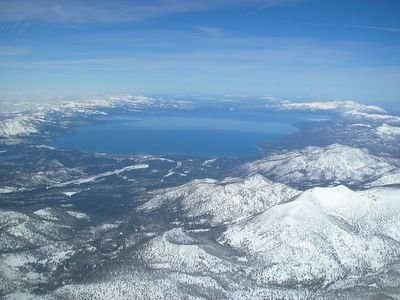
We were given a descent to 14,000 just before Lake Tahoe, so we got an excellent view of the lake and it's surroundings. We continued north over Truckee before turning east over I-80 for the descent into Reno.

Contrails over Nevada.
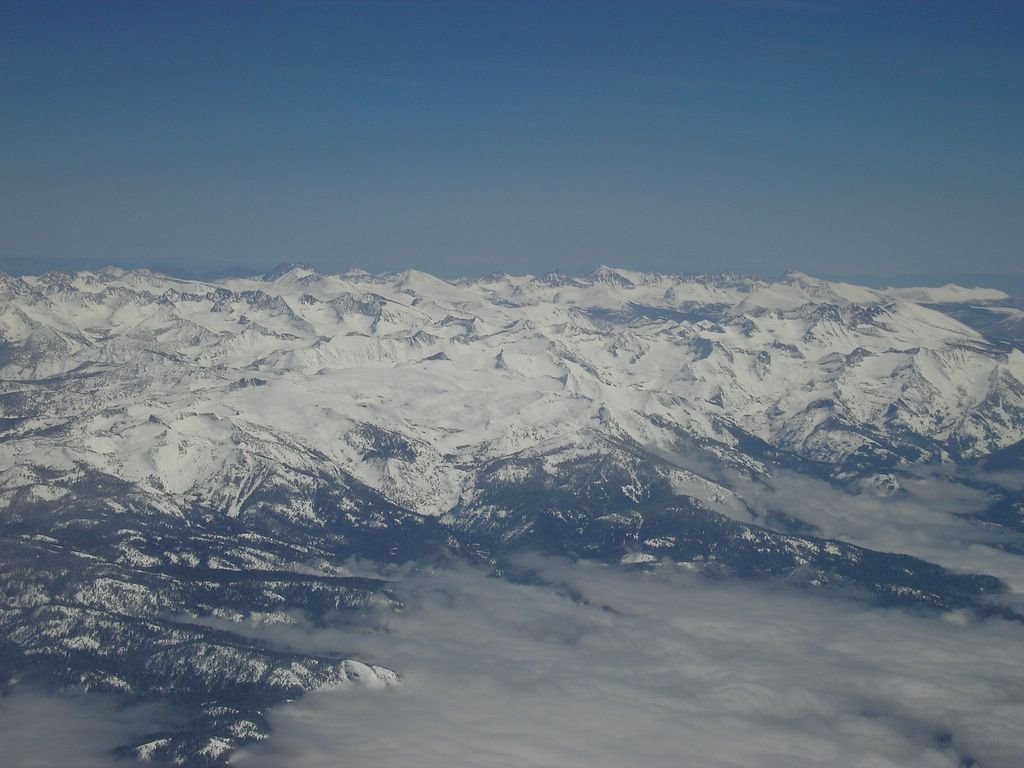
The Sierras from near Porterville, looking up towards Sequioa National Park and 14,497' Mount Whitney. Although Whitney is the tallest mountain in the lower 48 states, it's pretty tough to pick out from this angle because most of the mountains around it are only a few feet shorter.
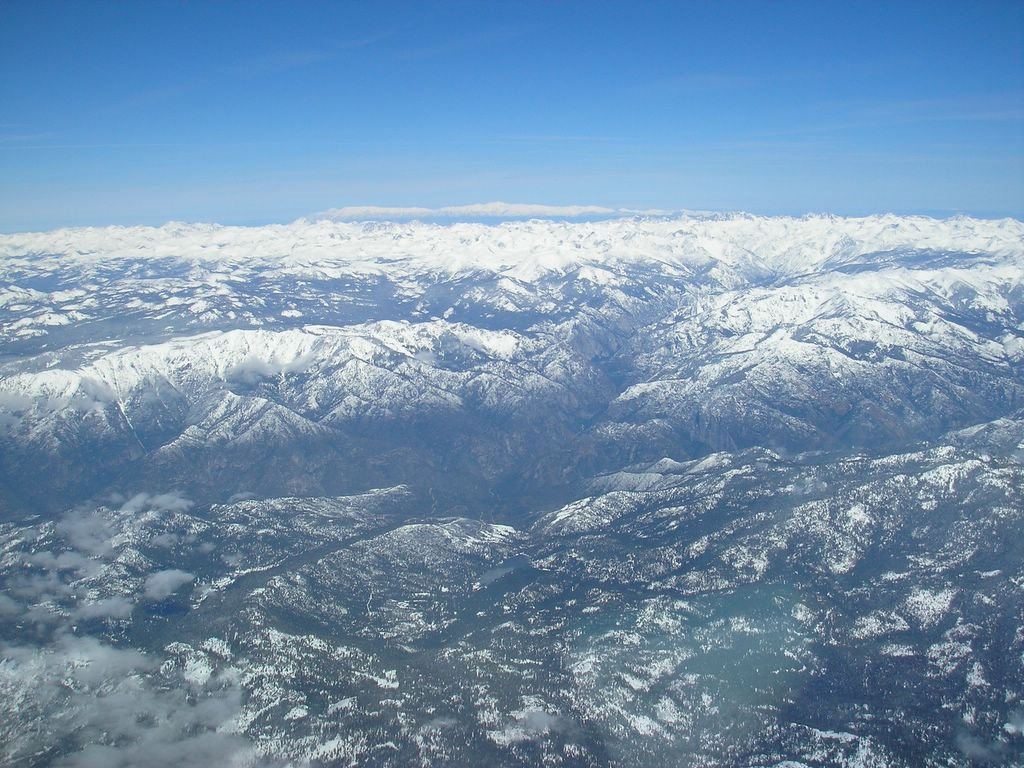
King's Canyon, just north of Sequoia. At the center of the picture, you can see where the North Fork and South Fork of the King's River meet.
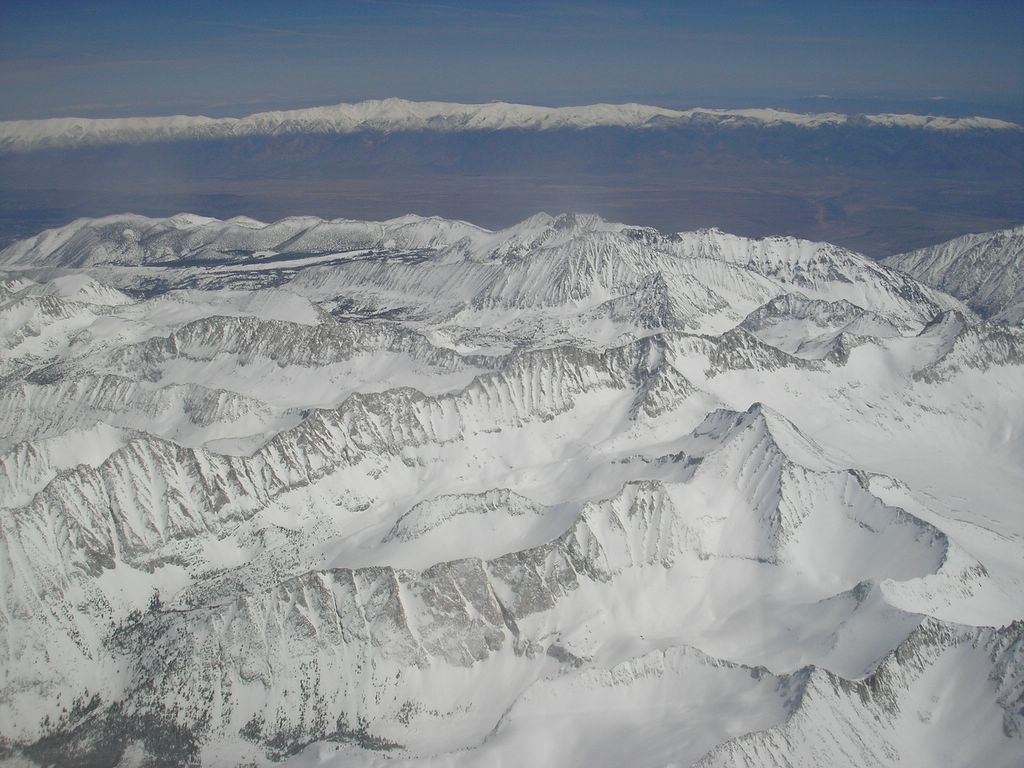
The High Sierra just west of Bishop, CA. It's been a very good year for snow in the Sierras, and I suspect the snowpack will last well into summer. Across the Owens Valley, you can see the White Mountains of Nevada.
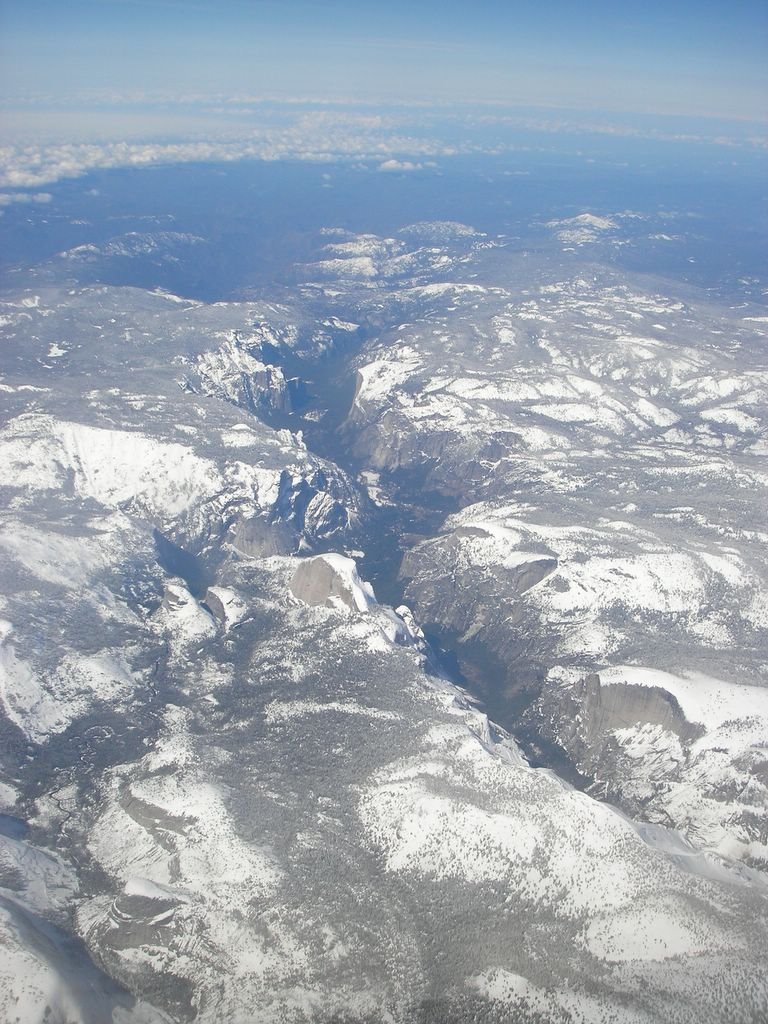
The Yosemite Valley, seen from the east side of the park. Near the center of the picture, Half Dome is visible (left side of the valley).

We were given a descent to 14,000 just before Lake Tahoe, so we got an excellent view of the lake and it's surroundings. We continued north over Truckee before turning east over I-80 for the descent into Reno.

Contrails over Nevada.
Monday, April 03, 2006
Bump and Grind

We're climbing through FL180 after our early morning departure from Bozeman when the turbulence begins.
It's just some constant rhythmic jiggles at first, but there's a few more earnest bumps thrown in for good measure. I call the flight attendants. "Hey, ATC told us we're gonna have some turbulence at our cruising altitude, you might want to stay seated until we get a better idea."
No sooner do I switch off the interphone than the turbulence starts for real. Bam Bam Bam! Three quick raps, followed by the some wallowing from side to side. Bam Bam BOOM! I'm thrown upward into the seatbelt; I grab onto the glareshield with my left hand. We're climbing through FL210 right now; I look at the captain and he says "Yeah, let's go back down to FL200." I key the mic and request FL200; ATC quickly agrees.
I reach for the altitude alerter and twist it down to 20,000 feet. BAM! Whoops, 19,700. I reach for it again. Boom! Again, the turbulence makes me spin the alerter past my target, to 20,300. Okay, let's just... BOOM! Argh! 18,900! Now I'm just getting mad. After several more turbulence-hampered tries, I get the darn thing to 20,000, and start to push the ALT SEL (altitude select) button on the autopilot panel. Bam! My hand slips and I push the VNAV button instead. Grrr....
I'm starting to realize that push-button airplanes just aren't designed with moderate turbulence in mind.
Subscribe to:
Posts (Atom)


