Tuesday, October 04, 2005

Selling the Dream

I've said it before: many aspiring professional pilots have a skewed view of the profession. They have unrealistic expectations of the time and effort required to become a working pilot, and an overly rosy view of the pay and lifestyle that await them. In my opinion, these attitudes are fostered by the flight training industry. At a time when few people have contacts within the industry to set them straight, flight schools will promise these potential students the sky. There are many variations, but the general theme is this: if you give us enough money, we'll put you on the fast track to the good life.

The following are advertisements in two recent issues of Flying Magazine. The thumbnails are a bit small; click on the pictures to see them close up. Let's do a little fisking, shall we?
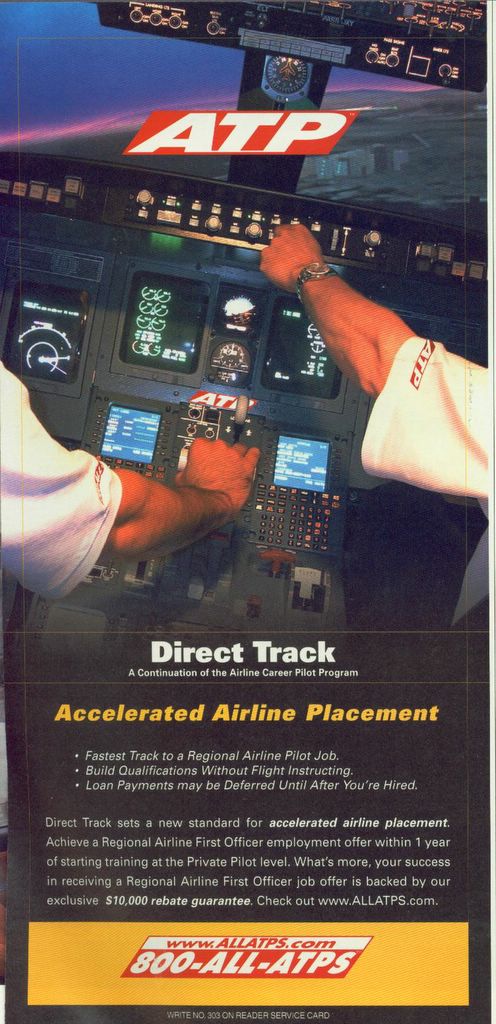


First up: All-ATPs. "Direct Track...Accelerated Airline Placement....Fastest Track to a Regional Airline Pilot Job...Build Qualifications Without Flight Instructing." Heh, God forbid that one should lower themselves to flight instructing to "build their qualifications." Of course...if you instruct, you get paid. This way you get to keep shelling out money to build those hours. Convenient how that works, no?
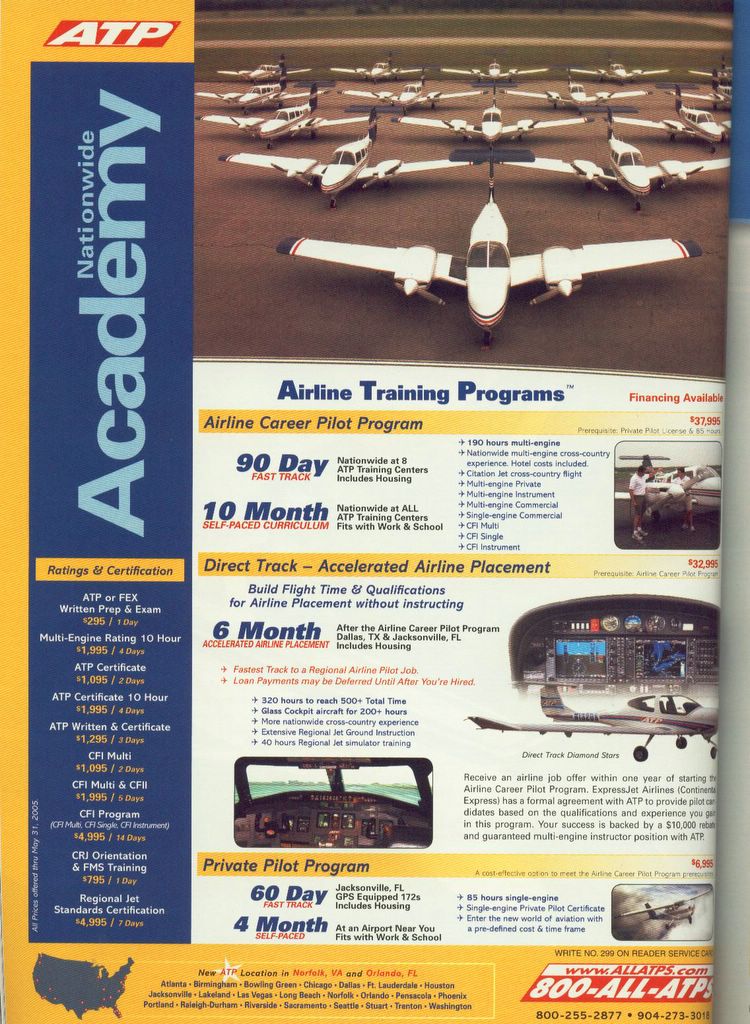


A slightly more illuminative ad from All-ATPs. Check out the incredible cost involved: if you start with zero hours, it takes $77,985 to do all three programs. This leaves you with your Commercial and CFI/II/MEI, plus 600 hours, 190 of which are multi-engine. That qualifies you for an interview with ExpressJet, making $19,800 your first year if they hire you. Funny how the ad doesn't mention that, eh? If they don't hire you, plan on keep shelling out money to get yourself to around 1000 hours - or, gasp, do some instructing so you actually have an aviation job on your resume before you interview with another company.
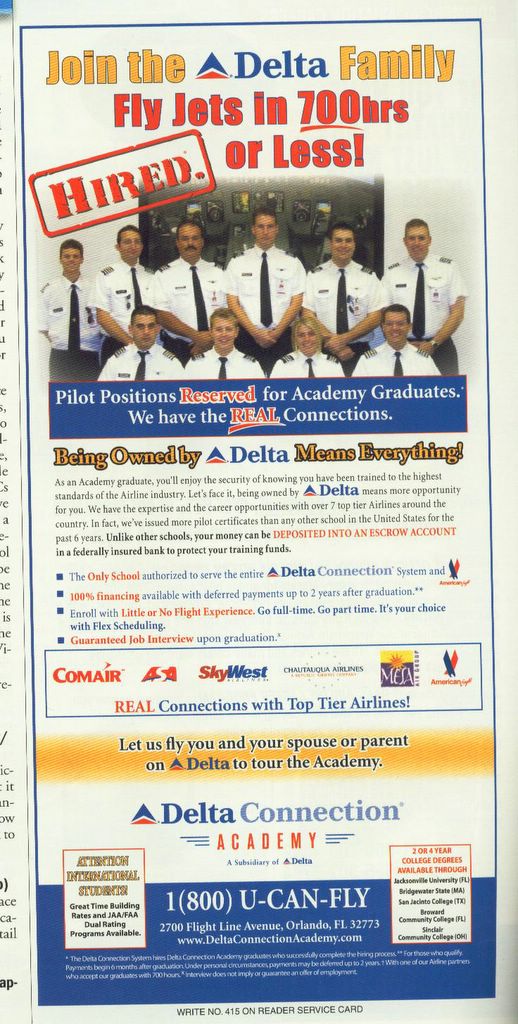


Ooh, it has the Delta logo on it! Everyone knows that Delta pilots make a ton of money! Heh, perhaps with Delta in bankruptcy they'll redesign this ad next month. Like ALL-ATPs, Delta Academy guarantees a job interview - in this case, with Comair, ASA, American Eagle. etc. What students don't realize is that these airlines hire less than half of the applicants they interview. The airline is simply agreeing to spend a few hours with Acadamy grads, talking and giving them a sim ride. They can then offer a job offer, or not, and the school's obligation is complete.



Besides the interesting concept of affordability, a few things jump out of this ad from Orlando Flight Training. 200 hr Jet First Officer? Are they completely mad? There is not a commercial jet FO is the world with 200 hours. Not one. And "Jet/FO Part 121 certification?" There is no such thing. Under FAR 121, you are qualified in equipment by your airline after they hire you. Even if you have a type rating, you are not Part 121 qualified until you complete that airline's approved syllabus. So basically they used terminology that, while incorrect, is calculated to make a young pilot's drool reflex kick in. Jet! FO! Part 121!
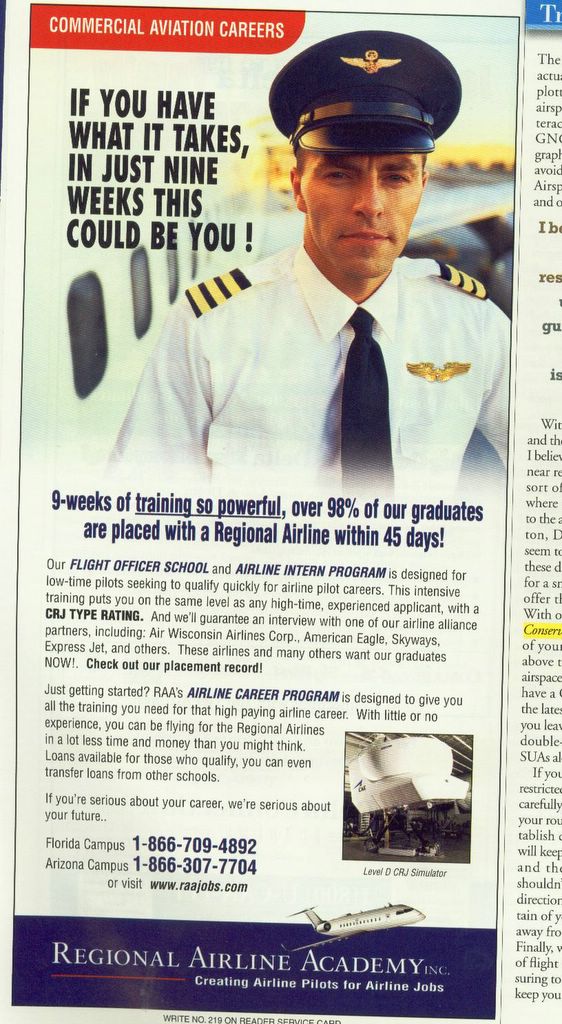


This could be you! In just nine weeks! Standing proudly next to a real jet airplane in snappy uniform, epaulets, and spiffy hat...the dude that guys wanna be and girls wanna be with! All because your nine weeks of training were so powerful. Seriously, this RAA ad is pretty disingenuous with it's claim that your CRJ type rating will "put you on the same level as any high time, experienced applicant." All things being equal, most regionals would far prefer a 2000-hour guy with multi-engine Part 135 experience to a 500 hour kid with a CRJ type rating. I also got a chuckle out of this ad's reference to "that high paying airline career."
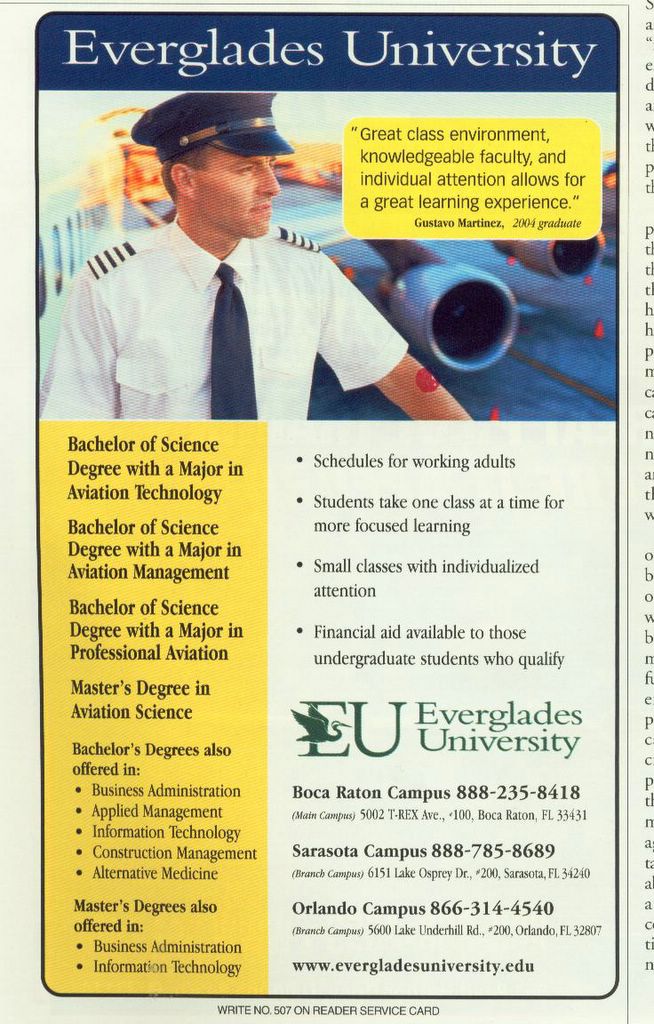


This isn't a deceptive ad, I'm just amused that the model from the RAA ad is apparently a 747 captain this time!
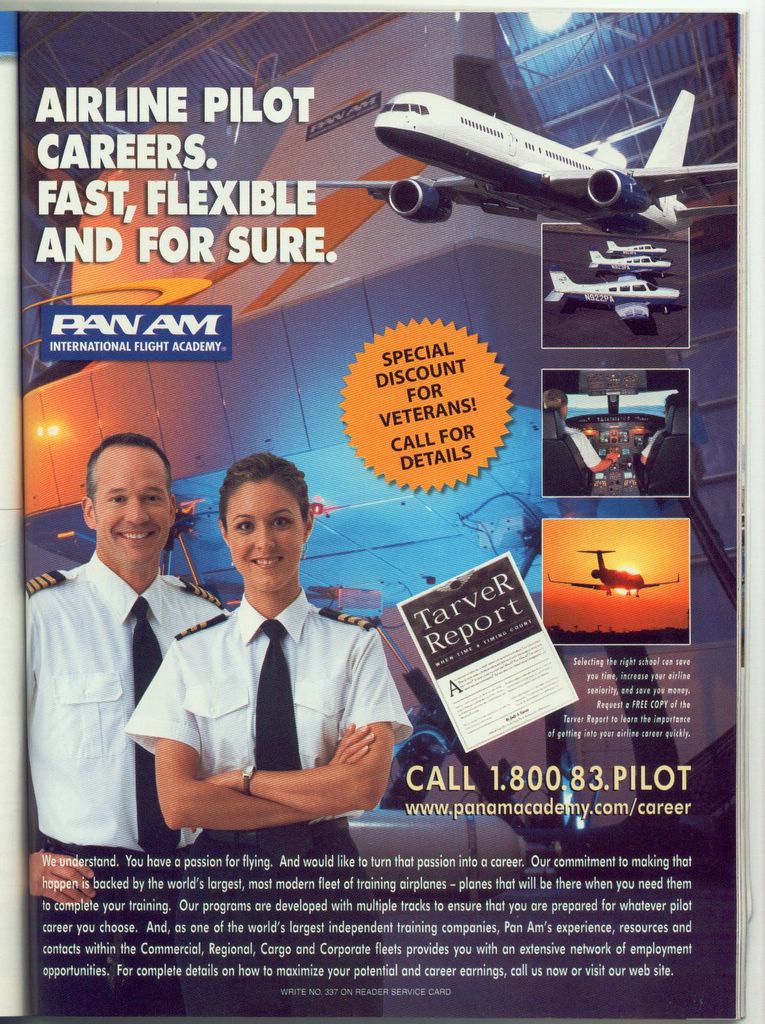


My all-time favorite, straight from PanAm International Flight Academy. "Airline Pilot Careers: Fast, Flexible, and For Sure." Excuse me?!? Do they believe that? An airline career is none of those things! It's seldom fast, particularly if a major airline is the intended destination. It's often a very inflexible job. And For Sure? Are they stark raving mad? Tell the thousands of furloughed pilots on the streets that this career is for sure. Tell the pilots whose careers were ended by accidents, enforcement actions, and denied medicals. Tell the flight instructor who's barely making enough money to live on and can't seem to get a lucky break. Fast, Flexible, and For Sure. I hope none of their students actually believe that, because they are being set up for disillusionment and failure.

Jeeze, it's not even a very good alliteration.
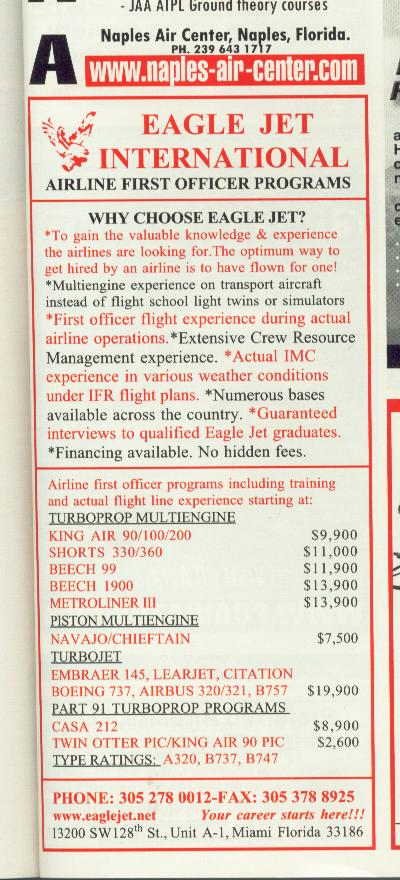


Of course, your career will be considerably more for sure if you don't expect to be paid for your commercial flying; even moreso if you pay to do it. Enter Eagle Jet International. You, too, can be a first officer on a Beech 1900, flying freight in godawful weather at all hours of night...for only $13,900 out of pocket! But hey, at least you won't have to flight instruct.


Our final entry, from the late, great, TAB Express. This was another "pay-for-your-job" outfit, with the additional "enticement" of four years' indentured servitude. Either this ad was placed much earlier, or TAB is absolutely shameless, because the venture closed down some time before this ad appeared, before the "airline" flew a single revenue flight. They took a lot of people's money with them, including the deposits of some folks who hadn't even started training. Such are the risks of trying to buy your way out of demeaning jobs like flight instructing, jump flying, banner towing, freight haulting, etc.

Okay, that's enough for tonight. I could go dig up some old "Flight Training" magazines for some real doozies, but you probably get the idea. It's disheartening to see the dishonest way that many flight training organizations sell the airline pilot dream. To be sure, many of these schools have good programs that've helped capable pilots achieve realistic goals. At the same time, though, they've pumped out a number of starry eyed greenhorns who expect a high paying jet job to immediately fall into their lap, and it usually just doesn't happen that way. For that matter, when they do get the job, it's seldom what they expected once the initial glamour wears off.

I know I'm running the risk of sounding bitter with this post. I'm not; despite the perils of this industry, I'm glad I chose this career. I do think, however, that a realistic outlook has made the rough patches that much easier to overcome. And that's part of the reason for this blog: to inject a little realism into aspiring pilots' plans, to provide a counterbalance to the marketing hype. In the next week or two, I'll be posting about the various paths to an airline career, and some of the struggles and pitfalls along the way. Hopefully it'll be useful information to anybody considering a flying career, as well as interesting for those smart enough to stay away but curious enough to read about it!

Saturday, October 01, 2005

LA Story: a long-winded rant.

Since my company started adding service at Los Angeles earlier this year, a number of our pilots have started to consciously bid away from it. They'll look at a line they're interested in, check the trips, see that it has a bunch of LA turns, and look elsewhere. It's not that the Northwest has given us vampire-line reactions to excessive sunshine or anything. Rather, doing a LAX turn is a surefire way to screw up your day thanks to a ramp operation that is 100% FUBAR. Our experience there last night was more of the same.

A little background. LAX has far more XYZ Co. flights than ABC Co. flights, so they handle our operations. Alaska gate agents work our flights. XYZ Ops prints out our releases and serves as our main point of communication. And Menzies Aviation, contracted by XYZ Co. to provide their ramp service, handles our ramp service. These duties include marshalling airplanes into parking, connecting ground power if needed, loading and unloading bags, servicing the lavatory and potable water when applicable, and performing pushbacks. Menzies seems to take the position that these are very basic functions that any high school dropout could do, so that's the kind of minimum-wage help they hire. XYZ Co. certainly appreciates the price that they can do it for.

A little more background for those without airline experience. For airliners, having a source of electrical power other than the batteries is very important. We can run on the batteries for short periods of time, but we really try to avoid putting any great load on them, such as an engine start. When our engines are shut down, their generators do not operate, so we must get power from alternative sources to avoid depleting the batteries. A Ground Power Unit (GPU) is often used. It's essentially a little cart with a cord that plugs into a receptacle somewhere on the airplane. For my airplane, the preferred type is solid-state and converts AC power from the terminal into 28 volt DC power that the airplane can use. Diesel-powered GPUs are a self-contained alternative, but we try not to use them because they're noisy, smelly, and are not reliable in providing good 28-volt power. If faced with a diesel-powered GPU, we'll often opt instead to use the Auxiliary Power Unit (APU), a small jet engine installed in the tail for the sole purpose of providing DC power and heating/cooling on the ground. At LAX, we usually use the APU. Because of congestion around the gates, the usual procedure at LAX is to push back and then start the engines, which is not possible with a GPU. Until yesterday, I'd never used a GPU at LAX.

Yesterday, when preflighting the airplane in Portland, we discovered that the APU was inoperative and deferred. Knowing that we'd be in LAX a few legs later, the captain called dispatch. They assured him that a GPU would be available at LAX, available by prior request. Hours later, as we approached the LA basin, the captain called LAX operations to alert them of our revised time of arrival. He made sure to communicate our need for a GPU. They said they'd pass that request along to ramp service; the captain and I were both skeptical that it'd be there.
When we landed at 8:00PM, our gate was still occupied by a late-running MD80. Ground Control gave us the dreaded "continue straight on E, turn right on D10, right again on D and hold short of the alley until your gate opens up." Within a minute or two, I contacted LAX operations to let them know we would be holding for the gate, and to reiterate our need for a GPU when we arrived. They acknowledged. Twenty minutes later, our gate opened up, and not a minute too soon: the passengers were about to mutiny for the right to get up and use the restroom. As we taxied in, we looked for a GPU; sure enough, nowhere in sight. When parked, the captain gave the rampers the established "Connect ground power" hand signal. They looked at him in utter confusion and kept responding with the "Your wheels are chocked" hand signal.

Further attempts at hand communication were futile. I radioed operations and told them that we were still missing a GPU. They said they'd call ramp and let them know. In the meantime, our passengers could not deplane so long as our engines were running. We decided to shut them down, get the passengers off, and power down the airplane to protect the batteries if a GPU was not quickly forthcoming. I got off with the first passengers and flagged down a ramper to tell him we needed a GPU, NOW! He took off and returned with a diesel-powered GPU a few minutes later. About five rampers stood around trying to figure out how to fire it up. They finally succeeded and plugged the cord into the receptacle. I flashed the captain the "ground power connected" hand signal. In the cockpit, I saw him flip the external power switch.

No good. The GPU wasn't putting out any current; the aircraft remained on battery power. The rampers all stood around scratching their heads and flipping switches; I doublechecked that the cord was plugged in securely. I returned to the cockpit and called operations to let them know we're killing our batteries, we need somebody who knows the GPU out here now. The woman on the radio gave a knowing chuckle and said she'd call a supervisor. In the meantime, we couldn't depower the airplane because one passenger remained on board, an elderly woman who informed the FA's at the last minute that she needed a wheelchair. We turned off the cabin lights to save battery power; I felt bad for the woman, sitting alone in the dark cabin, waiting for a wheelchair that never seemed to come. It reminded me of the scene in Office Space where Lumburgh leaves Milton muttering in the dark at his new desk in the basement.

The Menzies supervisor arrived and now a little crowd stood around the mysterious GPU, fiddling with switches and knobs. Our battery voltage started dropping. The old woman sat quietly in the darkened cabin. A few gate agents ran out and urgently whispered to the flight attendants. We shut down the cockpit avionics in preparation for depowering, and wondered how much longer the batteries could discharge before they needed replacing. Our scheduled departure time to Medford approached. I felt very tired.

Finally, success: somebody divined the magic combination of knob twists that convinced the wayward GPU that it should indeed put out 28 volts DC. Well, almost. Like most diesel GPU's, the voltage swung up and down, sometimes dipping to 24.5 volts. The captain had doubts about whether it'd charge the batteries enough by departure, and I wondered whether the thing would puke out when we put a load on it by starting the engines. There didn't seem to be any alternative to giving it a go, though, so we turned the lights back on. The wheelchair finally came and took the old woman, so we began boarding for Medford.

The GPU held on during engine start, and although the battery loads stayed high for a while, a slow taxi helped them get below the departure limit before we got to our runway. Before we left the alleyway, though, we got to witness Menzies' next blunder: attempting to marshall another flight into gate 31B when it was assigned gate 32. We blocked out almost 30 minutes late; favorable winds and a great turn by the good folks in Medford helped us make up most of that by the time we arrived in Eugene after midnight.

In the race to get costs down, many airlines have turned to outsourcing functions that well-paid employees used to do. There are certainly financial advantages to outsourcing in many industries; the one huge disadvantage is that you lose a certain amount of control over your product. Outsourcing only makes financial sense if you put the mechanisms into place to ensure that your vendors are providing you with a quality product. This is one prime example of a vendor providing horrible service with no apparent repercussions. Menzies employs uneducated, minimum-wage labor from the poor areas around the airport, trains them poorly, and neglects to provide oversight by knowledgable supervisors. The operation can truly be described as dysfunctional. Menzies' reward? A bigger contract, this time for ramp service in Seattle. Up there, they've wreaked havoc on the operation with a string of damaged airplanes, misplaced priority cargo, and even a gang fight on the ramp (!).

Hey management, would you care for a suggestion from a lowly junior FO? Go take a close look at the ramp operations in Spokane and Boise. These people are experts at turning airplanes quickly, efficiently, and safely. They are proficient at dealing with unusual situations; they're well-trained guys and gals who can think on their feet without being babysat. They take pride in the great job they do. And our company is considerably better for it. Do they cost more than Menzies? I'm sure they do. Are they worth it? Every penny. They contribute to the quality of our operation rather than detract from it. Keeping in mind our companies' roles as smaller, niche providers of high-quality air travel in our region, a quality operation is paramount. Without it, we won't survive. You know the barbarians are at the gates - you know, the guys with ugly airplanes and cheap fares and smart management and a well-run operation. I'm proud to fly for you guys. I want this airline to survive and prosper. Please, please, please: realize that our success depends on far more than getting costs down. Do not outsource this operation to the people who will trash it.

Sunday, September 25, 2005

Fly With Me

For some time I've been following a cool podcast put out by an airline pilot named Joe called Fly With Me. Most recently, he posted some very interesting audio from the jetBlue 292 incident last week.

Tuesday, September 20, 2005

The Air Up There

At altitude, most airliners pressurize for a cabin altitude of around 8000 feet. The average passenger, inert in their seat, will not notice the altitude difference. The air is often stale and overly dry, and in my airplane it's likely to be 10 degrees too hot or cold! So it is the rare passenger that thinks of the air as being the equivalent of what you'd breath high on a mountain.

There's something about mountain air. It's crisp and light and refreshing, when not bitterly cold. It's uncommonly clean, almost sanitized, right down to the "Pine-Sol" scent. You don't truly appreciate the difference until you return to sea-level civilization. If the return is rapid, you'll almost choke on the smelly, oppresively thick air.

This weekend, Dawn and I returned to the Alpine Lakes Wilderness east of Seattle for another backpacking trip. This time, our destination was Spectacle Lake, an 11 mile hike in. My dad flew out from Minnesota to join us.


After a 5 hour drive from Vancouver, we began the hike at the Pete Lake Trailhead, elevation 2800. The first four miles followed the Cooper River valley floor, with lodgepole pine towering over wild raspberries, huckleberries, and maple brush just beginning it's fall show:


The trail had a distinctly "horsey" flavor, with piles of equine dung making fancy footwork an occasional neccessity. After four miles, we came across Pete Lake, elevation 3000. While stopping there for a rest, several F-18's came roaring up the valley, passed over the lake, and turned north over Lemah Ridge. What a kick! I'm sure other backpackers were less enthused by the show of raw power than I was.


A mile beyond Pete Lake, the trail crosses Lemah Creek. In late summer the water is low, making for an easy crossing. In early summer, this creek would necessitate a tricky ford.


Shortly after crossing Lemah Creek, the trail tees into the Pacific Crest Trail. Taking the PCT southbound, you climb slowly upwards alongside meadows filled with raspberry and huckleberry before beginning a long series of switchbacks up Chikamin Ridge. When the trail straightens to cross Delate Creek below a nice waterfall, the map shows only a short distance remaining before the Spectacle Lake Trail junction. In reality, you have another long set of switchbacks before turning off and descending back down to Spectacle Lake.

By the time we arrived, nightfall was getting close, but there was enough light for us to find a good campsite, set up our tents, and gawk at Lemah Peak tearing at the clouds.


The next morning's light revealed the rugged beauty that surrounds the lake. To the north, Lemah Mountain (center) and Chikamin Peak (far left) dominate the scene. A prominent ridge forms the northeast corner of the lake, and Chikamin Ridge wraps around the lake's west shore from Chikamin Peak to the Three Queens at due south (second picture). The lake's eastern shore falls away to the valley we hiked up, allowing for expansive views of the mountains to the east. Delate Creek cascades from this eastern lip (third picture).


My dad hurt his right knee on the hike in. Heredity and years of carpentry left him with weak knees, and severe pain flared up shortly before we reached the lake. On sunday morning, he was only able to walk several hundred feet before it became too painfull. He decided to rest in camp while Dawn and I went exploring.

Glacier Lake lies several hundred feet above Spectacle Lake in a valley that cuts into Chikamin Ridge. No trails go there, but it looked like the lake might be reachable by walking up its outflow stream. Dawn and I bushwhacked across the southern edge of Spectacle Lake to reach the stream, then rock-hopped up, climbing several gentle cascades. A high waterfall turned us off of the main stream, so we tried to skirt it by following several tributaries that seemed to come from the same general direction. We climbed a few steeper waterfalls, but came up against dead ends. Reaching Glacier Lake would require bushwhacking through thick underbrush on steep terrain; we decided to call it a day. Glacier Lake remained beyond our reach, but it was still pretty fun exploring the valley.


A day of rest left my dad no better off. We were all worried about how he was going to get down the mountain and 11 miles to the trailhead. Upon breaking camp Monday morning, we wrapped his knees with ace bandages, outfitted him with shortened trekking poles, and fortified him with Ibuprofin. Between those measures and some heartfelt prayers, Dad was able to make it down the mountain and to the trailhead using a weird stiff-legged lope. I joked that being German, goose-stepping should come naturally to him.


We made pretty good time to Pete Lake, but the last four miles seemed to last forever. Dad was getting tired, making it harder to keep his right leg stiff and swing it clear of the ground. Still, we didn't take much longer hiking out than we took hiking in.

Dad's already talking about starting a training program to strengthen his knees. "I might be getting older, but I'm sure not ready to give stuff like this up," he said. I hope he can come with on another trip next year. In the meantime, this backpacking season is drawing to a close, with enough time for perhaps one short run to Indian Heaven Wilderness. The days are getting shorter, the nights cooler, and the rain more frequent. I'm casting longing looks at the skis gathering dust in a corner of our garage.

I love the Northwest.

Sunday, September 11, 2005

My 9/11 Story

Every century, there are a few events which have the power to freeze time for all those who live through them. Three very different such events of the twentieth century were Pearl Harbour, JFKs assassination, and the moon landing. If you were alive during any of these happenings, they are crystallized pristenely in your memory. You can visualize yourself hearing the news, study the expression on your face, channel the long-dead outpourings of grief, rage, and amazement.

I was not alive during 1941 or 1963 or 1969. I'd never experienced an event while it was burned into the national consciousness. On on a clear September morning in 2001, I did. While the rest of 2001 fades into obscure reaches of my mind, the memory of September 11 still looms sharp and jagged, and I don't know that it will ever recede.

Everybody who recalls the day seems to mention its brilliance and warmth; almost the entire country was blanketed by high pressure systems. The uniformly good weather added to the perception that the horror unfolding on our TV screens was somewhere very close. Most Americans didn't lose friends or family; for most it was at worst a long-ago aquaintence or a friend of a friend. The loss, though, was very personal.

Do you remember waking up on that morning? Picking out your clothes? Making yourself breakfast? I certainly don't, and I miss those memories terribly. They are the very last vestiges of the life before. For most of us, that morning begins at the moment we heard, the moment that bridges the eternal chasm of before and after.

I'm a half-hour early for Aviation Law class at the brick and glass Odegard Hall on the UND campus; I need to work on a project for another class. As I walk into the research center, several students are gathered around the librarian. She has the radio on low and everyone is listening intently to it. It strikes me as vaguely strange, but I don't stop. As I pull my laptop computer from my backpack, several snippets of conversation reach me. I gather they're talking about a plane crash. My first webpage is Yahoo News.

The AP dispatch is only two paragraphs long and is accompanied by a single photo. There is little information other than that an airplane, possibly a USAirways B-737, crashed into the World Trade Center and an evacuation is underway. The photo shows smoke pouring out of a gash in one of towers.

What was your first thought when you heard? The first thing flashing through my mind was: this has happened before! In 1945, a B-25 bomber crashed into the Empire State Building after becoming disoriented in low clouds. I quickly realized, however, that there was no easy way for this to happen under modern radar control in the New York area. Besides, it appeared to be clear weather with unlimited visibility. Could this be intentional? I reloaded the webpage. "SECOND AIRPLANE HITS WORLD TRADE CENTER." Oh my god. The bastards finished what they started in 93.

In shock, I kept updating the AP story, then searched for additional news on the CNN and Fox News websites. They all had scant information, some of which turned out to be wrong. It became quickly clear that this wasn't limited to the World Trade Center; the US was under full-scale attack. Several false reports of car bombings in Washington DC went out before somebody realized another airplane had hit the Pentagon. It was almost time for class; I kept my laptop on as I walked down the hall to the classroom.

When I entered, everybody was talking in hushed tones. "The towers are both down...the second one just collapsed..." I whirled around to catch what my classmate was saying. "They've both collapsed?" I inquired skeptically. Buildings didn't just collapse in the USA, not with thousands of people still inside. My mind flashed back to the previous spring: I was in the jumpseat of a TWA 767 rolling down runway 31L at JFK, the twin towers dominating the skyline beyond the end of the runway. I struggled to reconcile the image with how the scene must look now.

Class began but nobody could concentrate. Everyone who had a laptop with had it turned on, and the others clustered around them, hoping to glean new tidbits of information. The AP was reporting 10 aircraft missing and presumed hijacked. The Sears and Library towers in Chicago and LA were being hurriedly evacuated. I slipped out of the classroom and across the hall to a public telephone, where I dialed my parents' cell phone. They were camping in Hawaii, and due to fly back that day. I left a message: "Mom and Dad...Sam here...I know it's early there but something important is happening...America is under attack...hijacked airplanes have been flown into the World Trade Center and the Pentagon...the trade center has collapsed...possibly over 10,000 dead. They think there might be more planes hijacked. I'll call you later. I love you."

I called my younger siblings at home to make sure they were okay, then rejoined the class. The professor had stopped even trying to teach, and turned on his own laptop. Then we followed the search for United 93, culminating with the news it had crashed in a Pennsylvania field. The military shot it down. They had to. My god, the airline industry is toast. There goes my career. The thought seemed piddling while other hijacked aircraft were still thought to be aloft. Later the world would learn about the passengers on UAL93 and their final charge down the aisle of the doomed 757, how they stormed the flight deck even as Ziad Jarrah rolled the airplane over and screamed Allahu Ackbar through their final plunge.

Those passengers couldn't save their own lives, but they may have spared Washington DC from further terror and loss of life. The military might have intercepted the airplane before it reached its target, but we'll never know. One thing became apparent from the crash of flight 93: Never again will terrorists be able to hijack an airplane and use it for destruction. The passengers would tear them into pieces long before they reached their target.

As everyone filed out of the classroom, a television at the end of the hallway caught my eye. Until now, the events of the morning had played out on my computer screen and in my mind's eye. Now, as I slowly approached, the television replayed the impact of the airplanes and the collapse of the towers in slow motion. The scene was even more hellish than I'd imagined. I stood transfixed by the specter of panicked survivors fleeing the roiling wall of dust and smoke as it tore through the canyons of New York. It was a clear blue day on the prairies of the upper midwest, but my heart was in the ever-blackening chaos of the streets of lower Manhattan that morning.

I don't remember much else that day. Like everyone else, I watched slow-mo replays of each airplane piercing the gleaming towers, disappear slowly into the structure foot by foot, knowing the exact moment at which each occupant of that 767 was perishing. First class, now row 23, now the aft galley. Then the airplane no longer existed, and for a frame or two the scene looked almost peaceful before aluminum, glass, steel, concrete, jet engines, human bodies, and burning fuel exploded out the far side of the building and heralded the arrival of a new day.

Every American identified with some portion of the tragedy that played out that morning. The aviation aspect hit home for me. I'd flown in the flight decks of 757's and 767's, and I knew pilots for American and United Airlines. I could see them preflighting the airplane, pushing back from the gate, rotating for liftoff, easing their seats back on climbout to settle in for a long westbound flight. I saw myself in the right seat as the cockpit door burst open and a young man with a knife lunged at me. Surprised, I tried turning myself around to defend myself but the seatbelt restrained me. I groped behind me for the crash axe, but too late - I feel the knife slice deep into my neck, and I slump helplessly as the life flows out of me.

I talked to a friend and fellow pilot that night, and she exactly voiced my other nagging thought: I feel dirty and used. My whole life had been a love affair with flight. The beauty and joy of flight had continually amazed me, and now it was utterly perverted. You can actually watch the very transformation: Admire the beauty and symmetry of the big Boeing 767, feel its power and grace as it arcs cleanly into the side of the North Tower. Then witness the transformation of this beautiful wonder of technology as it plows through the structure and explodes out the other side. Watching it, I almost felt ashamed to be a pilot.

That night, the nation felt its shock crystallize into a deep rage. At the time it seemed like a fundamental shift in American culture had taken place. Of course, the rage seems almost foreign now; national attention has long since turned away from the events of that morning. You can take that as a condemnation of American values if you wish, evidence of a nation with the attention span of a three-year old. My positive side prefers to see it as a national optimism that can't bear to dwell on painful memories for too long. Collectively, we had to move on.

Personally, though, the memories are still very clear and sharp; I doubt they will fade with time. Truthfully, I don't want them to. I want to cling to every scrap of the day. I want to stand and fight in that 767 cockpit. I want to choke on the dust as I run for my life through the streets of New York. I want to stand paralyzed in front of a TV screen on a small campus in North Dakota and watch slow motion replays under a clear blue sky.

Where were you? Everyone has their own 9/11 story.

Friday, September 09, 2005

Very Cool Pic


The captain I'm flying with, Keiko, snapped this picture through the Heads-up Guidance System (HGS) display.

Tuesday, September 06, 2005

Helena, Again

Well! If it's Tuesday, it must be Helena. This is my fourth trip in a row on trip #611, ie Helena & Spokane overnights. I was planning on exploring the mountains south of the hotel a little more today, but I apparently forgot to pack my hiking shorts yesterday. My only pants are a nice pair of khakis, and I'm not going to risk ruining them. There are so many better things to spend money on than clothes!

Dawn and I flew to Kalispell, MT, over the weekend. We were visiting our friends Jeremy & Crystal. Jeremy instructed with me at ADP, then came to Ameriflight shortly after me. He stuck around after I bailed, and he's already flying the SA227 (Metroliner). I'm sure he'll be a captain at SWA before I get my 1000 turbine PIC hours! Anyways, his Billings-based run is outstationed at Kalispell, and there aren't many more beautiful places you could live.

So the plan for this weekend was to go camping in Glacier National Park. I didn't get back from my trip until late on Friday, so we flew out early Saturday morning. We brought our backpacks and camping gear; my MSR Pocket Rocket propane stove aroused considerable interest at the security checkpoint, since the pot supports are somewhat sharp. This was the shake-out run for the gear we bought during last week's spending spree at REI. Besides the stove, we bought a REI Half-Dome backpacking tent and a lightweight cookset. All told, my pack felt about 10 lbs lighter than our last trip to the Cascades, and all the gear worked great. I really love the new tent.

Despite arriving at the park at 3pm on the Saturday of Labor Day weekend, there were a ton of camping spots available. We picked a nice one, pitched our tents, and headed up the Going To The Sun Road. We drove as far as St. Mary's Lake and did a little hiking at Logan Pass, then headed back to camp for some Jambalaya & sitting around the campfire.

Sunday, we hiked back to Avalanche Lake. I should mention that Crystal is seven months pregnant with their first child, so I was pretty impressed when she set the pace for us. The lake was gorgeous, and despite what the above link says, we saw some rather large cutthroat trout in the clear waters. They were quite aggressive, and we were kicking ourselves for leaving the fishing poles behind.

I'm really looking forward to the 17th. My dad is coming out, and he and Dawn and I will be doing a backpacking trip into the Alpine Lakes Wilderness. I'm keeping my fingers crossed for good weather.

It's Spokane tonight. Yay for BBQ ribs and peach cobbler at Chicken-N-More!